Not so long ago, we streamed the video for ‘The Mound’ from the debut double-A-side single by Girls in Synthesis. We’re now pant-creamingly excited to be able to share its partner, ‘Disappear’. Yeah, we like riotous, scuzzed-out punk noise, so get your lugs round this:
Archive for March, 2017
Listen: ‘Disappear’ by Girls in Synthesis
Posted: 18 March 2017 in Recommended Streams and VideosTags: Disapear, Girls in Synthesis, Noise, Punk, Single, Stream
0
Relay for Death – Natural Incapacity
Posted: 18 March 2017 in AlbumsTags: Album Review Helen Scarsdale Agency, Collapse, Industrial, Jim Haynes, Merzbow, Natural Incapacity, Nihilism, Noise, Relay for Death
Helen Scarsdale Agency – HMS039
Christopher Nosnibor
We live in a world of noise. We live in a decaying, post-industrial world. The so-called developing world is on an inexorable trajectory toward the same calamitous end, a world of tertiary industry and a level of noise – literal and metaphorical – which the framework of postmodern hinted at and but failed to fully appreciate the totality of its eventuality. To contextualise Natural Incapacity requires a certain grounding in postmodernism and the idea of a society defined by information overload. But, to reframe my comment on the shortcomings of postmodern theory, it essentially fails to account for the impact of the culture on those who find themselves existing in that culture. What have we done in making such technological leaps with so little consideration for the psychological consequences? Has the human mind evolved at a pace correspondent with the technologies we’ve made? What does the infinite noise actually sound like in the middle of that blizzard of information?
Natural Incapacity is an immense work, with a total running time of some two and a quarter hours across its two discs. Housed in a hand-rusted cover produced by Jim Haynes, this is serious art. The album soundtracks not the external noise so much as it does perhaps the internal noise, and the experience of the collapse of everything into an amorphous cyclone of everything happening all at once. The human brain simply isn’t built for the world in which we find ourselves. There’s so much talk of ‘white noise,’ but ultimately, total overload is an entirely different kind of noise, an explosive noise, simultaneously conveyed as the sound of collapse, of panic, anguish, and screaming despair.
Disc one is the shorter of the two, with has a running time of an hour and two minutes. A dark, quiet rumble soon breaks into a dense, harsh wall of sound. Tidal waves crash and planets explode in slow-motion, creating layer upon layer of textured noise that pounds the senses relentlessly. This is heavy, brutal stuff. The violent turbulence is punishing, effecting a psychological disturbance. The moments of calm are but brief and heavy with tension, the suspense of how and when the next wave of noise will erupt. And erupt it invariably does, tearing the fabric of the atmosphere, an annihilative volume of atomic force.
There’s no obvious shift moving onto disc two, but the effect of so much oppressively dense, murky and irredeemably inhospitable noise is cumulative. As the time crawls on, one senses the walls slowly moving closer, the light and oxygen gradually being pushed from the room and the life slipping from one’s soul.
Hums and whirs offer cold comfort in this funnelling fermentation of foul decay as factories collapse in slow-motion under the weight of so-called progress. The absence of vocals renders this even more disturbing, in that there are no obvious signs of human life to be discerned in the churning melee. As such, were reminded of our ultimate obsolescence, and there can be no bleaker prospect than that. Natural Incapacity is nihilistic in the absolute, a soundtrack to the end of time.

Video Exclusive: ‘The Brightest Stars Leave The Blackest Holes’ by Zeitgeist
Posted: 17 March 2017 in Recommended Streams and VideosTags: Neoprog, Prog, The Brightest Stars Leave The Blackest Holes, video stream, Zeitgesit
We’re elated to bring you a video premiere in the form of ‘The Brightest Stars Leave The Blackest Holes’ by Leeds three-piece purveyors of contempoary prog, Zeitgeist.
The new single is taken from the Vacuums EP, released today.
Zeitgeist’s keyboardist, Aleks Podraza comments on the track’s inspirations: “The tune in itself is about planetary death, and how nothing is permanent, no matter how big. The title can also be considered an allegory for human death, and how we miss the ‘brightest stars’ amongst us.
I spent a lot of time during my wrestle with my own existence and its meaning looking up the different theories surrounding the big bang. One theory I came across was that the big bang was a result of a past universe being swallowed up by a huge black hole, but so dense was the mass that the black hole became that it itself collapse and a huge explosion of matter happened. And here we are. So expiration and death, in accord to this theory, are just part of our universe’s cyclic existence, which I found a comforting and inspiring thought.”
Zeitgeist’s keyboardist, Aleks Podraza comments on the track’s inspirations: “The tune in itself is about planetary death, and how nothing is permanent, no matter how big. The title can also be considered an allegory for human death, and how we miss the ‘brightest stars’ amongst us.
I spent a lot of time during my wrestle with my own existence and its meaning looking up the different theories surrounding the big bang. One theory I came across was that the big bang was a result of a past universe being swallowed up by a huge black hole, but so dense was the mass that the black hole became that it itself collapse and a huge explosion of matter happened. And here we are. So expiration and death, in accord to this theory, are just part of our universe’s cyclic existence, which I found a comforting and inspiring thought.”
Watch the video here:
Watch: ‘Cold & Well-Lit Place’ by Oxbow
Posted: 16 March 2017 in Recommended Streams and VideosTags: Cold & Well-Lit Place, Hydra Head, Oxbow, Thin Black Duke, video stream
A new Oxbow album? Yep: their seventh LP, Thin Back Duke is out through Hydra Head on My 5th. As a taster, they’ve offered up a video for ‘Cold & Well-Lit Place’. It may or may not be a reference to Ernest Hemingway’s 1933 short story ‘ A Clean, Well-Lighted Place’, but it’s belting. Watch the video here:
PIG / Mortiis / Seraph Sin – Fibbers, York, 13th March 2017
Posted: 16 March 2017 in LiveTags: 2017, Fibbers, KMFDM, Live Review, Mortiis, Nine INch Nails, PIG, Raymond Watts, Seraph Sin, Technoindustrial, York
Christopher Nosnibor
Forget the ‘failed musician’ angle: any serious music writer (journalist might be stretching it, certainly where my own work is concerned) is likely to be a music fanatic first and foremost. PIG is a band who’ve inspired a degree of fanaticism on my part for a long time: since I first discovered them as the support for Nine Inch Nails on the Downward Spiral tour back in 1994. The nature of their scattered catalogue makes tracking down even a reasonable chunk of their discography extremely difficult, and they hold the perhaps dubious honour (through no fault of the their own) of being the band who I’ve paid the most for an album by, with the (then) Japanese-only Genuine American Monster skinning me for some £50 over eBay back in 2000.
It really has been 23 years since they last toured the UK, and it’s fair to say that York on a Monday night struck me as an odd choice. Suffice it to say the 400-capacity venue wasn’t exactly rammed, but the double-header tour did manage to attract a devoted bunch of oddballs.
Glasgow trio Seraph Sin made a decent fist of opening. With smeared makeup and lank locks, there’s a black metal element to the presentation of their grindy, metal-edged industrial rock riffage. Delivering some full-tilt noise, they play the ‘menacing’ card nicely. While there are some clear and quite accessible choruses to be found in songs which are perhaps a shade, dare I say, obvious, they boast a gritty, earthy guitar sound which really cuts through, especially when heard from a position close to the front, where the full force of the back-line has maximum effect. And their drummer sounds like a machine, which is admirable.

Seraph Sin
Also admirable are Mortiis. It transpires that shunning the band on account of the eponymous front man’s prosthetics – something I considered to be rather cheesy – has been my loss all these years. Still, the advent of Era 0 and the latest album, The Great Deceiver, has marked a shift of both style and sound, marked by an absence of prosthetics and an abrasive technoindustrial sound reminiscent of Ministry.
They’re still big on the theatrics, though, from the big, moody intro of drums and grinding guitar before the entrance of the man himself, to the smeared corpse paint. Håvard Ellefsen strolls on, barefoot and resembling a decayed suicide, and proceeds to stomp around the stage radiating petulant energy. Despite the absence of a live bass, the threesome forge a throbbing sonic intensity with a dense and murky sound counterpointed by a bright, ear-shredding top-end. The set is drawn predominantly from the latest album, which both makes sense both promotionally and in terms of rendering a cohesive performance, and it’s a performance which is powerful and intense. Yes, there are clear elements of rock posturing in evidence, but it’s played knowingly, and manifests as an aggressive channelling of a deep fury, making for an uplifting catharsis.

Mortiis
For a man spitting fury and venomous rage, Ellefsen smiles a lot. Granted, with the makeup, his grin takes the form of a maniacal, murderous leer, but it’s clear that this a man who’s having a pretty good time channelling his demons into his art and releasing it all on stage. It’s not hard to determine the reasons: as his skeletal guitarist, who has highly vascular arms, peels of sheets of blistering noise it’s all coming together perfectly out front, and Mortiis are a band on top form.
PIG crank up the rock posturing to the power of ten: Raymond Watts is a man who not only gets irony, but breathes it and chews on it slowly, savouring the flavour, as he throws his shapes around the stage amidst a musical tumult and a whole kitchen sink melange of electronica and grinding guitars on full thrust. He enters the stage in a preposterous fur number and gives it the full works on the posing front for the set’s slow-burning opener ‘Diamond Sinners’.

PIG
I’m immediately transported back to 1994: supporting Nine Inch Nails at Wolverhampton’s Civic Hall, where they audaciously opened with ‘Red, Raw and Sore’ over any of their throat-grabbing, up-front crowd-pleasers. But then, the appeal of PIG has always been their perversity and their stubborn refusal to do anything obvious. Having supported Nine Inch Nails, they could have been propelled, if not to a stratospheric level, then perhaps the upper strata of the troposphere. But, as I subsequently discovered, their material was almost impossible to locate, especially in a pre-internet age, and it’s a situation which hasn’t really changed over the last two and a bit decades.
As with Mortiis’ set, there’s a heavy leaning toward the latest release: the accessible industrial pop chop of ‘Found in Filth’ is dropped in early, but then there’s a reasonable plundering of the back catalogue, too: ‘Everything’ lands as the third song on the set list, and the atmospheric spoken word work ‘Ojo Por Ojo’ prefaces a pounding rendition of ‘Wrecked’ (which more than compensates the fact it doesn’t lead in to ‘Blades’ as it features on The Swining by virtue of its throbbing intensity). Really, it’s absolutely fucking blistering. The same is true of ‘Serial Killer Thriller’ from 1995’s Sinsation.

PIG
The fact that the current line-up features both En Esch and Gunter Schultz not only makes this incarnation of PIG something of a supergroup, but also illustrates the expansive nature of the musical family centred around KMFDM to which Watts belongs. And while there’s also a shared territory in musical terms, PIG have always sounded unique, and continue to do so. Watts’ showmanship is something else, and while there isn’t a weak element in the band’s performance, he’s indisputably the focal point, radiating a charisma that elevates the band to a different level. He’s a tall, limby guy, and he uses this to fill the stage and to dominate the space around him.
It’s a triumphant, and above all, thoroughly enjoyable show. Here’s just hoping it’s not another 23 years before they return.
Watch: ‘Got it Bad’ by Soma Crew
Posted: 14 March 2017 in Recommended Streams and VideosTags: Got it Bad, Indie, Psychedelic, Rock, Soma Crew, video stream
We love a bit of Soma Crew here at Aural Aggravation. ‘Got it Bad’, which prefaces the release of their new album, is perhaps the most definitie statement of their sonic capabilities yet. Check it hre:
Watch: ‘Organ Donor’ by Post War Glamour Girls
Posted: 13 March 2017 in Recommended Streams and VideosTags: Organ Donor, Post War Glamour Girls, Swan Songs, video stream
Leeds Post-punk quartet Post War Glamour Girls have shared a video for their new single ‘Organ Donor’.
The video was made by the band’s own Alice Scott and James Smith and is the product of several sleepless nights staring at the glitchy, strobing visuals that accompany the track, taken from the band’s upcoming third album Swan Songs.
But enough preamble already, just watch the video here: it’s ace.
Hecker – A Script For Machine Synthesis
Posted: 11 March 2017 in AlbumsTags: A Script For Machine Synthesis, Artificial Intelligence, Brion Gysin, Cut-Ups, Digital, Divvy, Editions Mego, Experimental, Florian Hecker, Hecker, Philippe Vasset, Robotc, Sampling, Stewart Home, William S. Burroughs
Editions Mego – EMEGO226 – 24th February 2017
Christopher Nosnibor
The latest work from Florian Hecker, A Script for Machine Synthesis is described as ‘an experimental auditory drama and a model of abstraction’. The press release continues, explaining that ‘A Script for Machine Synthesis presents a complex simplicity that spirals in an unending manner as an audio image of the uncanny valley. It is the third chapter in the trilogy of text-sound pieces Hecker has collaborated with the philosopher Reza Negarestani. A resynthesized voice outlines procedure as procedure itself unfolds… The suggestive encounter with a pink ice cube is a conceptual point of departure for a scene in which linguistic chimeras of descriptors are materialized through synthetic trophies, mental props and auditory objects. Exeunt all human actors, A Script for Machine Synthesis is an experiment in putting synthetic emptiness back into synthetic thought.’
I’m reminded of a number of theory-based text works centred around automation and abstraction, ranging from William Burroughs’ cut-ups and Brion Gysin’s permutations, to Philippe Vasset’s 2005 novella, ScriptGenerator©®™, via Stewart Home’s experimental audio piece, ‘Divvy’, which used computer-generated voices to read the two simultaneous narratives. The concept of the removal of the author from the creative process is nothing new, and while a robotic takeover may have been more greatly feared in science fiction works of the 1970s and 1980s, the fact of the matter is that the threat is greater now than ever before – but people are generally too wrapped up in reality TV or killing themselves just to make ends meet and to pay the bills that the technological developments of the last decade or so have gone largely unnoticed: instead of a seismic shift, the takeover has been gradual and insidious.
A Script for Machine Synthesis exists in a strange territory between territories, or, more specifically, times. While drawing heavily on the paranoias – and, by its sound, technologies – of preceding decades, it’s very much a contemporary work in terms of its concept if not so much its rather retro-sounding execution.
A Script For Machine Synthesis is not an album one listens to for its textual content: it is a drab, monotonous work which centres – aside from the introduction and credits – around a single track some fifty-seven and a half minutes in duration. Slightly fuzzy monotone voices narrate the process of the process in the style of technical manuals, and lecturing a highly complex theory in the driest, dullest of styles, while bubbling synths and electronic scratches and bleeps provide distracting incidentals which aren’t quite distracting enough to break the monotony. It’s hardly riveting from a sonic perspective, either. At points, the words become practically inaudible as digital distortion and file corruption disrupt the audio. Skittering, warping interference do more than interfere with the audio flow, but create a certain cognitive dissonance which engenders a sort of subliminal tension: I find myself growing twitchy and jittery, manifesting in increasingly awkward head-scratching, and a difficulty in sitting still. It could just be a unique individual response, ad of course, any experiment will produce different results with different subjects, but sitting by candlelight with a relaxing pint, I can’t readily identify any other factor which may explain my growing discomfort.
This is, of course, the ultimate synthesis of theory and practice, and more than anything, the experience of listening to A Script For Machine Synthesis bears strong parallels to the digitally-generated screeds of text published by Kenji Siratori in the late 90s and early years of the new millennium. That is to say, it’s a concept work which, while far from enjoyable, is undeniably admirable in its audacity and its absolute commitment to explore the concept at its core to its absolute end. This is art.

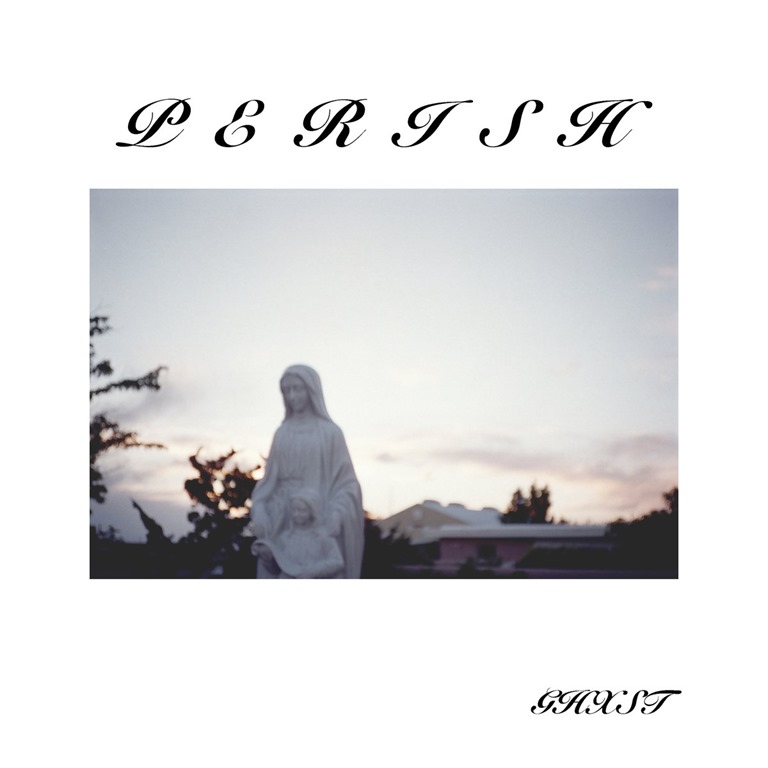
GHXST – Perish (EP)
Posted: 10 March 2017 in Singles and EPsTags: Atmospheric, Doom, Doomgaze, Drone, EP Review, Esben and the Witch, GHXST, Mammoth Weed Wizard Bastard, Perish
3rd February 2017
Christopher Nosnibor
As a band who really grabbed me by the throat with the release of their ‘Nowhere’ EP in 2015, the arrival of the latest offering from GHXST in my inbox was cause for excitement. And rightly so. To cut to the chase, Perish is a masterpiece.
The EP’s first track, ‘Southern Eye’, carries the refrain of ‘nowhere’ and as such, continues the theme of displacement, of outsiderdom, of not belonging which was core to the aforementioned EP. It’s a fair summary of what GHXST are about, musically, conceptually, and lyrically. Their songs deal with darker themes, and the cover art, which seems to evoke the spirit of Joy Division conveys an appropriate sense of bleakness, but also a certain, ineffable serenity and grace.
On the title track, a rushing guitar grind and reverberating samples are counterpointed by a haunting – and achingly beautiful – vocal that has hints of Alison Shaw of Cranes, only less squeaky, and Toni Halliday. The contrast is what defines the sound, and is ultimately what makes GHXST so special: it’s so rare for a band this heavy to convey so much emotional sensitivity. Theirs is not a sonic expression of nihilistic rage, but of something altogether more nuanced, possessing a heart-trembling beauty, rendered all the more distinct in their execution by the use of a drum machine. As such, they’re in an entirely different league from the few doomgaze contemporaries with female vocals one might name, like Esben and the Witch and Mammoth Weed Wizard Bastard. And on this outing they expand their sound to incorporate elements of blues and country. How does that sit as a genre? But it’s not merely the fact they exist within their own niche: the tracks on Perish: the quality of the songs, and their spectacularly atmospheric execution is something special.
‘Stories We Tell’ achieves a heart-rending beauty while crushing your skull with punishing guitars and pounding, slow-tempo percussion: the guitars grate and grind, each power chord throbbing with a malevolent afterburn. ‘Summer Moon’ presents a surging pop dynamic, a dash of Jesus and May Chain against a Chapterhouse-y whirl of shoegaziness and ‘Waiting for the Night’ is a slow-surging dirge, riven with the crackling pops of Akai snare bursts which shouldn’t work but actually bring a bleak aggression to the droning. Closer ‘No Wild West’ introduces a droning desert blues element, the chugging guitars drifting over an expansive, barren wasteland as Shelley X drawls into a sea of reverb.
This is by no means inaccessible music: it’s music to lose yourself in. The songs themselves are comparatively short – none extend beyond the five-minute mark – but all bear all the hallmarks of true epics, with a sound which is beyond vast.
 Aural Aggravation