Illegal is the new single from Sudakistan, first new music since the acclaimed debut LP Caballo Negro. It’s out now via PNKSLM Recordings. It’s a corking racket. You can hear it here. What more do you need?
Archive for May, 2016
Listen: ‘Illegal’ by Sudakistan
Posted: 17 May 2016 in Recommended Streams and VideosTags: Illegal, PNKSLM Recordings, single stream, soundcloud, Sudakistan
0
Christine Ott – Only Silence Remains
Posted: 17 May 2016 in AlbumsTags: Album Review, Christine Ott, Gizeh Records, Neoclasical, Only Silence Remains
Gizeh Records -GZH66 – 20th May 2016
Christopher Nosnbor
On her first album since 2009, Christine Ott presents eight pieces which touch on a range of moods and emotional states. While the piano is the central instrument, the multi-instrumentalist calls on a host of additional players to incorporate strings, drums and harpsichord to create a suite of music that’s beautifully detailed. In some respects, Only Silence Remains resides in the neoclassical bracket, but equally, there are elements of post-rock and avant-garde here, and ultimately, it boils down to being music. Exquisite music, at that.
Indeed, what’s perhaps most striking about Only Silence Remains is just how subtle yet simultaneously deep it is. That most probably sounds like a contradiction, but in a time when so much music is very much geared toward instant gratification, the hook, the immediate grab, and even orchestral works are so often centred around a certain hook, whether or not associated with a major film – and more often than not, they are associated with a major film, earning endless airplay on Classic FM – Only Silence Remains is an album which requires time and contemplation.
Only Silence Remains is certainly of a standard that would sit comfortably on any film soundtrack, but in many ways, it’s above that kind of mass-market reduction of anything that’s vaguely classical in its form to ‘soundtrack’. Only Silence Remains is a magnificently singular work, and is also, in its own right, simply a magnificent work.
‘Raintrain’ moves from a sad, lone accordion to a woozy, strolling jazz-informed double bass via a delicately dropping piano. From mournful shanties to pastoral hues, Ott evokes life, in all of its colours, expressing ups and downs and myriad in-betweens.
The nine-minute ‘Tempête’ begins dark and haunting, before a chorus of, inhuman strings rise, shrieking against scribbling insect walls of sound, plunging into unseen depths down, down, into the bleak ‘Disaster’. Featuring a narration performed by Casey Brown in a cracked monotone, until finally, a lone piano drifts into silence.
Skipping lightly from twinkling wonderment to brooding drama, she demonstrates a musical intuition that’s truly exceptional. To describe or define the ways in which the music reaches in and touch the listener’s soul is nigh on impossible: it simply does.

Hearth Life I – Chunk, Leeds, 14th May 2016
Posted: 15 May 2016 in LiveTags: Beige Palace, Chunk, Famine, Ghold, Grindcore, Hearth Life, Horsebastard, Human Certainty, Leeds, Live Review, Metal, Moloch, Palehorse, Sludge
Christopher Nosnibor
Given the vast array of microgenres and the broad spread of metal itself, curating a metal festival must be quite a challenge. A number of friends of mine have, in recent years, complained of events leaning too much towards a certain part of the metal spectrum, with an overemphasis on doom or sludge. A lot of credit is therefore due to the organisers of the first Hearth Life event, hosted in one of Leeds’ hottest new underground venues, Chunk. To describe it as intimate would be an understatement. A rehearsal room for arts and music which doubles as a two-room venue, it’s smaller than some living rooms. And yet they’ve managed to host 14 bands representing a huge cross-section of noise from the more extreme end of the scale. And there isn’t a dud act on the bill.
Using the two ‘stages’ to optimum effect, and keeping sets to half an hour or less means the bands are on back-to-back with no more than a few minutes in between, for eight hours straight. But by alternating the faster and slower bands, it’s neither a non-stop frenzy nor a marathon slog through hours of droning doom. That they’d not only got in a decent range of beers, but taken the time to mark up on the price list the vegetarian / vegan friendly beverages, not to mention having food courtesy of local ‘real junk food’ nosh merchants Armley Junk-tion on a pay-what-you-feel basis, all showed an attention to detail and general thoughtfulness you simply don’t find in larger commercial ventures. And most miraculously, the bands ran to time on what was an insanely tight schedule.
I’d seen around a third of the bands on the bill previously, so my expectations were set, at least to an extent. That said, the lineup’s diversity is the key, and discovering Human Certainty more than justified getting down early. Combining heavily chorused / flanged goth guitars with grindcore vocals buried in a fuck-ton of reverb and delay, while the singer battles invisible demons as he charges maniacally to and fro, they’re a unique proposition and a compelling live act.

Human Certainty
A whole lot less heavy were Beige Palace, and despite not being very metal, it as pleasing to see the young band, making their debut live appearance, receive a warm reception. Not for the last time during the event, I was reminded what an accommodating and thoroughly decent bunch of people attend the events with the most extreme bands. With shades of Young Marble Giants, Beige Palace make sparse-sounding music that’s jarring, dissonant and hints at a clash between early Pram and No Wave angularity.
While the space given to manic full-throttle thrashing was extremely welcome given the current vogue for doom, stoner and sludge, the grindcore acts on the bill felt a bit throwaway in their delivery here: Ona Snap announced themselves as being ‘fucking idiots’ before launching into 20 minutes of frenetic mayhem made up of short violent jolts of noise. They were tight, and went down well, but felt a bit too much like a party band to really pack a punch. Similarly, Famine – who I think are ace, and have seen evolve considerably over the last couple of years or so – seemed more about getting the crowd whipped into a frenzy, and consequent, their set felt more like an excuse to go mental than a serious assault on society. That said, having bemoaned the too-cool-for-school audiences at bigger gigs, they played hard and insanely fast, and it’s good to see this crowd going bonkers with some wild moshing and even crowd surfing in an extremely confined space. A tidal wave of bodies almost threatens to upend the makeshift bar during Horsebastard’s set. There is carnage. It’s good-natured, but carnage nonetheless.
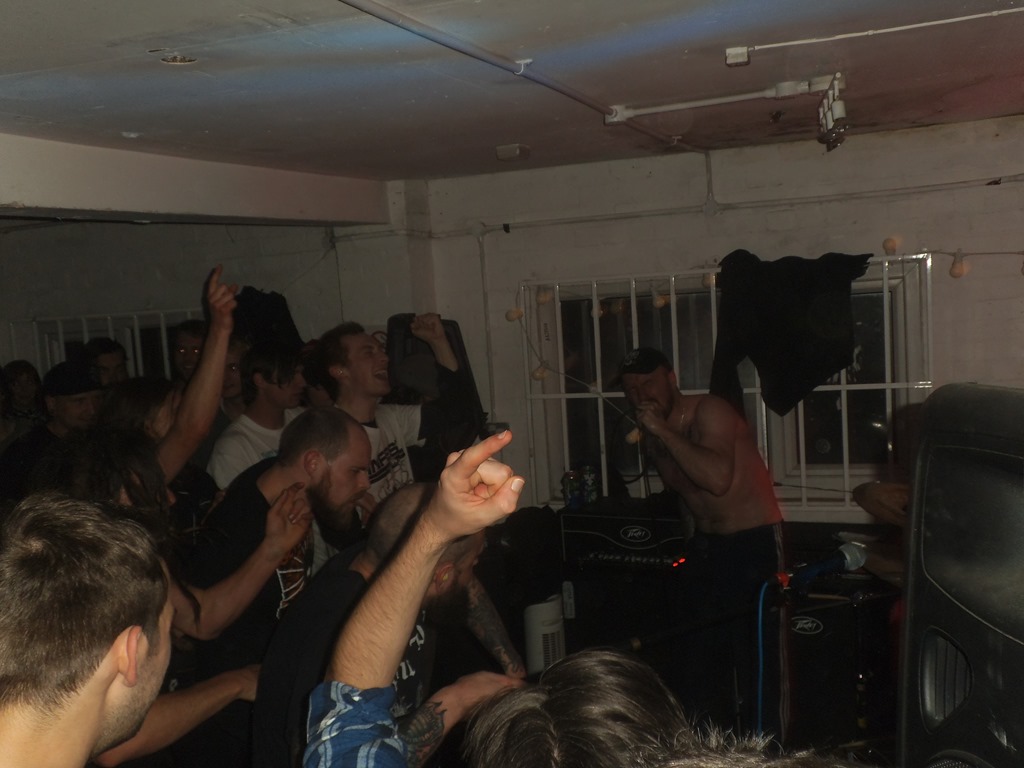
Famine
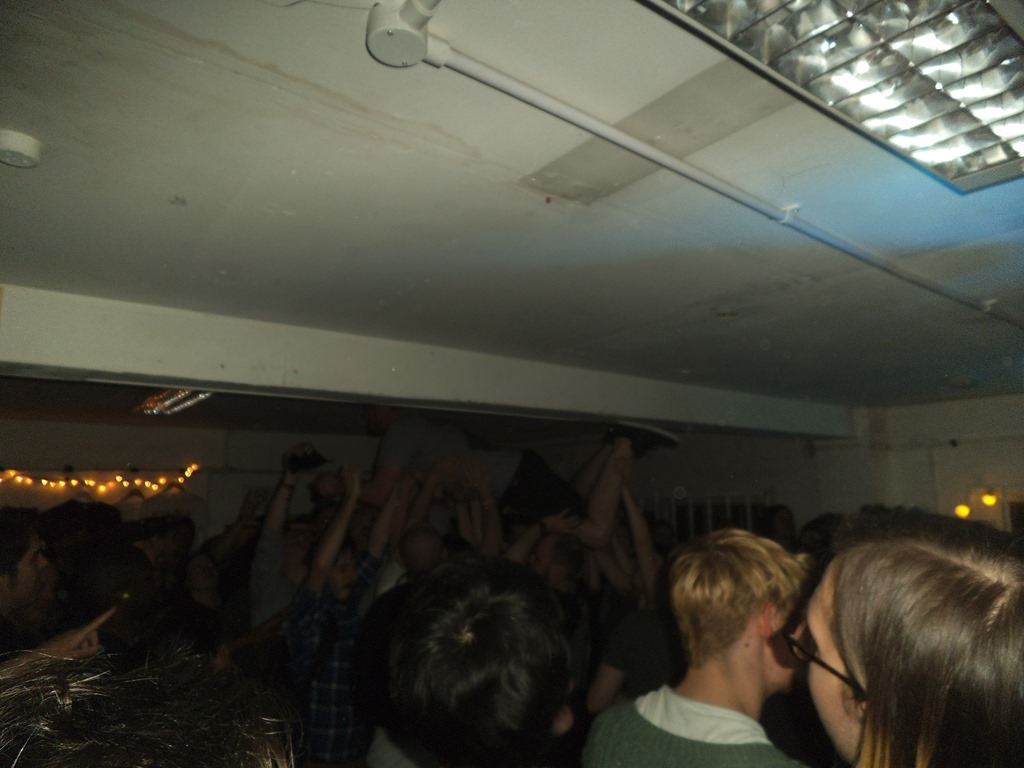
Horsebastard
Ghold, touting new long player PYR are a band on the rise. Having expanded to a three-piece since I last saw them 11 months ago, they’re sounding denser and more layered than before. The drumming is explosive, and there’s a perverse sense of performance, as Oliver Martin plays and sings with his back to the audience, and Aleks Wilson, while forward-facing, hides behind his hair and is hardly conversational. But cultivating this distance between audience and band work well, and adds to the intrigue of a band who trade in pulverizing heavy sludge riffs while also incorporating elements of psychedelia and offering radical changes of tone and pace. Epic sludge workouts are contrasted with fast-paced attacks, although thy always keep the ‘heavy’ cranked up to the max. One-dimensional they aren’t, and in the space of their half-hour set they demonstrate more diversity than some band manage over a whole career. They’ve got some chops, alright, and I’m not talking about Wilson’s monster ‘burns.
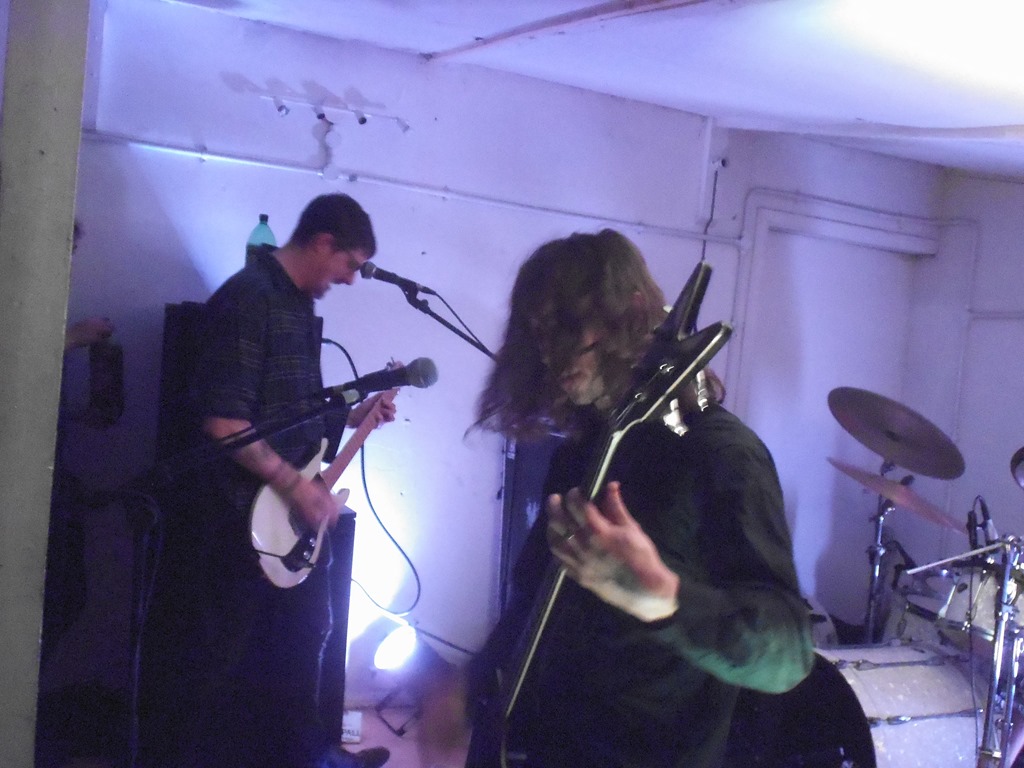
Ghold
The heavy trucker metal of Nottingham monster mofos Moloch bring the noise and a different kind of density. Dark, sludgy and burning with anguish, they embody pained nihilism, they’re unphased when the mic completely cuts out – that or front man Chris is simply too immersed in the thunderous wall of brutal rage he and his cohorts are churning out to make a deal of it. Either way, the sound guy is quick with a replacement and they power on through triumphant.
Palehorse, playing their last Leeds show and penultimate gig in a sixteen-year career, are given an extended, 45-minute slot, which is the day’s punishing highlight. Although not the last band to play (that slot is given to The Afternoon Gentlemen), they’re effectively the headliners. I took no notes during their set, too engrossed in the immense, brutal sound, and too crushed by the clamouring front rows to even consider anything beyond the immediate experience. The event page describes them as ‘noise shitting bass bastards’ (they’ve got two basses, but no guitars), while their bandcamp page heads them as being ‘London Powerviolence’. Call their music what you like, it’s as heavy as fuck. The vast bottom-end is enough to rearrange internal organs, and contrasts with Nikolai Grune’s sharp, seething vocals. But it’s music that’s textured, articulate and powerful beyond mere brute force.
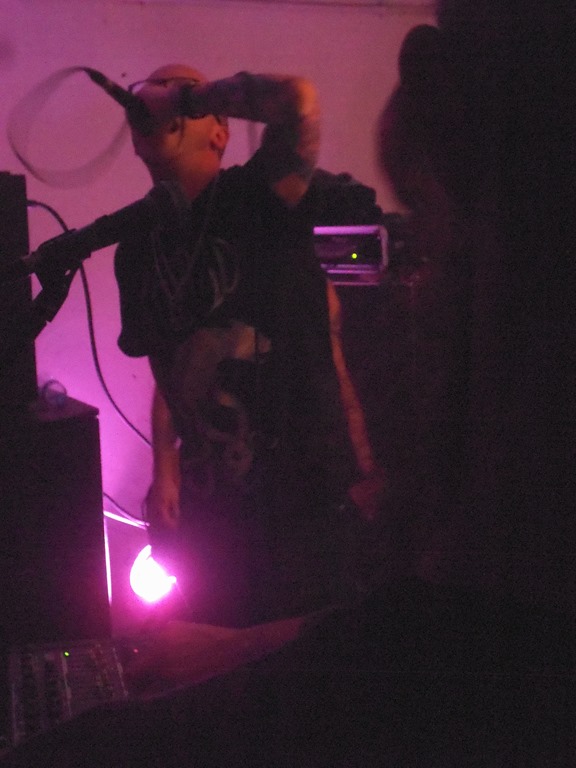
Palehorse
It’s hard to stumble out of an event like this feeling anything other than elated. Live music is all about escape, release, and the more brutal and cathartic the music, the greater the release, and seeing so many incredible, intense bands in such close proximity is exactly the way it should be. It’s personal, intimate to the point of exclusive, interior. There may have been a few crazies in the crowd, but there were no out-and-out cunts: the vibe was one of camaraderie and companionship, the event a coming together of outsiders and misfits in a celebration of all things outsider and beyond the grasp and cognisance of the mass media and general populace. Let’s hope this is the first of a long run for Hearth Life.

Shrykull
Watch: ‘Intuition Unbound’ by Suns of Thyme
Posted: 14 May 2016 in Recommended Streams and VideosTags: Intuition Unbound, Napalm Records, Suns of Thyme, video stream
Suns of Thyme blends space rock, shoegaze, and psychedelia reminiscent of Velvet Underground on sophomore album Cascades, to be released on May 27th via Napalm Records. Ahead of the release, they’ve put out video for ‘Intuition Unbound’.
Synopsis director Easton West comments:
“The storyline is about a wise forest stewart who leads his apprentice through the land teaching her ancient ways until one morning he finds a supernatural blue seed in the wetlands. The discovery initiates a mystical ritual that transfers his ancient knowledge to his apprentice, inaugurating her as the new keeper of the land.”
The video stars Swiss actor David Bennent (The Tin Drum, A Dangerous Fortune) and actress Sarah Johnson, and was directed by Easton West of Klein and West, a Berlin based production company and ensemble of film creatives whose work crosses over between narrative, documentary and commercial realms.
Watch the video here:
Güiro Meets Russia – Dystopia
Posted: 13 May 2016 in AlbumsTags: Album Review, Dystopia, Güiro Meets Russia, GMR, krautrock, space electronica, Stream
Verlag System – VS011 – 29th April 2016
Christopher Nosnibor
As the title reasonably implies, this is a soundtrack to a bleak landscape. The expansive instrumentals may hint at the potential for travel and movement, but they’re pinned to insistent motoric rhythms. The effect is at once spacious and claustrophobic. The stark synths call to mind New Order’s Movement, but they’re balanced by warmer, fuzzy-edged analogue sounds, which creates a different kind of feel, less morosely bereft and more abstract than figurative in form. Building some dense thrumming throbs and deep grooves, it’s eminently danceable for the most part. That said, there are some deep, sombre pieces which are less percussive: instead, the rhythms emerge from the regular pulsations which form a nebulous sonic body.
Single ‘The Possibility of an Island’, here remixed by GMR and Montxo Burgess is a sedate and rather grand piece, with hints of Visage’s ‘Fade to Grey’. Built around a simple chord sequence and heartbeat bass rhythm, it carries intimations both of 80s vintage and a certain sense futurism. Taking its title (presumably) from Michel Houellebecq’s 2005 science-fiction novel set in a dystopian future bereft of emotion and human contact, it echoes with isolation.
‘Ziggurat’ creates a vast, rippling desert of sound that undulates and pulses toward the whooshing gusts of air that encircle ‘Saturn Radio Waves,’ with fragmentary sounds of human voices drifting in and out.
Thrumming, looping motifs evoke a robotic, dehumanised world of synthesis and desolation. And yet through it all shine bright shafts of light, brave and optimistic, like the rising of a sun over a newly discovered world.
Listen: ‘When Will I Return? (Excerpt)’ by Swans
Posted: 12 May 2016 in Recommended Streams and VideosTags: Album preview, Michael Gira, sample, Swans, The Glowing Man, When Will I Return?
As a further taster for the forthcoming album The Glowing Man, with its Ballardian connotations, Swans have offered up an excerpt of ‘When Will I Return’.
‘When Will I Return?’ was written, explains Michael Gira, "… specifically for Jennifer Gira to sing. It’s a tribute to her strength, courage, and resilience."
It sounds like vintage Swans, and calls to mind the sound of The Great Annihilator, Love of Life and White Light. Hear it here:
The Glowing Man is out on 17th June.
Listen: ‘Dälek Soundscapes Sound pack’
Posted: 12 May 2016 in Recommended Streams and VideosTags: Dälek, Experimental hip-hop, Samples, Soundscapes
Dälek, pioneers of abrasive and distorted hip hop, have teamed up with Swedish music hardware makers Elektron for the Dälek Soundscapes Sound pack. The samples are results and outtakes of the late night studio sessions giving birth to their geniously intense seventh album Asphalt for Eden.
Broken, melodic, beautiful: this is a brutally honest testament of both the creative process and aural aesthetics of the grinding machine known to man as Dälek.
Get your lugs round it here:
Telebossa – Garagen Aurora
Posted: 10 May 2016 in AlbumsTags: Album Review, Bossa Nova, Garagen Aurora, Satubgold, Telebossa, Van Dyke Parks
Staubgold – 3rd June 2016
Christopher Nosnibor
It’s an immense claim that heralds the arrival of Telebossa’s second album, namely that they’ve achieved what many artists have failed to achieve during an entire lifetime of work in creating their own musical language. It’s a claim which almost inevitably colours my first hearings of the album. However, putting this line of discussion aside momentarily, it’s clear that the duo, consisting of Chico Mello and Nicholas Bussmann have evolved beyond the Brazilian Bossa Nova tradition, earning the support of Van Dyke Parks in the process. Parks’ previous collaborations are wide-ranging, and include Randy Newman, Brian Wilson, Joanna Newsom and Skrillex. It’s in this context that it’s perhaps easier to get a handle on the kind of musical progression that Garagen Aurora represents, drawing as it does on a vast range of different inspirations, while retaining links to tradition, and Parks’ woodwind contributions on ‘Nao So’ add depth.
The album begins with some vaguely jazzy scrapes, but the tone and mood soon alters on ‘Basta’ as a lone piano forms a delicate backdrop to Chico Mello’s haunting vocals. Whereas cello and guitar formerly defined the Telebossa sound, vocals and (‘robot’) piano are now the core features. The tension builds as woodwind discreetly enters the field.
The rhythms which pulse and thrum on ‘Funeral De Um Lavrador’ provide an unusual and unexpectedly contemporary feel to a more traditional sounding composition.
The interludes – there are four short instrumental fragments in all, which punctuate the album to good effect – are radically different in style from one another and from the songs themselves.
The chamber-jazz instrumentation in the first half of ‘O Luar’ has a certain swing to it which again contrasts with Mello’s affecting voice, which takes the lead as the tracks drifts into a hazy, woozy, sedated state. ‘Chevrolet’ shimmers and shudders, rippling oscillations build a languid, shady atmosphere, and hints of Scott Walker permeate the production.
The words are taken from the texts of ‘metaphysical engineer’ Fernando Pessoa, and appear in the booklet that accompanies the disc in English translation, and are worth engaging with, as they do add further dimensions to the work.
If the notion of a new musical language seems to suggest something unfamiliar and inaccessible, then on the surface, Garagem Aurora appears not to fulfil this: the sounds are familiar, the forms are immediately recognisable not only as music, with melodic motifs, rhythmic order and a certain sense of dynamic flow all inbuilt, but as songs, with structure, form, melodic and rich in emotion, steeped in longing. But in its carefully-composed and intuitively balanced approach to the incorporation of so many disparate elements, Telebossa really do offer something new.

OZmotic – Liquid Times
Posted: 9 May 2016 in AlbumsTags: Album Review, Christian Fennesz, Folk Wisdom, Frank Breitschneider, Liquid Times, OZmotic, Remixes, Senking
Folk Wisdom / SObject – March 2016
Christopher Nosnibor
IDM is one of those terms that sits a little uncomfortably. Not as uncomfortably as EDM, which is something of a tautology (granted, salsa, swing, and Ceroc is dance music, but in contemporary music circles, dance music is electronic by nature), but even so. The ‘I’ implies a certain snobbery over other forms of dance music, as if they must collectively be UDM (Unintelligent Dance Music) or DMM (Dance Music for Morons). Even if that is the case, isn’t it for the listener to decide whether the music is ‘intelligent’ or ‘dumb’? No matter: following on from Air Effect with Christian Fennesz, instrumental electronic duo OZmotic return with Liquid Times, an eclectic blend of forms which, as the blurb notes, embraces ‘IDM, ambient, nuances from techno, noise and glitch music.’ Nuance is indeed the operative word here, and precisely the key to the album’s success.
Fennesz, who also serves as a member of the live lineup, again features on two of the tracks here. Elsewhere, the duo have enlisted German producer Senking to remix two of the album’s tracks, as well as Frank Breitschneider: both are affiliated with Raster Noton, which more or less speaks for itself, being the label at the forefront of all things experimental.
So, that’s the form and the roll-call. As for the actual music… There’s a lot going on, in that nuance-heavy world they inhabit, with slow drips and creeping ambience, hums and drones which expand, rumble and eddy amidst jittery electronic buzzes. Low rhythms build murkily and the pieces unfold and evolve subtly. Extraneous sings – hooting owls, insectoid scuttles, scratches and clicks, and light veils of static all contribute to providing a layered sound. At times expansive and cosmic, at others more microcosmic, there’s always something going on, not only on the surface, but beneath.
Rising tides of distortion rupture smooth soundscapes, creating waves of tension which gnaw at the nerves. ‘Rhyzome’ operates within different parameters, exploiting the tropes of classical music and film soundtrack, paired with drum ‘n’ bass, hefty beats and resonant bass sounds booming dramatically before tapering down to a hushed discomfort, while ‘Diaspora’ (one of the Fennesz tracks) introduces abstract guitar drones which evoke Sunn O))) and Earth as they simmer in a squall of needling synths and mutant saxophone, rising into something resembling a conventional progressive riff that’s finally swallowed by a black hole of noise. There are some dark, heavy passages here, which throb and pulse. Flickers of the metallic and robotic bleep and scrape against thick curtains of sound to forge a dark cybersonic sonic vista. The Kraftwerkian closer, the Breitschneider remix of ‘Sliced Reality (and a world apart from the original version which also appears here), evokes sparse, dystopian sensations.
All of the different facets of the sound are drawn together seamlessly, coalescing into something unique and engaging. And while you can’t actually dance to it, it is, without doubt, intelligent music.
Watch / Download: ‘Shake Shake’ by REWS
Posted: 8 May 2016 in Recommended Streams and VideosTags: REWS, Shake Shake, Video, YouTube
‘Shake Shake’ from Irish girl-rock act REWS may be bit more accessible than a lot of the stuff you’ll usually find here at Aural Aggravation, but we’re all about music that excites us, and we know a cracking song when we hear one. ‘Shake Shake’ is a cracking song.
Consisting of songstress Shauna Tohill and beat-maker Collette Williams together they’ve been creating a genuine buzz with their brand of punky alt-rock including plays from Kerrang Radio, Planet Rock, Team Rock Radio, Steve Lamacq, Amazing Radio and Dan O’Connell on Radio X.
They also play at The Great Escape this year.
Watch the video here:
Download the track here:
 Aural Aggravation