Posts Tagged ‘theme’

Mortality Tables – 5th January 2026

Christopher Nosnibor

Mortality Tables’ Impermanence Project has grown legs over the course of the last year, and has offered some remarkable, striking, and intensely personal responses to the theme. And as the title of this latest addition to the expanding body of work emerging under the project’s auspices alludes, Gareth Jones’ 53_StOlaves : Response is a response to a response, so to speak, adding layers of interpretation but also a certain kind of dialogue to the project.

The original St Olaves (St Olaves : Catharsis) was recorded label owner and project curator Mat Smith and released in June, and stands as one of the most intense and deeply personal pieces, a churning whorl of noise distilled from a field recording made by Smith at St. Olave’s, Hart Street, London. Amidst it, there are footsteps, voices, all vague and barely audible in the overwhelming wall of sound. The accompanying notes relate, ‘For a brief moment, you settled into silence. I said that I loved you again. It seemed to sink in who I was and why I was calling. It would be the last time that I truly connected with you, and I am convinced that despite the blur of the drugs and your Alzheimer’s that you understood.

‘The moment lasted barely a couple of seconds during our nine-minute call, but it felt like an eternity. You began saying that you were about to be taken away for tests, but you didn’t know what the tests were. Except they weren’t tests: you were being taken to theatre.

‘Two hours and five minutes after our call, at 1405, you passed away during surgery.’

It hits hard.

AA

AA

And so we arrive at 53_StOlaves : Response, a field recording made by Jones while on holiday in Greece. He writes, ‘I was moved to create a response to St. Olave’s in the spirit of impermanence understood as, viewed through the lens of, transformation.’

53_StOlaves : Response is a similar duration – meaning it contains just over nine minutes of buzzing, jarring waves of background noise. It glitches frequently, the volume suddenly surging unexpectedly after an ebb, tapering to an elongated organ-like drone before altogether more optimistic-sounding ripples emerge. It has a wistfulness, a certain air of melancholy, but over time, this too dissipates, leaving gentle, dappled ambient hues with understated beats fluttering to the fade.

If St Olaves : Catharsis is the soundtrack to raw anguish and the howl of loss, the staggering bewilderment at the fragility and brevity of life, 53_StOlaves : Response feels like the emergence of acceptance over the passage of time. And this is where Response really comes to add to the theme of impermanence, and it feels like a subtle reassurance that while we likely never necessarily ‘recover’ from those deepest losses, that the wounds will forever remain psychological scars, the pain does ease, eventually, through, as Jones puts it, ‘transformation’. Nothing lasts forever. We transition. We transform. 

AA

AA

a3259884415_10

1st August 2025

Christopher Nosnibor

The other day, while riffling through my record collection, I found a few LPs and 12” I had quite forgotten owning, including a promo copy of ‘Chance’ by Red Lorry Yellow Lorry. Stapled to the plain black die-cut cover of this white-label record with the title hand-written in biro, is a press release which simply reads ‘I know this is what you’ve all been waiting for….. Yep. The new Red Lorry Yellow Lorry single It’s called “Chance” and as usual it’s on Red Rhino Records. It’s very good’ and is signed ‘Yours condescendingly’.

You just don’t get press releases like that any more – especially not typed in all block caps and photocopied.

I appreciate the effort that goes into a good press release, and a solid band bio, because it does help me as a reviewer get a sense of context, of what a band’s about, what an album’s about. But the counterpoint to that is that there’s so much detail being spoon-fed, there’s less room for creative interpretation. The fact of the music industry has changed radically since the 80s and 90s, the days of the weekly inkies, the time before the Internet.

There simply was no way of ‘doing research’. And writers had tight deadlines. And so they just riffed to fill the column inches. Facts were hazy, critiques were often based on first impressions and knocked out in an hour after an extended liquid lunch. Names, dates, titles weren’t always accurate. And fans scoffed at the errors – and still do when clippings are posted online – but that was the nature of the beast.

Now, misspell the name of the bassist or give the wrong year for their debut EP, or somesuch and PRs, labels, and bands are onto you straight away asking for corrections. In a competitive market – I often report that on average, I receive around fifty submissions a day – simply getting coverage is a massive feat. This is certainly not to say that those times past were better – simply different, and I simply navigate my way to this release via this route to demonstrate the ways in which things have changed in the years since I started out writing about music in the 90s. It’s also altogether rarer now to find negative reviews, and while a part of this is due to the overwhelming amount of music being released meaning that reviewers are generally more inclined to spend what time they have promoting music they like, there’s also a certain element of fear of there being a social media pile-on, or having their supply of gratis music cut off. But artists and their labels and PR really need to accept that they’re not going to please all the people all the time, and sometimes, it’s necessary to call out an act with dodgy politics or whatever, or to simply call a turd a turd.

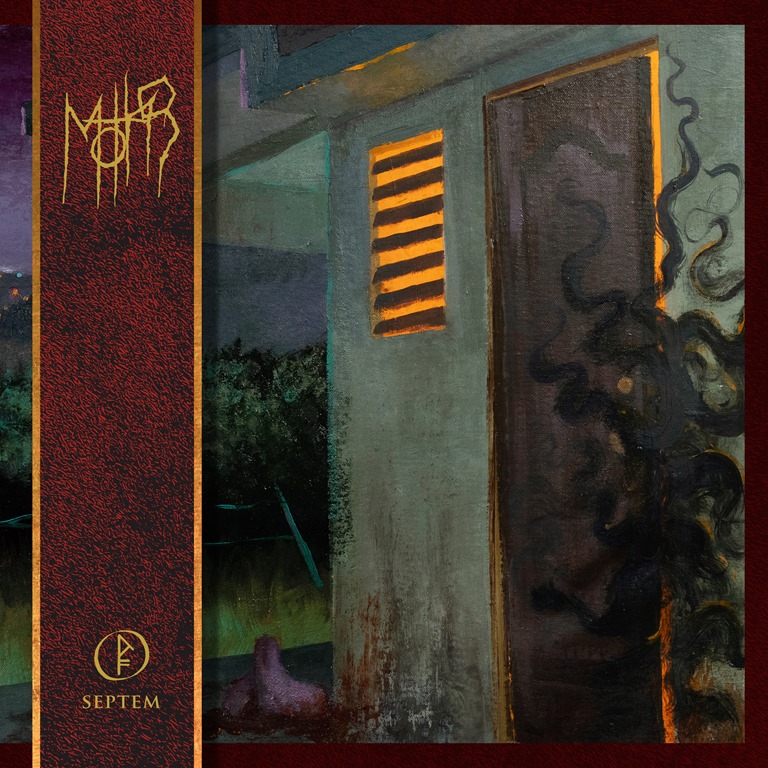
Anyway. Before I’ve even hit play, I’ve learned that this release by MOTHS is ‘a visceral journey through the Seven Deadly Sins, with each track embodying a facet of indulgence, obsession, and self-destruction — from the corrosive jealousy of “Envy” to the insatiable hunger of “Gluttony” and the rage of “Wrath”. The album plunges listeners into a dark, immersive experience where desire spirals into chaos’, and that ‘Diving deeper into heavier territory, MOTHS fuse elements of death and black metal with their signature blend of progressive, psychedelic, doom, and stoner metal, crafting a sound that’s both aggressive and atmospheric. With every step forward, MOTHS continues to explore new sounds and challenge genre boundaries, proving that music has no limits when driven by passion and innovation.’

I feel as if my work is already done. I can pour myself a large vodka and kick back, right? Well, I could. But that’s not my style. At least not the kicking back part. Large vodka in hand, I brace myself for the sonic onslaught… to be faced with some tinkering banjo or acoustic guitar giving country licks that are pure blues / Americana. And it gets jazzier and groovier as it goes on. What the fuck is this?

‘Sloth’ slides into ‘Envy’, a slippery, sultry alt-rock cut where the vocals are bathed in reverb, and the lo-fi production belies the fact that this is a vaguely jazzed-up take on grungy emo, at times coming on like Paramore recorded on a 90s cassette four-track. The haziness of the recording is actually something of a positive, but these are songs which require a slicker, fuller production. As a consequence, these takes sound more like demos than final versions.

The murky rawness works better on ‘Greed’, which brings rabid, raw-throated, growling black metal elements to the vaguely gothic metal compositions. It segues into ‘Pride’ which goes full-throttle skin-peeling abrasion before suddenly going commercial rock with fancy licks at the midpoint. I like ZZ Top, as it happens. I just wasn’t expecting a riff from Eliminator here.

‘Pride’ does take things full heavy, a prime slice of sludgy doom, and ‘Lust’ is, without question, a slugging slab of doominess, with some fancy fretwork thrown in on top. There’s certainly a lot going on here, and most of it works. MOTHS certainly bring some megalithic riffs and a lot of fire to an album that may be unpredictable in places, but is, overall, solid and with no shortfall of gutsy, guitar-driven heft.

AA

MOTHS - cover

Bubblewrap Collective – 15th November 2019

Christopher Nosnibor

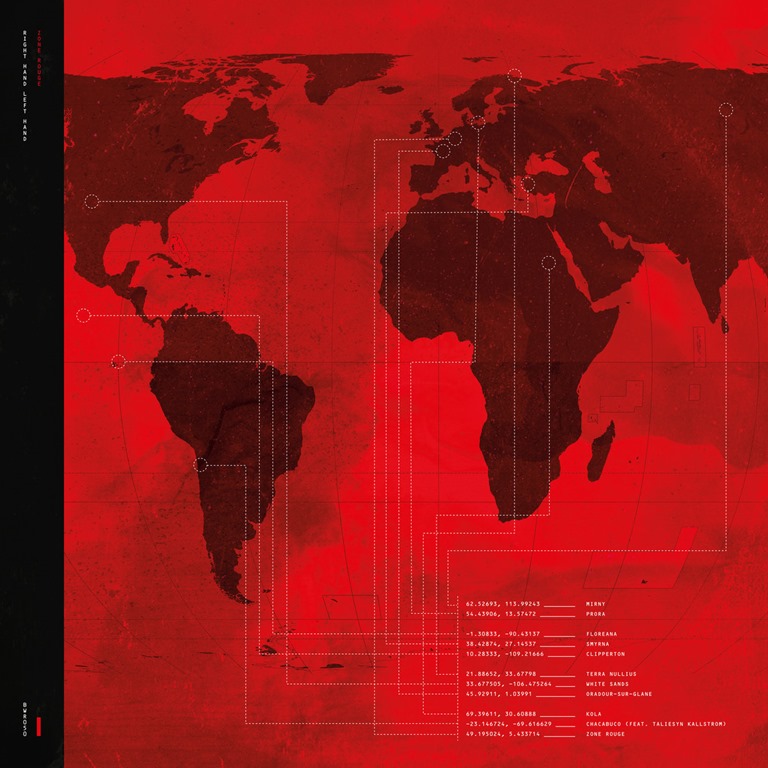
It’s 2019, but Right Hand Left Hand’s third album leaps us back to 2004. But let’s be clear: this is not a criticism. ‘Zone Rouge’ follows on from their self-titled, Welsh Music Prize-nominated second album, and, according to the press release, ‘tells the story of humanity’s contempt for the earth beneath us, the air above us and the people around us.’ The titles of the album’s 11 tracks each refer to ‘a location on Earth where something bad has happened: An act of corruption against the planet, an act of evil against fellow humans and occasionally both.’ Obviously, there’s scope for this to have been an album of infinite duration with a new track added every three seconds for all eternity, but there have to be limits.

Instead, what we have is a concise and urgent post-rock statement on the state of the planet. Being largely instrumental, the sentiment and intention isn’t immediately apparent or openly conveyed without some kind of preface, ‘Zone Rouge’ doesn’t scream ‘environmental crisis reaction!’ or ‘mass killing’ or ‘war’. A lot of this is pretty smooth, expansive, cinematic, with well-placed but ultimately controlled crescendos. The production is sensitive to the mood and the from, but ultimately, it’s clean, dynamic, textured.

There are departures: ‘Prora’ is a kind of choppy, post-punk funk effort with vocals, and it feels rather incongruous in the scheme of the hefty back-and-forth riffery and heavy atmospherics that pervade. ‘Chacabuco’, featuring Taliesyn Kallstrom of Cardiff’s ESTRONS feels particularly anomalous, being some kind of trippy indie / alt metal hybrid. For what it’s worth, it’s a belting tune and single-worthy in its own right, but stands out like a sore thumb in the context of the album.

At times, it feels like the Right Hand Left Hand doesn’t know exactly what the Right Hand Left Hand is doing, but for the most part, Zone Rouge is a solid post-rock album, pushing into an array of stylistic territories with rare aplomb.

AA

Right Hand Left Hand