Posts Tagged ‘The Incidental Crack’

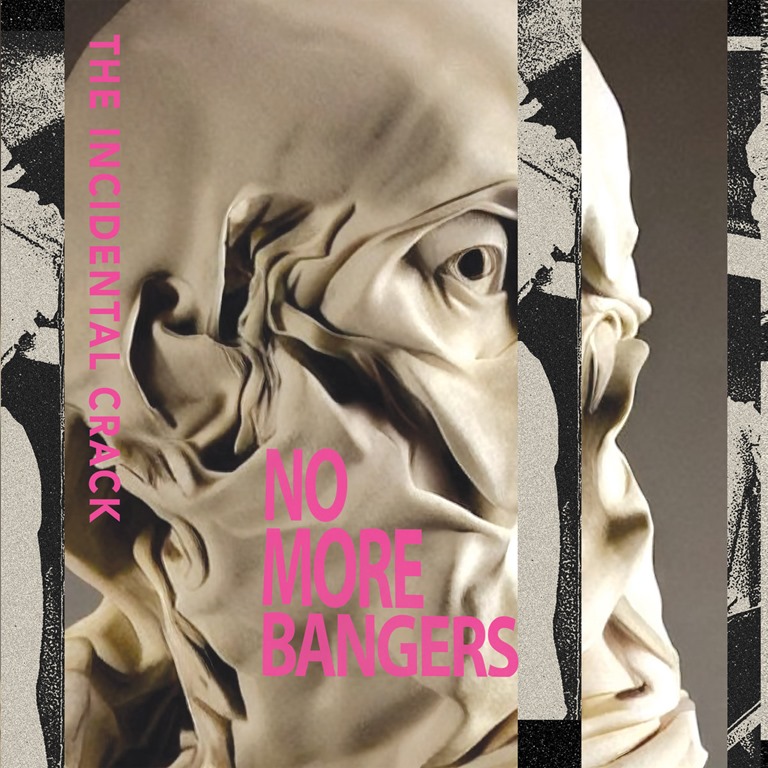
Cruel Nature Records – 28th June 2024

Christopher Nosnibor

It’s a perennial complaint around the passage of time, an oft-tossed-out remark with each month that everyone churns out as a space-filler, especially when speaking to someone they haven’t seen in a while – ‘I don’t know where’re the year’s going!’ But 2024: what the fuck?

I recently read Four Thousand Weeks by Oliver Burkeman after a friend kindly sent me a copy after I’d been bleating about how I always had too much to do and too little time to do it in. I almost simultaneously had a heart attack and shat myself reading the opening chapters which explained the book’s premise – namely, that the average human lifespan is around 4,000 weeks. Somehow, I’ve blinked and missed about 20 of them already this year. And whenever I receive an album in advance of its release, I add it to the list, and think ‘Hey, I’ve got a while on this one, I can take my time and still get a nice early review in.’ Because getting in early is satisfying – and, being transparent, brings traffic. I don’t make any money from doing this, so hits don’t equal quids, but there’s a certain pride involved – not to mention a sense of duty.

On learning of there being a new release imminent from The Incidental Crack – longstanding regulars at Aural Aggravation, an occasional collective who’ve managed to maintain a steady flow of releases in recent years, I was immediately enthused, but the end of June was a way off, and life… and here we are at the end of June. In no time, it will be the end of the school year, and once we hit August bank holiday the nights are shorter and it’s time to think about jumpers and central heating and the end of another year and being another year closer to death.

The Incidental Crack have a knack of conveying the pessimism that pervades the futility of the everyday, the way in which those small, mundane disappointments mount up and slowly sap your soul. Look no further than titles like ‘The Kettle Broke’, and ‘There Was No Path At the End of This Field’ on this latest offering for evidence of microcosmic gloom and frustration. The impact of small – almost non-events – can never be underestimated in the context of a stressed and overloaded mind. And people aren’t in that headspace simply don’t get it. Kettle broke? Just get a new one, they’ll say. No, no, that’s not the point. The kettle broke, the cat was sick on the rug, the bread went mouldy, I spilled my drink and it’s an absolute disaster and my life sucks.

The fact is that sometimes, when life feels intense, the smallest details count for a lot: it’s not making a mountain out of a molehill when simply getting through a day feels like an epic battle, and walking to the corner shop feels as daunting as a marathon. And No More Bangers – a title which is equally ironic and carries a tone of sadness, of defeat – is detailed, with infinite nuance proving integral to these five minimal – and lengthy – compositions.

The pieces are constructed around nagging electronic loops, scrapes, drones, hums. There’s nothing dominant, sonically, or structurally. Ten-minute expanses of trickling dark ambience create brooding soundscapes and a tension that sets in the jaw, the shoulders. Insectoid chatters and clicks, stutters and scrapes build the fabric of the sound. Clamouring echoes and rapid repetitions evolve internal rhythms without percussion, with surges and swells driving the second half of the twelve-minute ‘The Springtails Love It.’ But it’s a nagging tension and feels more like being poked repetitively while trying to rest than an inspiration to get up and dance.

‘The Kettle Broke; is largely a hum, a room ambient sound which does next to nothing other than play back the sounds in your head and your kitchen when you’re trying a new recipe and find it requires digging the blender out from the back of the cupboard.

Sometimes, late at night – but also during the day, as I work from home – I find myself acutely aware of the quietness. There will be spells with no traffic, no planes or helicopters overhead, no dogs barking, no pings alerting me of new messages, no meetings. During these often unexpected moments, I will become aware of the whir of the laptop fan, the constant hum of the dehumidifier in the bathroom adjacent to my office, my own circulation.

This is the soundtrack that No More Bangers presents. Low-ley, low-level ambience which sounds like the boiler running through a maintenance cycle, like the throb of the fridge, the fizz of extractor fan. Delivering 100% on its title, this album is absolutely banger-free. But more than that, it feels strangely familiar, and yet familiarly strange.

AA
a0749472000_10

Waxing Crescent Records – 7th July 2023

Christopher Nosnibor

Since parting ways with Gavin Millar and worriedaboutsatan, Thomas Ragsdale has been incredibly busy recording both as Ffion and Sulk Rooms, as well as playing synths with Mancunian post-rock act Pijn. Looking at his bandcamp, you wonder how he has time to piss, let alone sleep.

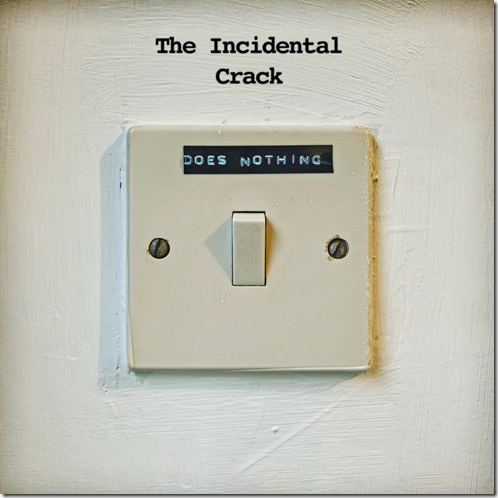
The Incidental Crack, meanwhile, are no strangers to these pages either, and Simon Proffitt, Rob Spencer and Justin Watson are hardly idlers when it comes to creativity, with The Incidental Crack Does Nothing, released almost a year ago to the day from this release, following two albums in 2021.

And as the accompanying notes explain, it’s this shared love of the act of creating that brought the two together: ‘Split was created through the desire to collaborate. Thomas Ragsdale and The Incidental Crack spoke about the idea of working on a split release and then all hurried away into their studios to get to work. The split idea soon become a reality as music was exchanged ready to share.’

The title is factual, and gives nothing away, but it’s also descriptive in a way, in that it’s distinctly an album of two halves, complimentary and contrasting.

Sulk Rooms present a single longform composition of some twenty-one-and-a-half minutes in duration: The Incidental Crack’s contribution is of more or less equal length, but spread across three pieces.

Sulk Rooms’ ‘Objects In The Mirror Are Closer Than They Appear’ has no connection to Meat Loaf and his bombastic rock, and is instead a big, slow-moving mass of ambience, which has a density and shade as well as a certain lightness. ‘Vaporous’ and ‘cloud-like’ are terms I often reach for in the face of such works, but this feels more like standing atop a mountain while the cloud thickens to the point that there is no visibility, to the point that you’re unable to even discern the presence of your own body, and so dense as to be suffocating – perhaps more like a smog or smoke. Tim Hecker managed to create such a sensation the time I saw – or, more accurately, was present, when he played in Leeds a few years back. The smoke was so dense and the lighting so minimal as to induce a kind of sensory deprivation. But with the swirling sounds all around, there was, simultaneously, sensory overload. You need balance: many of us are reliant on multiple senses, and those who lack sight, hearing, often experiencing a sharpening of the senses which do function. But his is not an immediate thing, and to suddenly find oneself with restrictions, it’s a shock of sorts. And so while ‘Objects In The Mirror Are Closer Than They Appear’ is soft and tranquil, the experience isn’t entirely soothing as I feel an inner tension grow as the time drifts and dissolves, diffusing in reverberating waves of vocal samples.

The Incidental Crack’s three cuts are descriptively titled and combine elements of the dramatic and the mundane to intercut aspects of pathos with bathos to somewhat comic effect.

‘Rob To Holland Via Köln And Back Again’ sounds like is should have something of a travelogue feel, but is, in fact, a work of dark ambience with deep tensions evoking the chilling fear of The Cold War, while ‘Lawnmower Death And Subsequent Resurrection’ isn’t an homage to the parodic thrash band Lawnmower Deth, but a soundtrack to the trauma of dealing with tools and appliances when they don’t function as intended. Yes, most of us have been there, but to feel it so bluntly and boldly is impactful. This – if I’m not mistaken – the sound of a guy recording his DIY and the like before seeking a narrator. Yet, there are some dark atmospherics too, and thee overall sensation is ominous rather than uplifting. And by that measure, the ‘Bus Stops In Wigan’ must be pretty fucking terrifying: places to avoid in bleak territories.

As split albums go, it’s absolute perfection in that it gives you everything you want. If the two acts operate very differently in formal terms, both have created deep, dark works here that make for a release that’s wide-ranging, interesting, and just a little scary.

AA

a0921513698_10

Front & Follow – 14th April 2023

Christopher Nosnibor

These are shit times to be alive in Shit Britain, UK Grim: having taken back our borders, this green and pleasant isle is floating in a sea of shit – literal shit – that we’ve pumped out onto our beaches for our domestic holidaymakers to swim in, and we have 16-hour quest to leave the country to go on holiday for those who want to escape for a bit – damn those French bastards for checking the passports off non-EU visitors. But hey, at least we got rid of all of those foreigners working on coffee shops and bars for minimum wage and those doctors from overseas, right?

And yet, while the cost of living is spiralling, major corporations – and not just energy providers – continue to push up prices, not to cover the cost of paying their workers, but to preserve profit margins. It’s not that they can’t afford to increase wages, they simply won’t because capitalism is built on maximising profit. Fuck the staff, look after the shareholders. And of course, rent continues to rocket: landlords, too, need to protect their rental yields

An investigation undertaken in behalf of The Guardian late in 2022 found that ‘asking rents on new listings are up by almost a third since 2019, and some people are facing increases of up to 60%. Prices in 48 council areas are now classed by the Office for National Statistics as unaffordable when compared with average wages’.

The trouble is, capitalism is based on exploitation, and invariably, the wealthy become wealthy and grow their wealth through the exploitation of the less wealthy.

There is an irony here: in nature, the most successful parasites achieve a symbiotic relationship with their host. Under capitalism, the parasites seem determined to kill the host (the poor) on the premise that there will always be more. But then, the same is true of the human relationship with the planet: only, the resources are finite and there isn’t another planet, so we’re fucked.

The accompanying text pulls no punches in explaining the context:

“As we travel further into the year of our overlord 2023, the cold snap that had enveloped the country no longer seems to mock us as we struggle to complete the simplest of daily tasks. With public services at a standstill as the people actually doing the jobs fight tooth and nail for honest payment and work prospects, the rest of us eke out a little more of the heat reserve to keep us going as the ice finally begins to thaw. But the Rental Yields do not stop. The opportunity to make hay while the sun refuses to shine carries on as if no one was suffering. The money continues to be made and the towers in space continue to be built. Dark shadows now dominate the skyline of a city that has been forgotten to the wishes and demands of the few. Some will say this is the progress promised by those in charge of levelling up. But many others will suffer as the bankrolls of the rental yielders grow ever fatter. Still, the spring brings promises of its own.”

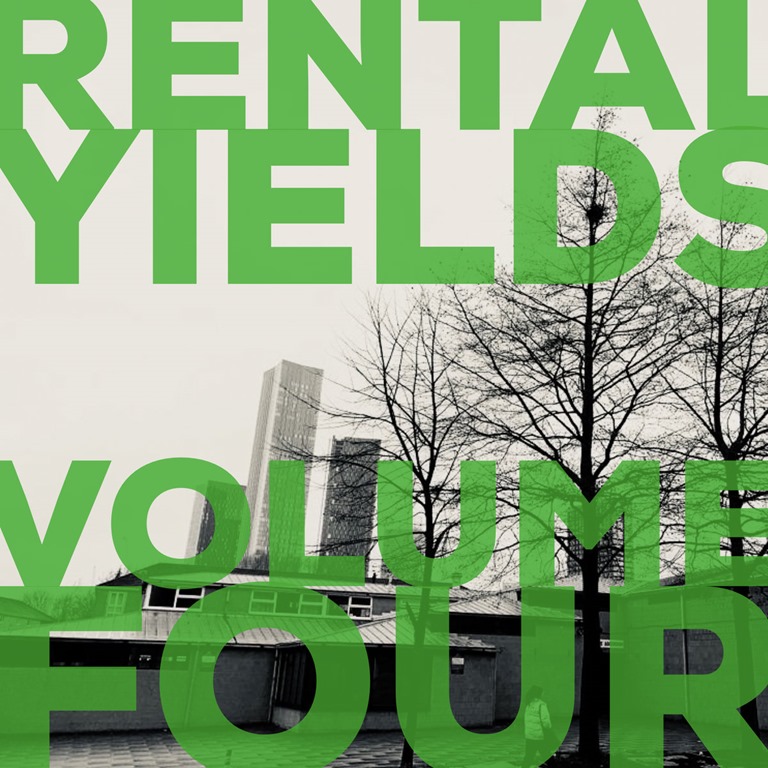
What makes life in this endless torrent of shit in which we’re all sinking is that there are some people who aren’t cunts, and who go out of their way to make the quality of life better for others, as well as themselves. The guys who run Front & Follow are among them, as are the many, many artists who have contributed to the Rental Yields compilation series, of which this is the fourth, showcasing tracks by myriad underground acts, remixed by myriads more in an exercise in infinite cross-pollination.

Featuring 26 new tracks and 52 artists, all money raised from this release will go to SPIN (Supporting People in Need), whose purpose is to feed, shelter, clothe and generally support the homeless and people in need of Greater Manchester.

As with the previous instalments, Volume 4, is very much geared towards ambient and more sedate electronica. With so many tracks and such an epic duration, and given the nature of the material, Volume 4 is a wonderfully immersive experience.

The overall quality is, again, excellent – meaning it’s consistently great across the duration and there’s nothing that makes you feel inclined to hit skip. There are, as always some names that leap out for a range of reasons: Kemper Norton. Yol, Omnibadger, The Incidental Crack, Field Lines Cartographer, Sone Institute – but the main point of this is not the names, but the merits of collaboration and collectivism.

Some tracks do stand out, notably ‘Acid Bath’ by BMH vs Lenina for it’s pumping beat, and CuSi Sound vs Robbie Elizee’s ‘I’m Not A Tourist, I Live Here’ for its overt wibbly synth weirdness, for starters. ‘The Enamel Hamper’ by Cahn Ingold Prelog vs The Ephemeral Man is a nine-and-a-half-minute dark psychological drift, while Omnibadger vs Grey Frequency’s ‘Speeding Ground (Part iii)’ is a glitchy, collaged morass of disorientation, with layers of noise, tribal drumming, and disembodied vocals, and ‘Home on the Whalley Range’ by Opium Harlots vs Yellow6 combines dark ambient, murky noise, and a hint of The Cure’s ‘Pornography’ to forge something intensely claustrophobic.

Solo1 vs yol’s ‘Black Spoons And Crosses’ is a collision of ambience and noise that will twist your brain, and the sonorous drones of Laica vs Learn to Swim’s ‘High Yields, Low Prospects’ is a doomy post-punk affair with an agitated drum machine hammering away amidst a sea of murk, and both the title and sound encapsulate the sentiment and the message of the album as a whole.

It is, once again, a triumph, not only artistically, but socially: the Rental Yields series is the epitome of community. And while our government speaks of community while acting in every way to destroy it, promoting division by every means, and social media has become a warzone whereby the goal is achieved, musicians are showing the way. This, this is how we will survive the shit and create a better future.

AA

a0601616053_10

Preston Capes – PCT001 – 1st July 2022

Christopher Nosnibor

The Front & Follow label may have reverted to mothballed status (at least for the time being), but that doesn’t mean that Justin Watson is doing nothing these days, despite the title of the latest release from three-way collective The Incidental Crack, who we’ve been following – and covering – for some time here at Aural Aggravation. For this outing, they’ve found a new home on newly-established cassette label – and these seem to be springing up all over now – Preston Capes (and I’m guessing no relation to Geoff).

As the notes explain, ‘The Incidental Crack began with Rob [Spencer] recording himself wandering around in the woods and finding a ‘cave’ – Justin put some weird noises to it, and then Simon joined in. The rest is history. The Incidental Crack are joined again by Dolly Dolly / David Yates on this album.’ Indeed, however much The Incidental Crack may evolve, they remain fundamentally unchanged, their albums assemblages of random field recordings and strangeness melted and melded into awkwardly-shaped sonic sculptures that unsettle the mind and by turns ease and tense the body.

The Incidental Crack Does Nothing follows the two albums they released in 2021, the second of which, Detail, was a challenging and expansive work, and this very much continues in the same vein.

With The Incidental Crack, it very much feels as if anything goes, and reflecting on the name of the collective, this seems entirely appropriate. What their works represent is a crack, a fissure, in time, in continuity. Their methodology may not be specifically influenced by William Burroughs and Brion Gysin’s cut-ups, but are, very much, open to, of not specifically channelling and incorporating, the assimilation of random elements, and have a collage aspect to their construction.

‘Shitload of Rocks’ is comparatively airy, and serves as a brief introductory passage before the dank, gloomy ambience of ‘The Worst Party’. It’s a dark, ominous piece that hovers and hums, echoes, clanks, and rumbles on for a quarter of an hour; it’s cold, clammy, and unsettling. But is it the worst party ever? While it does sound like hiding in a cave while an armed search party charged with the task of your erasure stomp around in adjacent tunnels off in the distance, I don’t actually hear any people, laughing drunkenly or loving the sound of their own voices while holding court with tedious anecdotes, so I don’t think so.

‘Hair falling from our bodies clogs up the sewers,’ we learn as a clattering beat clacks in and rattles away on the industrial chop-up churn of ‘Hair’, featuring Dolly Dolly, who’s clearly no sheep. It’s the album’s most percussive cut, the monotone spoken-word narrative somewhat surreal, and looping eighties synths bubble in around the midpoint, although it’s probably too weird for the Stranger Things retro adopters.

‘Couch Advantage’ is the album’s second longer piece, a sinuous, clattering workout almost nine minutes in duration. It’s minimal, yet somehow, there’s enough stuff going on as to render it all a blur: is that jazz drumming, a groove of sorts off in the distance? Or is it simply some clattering chaos, the sound of bacon sizzling? What is going on? And following the brief interlude that is ‘Belting’, the final piece, the ten-minute ‘Photography’ with more lyrical abstraction from Dolly Dolly depicting random fragmentary images against a backdrop of clicking sparks and evolving, supple sweeps of drifting clouds of sound. It’s all incidental, every second of it: fleeting, ephemeral – and in the cracks, is where it happens. As they open wider, you peer in, and observe. There is movement. There is life. Because life is what happens between the events, among the random incidents and accidents.

The Incidental Crack Does Nothing may be confusing, bewildering, difficult to grasp – but it is, without doubt, a slice of life. You can do with that what you will.

AA

cover

Herhalen – H#023 – 21st May 2021

Christopher Nosnibor

The press release for this second album by The Incidental Crack – a collaboration between Justin Watson, Rob Spencer and Simon Proffitt – which follows last year’s Before The Magic describes the trio ‘exchanging field recordings, samples and random noise between Manchester, Wigan and North Wales, culminating in studio sessions focused on detailed processing and sound manipulation. They have yet to meet. Maybe one day when this is all over, in a pub in North Wales, free from this madness’.

As such, it’s a classic lockdown project, a virtual collaboration that proves that when it comes to the making of music, distance doesn’t have to be an object. In fact, it’s probably easier to collaborate without the logistics of brining people together in the same place at the same time. Writing on the project, Justin (one half of The Gated Canal Community and formerly of Front & Follow, a label which will be familiar to regular readers of AA), notes that Municipal Music ‘includes tracks recorded during the same period, using our now foolproof approach of sharing stuff, fiddling with it, sharing some more etc.’, adding, ‘It kept me sane at least during the last year!’

That is something that’s certainly relatable: keeping occupied has, for me, been the only way to keep myself together. I’m not saying it’s healthy, it’s just how it is. And increasingly, I’ve found abstract music easier to manage. Structured music, anything overtly ‘song’ orientated and rhythm driven is, all too often, just so much noise and instead of providing a welcome point of focus, feels just like being smacked from all sides at once. So while there may still be a lot going on in this, it’s not psychologically disruptive, and is suitably absorbing and immersive.

There are three extended-length tracks in all, which exploit the full dynamic range, with a strong focus on texture. The first, ‘The Second Cup of Tea of the Day’ is strong – certainly more English Breakfast or Nambarrie than Earl Grey or anything herbal – and probably inspired by the sound of a boiling kettle that’s been manipulated and fucked around with. However, it sounds at first more like a freight train, an extended continuous roar occupying the first three minutes before it gradually abates in volume and intensity, and gentler, softly-woven ambient drones fade in. there are still rumblings and incidental clatterings, forging a soundscape that never fully reconciles the tensions between the elements of soft and harsh, the light and dark. Bubbling Krautrock with bulbous beats collides with metallic shards of grating noise.

‘Just Passing Through’ is appropriately positioned in the middle, and is altogether gentler, softer, warmer, and pursues a more conventional ambient line. But there are peaks and troughs and ebbs and flows as the sound swells and at times shifts toward more unsettling territory, with some woozy oscillations that tug uncomfortably at the pit of the stomach before receding and allowing calmer vibes to return once more.

The third and final cut, the fourteen-minute ‘Ice Cream at the Pavilion’ starts with what sounds like the crashing of waves against a rocky beach in a storm, which strangely reminds me of a number of occasions we’ve had ice cream at the coast on family outings, because it’s always ice-cream weather for children. Voices chatter and babble and whoop excitedly, while a dolorous church organ begins to while away majestically in the background. Eventually, it’s superseded by a barrelling drone and a throbbing, slow-pulsing sound that swells and surges.

There’s a certain wistfulness and nostalgia to be found in the spaces in and around Municipal Music, although perhaps some of that’s my own reception aesthetic, a response as much to the circumstances of its creation and the allusions of the title, both of which remind me I’ve not left my own municipality in months, haven’t met any of my collaborators or friends in so very long, and yearn for both proximity to (some) people and also the countryside and country pubs. All of these thoughts wash around in my mind as the sounds surround me, and it occurs to me, finally, that Municipal Music is good music to think to.

AA

023 The Incidental Crack - cover

AA

The Incidental Crack - artist photo

Soundtracking The Void – 18th September 2020

Christopher Nosnibor

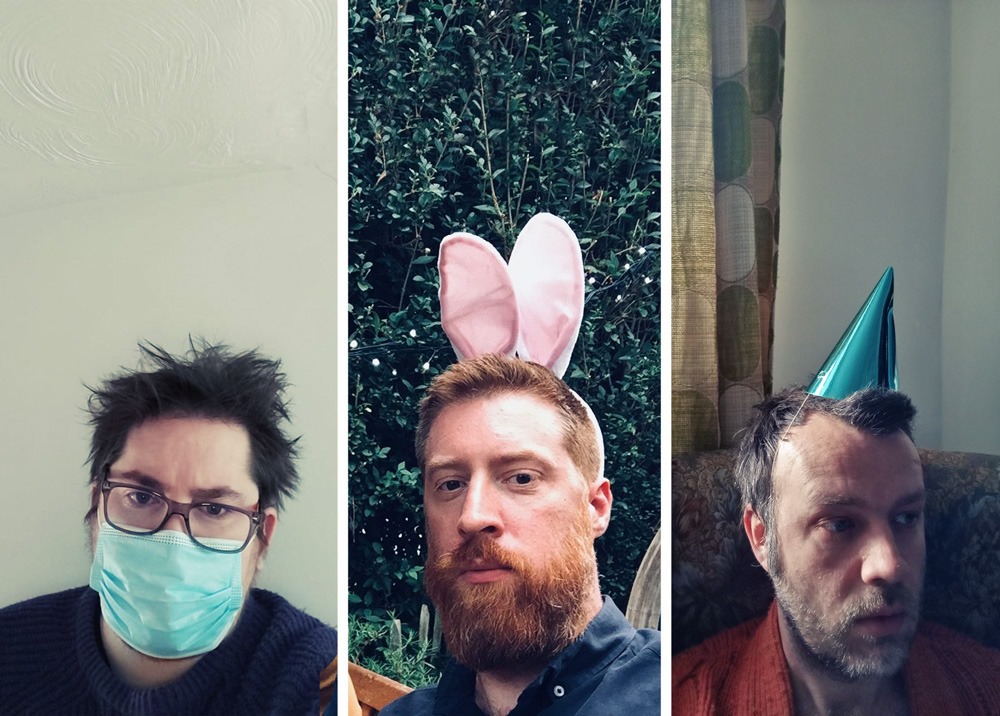
Before the Magic is the debut from The Incidental Crack, a new collaborative work from Front & Follow and Gated Canal Community’s Justin Watson and Rob Spencer, alongside Simon Proffitt, who also performs as Cahn Ingold Prelog and The Master Musicians Of Dyffryn Moor.

Under the seemingly eternal lockdown and difficulties arising from distancing, which continue to loom large over all things creative and musical where collectivism and collaboration are concerned (live performances are another essay altogether, and their absence will continue to leave an immeasurable void for so many and on so many levels), The Incidental Crack is a project that could only exist thanks to the Internet, which saw, ‘a six month period of remotely sharing atmospheric field recordings, samples and random noise, culminating in studio sessions focused on detailed processing and sound manipulation.’

The album’s four tracks are significantly differing in length, ranging from a ‘mere’ six-minute snippet to an eighteen-minute exploration of the deepest, darkest tunnels

Why are children’s voices always so unsettling? Especially samples of chirpy, innocent calls and singing, when juxtaposed with murky, dark ambient drones? I suppose it’s not least on account of that unheimlich sensation instilled by those quite specific contrasts of carefree naivete and gut-clenching fear. Individually, these sensations can be processed and compartmentalised, but together, they sit uneasily, tapping into a biological parental instinct that tells us that children should be kept safe from harm, and a doomy sonic fog, with connotations of imminent danger, creeping around the ankles is something of a hard-wired trigger. ‘If I Can Do It’, then, is a thoroughly unsettling collage. The voices fade out, but deep rumbles of thunder persist, a different kind of threat as a storm breaks and it reminds us that there is nothing harsher, more devastating, than nature.

‘Skin’ provides some much-needed levity, overlapping myriad snippets of adverts for skin products by way of an intro before drifting off into soft bubble of drifting mellowness. There’s a spoken-word piece, from what initially appears to be lecture on skin but wanders more into the territory of a reflection on skin more generally.

With murky, clunking percussion and inaudible sampled dialogue running throughout its twelve-minute running time, the dark and impenetrable ‘Set free all the birds from your wife’s aviary’ is another level of unsettling, and it’s difficult to settle or adjust to despite the relentless booming plod that hangs in the background.

The sparse, clanging pulsing noises of the final track are hollow, empty, and even when joined by a slow-swelling tide if amorphous, extraneous noise, feels quite bleak and desolate, and the title, ‘We All Feel Happy Now’ feels grimy ironic. Gasping breaths, the sounds of panic, along with slivers of spoken-word narrative (which in passing includes the album’s title is dense and dolorous, and there is no joy to be found here.

And yet the album as a whole feels positive, if only in terms of its fulfilment of purpose as an experimental album with unsettling connotations, and sometimes, you just need a dark, desolate atmosphere to match the mood.

AA

The Incidental Crack - Before The Magic