14th March 2025
Christopher Nosnibor
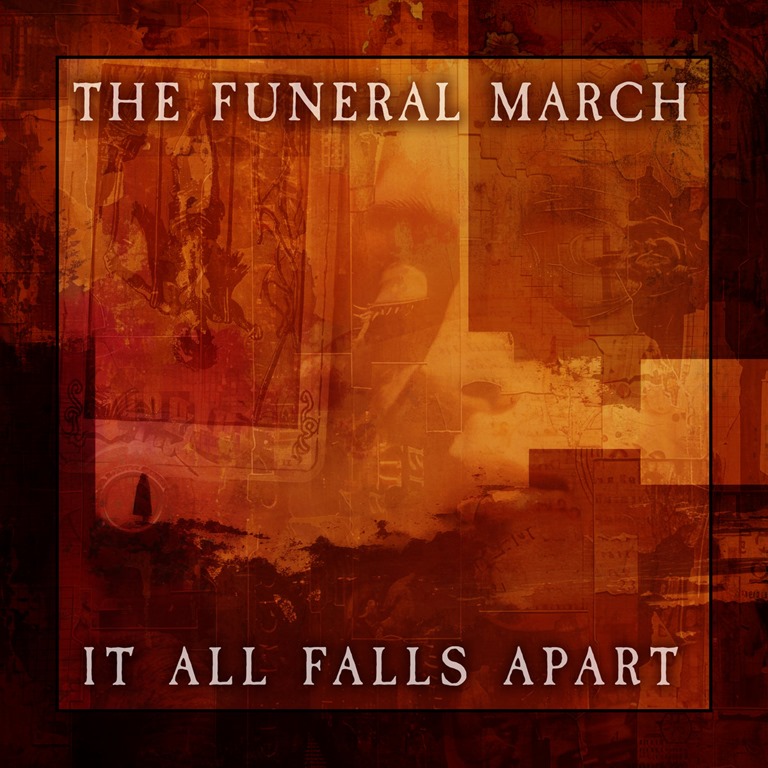
While the early- to mid-80s is considered by many to be the ‘golden age of goth’, 87-88 were pretty good years, too, and saw some of the first wave of bands breaking through commercially… It was at this time, with the release of Floodland and Children that The Sisters of Mercy and The Mission, respectively, broke big in the charts, and being 12/13 at the time, this was when my eyes – and ears – were opened to a whole new world of music. And so it was, too, that things really started to happen across the pond, too, and it was in 1987 that saw the formation of The Funeral March of the Marionettes, often referred to as The Funeral March.
There may well be a whole thing about how goths are obsessed with death, as even the band’s name suggests, but this release arrives in a genuinely sad context, namely the passing of founder and front man Joe Whiteaker from pancreatic cancer in his mid-fifties. With every year that passes, it becomes apparent that the people who are dying are closer to our own age, are our peers, or close to. But the fact Joe did complete the recording of It All Falls Apart is something to celebrate. Many of us ponder our legacy: what is it that we leave behind?
The Funeral March are drawing the curtain on a thirty-seven year career with what may be their finest work to date.
They started out, like so many gothy / post-punk inspired acts, drawing inspiration from seminal English acts like Bowie, The Cure, Siouxsie and the Banshees, Bauhaus, and Joy Division. The band’s name, meanwhile, was a nod to Charles Gounod’s ‘Funeral March of a Marionette’, best known as the theme music for TV’s Alfred Hitchcock Presents. And truth be told, this is all pretty standard: marionettes seem to be part of textbook goth catalogue: There was The Marionettes, for a start who started life as The Screaming Marionettes in ’86, and when you chuck all the words into a goth band name generator, let’s not forget Screaming Banshee Aircrew… So much goth seems to thrive on derivation.
It All Falls Apart brings with it a certain familiarity by necessity, really. But this release sees them push the boundaries rather more, forging their own identity more strongly than ever before. It’s a sign of artistic growth: many artists – regardless of medium, be it music, writing, visual arts – begin by learning from their precursors, leaning on their influences, and finding one’s own voice takes time and confidence. It’s also an album of two halves – essentially an EP and a remix EP, but again, in context, it feels appropriate.
So if ‘Starts at Night’ brings hints of The Mission’s ‘Sacrilege’ or ‘Amphetamine Logic’ by The Sisters, perhaps even Skeletal Family’s ‘Promised Land’, all of which are killer by virtue of the complex picked lead guitar parts, it’s equally worth noting just how hard it blasts out of the gates. Pow! It’s the drums that really make this one. More Danse Society circa Seduction than anything else than comes to mind, it packs all the power up front, and that impact really lands strongly.
All of the ‘standard’ goth tropes are present and correct, from the loping, dynamic drums, the chiming, chorus-rich guitars, and thumping down-on-the-floor bass, but their execution is exemplary. This is the sound of a band who are intensely honed and striding confidently through all aspects of songwriting and production. It’s the thinking bass that really makes ‘Shadow Games’, but with its chiming guitars and vocal inflections, it ventures into the territory of classic contemporary post-punk, in the way that the likes of Interpol have built on the foundations of Joy Division without being a carbon copy, and the energetic chorus calls to mind White Lies at their best. It’s not that The Funeral March have abandoned their roots here, but that they’ve cut loose and taken flight.
‘Save Us’ is more driving, more hard-hitting, more overtly post -punk than goth, bit it’s also dark, snarly, proper rock ‘n’ roll, the sound of leather jeans and legs akimbo, and a contrast with the more overtly atmospheric but no less punchy ‘Bobblehead’. As for the title track… well. It feels like the finale, and, with the benefit of hindsight, the farewell. Stretching out to six minutes, it’s the perfect blend of guitars, shimmering in waves of treble an reverb, atop the phattest drums and underpinned by a thick bass. It’s goth perfection and would have been at home on the recent album by Pink Turns Blue. It All Falls Apart is appropriately titled, as it turns out.
The quality is consistent throughout, and the remixes are actually nice additions here, making All Falls Apart a superb addition to the band’s catalogue, we can only speculate on what they might have done next, but All Falls Apart feels like the perfect way to finish a career.
AA

 Aural Aggravation