Posts Tagged ‘surreal’

Celebrating the release of his new album AFR AI D, Mariusz Duda unveils a spectacularly shot new video for ‘I Love To Chat With You’.

Directed by Oskar Szramka and produced by both Szramka and Mariusz Duda the video is a poignant cinematic look into an intimate and slightly ominous subject, that could well become a reality for many in ‘I Love To Chat With You’.

Multi-faceted in its approach ‘AFR AI D’ explores the many different aspects of AI. ‘I Love To Chat With You’ turns the gaze to the possibility of having a relationship with artificial intelligence and what that might look like. Using ChatGPT as it’s protagonist the track was inspired by the cult classic sci-fi romance story of Theodore Twombly as Mariusz elaborates on below:

The title ‘I Love to Chat with You’ is obviously a reference to ChatGPT which, in 2023, put artificial intelligence in mainstream. Musically, I wanted “AFR AI D” to have its own… electronic love song. The main inspiration for it was Spike Jonze’s 2013 film called “HER”. Perhaps you can call love by different names but it’s a little frightening when it is called “AI”.

Musically the track features cascading arpeggios with ethereal vocals and gentle piano that could reflect the bliss of falling in love or the eternal longing for a human relationship with a machine.

Mariusz Duda has always been fascinated by the telling of a story, idea or concept.

His new solo record looks at the growing commodification of AI and specifically with artificial intelligence entering the mainstream.

Using the notion of ChatGPT and Midjourney and the increasing use of deep fakes as a springboard, ‘AFR AI D’ explores these interesting and forward thinking theories musically just as much as it does conceptually.

AA

Duda

Bearsuit Records – 31st October 2023

Christopher Nosnibor

Just a little over two years since the idiosyncratically-monikered Eamon the Destroyer arrived with his debut single ‘My Drive’, he’s gone from strength to strength – to the extent that his output has erupted, Godzilla-like, expanding and flexing immense musical muscles. Sort of. Because Eamon the Destroyer’s work is, despite the connotations of a raging beast laying waste to entire civilizations with a single roar, incredibly intimate, with tension building from the introspective minimalism of the songs. With the release of the debut album A Small Blue Car and a remix / reworking of said album landing in quick succession, the arrival of We’ll be Piranhas seems swift.

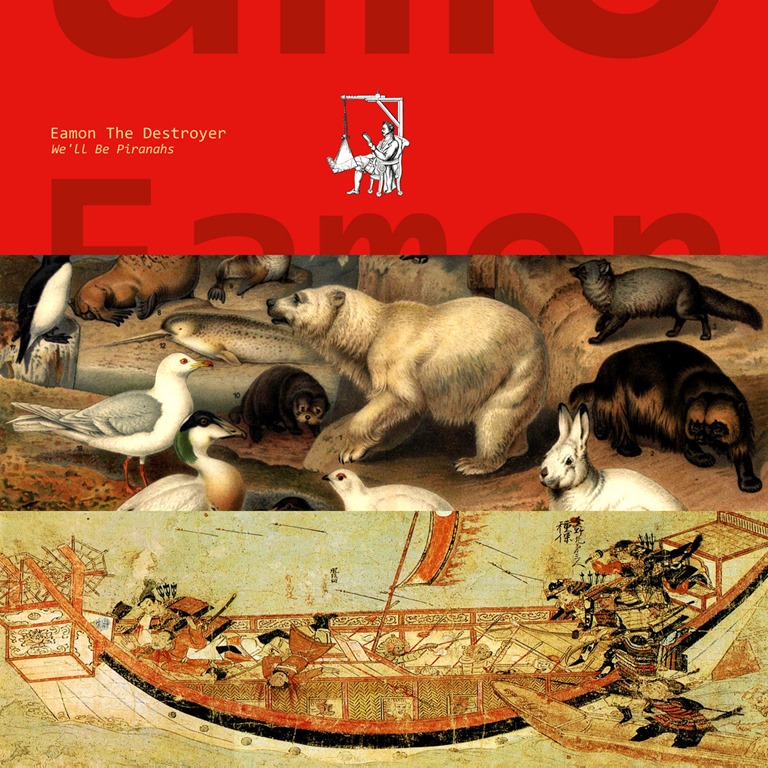
We’ll be Piranhas finds Eamon the Destroyer (any truncation of the name feels wrong: Eamon too casual and to cuddly; the Destroyer simply unrepresentative) pushing the parameters of experimentalism, conjuring the sonic equivalent of the surreal oddness of the album’s cover, which looks like a three-way split-screen of medievalism, Anglo-Saxon fable, and a deranged reimagining of some of Captain Cook’s sketches of newly-discovered species with what appears to be a polar bear resting its chin on a narwhal, while gulls look on and rabbits look away. Or something.

‘The Choirmaster’ is both droney and playful, quirky, and mellow, until it spins off its axis and into a whole other world of spiralling prog and doodling daftness. It certainly packs a lot into five strange and disorientating minutes. Single ‘Rope’ is glitchy, awkward, and feels like it doesn’t belong to anything, and suddenly, it lurches too life with a loping rhythm and fuzzy synths which provide a backdrop to tense, almost strangled vocals, hushed, strained, and gravelly. Not for the first time, I long for a lyric sheet as the scratchy vocals render the words difficult to decipher, but this is perhaps his most vitriolic piece to date; more often than not, Eamon the Destroyer croaks melancholy: here, there’s a fire, and it carried through into the wheezing clatter of ‘Sonny Said’. There’s a moment around the mid-point I get a pang of Seventeen Seconds-era Cure. But it’s fleeting, and nothing is pinpointable, particularly in this swirling maelstrom of a piece.

When it comes to Bearsuit releases, I often find myself using and reusing the word ‘weird’ as a descriptor – mostly because it’s the thing that really defines the label. While the likes of Harrold Nono spin Eastern hues into spirals and spin drifts of experimentalism, We’ll be Piranhas finds ETD really going all-out to try stuff. And the result is brain-bending.

‘Underscoring the Blues’ somehow manages to melt fairground oddness with The Doors and prog and, well, all sorts, to blur into a curious cocktail.

It’s difficult – if not impossible –to listen to this album and feel ‘normal’. It feels like the soundtrack to a dream: one of those weird dreams where familiar places aren’t quite right – the walls of familiar rooms are different, doors and windows are in the wrong place, and continually moving, and you look to make your way out and suddenly the door has vanished. The floor is moving and familiar faces warp and acquire new, alien aspects. You don’t know who you are or what’s going on, but you know that this isn’t what you expected as the sights and sounds of the familiar melt into one another. You feel your sense of time and space begin to crumble. Where am I? What even is this?

It feels like isolation. It feels like… like… like numbness, confusion. You feel your body tense, the backs of the legs growing taut. The title tracks sends everything spinning and whirling every whichway, and there is no easy way to assimilate this, and the same is true of the woozy glitchings of the desolate ‘A Call is Coming’. Ignore the call; decline it. Look inwards. Woah, something isn’t quite right.

We’ll be Piranhas leaves you feeling detached, askance, apart, removed, not quite right. It’s an introspective work delivered from on the cusp. On the cusp of what? It’s hard to say. Perhaps it’s best not to.

AA

a3572746252_10

17th April 2022

Christopher Nosnibor

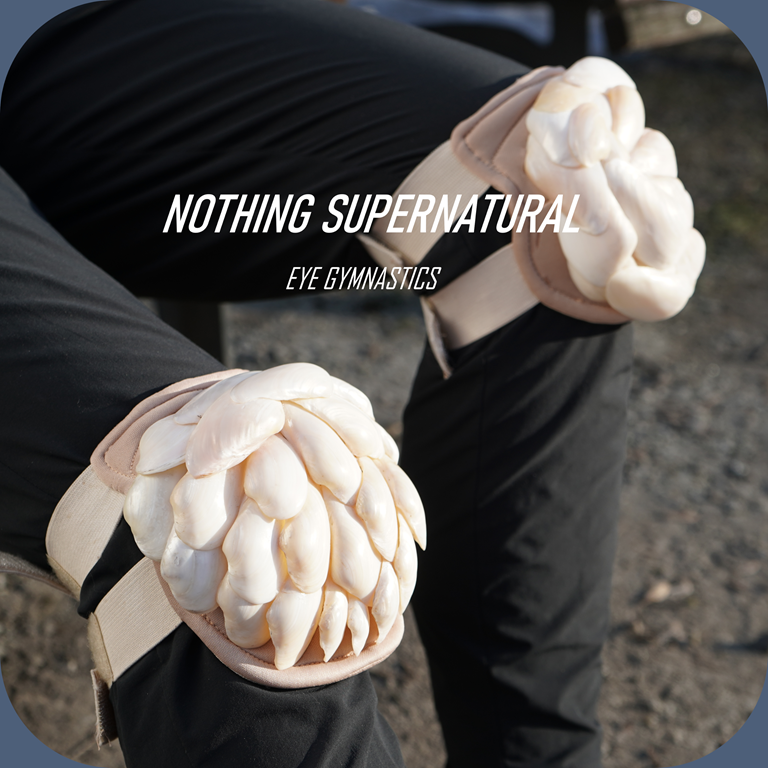
There’s something quite surreal about the imagery of ‘eye gymnastics’: it’s highly visual, yet at the same time, beyond physicality, and as such, it possesses a cartoon-like quality. This surrealism extends to the cover art, too: what exactly are we looking at here? It’s the debut album from a Lithuanian duo consisting of Viktorija Damerell and Gailė Griciūtė, who first came together in 2018.

And so it is that these clues are also representative of the music: the words are strange, fragmented, abstract – but also not, with improbable and incongruous images, and the album’s first piece, ‘Eye Gymnastics’ could be something of a signature tune for the pair. It’s sparse, the beats subtle, distant, subdued, yet insistent as they pulse through eddying swirls of semi-ambient synth drifts, through which a spaced-out, vocal dreamily intonates lyrical abstractions. If surrealism has a certain preoccupation with dreams and the subconscious, then on Nothing Supernatural, Eye Gymnastics plunder that inner realm for inspiration and render it in such a way as to remain to the vagueness, the indistinct focus of the fugue state, the disconnects and strangeness of dreams, and recreates the way those sensations and images echo, hauntingly, in the waking hours which follow those most vivid of nocturnal experiences.

The title feels vaguely ironic in the context of the disconcerting, dislocated vocal treatments of the ominous and eerie ‘Tree Tops’, where a glitchy, industrial beat clatters in thick and leaden. Then again, it’s dark pulsations feel as much the product of a troubled mind as of anything supernatural.

While there are some significant leanings towards ambience and hypnotic drifts imbued with an ‘otherly’ feel, elsewhere, snarling, growling electronics dominate a number of the tracks, with ‘Sadness and Joy’ being really quite heavy, with a gloopy bass that whips and whirs and fizzes. ‘You Destoy Me’ epitomises this industrial darkness: the murky drumming pumps away with the palpating tension of Nine Inch Nails’ ‘March of the Pigs’, while the multi-layered vocals whisper and echo dark thoughts, and the relentless pulse of ‘Let it In’ is harder and harsher still, the bass drum a booming throb, the snare – such as it is – a smash of distortion. You don’t want to let it in: no, you want to shut it out, make it go away. It’s not pleasant, it’s uncomfortable, claustrophobic, suffocating. Sparse and spooky, ‘Bitter Night’ bridges the territory between Young Marble Giants and Throbbing Gristle.

It’s unsettling, a creeping burrowing into the brain, as if overhearing someone’s internal monologue. This is not what you’d really call a ‘relatable’ experience, at least for the majority. It’s not full-on horror, but it is chilling, challenging, eerie, unsettling. But it’s also compelling, hypnotic, and a quite remarkable debut.

AA

Nothing Supernatural art

Front & Follow – 26th October 2016

Christopher Nosnibor

In the last property I rented, I suffered an infestation of moths. It may sound amusing, but it wasn’t. the larvae of said moths devoured chunks of carpet under the bed and in various other places in the bedroom and other spots on the first floor. So, moths, it transpires, consume wool-based material and require Rentokil to halt them. Miraculously, I did get my full deposit back, but was reminded that one sold never trust a creature made of dust. Yes, I fear moths. A body that powders on contact with a heavy blow presents a curious intangibility, a lack of substance, a sense of not really existing in the corporeal world.

This presumably isn’t the kind of scene the title of Sone Institute’s latest offering is attempting to convey, and the connotations of rust are more of slow decay and dilapidation, in keeping with the dark, damp crevices moths are more conventionally associated with inhabiting.

Sone Institute describes Where Moth and Rust Consume, his first new material in six years, as his ‘pop album’, but don’t expect to hear it on R1 any time soon, or ever. 6Music’s Gideon Coe has championed previous work, describing it as ‘delightfully strange,’ which seems a fair summation. Sone Institute inhabits the world of the unheimlich, the uncanny, and this is no more true than of the landscape conjured by these compositions.

Sparse, stuttering beats and even sparser synths provide the backdrop to robotic, monotone vocals on the first track, ‘Only I Exist’. ‘Your wretched anus / discoloured teeth / Tree-trunk legs / A dog on a leash…’ The obtuse, fragmented lyrics follow the trajectory that charts a line from Dada and Surrealism to Burroughs’ cut-up technique. The images layer up, juxtaposed and disconnected, and the album gradually unfurls, pushing a clinical 80s Eurodisco sound that’s centred around crisp, mechanoid beats. It’s the beats that are perhaps the most overtly ‘pop’ aspect of the album, bringing a consistency of structure and solidity to the compositions rarely found in Sone Institute’s work.

‘The Devil Works in ASDA’ judders and thumps along, building a conspicuously linear groove while exploring the dynamics of dance music, and if ‘What’s Bred in the Bone’ pulls back the intensity and volume a couple of notches, the spacious bump and bleep, built around a framework of drum machine evokes the spirit of retro-futurism. Analogue synths modulate rhythmic pulses, but stark angularity and minimal production values give the atmosphere a cold, detached edge.

‘Winter is Dead’ marks something of a departure, venturing into more ambient and also rather weirder territory with its woozy vocals and warping sonic backdrop. And there are times when it all goes Kraftwerk / Tangerine Dream, and if truth be told, that’s pretty cool. There’s creeping tension in the undulating drones and whispered vocal slivers of ‘Oblique Messages’, and the dark heart of Where Moth and Rust Consume beats on through to the final fragments of the crackle-scratched sketch of a closer that is ‘God Bless You’.

We need more of this: and with this release, we get more, lots more. Front & Follow don’t only deliver leftfield albums of quality, but are now, it seems, on a mission to go above and beyond in providing value for money with a bonus album: this release also marks the first volume of a new series on Front & Follow – Ex Post Facto – which, the label explains, ‘seeks to celebrate experimental electronic music in all its forms, showcasing new work and old, exploring the relationship between the current and the past, how they influence and shape each other and our experiences of them.’ And so, a collection of tracks from the Sone Institute archive, including remixes and previously unreleased music offers eighteen tracks lifted from the far reaches of Sone Institute’s career. Not only is it extremely interesting in its own right, but it resents a wide-ranging representation of the sample-riven, string-soaked and analogue-based wibble-tastic work of Sone Institute through the years. It’s not all comfortable, easy -listening, exploring equally areas of introspective elegy, discord, and smooth, rippling mellowness: the chanking ‘4 (Version 3)’ is a discordant guitar blitz over a creepy Theremin / organ shiver, while the stammering robotix vocal loop on ‘Dark Forest – Silver Sea’ hardy says ‘easy to get on with’: and the context is all.

Still reeling from Where Moth and Rust Consume, Past and Spared is the very definition of headfuck not because it’s especially intense, but simply because it is. And that’s cool. Just be prepared.

AA

Sone Institute – Where Moth and Rust Consume

Vocalist Launches Crowdfunder To Raise Funds For “The Guiding Light”

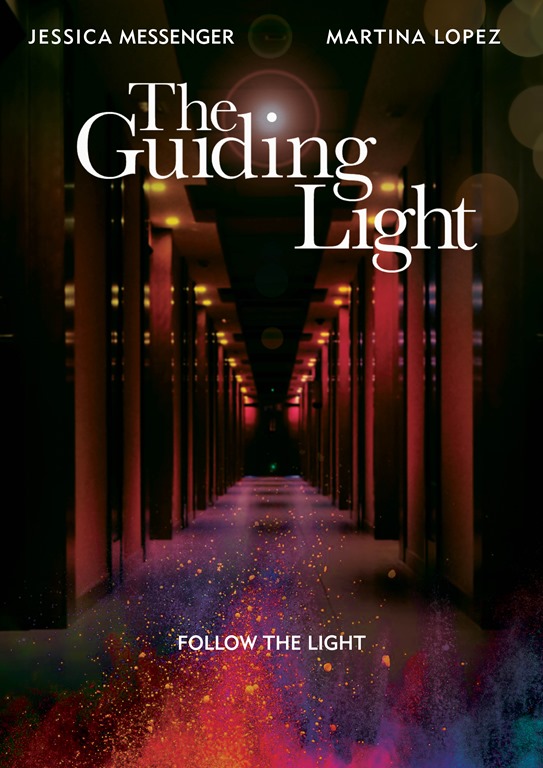
Former Akarusa Yami vocalist Tom Brumpton has announced his latest project; “The Guiding Light”, a short film that’s been described as “La La Land if directed by David Cronenberg”.

Brumpton, who co-founded Akarusa Yami in 2011 with Guitarist Tom Clarke, parted ways with the band in 2015 after releasing two EPs (2011’s “Ouroboros” & 2012’s “Trace Element Rebirth”) and an album (2015’s “Heavy Climb”), states he hasn’t performed live since leaving the band. “I had a lot of fun in Akarusa Yami. I got to do things I’d always dreamed of with people who to this day are among my best friends and made music I’m still very proud of. However, by the end I’d lost my passion for performing live and that was a big contributing factor as to why I left.”

Having been an actor for many years outside of music, Brumpton spent the next two years appearing in various films and co-directed and produced a handful of projects with writer and best friend Adam Luff. This included 2016’s “Nurture of the Beast”, which was nominated for a number of awards, including Best Actor for Brumpton, and was screened at various film festivals around the world. In mid-2017 the pair began working on “The Guiding Light”, a sprawling surreal film that in Brumpton’s own words “Is a celebration of life, those we share it with and the idea of legacy”.

The inspiration for “The Guiding Light” comes from a particularly difficult period in Brumpton’s life. He lost his Aunt Pat in April 2016 and later his Aunt Kath in late June 2017. “My aunts were wonderful people. I was very close to them and losing them felt like losing a family home.” As the pair began working on “The Guiding Light”, Brumpton aimed to create something life affirming. “I didn’t want my last memory of these women to be death and misery. I wanted to turn that grief into something positive”.

The film follows Barbara, a world champion dancer who after years of struggling with autoimmune disease is forced to retire. Shortly after, she contracts pneumonia and becomes critically ill. Minutes from death, she’s visited by the mysterious Angela. The two embark on a journey through Barbara’s happiest memories before she’s forced to face her pending mortality. The film is set to be filmed in the East Midlands in late Summer/early Autumn 2018.

Asked on his inspiration for the film, Brumpton stated “Whatever happens, blame Nicolas Winding Refn!” he jokes “I discovered him in 2009 when I saw “Bronson”, and fell in love with his work. His use of music and lighting is a massive inspiration. As Adam and I worked on the “The Guiding Light” we agreed we wanted to push our boundaries as film makers and sought to draw in a wide array of influences, specifically body horror and musicals.”

Despite the bleak sounding subject matter, Brumpton thinks of the film as a celebration of love and life. “To me, “The Guiding Light” is a celebration of life and the people we share it with. It’s about looking back on the things you achieved with a sense of pride and completion, and the role the people closest to us play in the value of those memories. Adam also wanted to tackle the idea of legacy; what do we leave behind and how will we be remembered by those close to us and the wider world. I liked that idea a lot, and it’s been fun melding these different ideas into something expansive.”

You can see a teaser for the film here:

AA

The pair are running a crowdfunder via Indiegogo which can be found here.

Brumpton states that while he hasn’t been performing since 2015, he has recently recorded vocals for a new project that former band mate Tom Clarke is working on. “Its one of the best things he’s ever done. Easily. I don’t want to say too much, but I remember him sending me the tracks and loving them. I’m only on one track, but the other vocalist has done a killer job. I really hope they take it on the road.”

00342 - THE GUIDING LIGHT A3 V_6

Discrepant – CREP53

Christopher Nosnibor

This double album gathers two previous CD-only releases, both of which focus on Laurent Jeanneau’s love/hate relationship with China.

Soundscape China comprises two side-length sound-collages, with long samples of songs and TV shows, including what sounds like an exercise routine, and street bustle and radio, children’s voices, are overlayed with sounds of the sea and myriad extranea. Jeanneau’s work under the Kink Gong guise is often described as ‘surreal’, as collage works so often are, on account of their tendency to collide incongruence. The effect of displacing objects or text (with sound and moving images included in this category… one could argue that anything and everything is text in some form or another) and relocating it to an unfamiliar setting or alien context has the capacity to instil a sense of the uncanny. ‘Soundscape China Part 1’ doesn’t produce this effect, and feels more like reportage, a work which captures something of the flavour of the county without making any inference or comment, and without affecting any discernible change to the material or what it represents.

The Kink Gong website carries the notice that ‘Under the name KINK GONG you find 2 activities, the 1st one is to record ethnic minority music mostly in south-east Asia, the 2nd is to transform, collage, recompose the original recordings into experimental soundscapes’.

The second piece fulfils these both: it is far more intense, with jarring juxtapositions, crashing percussion. The material is more overtly spliced, the collaging nature of the work more apparent, and the overlaid noise louder, more abrasive. Yet there is still no sense of location in either time nor space. Not that this is a criticism, or something that could be considered a failing of the work: it’s simply its nature, and, more likely than not, my personal reception – Jeanneau’s experience of, and relationship with, China is considerably more deeply engaged than my own virtually non-existent experience beyond television.

Destruction of Chinese Pop Songs, on the other hand, is indeed, surreal. In fact, it’s fucking weird. Recorded (?) between 2000 and 2002, made mostly from skipping CDs of Chinese pop songs and further recomposed in Kunming (China), Vientiane (Laos) and Paris.

Why would anyone do this? And then, why would anyone listen to it? I could defend my choice to stick the album’s full duration – and in a single sitting – as research in the line of duty as a critic, but the truth is, these skipping, jitter, scratched-up, fucked up defacements hold a perverse pleasure, and I listen with bemusement.

‘Car crash’ is a phrase that’s been overused to the point of cliché obsolescence, but it’s appropriate here: not only does it convey the awkward compulsion to continue listening despite the discomfort and the knowledge that it will be impossible to unhear this, but it also reflects the mangled musical wreckage that’s wrapping itself around your ears. That said, having driven past two accidents within a short distance of one another on the A1 on Good Friday, noting my wife’s irritation and snappy frustration at all of the cars slowing as they passed, I made a point of not looking to prove that it is possible to resist. I felt a little cheated at denying myself from observing the Ballardian spectacles, but have no such need for restraint in the face of this exercise in avant-garde appropriation and defacement.

And the collisions keep on coming. ‘Hit Qin Qin’ sounds like R2D2 in the middle of a circuitry meltdown in a sea of distortion and static, while plinky-plonky piano lift music rolls on, despite the notes warping and melting. It’s simultaneously comedic and horrific. Elsewhere, ‘Pingtan’ sounds like a string instrument being slowly pulled apart while a radio plays random stations in the background, and ‘Bai Street Dance’ sounds like it was recorded on a condenser mic and played back through a Walkman speaker with a torn cone.

Everything about these songs is difficult and obtuse. Even when the ‘songs’ aren’t devoured by stutters, glitches, sticks and all other kinds of sonic wobble that’s a variant on the digital stutter, or by distortion and static and fast-forwards – yes, even when the form and sound of the song beneath the fiddling is fundamentally intact and discernible – there’s other shit thrown in to interfere and interrupt it. So yes, it is surreal, and continues the lineage of William Burroughs’ audio cut-ups, while revisiting the questions of context, ownership and defacement raised by Duchamp and the Dadaists before.

It’s obscure, awkward, bizarre, messy. It’s disorientating, destructive and really rather silly, both in terms of concept and execution. But these are all the reasons to appreciate Kink Gong’s commitment to forging his own path.

Dian Long: Soundscape China / Destruction of Chinese Pop Songs present two very different – if closely connected in thematic terms – aspects of the artist’s work, and releasing them together as a single document makes perfect sense, so long as you’re amenable to experiencing a total mindfuck.

AA

Kink Gong - Soundscape

SOFA – SOFA 556 – 7th April 2017

Christopher Nosnibor

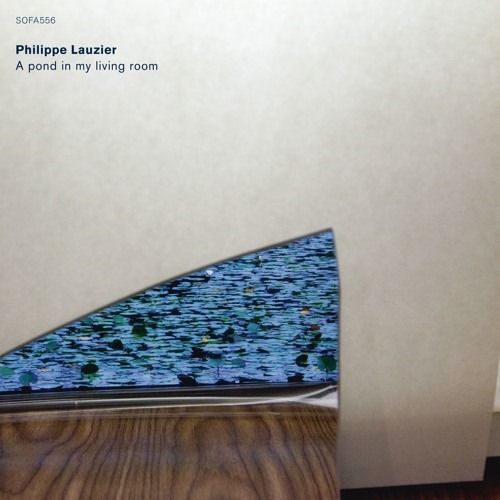
Within a few weeks of moving into my current home, there was an immense storm, which led to my discovery that it wasn’t water-tight, on account of a) having no cover over the letter box b) some defective guttering c) a gap between the roof tiles and the brick work. Consequently, this – admittedly unusually heavy – downpour resulted in there being a pool of water, an inch or so deep and over two feet in circumference just inside my front door. Ok, it was more of a puddle than an actual pond, but the anecdote serves to illustrate that the surrealist image conjured by the title of Philippe Lauzier’s second album is neither strange nor funny when the abstract notion becomes an actual lived experience.

The album’s four tracks are built around multiple tracks of bass clarinet, but there is nothing on A pond in my living room which could be readily identified by ear alone as being woodwind, and the longform compositions are explorations of sound rather than structure, with not a trace of jazz or orchestral influence to be heard.

‘Bleu Pénombre’ opens the album in a long, swirling churn of feedback. Gradually, layers of sound build, granular textures roughen the surface of the undulating, elongated multitonal humming. It’s a richly atmospheric composition, which suggests a preoccupation with the relationships between sounds as much as with the sounds themselves. Higher pitches and nagging oscillations emerge as ‘Bleu Pénombre’ bleeds into the uneasy ‘Water Sprinkling’. The notes quiver and ripple, like a mirage through a heat-haze. Sharp blasts of white noise fizz against the creeping whines which populate the sparse, eerie ‘On the Window Side’. The result is ominous, unsettling, with the unpredictably-placed shards of static adding moments of shock to the tension which Lauzier sustains over the full duration of the ten-minute piece, which culminates in a dark, rhythmic pulsation.

None of the sound contained on the album carries connotations of water, or even any overt reference to the surreal juxtaposition the title suggests, but this only accentuates the air of abstraction which hangs over the album as a whole. The final track, ‘Napping in a Neglected Garden’ yawns and grates, a metallic creak like a rusty gate opening and closing replayed in half-time dominates the haunting eleven-and-a-half-minute work. Gradually, the slow, natural rhythm becomes subject to disruption and halting adjustments bring further disruption and twist the listener’s sensory adjustment.

A pond in my living room is more effective and affecting by virtue of its comparatively subtle approach. A pond in my living room is not a loud album, and does not rely on harsh textures and tones to achieve its discomforting impact.

Philippe Lauzier - Pond