Ernest Jenning Record Co/Khannibalism – 15th July 2016
Edward S. Robinson
Fans of William S. Burroughs rejoice! An album containing new recordings of classic material gets to see the light of day, only fractionally short of 20 years after it was recorded.
If my proclamation appears tinged with sarcasm, it’s only slightly so. I am as enthused as any Burroughs enthusiast over the release of Let Me Hang You. How could I fail to be excited in the face of new audio work from the seminal author? On his death in August 1997, Burroughs left an immense gap beyond literature. Often imitated and even more often referenced and invoked, no-one else could really write like Burroughs. Despite his imploring other writers to adopt the cut-up method in the 1960s, Burroughs’ work remained distinctive because it was produced by Burroughs. To write like Burroughs required Burroughs’ mind, and if history has proven anything, it’s that Burroughs was unique a one-off.
Because this is Burroughs, an author whose biography subject to the same intense scrutiny as his major texts, the origin and evolution of this album is worth quoting from the official press release here:
‘Shortly before his death in 1997, William S. Burroughs was recorded reading some of the most shocking yet outrageously funny sections of Naked Lunch, his powerful fever dream of a novel.’
It’s perhaps not the place to comment here on the extent to which this feels exploitative or like an exercise in recycling, not least of all because Burroughs spent his career recycling material and it’s clear from the now legendary spoken word performances he gave in the 1980s when promoting his final trilogy that he was keenly aware of the enduring appeal of Naked Lunch, the book to which he essentially owed is subsequent career. As such, recordings of selected highlights from his career-defining (if not necessarily definitive) novel seem to provide a fitting sign-off, and its’s a shame we have all had to wait so long for them to surface.
The press release renders the account that producer Hal Willner (who has worked with Lou Reed and Marianne Faithfull, and perhaps more significantly, worked on Allen Ginsberg’s The Lion For Real and two previous Burroughs albums in the shape of Dead City Radio (1990) and Spare Ass Annie and Other Stories with The Disposable Heroes of Hiphoprisy (1996) and Burroughs’ manager James Grauerholz also recruited a team of world class musicians including Grammy winning guitarist Bill Frisell, pianist/keyboard player Wayne Horvitz and violist Eyvind Kang to add a touch of their experimental genius over the course of several sessions. Given his avant-garde credentials, Kang was, I would say, a particularly inspired choice.
The blurb continues: “Subsequently abandoned, these recordings collected dust on a musty shelf as forgotten as a piece of rancid ectoplasm on a peepshow floor. However, in 2015 Willner re-examined this unfinished masterpiece and sought additional help from King Khan, the eccentric Canadian punk/soul frontman that he and Lou Reed had befriended in 2010 following an incendiary performance by his The King Khan & BBQ Show at Sydney Opera House as part of a Lou Reed/Laurie Anderson curated festival. Willner sent Khan the recordings and asked him to add his gris gris to this already extremely perverted gumbo.
Khan in turn contacted vocalist/composer M Lamar (creator of the Negrogothic manifesto and the identical twin brother of transgender actress Laverne Cox) and Australian psych/punk act The Frowning Clouds for help with contributions that further heightened the unsettling mood of Burroughs’ narration.’”
Here we see new strands of the Burroughs legend in the making, and to what extent the recordings were subsequently adjusted is unclear (and indeed anyone’s guess. Perhaps in another 20 years’ time we’ll hear the ‘unmixed’ version, a Burroughs equivalent of Let it Be stripped of all of its Phil Spector intrusions). In many ways, the extent of any alteration made later matters little. After all, as the author himself said in an interview in 1974:
The past only exists in some record of it. There are no facts. We don’t know how much of history is completely fiction… There’s no record this conversation ever took place or what was said, except what is [recorded]. If the recordings were lost, or they got near a magnet and were wiped out, there would be no recordings whatever. So what are the actual facts? What was actually said here? There are no actual facts.
So, it’s 2016. There is nothing here now but the recordings. And, it must be acknowledged, these recordings are exceptional. The clarity is striking particularly against classic albums like Call Me Burroughs.
Anyone who has heard Burroughs reading before will know what I mean when I refer to that voice. Delicately picked strings drift in before that voice starts up. As ever, familiar yet alien, dry and detached. Given how late in the author’s life the recordings were made, and given how frail he became in his later years (although given that he survived decades of heroin addiction and a triple heart bypass in 1991), what’s most striking about these recordings is just how strong Burroughs sounds. Of course, frailty is relative, and Burroughs clearly had the constitution not of a proverbial ox, but something beyond human or even biological in origin. And so what’s perhaps most striking ‘They call me The Exterminator,’ he croaks as the album’s opening line. And it feels like some kind of homecoming.
Evaluating an album of this type is incredibly difficult, particularly on account of the level of personal investment so many Burroughs fans – myself included – have in is work. By this, I mean that everyone has their own version of Burroughs and their own personal appreciation of Burroughs and his work. Better just stick to the facts here.
The musical backing to ‘Manhattan Serenade’ (AJ’s Annual Party?) Purple-assed baboon… climbs up a woman…runs up and down the bar) evokes the Joujouka players and the exotic mysticism of Tangiers, where much of the manuscript that would ultimately become Naked Lunch was written. But this is intertwined with chimes and dissonant industrial drones. Burroughs’ ability to adopt high-pitched ‘shrieking posh woman’ voice is magnificently incongruous, and very funny indeed.
As much as he’s renowned as a satirist, Burroughs’ skills as an entertaining and extremely humourous spoken-word performer are often overlooked. On Let Me Hang You, Burroughs demonstrates a keen sense of delivery and timing.
‘This you gotta hear…’ is how the begins ‘This You Gotta Hear’, and proceeds to spin a yarn about a boy who follows his father’s instructions to ‘get a piece of ass’ literally. Because while the mosaic-nature of Naked Lunch and the cut-up method which would become his signature in the 60s and inform his subsequent work position Burroughs as one of the greatest innovators in narrative form of the 20th Century, he was also a master storyteller. ‘son, here’s $20… go get a good piece of ass.’ Against a skewed, barren country backdrop, Burroughs delivered a typical routine – brief, pithy, fantastical and darkly funny, and with a bone-dry delivery.
‘Disciplinary Procedure’, one of the album’s longest tracks, is a passage which represents the kind of horrors that Burroughs’ reputation was based, an expletive-filled scatological explosion, with the refrain ‘shit on the floor’ echoing out over one of the most overtly ‘rock’ backings I’ve heard Burroughs’ voice put to, sounding musically more like 80s John Giorno Band than Burroughs. For all that, it works well, and provides contrast, not least of all against the haunting experimentalism of ‘Lief the Unlucky’, on which Burroughs recounts the character’s misfortunes with ass-fuckings and Sani flush enemas galore.
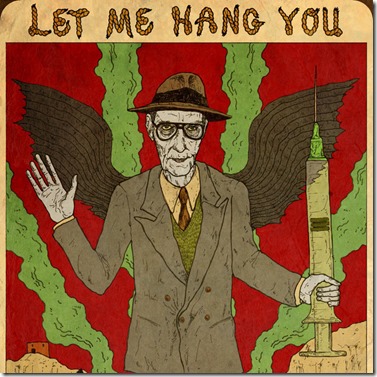
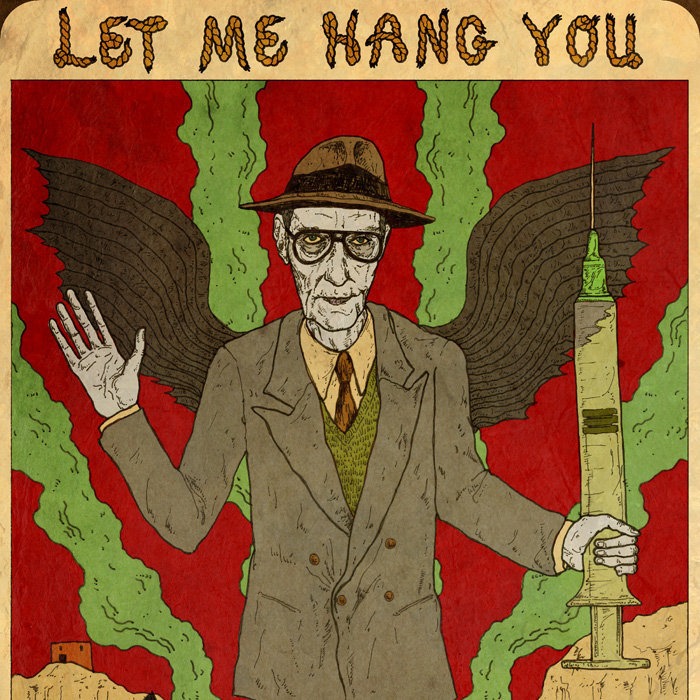
‘AJ’s Annual Party’ stands, along with the Talking Asshole as one of Burroughs’ definitive and most notorious routines. Presented here as ‘Let Me Hang You’, it’s unquestionably one of the album’s high points. Discordant guitar scrapes and dissonant noise accompany a collage of endless hangings, jockstracks, spurting cocks and jissom. There are numerous other recordings of key passages from Naked Lunch, including those gathered on Disc One of the Best of Giorno Poetry Systems four-CD box set and the triple-CD audiobook of Naked Lunch, but this one arguably has the edge and could yet stand as a definitive recording.
There’s more skewed blues / country behind ‘Clem Snide’, and while it may not be the type of musical backdrop most commonly associated with Burroughs, it does work, and in truth the idea of Burroughs set to jazz or industrial tape loops has always seemed like a forced history. And so, in context… why not? Wouldn’t you?

 Aural Aggravation