Metropolis Records – 17th January 2025
Christopher Nosnibor
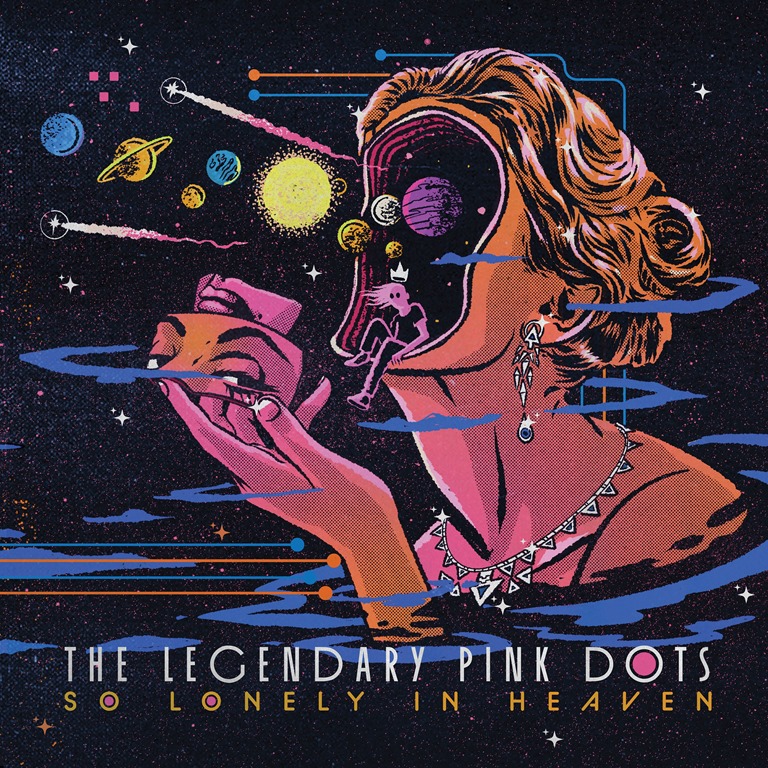
The arrival of So Lonely in Heaven marks the twenty-fifth anniversary of the existence of The Legendary Pink Dots. And it’s a concept album. Edward Ka-Spel sets it out as follows: ‘Way way back in the early days I used to say a lot about ‘The Terminal Kaleidoscope’, a concept comparing the fragile planet we live on to a drowning human being with life flashing before his or her eyes, the images constantly accelerating. It’s 2024, a little over two decades since the turn of this unbearably turbulent century and the concept appears to have become an unlikely soap opera where we are the cast.’
It’s their second post-pandemic album, and it’s weighted with a sense of impending doom and biblical destruction spun in a suitably grand fashion whereby prog meets avant-garde and electronica.
It can be a bit of a gamble opening an album with a long song – the risk being losing the listener before things have even got going. But it’s a calculated risk, on an album where most of the songs are pretty long.
Some of it’s Ka-Spel’s tone and enunciation, but the title track which is that first long song, carries hints of an electronic reimagining of Suede, circa Dog Man Star. That is to say it also sounds a bit Bowie, and a bit Kraftwek, and with some weirdly bits of glitchy noise and reverby piano, it has echoes of Outside.
Thereafter, there are big sounds and big moods and big concepts in abundance, and it’s by no means an easy album to pigeonhole. Space and environmental issues are woven through the twelve tracks, which, as I fumble for a context, evoke equally the whimsical hippy trippiness of Gong and the inventiveness of The Young Gods. ‘Choose Premium : First Prize’ delves into tense electro territory, and presents a rather harder edge than the preceding songs, and it’s here we really begin to feel the sense of the ‘machine’ which is a central focus of the album’s thematic content:
The machine is everything we are. It sees everything, hears everything, knows everything and feeds, speeds, drinks us down, spits us out – we lost control of it at the instant of its conception. You may cough, curse and die, but the machine will resurrect you without the flaws, at your peak, smiling from a screen, bidding someone in a lonely room to join you. It’s an invitation from Heaven, where anyone can be anything they want to be, but it’s a Nation of One. You’ll be everything we are. You’ll be a shadow of yourself. You’ll repeat yourself – endlessly. You’ll be desperate for some kind of explanation. You’ll be lonely. So very lonely…
This is nowhere more apparent than on the sparse, acoustic-guitar centred neofolk bleakness of ‘Wired High : Too Far To Fall’, which swells and soars and expands to immense proportions, as well as plunging to dark, sonorous depths over the course of its seven minutes. Elsewhere, ‘How Many Fingers In the Fog’ has a more post-punk feel to it, but still spun with a proggy haze, and there’s a lingering wistful melancholy which clings to it.
That there are whimsical, light-hearted moments of plinky-plonky keys and segments of So Lonely in Heaven sound more like wide-eyed stargazing in pure awe shouldn’t trick you into thinking this isn’t a serious album. The medium is the message, and entertainment is a diversion, a distraction, the ultimate lie that it’s ok to sit, sedated, and forget the world. The shit that’s gone down in America is the absolute proof of this: while everyone has been entertained by the circus, a coup has been taking place. This isn’t hyperbole, and this isn’t simply some scuffle in a small third-world republic. Meanwhile, people, especially here in the UK, are largely preoccupied with the current season of Love Island or whatever instead of trembling in fear for the future.
For all the buoyancy and quite enjoyable moments – ‘Blood Money : Transitional’ offers a quite accessible, easy groove beneath its darker surface – ‘business is business’, Ka-Spel sneers over a quite Depeche Mode-like accompaniment.
So Lonely in Heaven is varied, and sometimes sounds as if belongs to another era – but at the same time, it’s unexpectedly and shockingly relevant and now, and is well worth your time – whatever time you have left.
AA

 Aural Aggravation