Metropolis Records – 8th August 2025
Christopher Nosnibor
The singles released ahead of the album did their job, at least for me, in the way it used to happen in the pre-Internet days, when you’d hear a single or two on the radio, and you’d get hyped for the album.
Half the time, the singles were the only tracks that were any good, but the other half of the time, the singles would actually prove to be representative and stand in a solid set of songs.
In this instance, the title resonated early. Perhaps it’s an age thing. In my 30s, I witnessed many of my peers somehow pass into middle-age overnight, bemoaning that there’s no good music anymore, how things aren’t how they were when they were between the ages of 16 to 21, how everything’s shit now and the nostalgia-wallowing would grow deeper with every beer consumed. As I approach fifty, it’s only got worse: many of us have teenage kids, and many of them go on about how the music their kids listen to is shit, it’s just noise, how their kids stay in bed till lunchtime at weekends and on school holidays, and so on. It’s as if the grind of the day-job and family life has erased their memories of what it was actually like being a teenager. It’s broadly true that people become more conservative as they grow older, and, despite the vehement intentions stated in youth, they become their parents, one way or another, perpetuating the same mistakes, while blaming their parents for the fact. This is but one example of the way people do have a tendency to become the thing they hated, but one which is close to my heart.
Right now, the world is almost unrecognisable from the one I grew up in, but instead of fighting the system and pushing for positive change and a more just society, greed, division, and hate have become evermore ingrained.
They open in grand style, with a smouldering six-minute epic in the form of piano-led ‘All Tomorrows’, which builds slowly and creates an air of wistfulness, of reflection, before hitting a solid upbeat dance groove. But as it ends, tomorrow is marked by departure, ending, alone. Across the course of fourteen songs, Rotersand explore the human condition in all its complexity, all the while dusting solid dancefloor-friendly tunes with a deep melancholy, their dark electropop leaning towards more industrial dance at times, as on ‘Father Ocean’, and ‘Watch Me’ particularly mines that late 80s / early 90s Wax Trax! vibe – while the use of autotune and the overall production firmly roots it in Europop territory. Elsewhere, ‘I Will Find You’ rolls up the entirety of electropop circa 1983-85 into a magnificently crisp four and a half minutes.
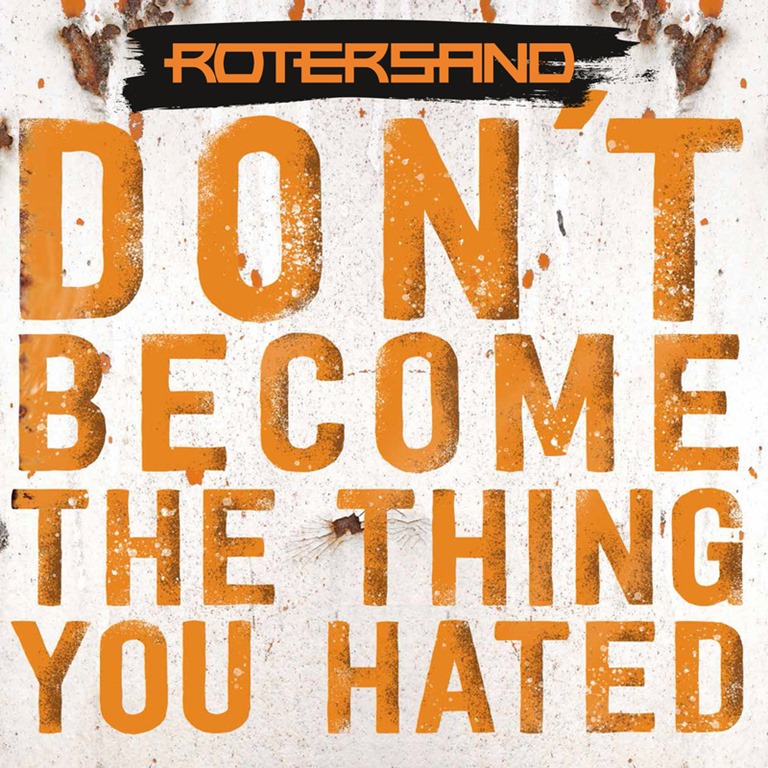
Unusually, the singles are both to be found in the second half of the album, but this is perhaps an indication of the consistency and depth of the material: while many albums suffer from a second-half slump, Don’t Become the Thing You Hated gets harder and more intense in the final third. ‘Private Firmament’ is a clear standout when it comes to dark intensity.
And so it is that Don’t Become the Thing You Hated is something of a caution, a reminder, a note to self, and it’s heavy with simmering anger – anger and twisted emotions directed in all directions, far and wide outward, and inwards, too. ‘Click Scroll tap Believe ‘ is a particularly taut listening experience and succinctly summarises life in the contemporary climate: ‘Technology the new religion / The lines between us are wearing thin’ may not be the pinnacle of poeticism, but it hits home. And that, really is the strength of Don’t Become the Thing You Hated: Rotersand zone in and hit their targets with a rare accuracy, again, and again.
AA
AA

 Aural Aggravation