Posts Tagged ‘Riot Season Records’

The differences between proper indie labels and major labels are manifold, but a key one is not professionalism, but passion. Riot Season release records for the love, not the money: they make enough to keep releasing albums, and that’s pretty much the aim. It’s by no means a capitalist endeavour. So when Andy announces the next release thus, it’s a sincere reflection of what it’s like to release an album by a band you love:

Over the years, I’ve released many a great noise rock (for want of a better term) record.

And pretty much every one of those bands have been influenced at some point by the Swedish underground legends BRAINBOMBS.

A band that thrills and disgusts in equal measure. With their bludgeoning repetitive riffs, and interesting lyrical themes, They’re pretty much held up as masters of the genre.

So, to be sat here in August 2025 announcing I’m releasing their new album on my little label is a fucking thrill. I’ve been listening to it non stop for about two solid months, and now you lot finally get to have a taste yourselves

And the press blurb is gold. Read it, and then get stuck into ‘Midnight Slaughter’ below. It’s a killer.

PRESS BLURB

The Swedish underground legends return with a brand new album.

Let this reddit user take over …

“Listening to Brainbombs has been one of my weirdest experiences with music.

Brainbombs are most definitely a band. I guess at the core they’re a hardcore punk/noise rock hybrid I guess? But… its so unlike anything I’ve ever heard and I still don’t know if its good or bad. I saw the edgelord Ed Gein album cover, and it intrigued me, so I listened to their biggest song and it was easily THE WORST thing I had EVER FUCKING HEARD. I shut it off as soon as it got to the vocals. I was shocked by the fact that it had almost a half million streams. But, a few hours later, I clicked on it again and didn’t know why.

Over the past few days, I’ve listened to all of their discography and looped a lot of it. And I don’t even think I like them. The music is abysmal, its the same single riff and verse repeating for 5 minutes. To make it worse, the vocals are just a guy with a swedish accent awkwardly talking about murder and rape. That sounds awful right? It is awful. But at the same time I want to keep listening? It’s so childishly edgy and obnoxiously repetitive but so.. intriguing? Catchy? I’m not even sure. Its one of if not the weirdest experience I’ve ever had with music and I don’t know how to feel about it.”

Anyway: this is good noise. Listen for yourself:

AA

a1584943159_10

Riot Season Records – 23rd June 2023

Christopher Nosnibor

Having had something of a chuckle at Henge for their pseudo-space mythology and psychedelic psilliness, I find myself squaring up to purveyors of genre-straddling experimental doom, Codex Serafani. Their biography explains: ‘Their journey started a long time ago, some say on Saturn, some say in the subconscious of the human psyche, coming out in different manners through the ages, channeled by mystics, witch doctors, shamans, free thinkers, free spirits. But we do know that what has become Codex Serafini travelled here from their home world on Enceladus in 2019 and crash landed into the music scene of Sussex.’ Of course they did.

But what are the chances that a I’m writing this review, an article from The Guardian pops up in my news feed reporting on how astronomers have spotted a six-thousand mile plume of water vapour blasting from Enceladus – a small moon belonging to Saturn believed to be one of the most promising places in the solar system to find life beyond Earth? As coincidences go, this was an usual one, and one which befits this band.

With a name which references Luigi Serafini’s Codex Seraphinianus, an illustrated encyclopaedia of an imaginary world, written in an imaginary language, it’s clear these guys have a keen interest in the realms of fantasy and mythology, to state it lightly.

I suppose that the concept piece whereby the concept includes the artist as much as, if not more than, the album goes back to Bowie – but back in 1972, this was new and novel, and moreover, Bowie was unique and an artist whom you could almost believe was from another planet. But even then, however much the concept became all-encompassing, it was also clear that the concept was a persona. But to base an entire career on a persona – not a media or public persona, but a far-fetched one which requires the suspension of disbelief – can be somewhat limiting. Where do you go when you’ve explored the concept to its logical limits?

In creating such a vast and multi-faceted alternative universe, Codex Serafini have ensured an abundance of time and space in which to explore and expand their concept, and rather than it being self-limiting, the challenge will be to test the capacity of their imagination, not only conceptually, but also musically.

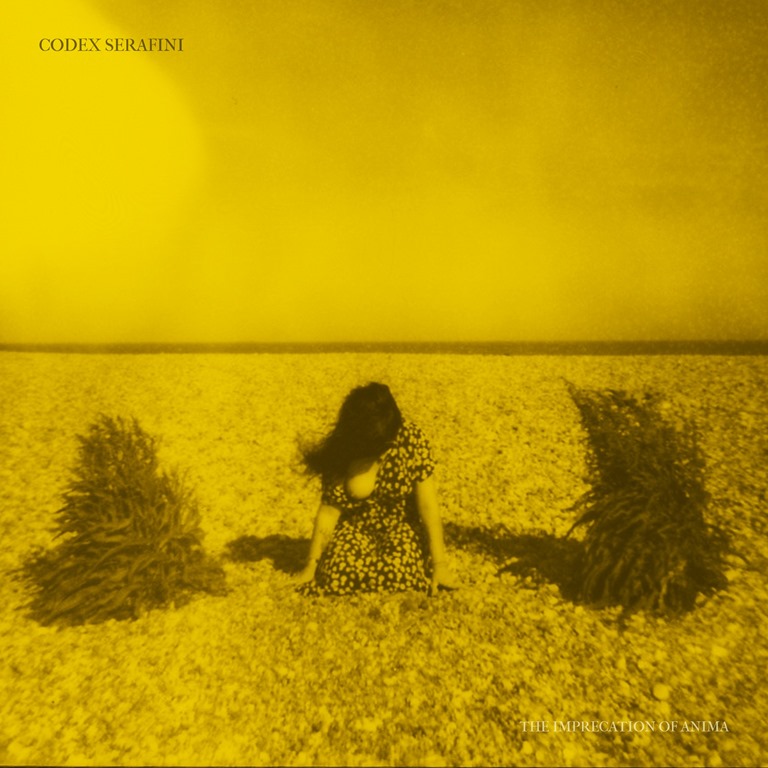
While the adage that you should never judge a book by its cover hold some merit, one can tell much about an album by the ratio of its duration to the number of tracks, and The Imprecation Of Anima has a running time in excess of forty-five minutes and contains just four tracks. We know we’re in ‘epic’ territory before hearing a note, and the first of the four compositions, ‘Manzarek’s Secret’ unfurls slowly with a long droning organ (which one suspects is no coincidental nod to The Doors) and chiming percussion. It’s not long before a thick, gritty bass and reverb-heavy vocal incantations are joined by some wild brass to burst into the first of numerous big, jazz-flavoured crescendos. At nine-and-a-half minutes long, it’s epic, but only an introduction ahead of the fifteen-minute swirling mystical monster that is ‘Mujer Espritu’, which brims with Eastern promise and sprawls in all directions at once.

Single release ‘I Am Sorrow, I Am Lust’ is perhaps the least representative song of the album as a whole: it’s snappy, exuberant, uptempo, jazzy, rocky, busy, climactic, and fairly structured – and clocking in at three minutes, it feels like a single when standing alone, but more like an aberrant interlude in context of the album ahead of the seventeen-and-a-quarter minute ‘Animus in Decay’. Now this is a wig-out! It’s heavily psychedelic and transitions through a succession of passages on the path to – what? Enlightenment? It’s certainly a journey, whichever angle you approach it from. It builds and grows in volume and tempo, then falls again and there are some expansive ponderous sections and shifts like sand dunes in a vast sonic expanse.

And so it may be that the concept is a little daft, but they deliver The Imprecation Of Anima – a work that’s as ambitious as it is immense – with absolute conviction, and the vast sound pulls you into Codex Serafini’s (other) world. Inventive and accomplished, it’s a truly mighty record.

AA

thumbnail_THE IMPRECATION OF ANIMA FRONT copy

16th April 2018 – Riot Season Records

Christopher Nosnibor

For the love, not the money, Every time. I fell out of the loop, and missed out on the promo and wasn’t even aware that one of my favourite active bands had a new album out. And that’s reason to write about it. I feel I somehow owe the band for all of the killer music so far, and owe it to myself for posterity. So, I’m playing catch-up here with the Hey Colossus offshoot, and immediately, what strikes is the grit of the guitar and the murky production that renders The Making of Junio Bonner possibly their grimiest effort to date.

It’s the combination of spindly lead guitar lines that loop over the bowel-bothering bass frequencies before dissolving into overdriven sludge, coupled with the cool-as-fuck drawling vocals that does it. And yes, it’s pure 90s grunge, with big nods to Alice in Chains and Soundgarden, but with the dingy, greasy, rough-hewn raggedness of Tad. Do I like Henry Blacker for being an allusive throwback? Inevitably, grunge is in my DNA having immersed myself in all the bands of the day in my mid-late teens in the mid-late 90s. But no: Henry Blacker don’t evoke nostalgia. However much their template may be of an era, their music is timeless. Because good music is.

Initial spins don’t reveal any instant grabs like ‘Pullin’ Like a Dray’, ‘Cold Laking’, or ‘The Grain’, but then again, it’s time spent with Henry Blacker that allows the growers to emerge: over time, their previous two albums have proved themselves to be solid gold, albeit caked in mud and shit. And perhaps the lack of standouts is an indicator of its absolute consistency: all the songs are equal, and all are equally solid. And solid is the word. The back-to-back dispatching of songs centred around cyclical grooves and relentless riffery places it in the same space occupied by Nirvana’s debut. It grafts and grinds, hawks and chisels away, snarling, spitting, raging.

‘Shingles to the Floor’ is almost an accessible rock tune when you wipe it down. The classic rock intro on ‘Cellmate’ gives way to a panelling, thick, grungy riff that hits that sweet spot of optimum density, where the guitars fill the speakers with a distortion that threatens to overload them with a fuzz that sounds like tearing cardboard while the bass isn’t something you hear but feel. The mangled vocals, half buried, are the perfect addition.

‘Keep it Out of Your Heart’ locks into a thick, stoner groove that Queens of the Stone Age would likely kill to replicate these days. It has a certain overloaded smoothness and a swagger that chugs and chunks as it drives onwards. And maybe it’s one of those tracks that grows as a standout after just a few plays after all…

The density of sound, the way the riffs churn in on themselves and repeat as they snarl and grate, all combine to build a claustrophobic intensity. There’s no room to breathe here, and there’s no slow-tempo lighter-waving anthem at the end of side one: it’s truly end-to-end in conception and delivery.

AA

Henry Blacker