Posts Tagged ‘psychological’

29th August 2025

Christopher Nosnibor

When I was a child, I used to suffer anxiety – often when I was unable to sleep (my complex relationship with insomnia began at the age of five) – that my memories were stored in the vast eighteen-volume encyclopaedia my family owned, and I would be unable to access them because I couldn’t remember which volume they were stored in. Not that it was recognised as anxiety at the time: my parents would tell me to stop padding downstairs and bothering them, and to go to sleep. There’s a (sort of) valid reason for this (the anxiety, not the parental dismissal, but that’s an essay for another time): said encyclopaedia was made up from weekly magazines string-bound in identical hardback covers – a precursor to those infinite volume magazines devoted to knitting or whatever, or where you would build a Death Star in 300 instalments, that would likely cease publication before the collection was complete – and there were issues missing, including segments of the index, and topics were not arranged alphabetically like a conventional encyclopaedia. I couldn’t even find my favourite illustrations of dinosaurs fighting a lot of the time.

Things have only become more difficult since the advent of the Internet, and while spent my youth and even my early twenties in a pre-Internet world, there are many now who have never known anything else. Kids have existed online even pre-cognisance thanks to parents posting endless pics of them growing up on social media, and YouTube and Netflix have replaced conventional TV for anyone born in the last twenty years now.

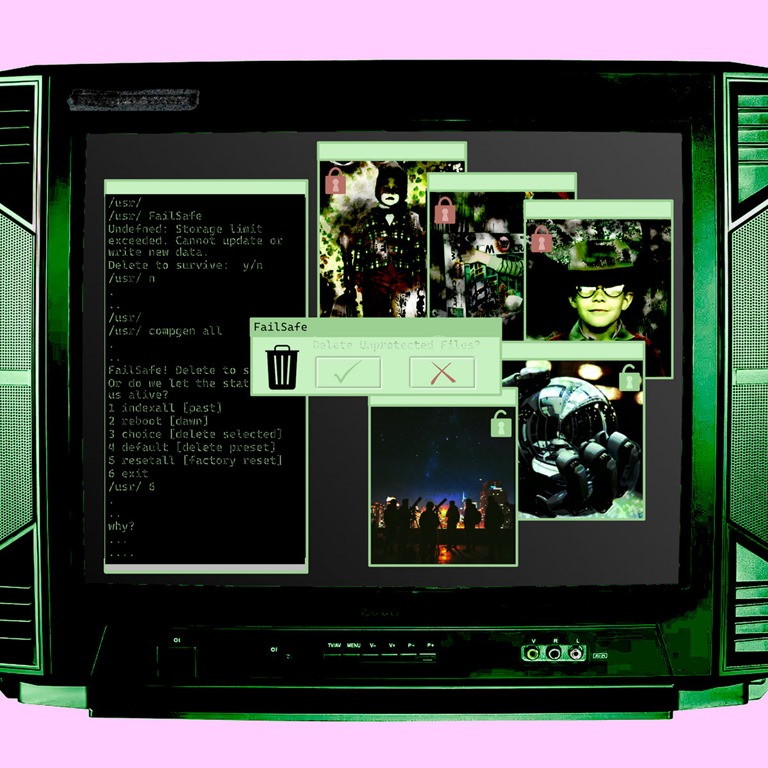
Memory, identity, and their changing nature of both under the conditions of lives lived permanently online, are primary subjects of exploration for solo artist Will N, songwriter, performer, engineer, admin, and the man behind industrial / darkwave act Solid State Sunlight. These topics provided the focus of the ExoAnthro EP last year, and ‘Failsafe’ continues that trajectory, ‘address[ing] the realization that the more we develop our own identity, the less memory remains for experiencing life moving forward. Does it delete previous memory to make space for ongoing growth? What memories are disposable? What are the consequences if it fails?’

I hadn’t considered this, or the idea of what he refers to as ‘data-poisoning’ before, having come to view the mind as a recording device, which captured and archived every single experience, every thought, e very book read, movie seen, but stored them in such a way that it accessing those archives was often a random process – Random Access Memory in the most literal sense.

But we scroll, and we scroll, and we troll, and we troll, and personalities become fragmented, real-life and online personas and experiences partitioned off from one another. Who are you? As AI takes over, the lines are becoming increasingly blurred.

‘FailSafe’ is a gnarly, glitchy technoindustrial stomp through melting circuitry that collides Depeche Mode and Nine Inch Nails with Twitch-era Ministry, with crunching beats dominating jolting electronics and raspy vocals. The intro is a grating bass throb, emerging from an abstract crackle – and then the beat kicks in. And it kicks hard.

If the autotune / robotix breakdown in the middle sounds a shade retro or corny, it works in context, reminding us of how the visions of the future portrayed not so long ago have been replaced by a truly dystopian present. The future was exciting. Computers would make life easier, give us more leisure time and infinite knowledge: that was the promise. Now look where we are. The corporate takeover of the Internet was where it all started to sour, and it was inevitable, but still somehow came as a surprise.

With ‘FailSafe’, Solid State Sunlight draw together a host of references and points of discussion, directly or otherwise, through the savvy hybrid formulation of the composition. It’s hard, and it hits with some attack. This is the vibe of the late eighties and early nineties updated to poke the paranoia of the now. We live in troublesome – by which I mean hellish, fucked-up – times, and with ‘FailSafe’, Solid State Sunlight poke that nerve.

AA
a1907026816_10

Sub Rosa – 24th May 2024

Christopher Nosnibor

Yet another 24 May release… It really does feel as if the world had conspired to release 75% of the years albums on this one day. So I’m still working my way through them. And this release from some known names is not what I was expecting. I can’t recall precisely what it was that I was expecting but certainly not anything as heavy or as percussion-led as this.

They describe SIHR as a ‘sonic manifesto by a post-anything quartet’, a work that offers up ‘new folklore for a devastated planet’. Within these words, there’s a sense of nihilism and gloom, but simultaneously an undercurrent of ‘fuck it’ and of quintessential avant-gardism, the principle ethos of creating anew only being possible from the destruction of that which came before. There’s a sense here that the destruction – the devastation of the planet – clearly isn’t something they’ve chosen, but in the face of apparent futility, they’ve come together to create, perhaps in the hope of a brave new world, or perhaps, more likely, something to be discovered among the ashes and the ruins of society and life as we know it.

The way in which they document their coming together and the creation of SIHR has all the hallmarks of the first stages of developing a mythology, which has the potential, in time, to grow its own legend: ‘The first sonic moves of this eclectic quartet, made in a bunker studio somewhere between Paris and Berlin, urgently took the form of a quest, that of a neo-folklore for troubled times, a music seeping with many kinds of atavism and experimenting in all directions. A fertile no-man’s-land where trance and contemplation, jazz and electronica, acoustics and electricity would merge in a stimulating mystical magma. From the possible emergence of a Babelian language to the shared desire to rediscover music as a ceremonial act, this encounter took place over three days of improvised sound bacchanalia, the phases of which were all recorded by Benoit Bel.’

The first track, ‘Oui-Ja’aa’ is a nine-minute colossus of a cut, drawing together elements of electronica and ‘world’ music with a dash of Krautrock and the sensibility of Suicide, with a throbbing rhythm melting into a hypnotic bubbling sonic cauldron. The tempo twists and seems to quicken as drones and jazz horns warp this way and that as if blown by the wind and everything builds to a frenzy before collapsing, exhausted in the dying moments.

While conjured in a bunker studio, SIHR sounds as if it was improvised around a fire in the middle of a desert while string out in an hallucinogenic haze. I suppose in some respects, the two scenarios bear numerous similarities in terms of their psychological effects: while one setting is a vast expanse of space with a huge sky vista and a distinct absence of other people, so the other, equally devoid of other people, forces the contemplation of the infinite realms of inner space.

‘YouGotALight’ is slow, smoking, soporific, a crawling, sprawling, mellowed-out meditation, before the glitchy whorl of bleeps and jitters that define the sound of ‘OhmShlag (Quake Tango)’ sees things take a very different trajectory at the album’s midpoint. A pulsating, seething miasma of sonic swampiness, punctuated with a metallic tin clatter of a snare that cuts through the murk, it’s like slowly sinking, not only in boggy terrain, but in a mental fog.

‘Babel Cedex’ eliminates the fog and just goes for the mental, beginning as another slow, serpentine, hypnotic exploration before building to a deranged frenzy of frenetic percussion and howling horns and chaotic discord that’s truly brain-melting. Eastern vibes and glitchtronica ripple through the woozy ‘Black Powder’, and you find yourself marvelling and utterly bewildered by the whole experience.

My earlier visions of desert campfires dissipate life vapourising mirages during the second half of the album, and I come to conclude that SIHR is indeed the sound of bunker life: one envisages the collective huddled in semi-darkness, hunched and half-crazed after months below ground in the wake of a global catastrophe, trying to keep it together in the hope of one day being able to return above ground. How will they know when it’s safe, when the coast is clear? Or is this a scenario akin to Philip K. Dick’s The Penultimate Truth?

We live in perilous times, and likely closer to the brink than any of us know or can even compute. In this context, SIHR feels like a document, and a message to future times.

AA

a0579997776_10