Posts Tagged ‘Plague Rider’

Transcending Obscurity Records – 10th November 2023

Christopher Nosnibor

Somehow, despite James Watts having about a dozen musical projects on the go, with each touring in support of recent releases in addition to running a label, Newcastle quartet Plague Rider have come together once more to record a new album. It’s been out a few weeks already, but now, in addition to the myriad packages which include all the merch bundles you could possibly want and more besides, from mugs to denim jackets, it’s available on some pretty lurid-looking coloured vinyl. One might describe the retina-singeing flame-coloured hues of the disc as intense, which is fitting, given not only the album’s title, but its contents.

All of the various outfits featuring Watts are at the noisy end of the spectrum: the man has been blessed – or cursed – with vocal chords which have the capacity to evoke the darkest, dingiest, most hellish pits of hell, and the ability to transform the least likely of objects, like radiators and so on, into ‘musical’ instruments capable of conjuring the kind of noise that would bring forth demons.

Whereas Lump Hammer are devotees of relentless, repetitive riffs, and Friend are heavy buy dynamic, Plague Rider are… Plague Rider.

This isn’t just about Watts, though: guitarist Jake Bielby is of Dybbuk, and ex-Live, Lee Anderson (no, not that one) on bass is ex-Live Burial, and ex-Horrified), as is Matthew Henderson on drums. They make for one mighty unit, who, according to the accompanying notes, exist to weave together ‘vile, repulsive, and challenging death metal music whose original influences are now twisted and decomposed beyond recognition. Sure, you can find bits and pieces here and there, traces of hair, fingernails, broken teeth fragments, but overall their music is too far gone for any obvious comparisons. And that’s only remarkable because it adds an element of uniqueness and unpredictability in their music, a rare thrill to be derived from this style these days.’

There is so much going on all at once, it’s brain-blowing. It’s not technical metal, because it’s simply too raw, to ragged, and it’s not jazz, because, well, it’s just not – but they apply the principles of jazz to extreme metal, resulting in a mess of abrasion that’s… I don’t know what. I’m left foundering for marks and measures, for adjectives and comparisons and find myself grasping at emptiness. ‘Temporal Fixation’ explodes to start the album, and within the first three minutes it feels like having done six rounds in the ring. It’s as dizzying an eight minutes as you’ll experience. When I say it’s not technical, it’s still brimming with difficult picked segments and awkward signatures – but to unpick things, the technicality is more jazz-inspired than metal, the drums switching pace and fitting all over. The vocals are low in the mix, lurching from manic frenzy to guttural growling at the crack of a snare.

And at times, those snare shots land fast and furious, but not necessarily regularly. The rhythms on this album are wild and unpredictable – but then the same is true of everything, from the instrumentation to the structures. The mania and the frenzied fury perhaps call to mind Mr Bungle and Dillinger Escape Plan, but these are approximations, at least once removed, because this is everything all at once.

It’s as gnarly as fuck, and if ‘An Executive’ is all-out death metal, it’s also heavily laced with taints of math rock, noise rock, jazz metal and grindcore. It’s a raging tempest, an explosion of blastbeats and the wildest guitar mayhem that sounds like three songs all going off at once, and that’s before you even get to the vocals, which switch between raging raw-throated ravings and growls so low as to claw at the bowels. The sinewey guitars and percussive assault of ‘Modern Serf’ are very Godflesh, but in contrast, immediately after, ‘Toil’ is rough and ragged, and dragged from the raw template of early Bathory.

The lyrics may be impossible to decipher by ear, but thanks to a lyric sheet, it’s possible to excavate a world that’s broadly relatable to the experience of life as it is: ‘Psychically exhausted / Yet still plugged in and wired’ (‘Temporal Fixation’);

‘An Executive’ nails the way corporate speak has come to dominate everyday dialogue:

‘Chant the slogans

With conviction

Doesn’t matter

What we tell them

All that is solid melts into PR’

Fuck this this shit and capitalism’s societal takeover. As if it’s not enough to dominate the means and the money, the cunts in suits are taking over the language, too. But they’re not taking over Plague Rider. No-one is touching them as they lay convention to waste with this most brutal album. ‘The Refrain’ takes the screaming noise to the next level and brings optimum metal power for almost ten minutes before, the last track, the twelve-and-a-half minute ‘Without Organs’ is grim and utterly relentless.

With Intensities, Plague Rider deliver a set that lives up to the title. It’s utterly brutal, frantically furious, and devastatingly dingy. It’s almost impossible to keep up with the rapid transitions between segments, and it’s likely many will move on swiftly because it’s simply too much. But that’s largely the point: Intensities spills the guts of dark, dirty metal. Utterly deranged, this is the best kind of nasty.

AA
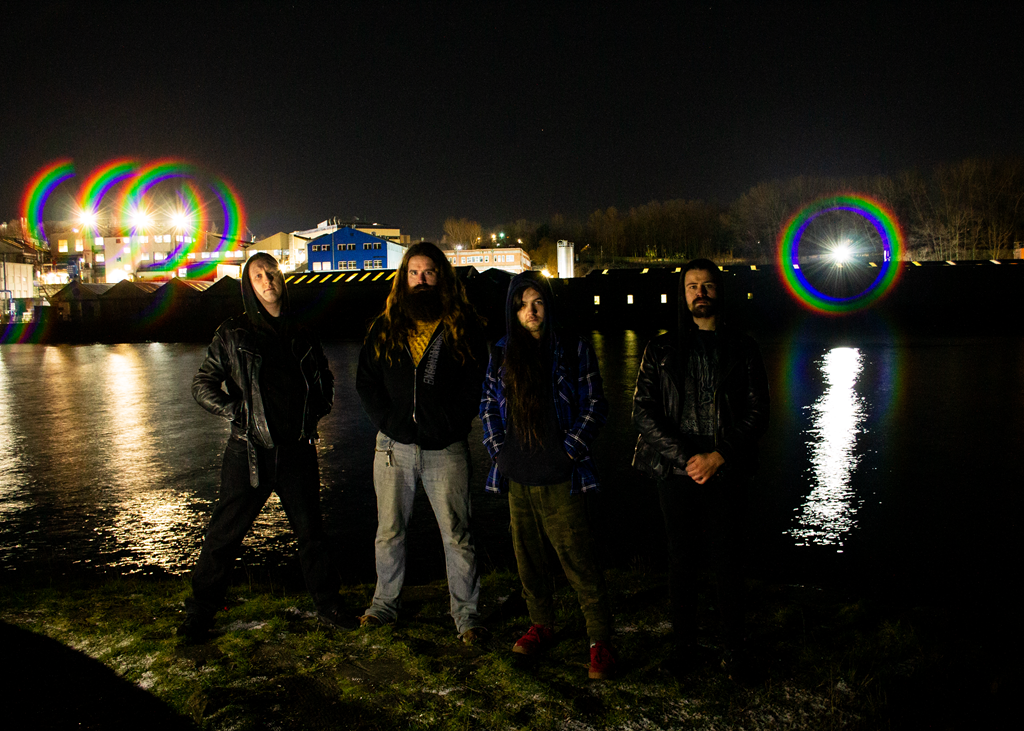
band photo

Christopher Nosnibor

Leeds’ DIY scene is becoming increasingly adept at turning poky rehearsal spaces into gig venues: it makes sense from a funding perspective, but also means that while conventional scenes are struggling to stay open for various reasons (as often redevelopment as being squeezed financially) and new and niche acts are finding it increasingly difficult to get gigs, the Leeds scene is thriving and as diverse as ever.

I’ve previously sung the praises of rehearsal-room-turned venue CHUNK, and it’s Theo Gowans, who does a lot of the stuff there, who’s behind this evening’s show. Tonight, Mabgate Beach (or Madgate Beach, as the poster has it), tucked away in a corner of an industrial estate in an obscure corner of the city plays host to a brace of Newcastle noisemongers, supported by a brace of very different local supports.

I’d been forewarned that the room was small, but that’s something of an understatement.

Intimate isn’t even close.: it’s about the size of my living room, although it’s still probably a few feet bigger than The Hovel in York’s South Bank Social, which has a capacity of maybe 16. The drum kit and back-line fill most of the room, after which we manage to pack in maybe 20. And the lighting is as minimal as the space, only less consistent.

The Truth About Frank have been knocking around for over a decade now, and Alan Edwards’ sets don’t get any more mellow over time. Kicks off the bill with a riot of samples, the set comprises a single continuous improvised soundwerk, a jarring audio cut-up through which murky beats fade in and out through an ever-shifting collage of noise, creating what cut-up originator Brion Gysin would refer to as ‘a derangement of the senses’. Playing in near-darkness with a pencil beam of light emanating from the arm of his glasses to illuminate his minimal digital kit, Edwards’ stubby nicotine-stained fingers manipulate shapes on a touch screen and jab buttons, and with each prod and poke, more strange sounds emerge, and it’s brilliantly bewildering.

DSC_3262[1]

The Truth About Frank

Things start to feel quite cramped when a full band with bass and two guitars play, and I’m less concerned about site lines for photographs than being smacked by the bassist’s headstock, meaning I’m happy to settle for the second row to observe Loro spin a set of mellow post-rock. It’s kinda standard circa 2004 fodder for the most part, but it’s nice, and with twists of mathiness and jazz without being indulgent.

DSC_3265[1]

Loro

Penance Stare prove to be an absolute revelation. Their recent recordings are a hybrid of ethereal shoegaziness with black metal production values, and while those elements are very much present here, witnessing their colossal noise in such an enclosed space is an incredibly intense experience. There’s ferocious reverb on the vocals, and murky as fuck guitar duels with thunderous drumming. The duo explore some deep, dark atmospheres, too, and coupled with Esmé’s brutal anguished shriek, there are comparisons to both Amenra and early Cranes to be drawn here. Some of the soft instrumental segments are achingly beautiful and affecting, and are invariably obliterated by devastating distortion and howling agony. This is music that reaches deep inside and leaves one feeling somehow altered.

James Watts has more bands and projects than I have albums in my review pile, and having met him and performed alongside Lump Hammer in the summer, I was keen to see how things worked with a different slant and lineup, and an absence of knitted head/face garb. Whereas Lump Hammer ae sludgy and repetitive, Plague Rider mine a seam of pounding math metal, with Watts’ vocal veering between shrieking demonic and guttural taking a shit deep grunt. And what the fuck even is his two-string instrument with some kind of touchscreen attached? In the less-than—half-light, I’m struck by how much Watts resembles a young Alan Moore. It’s so dark, I can barely see the rest of the band to know what they look like, but they relentlessly kick out juggernaut riffs that hammer hard.

DSC_3274[1]

Plague Rider

Technical difficulties struck 15 minutes in, with a power outage on the guitarist’s pedal board bringing a halt to the set, but after a brief intermission they resumed as loud and punishing as before, and then some.

In such a confined space, the effect is staggering: every beat, every chord, lands like a punch to the gut. It’s exhausting but exhilarating.

Panurus Productions – 25th January 2019

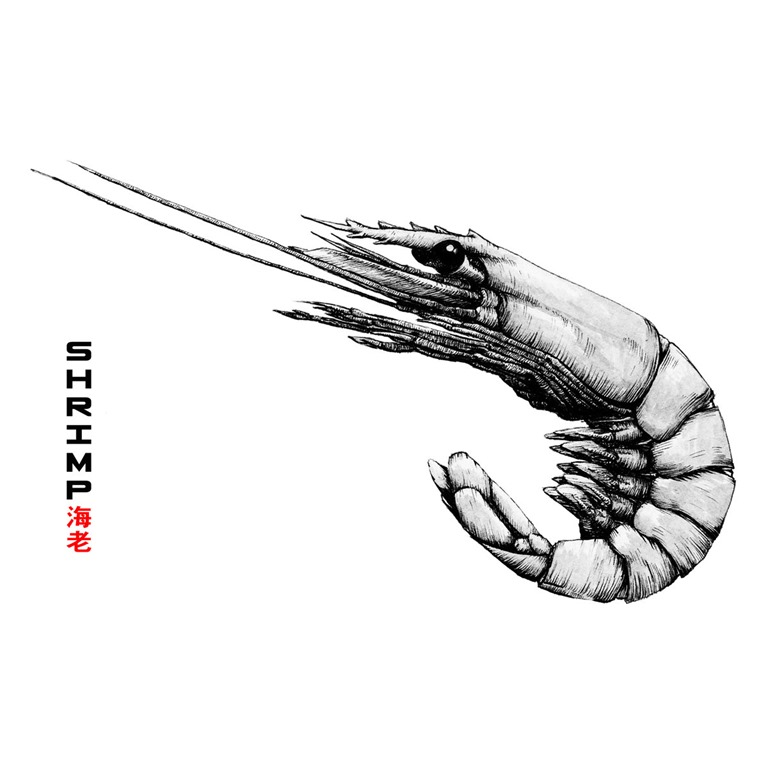
Is it a supergroup if the members of a collective all belong to acts no-one has ever heard of? Shrimp is a project which represents the coming together of Jon O’Neill (The Smokin’ Coconuts, The Shits, Skronk et al), Chris Watson (Snakes Don’t Belong in Alaska, Forest Mourning), James Watts (Plague Rider, Lovely Wife, Lump Hammer et al),Rob Woodcock (Plate Maker, Fret!) and Ryosuke Kiyasu (Sete Star Sept, Fushitsusha, Kiyasu Orchestra et al). Initially converging to perform on the bill at a Ryosuke solo show in Gateshead, this eponymous release captures the intensity of that performance in a studio setting – at least, so they claim.

Listening to this, it’s probably a claim that’s justified: it is, indeed, intense. They promise ‘a maelstrom of clanging, shrieking guitar, relentless frenetic drum savagery and inhuman vocals’, and forewarn that ‘Shrimp, in direct contrast to the weakness implied by its moniker, is the sonic equivalent of being trapped within a chitinous storm of pincers and consists of a thirty minute studio onslaught and a live recording, featuring additional electronic noise.’

Yep. It’s brutal and harsh from the outset. A cacophony of guitar feedback and whiplash explosions of extraneous noise whirl into a tempestuous frenzy around smashing percussion. The first five minutes sound like the climactic finale of something immense. And it just keeps on going from there. On and on, notes and beats and crashing cymbals flying in all directions, slowly bringing things down only to resurge and burst into a raging sonic storm once more. Deranged shrieks lie half-buried in the mix amidst all kinds of chaos that combines stoned desert rock, psychedelia and free jazz.

Twenty-two minutes in and the speakers are melting with a blistering stream of frenetic noise, formless, atonal, punishing in its complete lack of shape or musicality. After half an hour it bleeds into second piece, ‘Light as Hell’. It’s more of the same – an ear-bleeding aural tidal wave that continuously threatens to break but never does. It’s dizzying, and difficult. And yet, supergroup or not, it is definitely super, in a wild, chaotic, insane way.

Shrimp