Posts Tagged ‘odd’

Klang – 15th December 2023

Christopher Nosnibor

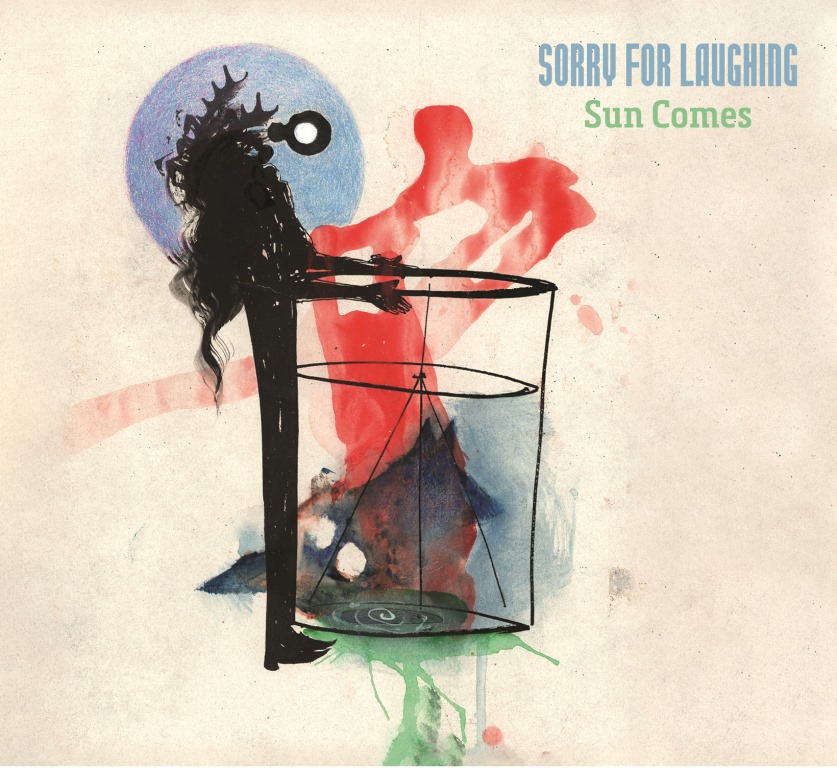
Gordon H. Whitlow has been involved in a number of group projects, perhaps most notably as a member of US avantgarde collective Biota. His first release under the Sorry for Laughing moniker was a solo cassette release back in 1986.

There have been a number of releases since then, and as we learn from the press release, recently, following a pause of some three decades, ‘Gordon reactivated the project and changed it from a solo effort into a new supergroup: it now consist of himself, Edward Ka-Spel of Legendary Pink Dots fame, and Martyn Bates of Eyeless In Gaza. Also contributing is Denver guitarist Janet Feder and the Dots’ Patrick Q-Wright.’

Sun Comes is one of those avant-garde collaborations which is certainly worthy of its contributors. Being an avant-garde collaboration, it exists beyond the realm of Spotify wrap stats, radio playlists and anything remotely ‘industry’ or otherwise concerned with commercialism or even audience. Listening to the first of the album’s four pieces, the thirty-one-minute ‘Sun Comes Suite’ is an uplifting experience, because not only is it a work that’s – in the main – melodic, musical, mellow, and soothing, as strings and electronics combine in harmonious balance, but every bar seeps a sense of pleasure from the enjoyment of simply creating. Whitlow’s vocals are understated, with what one might describe as a folksy lilt. Bold string strikes contrast with quavering mid-range drones which hover and hang. In places, otherworldly voices rise wordlessly, with ghostly moans and cries blending with ascending drama, and the sheer scale of the piece and the way it transition from one place to another is remarkable, moving from classical to shanty to film score and beyond. The transitions are often unexpected, but always seamless. This first piece feels like an album in its own right, and with so many segued segments, the listening experience is a journey which takes substantial mental energy.

‘Heart of the Matter – The Three Roses’ and ‘Adam Lay Ybounden’ are but brief interludes by comparison, running to around ten and seven minutes in duration respectively. The former marks quite a change in tone, with a cinematic string section providing a subtly dramatic backdrop to a spoken word narrative. The score veers between elevating and ominous, and it’s fitting as the accompaniment to a story that has the tone of a children’s tale but the darkness of an altogether more adult allegory, with some disturbing imagery, and the meaning of which remains somewhat obscure. The latter is folky but experimental, which makes for a rather alien experience. How does one process and compartmentalise this? We struggle with the unfamiliar, and Sun Comes is difficult because it uses many familiar elements in an unfamiliar way, often juxtaposed in a way which jars and has no immediate or obvious musical precedent.

The twelve-minute closer, ‘So, You Rest Easy’ begins ostensibly as a minimalist folk song with an almost acapella vocal, with some mangling noise twisting darkly in the background. The contrast between the warm, tuneful voice and the stark, minimal electronics are something for debate. It feels tranquil, sparse, and yet I’m left feeling uncomfortable.

There’s not much to laugh at here, but there is much to explore.

AA
gg456 Digipack

Bearsuit Records – 31st October 2023

Christopher Nosnibor

Just a little over two years since the idiosyncratically-monikered Eamon the Destroyer arrived with his debut single ‘My Drive’, he’s gone from strength to strength – to the extent that his output has erupted, Godzilla-like, expanding and flexing immense musical muscles. Sort of. Because Eamon the Destroyer’s work is, despite the connotations of a raging beast laying waste to entire civilizations with a single roar, incredibly intimate, with tension building from the introspective minimalism of the songs. With the release of the debut album A Small Blue Car and a remix / reworking of said album landing in quick succession, the arrival of We’ll be Piranhas seems swift.

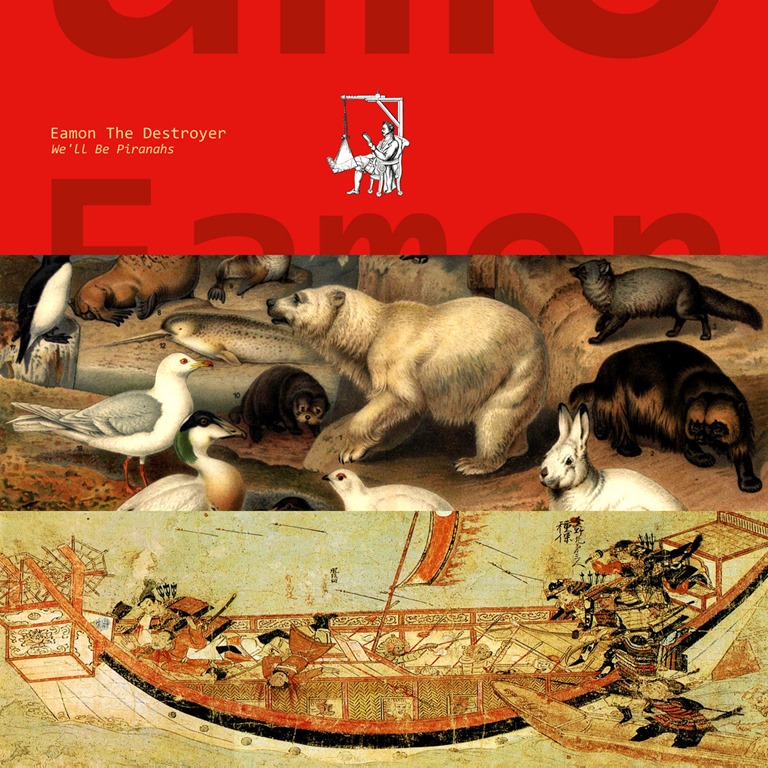
We’ll be Piranhas finds Eamon the Destroyer (any truncation of the name feels wrong: Eamon too casual and to cuddly; the Destroyer simply unrepresentative) pushing the parameters of experimentalism, conjuring the sonic equivalent of the surreal oddness of the album’s cover, which looks like a three-way split-screen of medievalism, Anglo-Saxon fable, and a deranged reimagining of some of Captain Cook’s sketches of newly-discovered species with what appears to be a polar bear resting its chin on a narwhal, while gulls look on and rabbits look away. Or something.

‘The Choirmaster’ is both droney and playful, quirky, and mellow, until it spins off its axis and into a whole other world of spiralling prog and doodling daftness. It certainly packs a lot into five strange and disorientating minutes. Single ‘Rope’ is glitchy, awkward, and feels like it doesn’t belong to anything, and suddenly, it lurches too life with a loping rhythm and fuzzy synths which provide a backdrop to tense, almost strangled vocals, hushed, strained, and gravelly. Not for the first time, I long for a lyric sheet as the scratchy vocals render the words difficult to decipher, but this is perhaps his most vitriolic piece to date; more often than not, Eamon the Destroyer croaks melancholy: here, there’s a fire, and it carried through into the wheezing clatter of ‘Sonny Said’. There’s a moment around the mid-point I get a pang of Seventeen Seconds-era Cure. But it’s fleeting, and nothing is pinpointable, particularly in this swirling maelstrom of a piece.

When it comes to Bearsuit releases, I often find myself using and reusing the word ‘weird’ as a descriptor – mostly because it’s the thing that really defines the label. While the likes of Harrold Nono spin Eastern hues into spirals and spin drifts of experimentalism, We’ll be Piranhas finds ETD really going all-out to try stuff. And the result is brain-bending.

‘Underscoring the Blues’ somehow manages to melt fairground oddness with The Doors and prog and, well, all sorts, to blur into a curious cocktail.

It’s difficult – if not impossible –to listen to this album and feel ‘normal’. It feels like the soundtrack to a dream: one of those weird dreams where familiar places aren’t quite right – the walls of familiar rooms are different, doors and windows are in the wrong place, and continually moving, and you look to make your way out and suddenly the door has vanished. The floor is moving and familiar faces warp and acquire new, alien aspects. You don’t know who you are or what’s going on, but you know that this isn’t what you expected as the sights and sounds of the familiar melt into one another. You feel your sense of time and space begin to crumble. Where am I? What even is this?

It feels like isolation. It feels like… like… like numbness, confusion. You feel your body tense, the backs of the legs growing taut. The title tracks sends everything spinning and whirling every whichway, and there is no easy way to assimilate this, and the same is true of the woozy glitchings of the desolate ‘A Call is Coming’. Ignore the call; decline it. Look inwards. Woah, something isn’t quite right.

We’ll be Piranhas leaves you feeling detached, askance, apart, removed, not quite right. It’s an introspective work delivered from on the cusp. On the cusp of what? It’s hard to say. Perhaps it’s best not to.

AA

a3572746252_10

New Reality Records – 17 October 2023

Christopher Nosnibor

Speculum Bunny’s been doing the rounds on the live circuit with New Reality Records labelmate Stewart Home of late, and while in terms of presentation they’re leagues apart, her modus operandi bears strong parallels with Home’s, not least of all the audacious piss-takery of his earlier career, which is – quite unexpectedly – experiencing something of a renaissance – she’s also a completely different animal.

Her bio outlines how ‘Having written music since she was a kitten, Speculum Bunny enjoys blending words and sound to provoke, enthral and mystify her audience. Inspired by the depraved nature of love in all of its majestic forms, her childhood, masochism and devotion. Challenging mainstream narratives on motherhood and women’s expression she blends noise, synths, voices and field recordings. She pushes her edges.’

Female voices in music – strong ones, not sonic wallpaper popmakers dollied up by record labels – may be growing in number, but they’re still few and far between in the scheme of things. It’s a sad reflection on society and the music industry, but it does mean that when someone comes along and says ‘fuck the norms’, it’s powerful, and stands out, and Speculum Bunny – an overtly challenging moniker, uses a profile pic on her Bandcamp bearing the slogan ‘I’m not cute, I’m disgusting’ (it’s the cover art from her first release in May 2023: this is her fourth). It’s clear that her objective is to provoke a real sense of discomfort, and if both her choice of name and the EP’s title work through incongruous juxtapositions of hard / soft or similar, then the four tracks contained therein are the sonic manifestations of this oppositionality.

‘Demon Boyfriend’ is built around a chubby bass groove that’s reminiscent of the early years of The Cure, and it provides the backdrop to a dark spoken word piece. ‘he’s quite old… and he’s quite hairy… and he’s got horns…’ Much of the impact / appeal lies in the delivery, of course. Flat, monotone.. and unashamedly Scottish. There’s a tinkly fairytale tone to the keyboard sounds on the lo-fi ‘Dragon of Lure and Dread’. The vocals are sung, but mumbled so as to render the words almost inaudible, and the drums are distant, a thumping heartbeat below the surface.

You can probably consider this a spoiler alert. Pretty much the last thing I expected was for ‘House of the Rising Sun’ to be a fairly straight acoustic cover, delivered in what one might – for wont of a better description – an intimate, witchy tone. As the song plays out, a double-tracked vocal gives a slightly disorientated twist. The final song, ‘There is No Ash Without Fire’ is again minimal in its arrangement, and while a bulbous Curesque bassline provides the main element of the backdrop to her haunting vocal, which soars and swoops, the atmosphere is more akin to Young Marble Giants.

Liminal Fluff doesn’t sit within any single genre pigeonhole: in fact, none of the songs really conform to any style or genre, and ultimately, it seems a fair summary of Speculum Bunny as an artist. It’s truly refreshing to discover an artist who really doesn’t sound like anyone else – and even more of a deal when what they’re doing is good. And this is good.

AA

a3042142564_10

Christopher Nosnibor

I get a lot of weird shit come my way. I guess it’s to be expected: I review a fair amount of weird shit and it just snowballs: weird shit finds me. And this is very much weird shit. Despite some serious deliberation, I can’t decide where the emphasis lies in that statement.

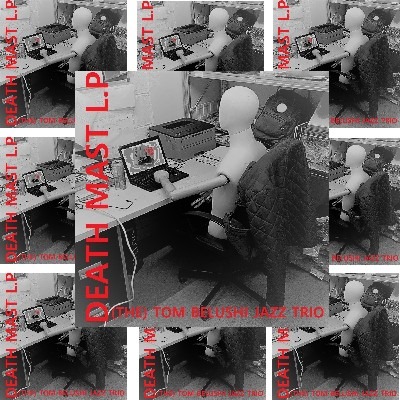
Details about the artist or the release are practically non-existent, but it doesn’t take too much digging to establish that the Tom Belushi Jazz Trio aren’t a trio and they don’t play jazz.

Having released an EP (also entitled Death Mast) and deleted it almost instantaneously, Tom Belushi Jazz Trio seem determined to render themselves as evasive frustratingly obscure as is conceivably possible. But this is clearly not simply a musical project, so much as an exercise in postmodernism that revels in ephemerality. With CD copies of this release being limited to single figures, I’m reminded of various crackers projects by Bill Drummond and The KLF, among others, whereby the objective seems to be to create an objet d’art that’s so scarce it’s beyond reach even before it’s released, essentially only existing in legend.

Slapping synths, gloopy stuttering beats, warping irregularities and groaning keys redefine the sound, along with snippets of robotic, autotuned vocals. Oriental motifs are dominant in this instrumental album’s ten exploratory tracks, which appear to be largely AI in origin. Because yes, it’s taking over the world. Think you can hide or linger on the peripheries now? You’re simply deluding yourself.

There are some nice sounds – and some naff ones – all balled together in an eclectic hotchpotch of ersatz electronic collaging. ‘Traitor’s Gate’ is a droning shanty that’s actually got human vocals; it’s woozy, disorientating in an uncanny sort of a way.

The titles are daft, absurdist, Dadaist or abstract, and littered with references, many of which are obscure – ‘Luke Haines. I Have Your Hat’; ‘No Mark Wynn’;(a particularly cheesy and overly synthetic slice of r ‘n’ b); ‘Stairwell Crooks Shutterstock Dust Jacket’ but ultimately seem to present as little true meaning as the music itself (and I can’t ever recall having experienced any dilemmas over purchasing avocados).

Death Mast is one of those albums that was probably more fun to produce thana it is to listen to. It does have considerable novelty value, and it does have lots of ideas, but few seem to be explored in any real depth or fully realised, and as such, the main idea seems to be the concept for the creative process – or should that be ‘creative’ process?- rather than the end product. But with the ideas and even the passages within the tracks being as fleeting and as ephemeral and impossible to locate as copies of the album itself, what are we really left with? Ultimately, Death Mast presents more questions than answers, a point of discussion more than a musical project. But, if there is one conclusion we can draw from this it’s that there is no need to worry that AI will bring about the end of music as we know it. At least, not this week. Welcome to the post-postmodern age.

AA

54d90880-c561-48af-aa9e-fda70c47391e_thumb_400

Bearsuit Records – 21st October 2022

Christopher Nosnibor

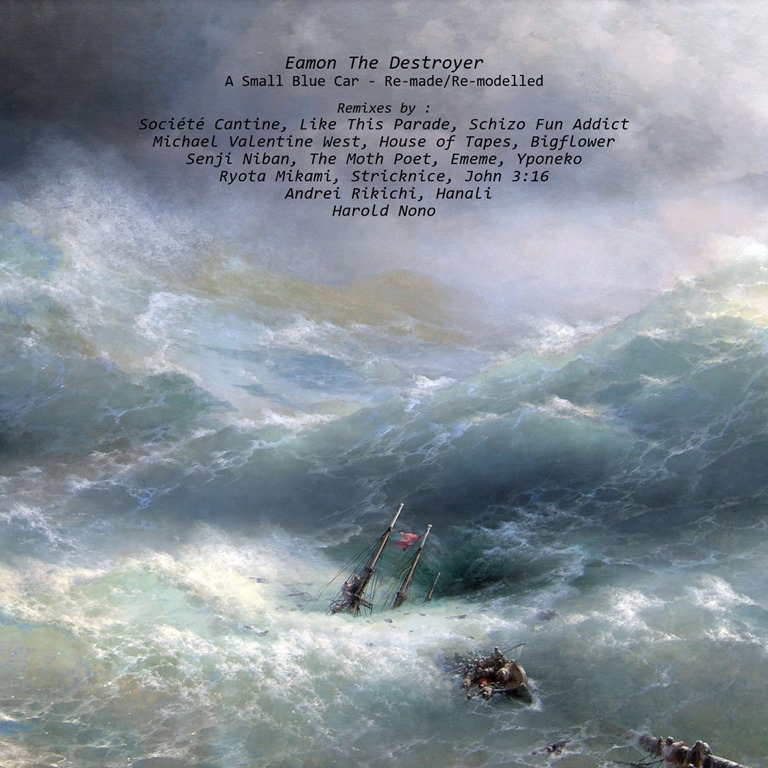
To recap on a long and often retold tale of mine: I love weird shit, but I’m not quite so mad keen on remixes – unless they’re inventive and interesting. So what to make of a remix album of Eamon the Destroyer’s A Small Blue Car?

When I reviewed the album on its release back in November of last year – which barely feels like three months ago, let Alone the best part of a year – I was perhaps ambiguous in my appreciation, describing it as ‘downbeat’, gloomy’, and ‘soporific’. It is very much all of these things, but these are reasons to appreciate this understated collection of songs, with their lo-fi bedroom production style being integral to the Eamon the Destroyer listening experience as he rasps away darkly to aa droning backdrop in a crackle of distortion

One frequent niggle with remix sets is the repetition, but here, only a handful of tracks appear twice, with three interpretations of ‘My Drive’, which is fair enough having been the lead single, and dispersed among sixteen tracks in total, it doesn’t feel like overkill.

The reimaginations of the original songs certainly capture their spirit and essence, from the stop/start glitchy gloopiness of the wandering Like this Parade remix of ‘Nothing Like Anything’ to the longer, more abstract reworkings, like the six-and-a-half-minute festival or reverb and cavernous slow-mo, downturned echo that is Société Cantine remix of ‘Tomahjawk Den’ that’s as experimental as you like and quite disturbing in places, to Michael Valentine West’s seven minute spin on ‘My Drive’, A Small Blue Car – Re-Made / Remodelled is the definition of eclecticism. There’s low-level pulsating electronica and swerves into electronic chamber pop, against ambient electro and scraping industrial noise.

Yponeko brings swirling synths and grating distortion together in a drowning space-rock drift, while MVW deconstructs ‘My Drive’ to a junkyard of spare parts that’s somehow elegant and delicate as well as a wheezing, droning hum that wheezes and groans.

There are no obvious rehashings here, no lazy no-effort remixes that do the usual thing of whacking a booming beat behind the original. In fact, there are absolutely no stonking beats, techno or disco remixes here: these are all most sensitive to the original intent. Sometimes there are beats – as on the thrumming Ememe remix of ‘Avalanche’, but it’s a stuttering wall of drilling noise, ploughing into a mess of glitching loops, a mangled cut-up collage of sound – and often there are not: The Moth Poet’s take on ‘Slow Motion Fade’ is nightmarishly dark, a whirling churn of sound, which drifts into sepulchral opera at the end

Across the course of the album, there’s a lot of cut-and-paste splicing galore, resulting in an ever-shifting sonic collage, and John 3:16 brings gloomy, stark industrial to ‘Humanity id Coming’. House of Tapes turn ‘My Drive’ into a throbbing grunge beast, with additional helium. It’s hard to imagine anything further removed from the original, and that includes Halai’s twisted tribal techno take on the same song.

Alongside one another, it should all amount to a horrible mess, but is, in fact, an absolute triumph, because this is exactly how it should be: Eamon the Destroyer’s original work was a kaleidoscope of darkly disorientating oddity, and this revisitation is more of the same, only different. It’s unlikely to land any spins in nightclubs across the land, and even less likely to find any of the tracks landing Radio 1 playlisting, and it’s even unlikely to win many new fans – but then again, Eamon’s acquired some admirably influential fans, and moreover, that’s not really the ambition for any artist releasing work through Bearsuit. And it’s so refreshing when so much emphasis is placed on not just sakes, but airplay, streams on Spotify, and likes and followers on various platforms, that there are still those who value artistic freedom and exploration above all else.

A Small Blue Car – Re-Made / Remodelled is a source of pleasure, not only because it’s genuinely interesting, but simply because it exists.

AA

a0817555736_10

After a lengthy hiatus from 2013 to making a return to the fray this summer, Benjamin Heal’s Cowman alter ego is back with a vengeance: hot on the heels of the Crunch’ EP, which was essentially the salvage from an aborted album project, we have a full-length album proper in the form of Slaughter.

The title may or may not be a fairly off-the-cuff and easy reference to its being recorded at a studio by the name of The Slaughterhouse – evidently not the one in Driffield, favoured by Earache acts back in the day, since it was destroyed by a fire in the 90s – but it equally seems appropriate to the tense, tortured atmosphere that pervades this release.

Kicking off energetically with ‘Hydrant’, this is the sound of Cowman reinvigorated. It’s still gloriously lo-fi, and still warrants Pavement comparisons I effortlessly tossed at its predecessor, but this carries the unbridled excitement of those early EPs which preceded Slanted. But moreover, it’s fuller, scuzzier, dirtier, somehow more adrenalized, and also more frenetic, more angular, as if Trumans Water had witnessed the apocalypse. In this sense, it’s very much a return to the gnarly grind of 2013’s Artificial Dissemination and Palpating the Rumen (2009).

AA

This tension carries on into ‘Rinka’, two and a quarter minutes of multi-layered mumbling vocals largely submerged beneath a hefty chug of rhythm guitar and a lead guitar that just about carries a motif, but wanders and around as if half-blinded and disoriented by a spinning compass on a map that’s missing bits.

‘Blackstock’ is a full-on wall of sound, the mangled vocals echoing impenetrably in a churning cyclical riff, and it’s not until ‘Kissing the Rock with Eyes’ that we get something approximating a groove, but even then, it’s impossible to settle into it for long. The beat may be vaguely baggy, but it’s urgent, thwacked out at a hundred miles an hour while the guitars are cracked up, overdriven and grungy. Something has happened here, and perhaps perusing the 2010 Cowvers album, which includes rough-as-fuck renditions of songs by Big Black, The Fall, yes, Trumans Water gives a clue of the roots to which Cowman is returning to here, but there’s also a newfound sense of purpose here, as if there’s a real need to channel some post-pandemic angst into big, bad, noise.

‘Itch’, clocking in at a minute and forty-one is pure Big Black, with a squall of treble-to-the-max guitar clanging over a pummelling blast of drum machine, before the dark, dank mass of the lumbering closer, ‘Wichita Black Sun’ rolls in and mines a mid-tempo motoric groove for over a quarter of an hour. The nagging monotony is integral to the experience, like a feedback-strewn reimagination of Lard’s ‘Time to Melt’ and the entire back catalogue of Terminal Cheesecake pulped into a single document.

While ‘Crunch’ was fun, Slaughter feels like the real Cowman. It’s not an easy or accessible record; in fact, it probably requires four stomachs to fully digest, but it’s a magnificent set of dingy alt-rock noise with firm roots in the early 90s, the likes of which is rare these days, yet seems fitting for these challenging times.

Listen EXCLUSIVELY to album tracks ‘’Blackstock’ and ‘Sticks, Stones, Fingers and Bones’ here:

AA

a2206602401_10

Christopher Nosnibor

Over recent months – and more – we’ve unravelled the series of releases by experimental oddballs Kröter, via their affiliation with the king of quirk, Mr Vast, formerly of cack pop maestros Wevie Stonder, aka Wevie De Crepon. You can never have too many side-projects, offshoots, and affiliated acts, and so it is that Kröter-associated Hunger give us Wollufos. (Hunger is Christoph Rothmeier & Jörg Hochapfel; Rothmeier is the other half of Kröter along with Henry Sargeant, aka Mr Vast). This is their eighth self-distributed album, and their first on vinyl.

Have you managed to keep up so far? Good, because it’s only going to get more complex and convoluted, because these guys are a prolific, self-contained community cranking out endless oddities, and Wollufos is no exception. They pitch it as ‘mixing fake folk acoustic instrumentation like banjos and open tuning guitars with Harry Partch-style homemade devices’. Fake folk?

From the springy sproingy lo-fi shuffling synth whackout of the brief intro piece that is ‘Zwergenfieber’, it’s immediately apparent that this is going to be a substantial serving of quirky, off-the-wall music that doesn’t conform to any conventions, even their own. The Berlin-based duo work across time signatures and genres at the same time, with some woozy, warpy synths and picked guitars existing in the same space but seemingly playing different songs. Then there’s the leaning towards titling their quirky, heavily rhythm-orientated instrumental ditties in French.

‘Mambo Momie’ is an exercise in bleepy motoric minimalism, and the album is brimming with minimal beats and squelchy synths, as is nowhere more apparent than on the strolling ‘Sunset Sling’. When it comes to making music with all the bells and whistles, Hunger take this quite literally: download bonus cut ‘Schuhe aus Brot’ sees them pull out all the stops to create something that borders on the overwhelming, with additional droning horn sounds and blasts of noise on top of the stuttering, clamorous percussion, before winding down to trickling chimes.

There’s some kind of half-baked wonky country / space crossover on ‘Chariot de Pipi’, and the atonal, off-key pickings of ‘Macramée Cramée’ are truly brain-bending. And then there’s the twelve-minute ‘Hundenebel’, a quivering proggy space-rock workout that makes optimal use of space and distance and of Daniel Glatzel’s clarinet to forge a vast sonic vista. Great, yawning siren wails rub against bubbling synth swells, and there are so many contrasts, to may layers, so many juxtapositions.

Why do we find discord so difficult to process? Even while I enjoy it, I find that numerous things that are seemingly disconnected or otherwise independent create something of a sensory overload that isn’t always entirely pleasurable, and can at times prove quite disorientating and uncomfortable. It messes with our orientation and equilibrium, trips our sense of balance and spins us off centre. Wollufos will leave you dizzy. At times it’s quite bewildering, but it’s never dull or lacking in inspiration.

AA

a2004897443_10

Human Worth

Christopher Nosnibor

Since their formation in 2002, Enablers have forged a career that has truly defied categorisation, and they’ve maintained a steady output, delivering eight albums – occasionally in flurries, sometimes with longer pauses between – each of which has pushed different directions and different boundaries.

But while their debut saw them showcase a sound that was different, it was their second album, released on Neurot in 2006, that really made a definitive statement that set Enablers in afield of their own creation. 2006 is now a whole terrifying fifteen years ago, and so, just as the time is right to reflect and reappraise the feat that is Output Negative Space, so the time is also right for a magnificent reissue courtesy of Human Worth. And being a Human Worth release, 10% of the proceeds plus Bandcamp cut going to charity – on this occasion, Sounds of Saving, who aim to improve mental health and reduce suicide rates by celebrating the power of human connection to music and directing people to the resources they need before it’s too late – in respect of drummer Joe Byrnes, with this release also marking the tenth anniversary of his passing.

The album features the lineup of Joe Byrnes (Drums), Pete Simonelli (Words ), Kevin Thomson (Guitar), and former Swans bassist Joe Goldring (Guitar & Hammond), and they really do cohere as a unit: the interplay between the four is outstanding; everything flows, so fluid, so natural, so intuitive. The chemistry and the electric vibe is immediate from the opening track, ‘Five O’Clock, Sundays’, which touches so many areas, crosses so many boundaries, and yet belongs to no one genre.

Simonelli’s delivery certainly isn’t rap, but then, it’s not singing either; it’s spoken word but with a sort of poetical, beat slant, with rhythm and a wonderful cadence that’s calm, even, but dynamic, too. The instrumentation is a bit jazz but it’s not jazz, it’s a bit mathy but doesn’t have quite that cutty, choppy, angularity, instead meandering and noodling, but without ever hinting at indulgence, and then there are crests and waves and low-level crescendos.

Most spoken word with backing feels very much like that – spoken word with fumbled instrumentation or otherwise awkward and juxtaposed. Not so Output Negative Space. This feels like a band, a complete collaboration, where each contributor is fully cognisant of the bigger picture, that their part is just that – a part of a whole, where nothing works unless everything works. And everything does work. There isn’t a second that doesn’t hit a sweet spot in terms of the performers coming together.

Output Negative Space is a stunning journey, and it’s wildly unpredictable. And yet it works.

There are moments when riffs break out and things get as almost conventionally rock; elsewhere, as on ‘Mediterranean’, everything happens all at once and comes in from all angles, and there really isn’t a moment that’s predictable – but at the same time, it’s not unduly jarring, and it doesn’t feel disorientating or chaotic. What it does feel is remarkably balanced; all of the elements combine to forge a real sonic synergy, and the music is so, so sympathetic and intuitive in the way it provides an understated backdrop to Simonelli’s nonchalant, world-weary vignettes, brimming with observations, details, and aa palpable sense of humanity.

Fifteen years on, it still sounds fresh, unique, and absolutely amazing.

With a small and selective roster and a keen focus on quality, Human Worth have done a super job, to, producing a limited edition run of heavyweight 180g vinyl, packaged in a gatefold sleeve which includes a hand numbered booklet featuring writings by vocalist Pete Simonelli and friends of the band remembering drummer Joey Byrnes 10 years after his passing, accompanied by rare tour photography by Owen Richards.

In all, it’s pretty special.

AA

Enablers_OutputNegativeSpace_Artwork-Front

11th May 2021

(kröter) don’t do things by halves. Back in 2018, the landed not just one album, but three, all culled from the same sessions, with two of those albums arriving simultaneously. Fifteen minutes of (kröter) can be quite the headfuck, but three hours? (kröter) are a melting-pot of madness, and how much of their derangement does anyone need?

Well, from seemingly out of nowhere, they’ve dropped a further two albums, *d and *e, again drawn from the epic sessions in 2017-18.

‘avantgarde’, the first piece on *d is typically whacky, and knows it. A picked guitar, hesitant, and sounding more like tuning up than an actual composition, is immediately obliterated with a squelchy squirt of digital diarrhoea. ‘How much water does an avocado need to grow?’ they ponder by way of an introduction to some abstract lyrical ponderances. ‘This is avantgarde’. And yes, it is: and this is also an exercise in avantgarde self-reflexivity, art reflecting on art reflecting on art.

‘soul monkey’ does have that cack pop vibe of associated act Wevie Stonder and Mr Vast’s solo works, white soul played limp and strange, before a really dingy bassline grinds in like a bulldozer and distorted vocals rant and yelp half-submerged in the mix. The ten-minute ‘flattening shades’ marks a distinct shift of style and pace, manifesting as a slow, ponderous, piece with chorus-heavy guitar and a sparse, strolling that combine to create some palpable atmosphere. Despite some odd vocal segments, there are some moments of both menace and beauty, which show that beneath all the zany shit, these guys have some real talent and ability.

Not that you’d know it from the discordant chaos of ‘lambs brain’, which is twelve minutes of demented racket and shouting, and a bunch of twanging and sampling and whatever else happens to be at hand that ended up bring tossed into the blender. Then there’s ‘tomatos’ and ‘omatose’, companion pieces that are daft, quirky interludes. Because.

The album really only has one song that’s recognisable as such, and that’s ‘up to chance’ which incorporates elements of country and prog and autotuned Radio 1 chart pop, and of course, it gets pretty weird pretty quickly.

*e, described as ‘another bucket full of toad spawn fished out of the kröters sessions’ is more of the same, only more, containing four longform tracks that showcase leanings towards more spacey-electro and jazz. Tinkling synths and a wandering horn amble all over an insistent beat that in combination provide the disjointed backdrop to monotone chanting vocals on borehole (prelude), which provides an extended introduction to another aspect of their oddball stylings. It paves the way for the twenty-minute ‘borehole (suite)’, which is both more and the same, an extended drone of froth and foam and bubbling electronics, propelled by a swampy, looping, pulsating bass. It’s certainly darker in hue, and the expansive forms only add to the bewilderment.

The hypnotic weirdness continues through the snickeringly-titled ‘glandfather’, culminating in the eighteen-minute ‘coloumns’, another off-kilter spoken word piece accompanied by minimalist instrumentation that scratches and scrapes

If some of this feels like the whacky weirdness is something they’ve worked on, it’s equally something that they feel comfortable with, as if they derive pleasure from making you feel uncomfortable. As such, while there’s a certain self-awareness about all of this, it doesn’t feel particularly contrived or forced, and we leave this duo of albums with the conclusion that this isn’t a gimmick and that these guys are genuinely fucking barmy. And we should embrace that: while people all around us are losing the plot, (kröter) celebrate the idea that plot is overrated and they never had any grasp on it to lose in the first place. At their best, (kröter) evoke some of Bauhaus’ more experimental moments,, but mostly, (kröter) just sound like (kröter), and utterly deranged. Which is all the reason to like them, even if their music isn’t for everyone.

a1761606725_10

a4069748634_10

Room40 – 11th September 2020

Christopher Nosnibor

I struggle to keep up with the influx of material I’m sent for review, and have done for at least the last 8 years, which may or may not be coincidental with a) becoming a parent b) rapidly developing a massive network or PR and band contacts. It turns out that there comes a point when you don’t need to ask to be added to mailing lists, and people just find you. Anyway. Sometimes I just struggle, but that’s a whole other matter.

Apparition Paintings is a collection of oddly disjointed compositions that alternately soothe and trip the listener, moving between mellow melodies and rippling calmness – ‘All I Desire’ is a slow melt of chillwave, electronic post-rock and Disintegration-era Cure – and eerie weirdness – ‘When I first came here (I thought I’d never get used to the trains; now when it’s quiet I get nervous)’ is part chamber-pop, part deranged spookiness. None of this sits comfortably, in any context, and the deeper one delves into the eerie collage work that is Apparition Paintings, the more unsettling it becomes.

Toop’s notes which accompany the release are as disjointed and confounding as the music they accompany: ‘Don’t ask me about genre or consistency. Who cares? Half the world is drowning; the other half is in flames. Each story is an animal, a plant, something you drink, a surface you touch, a faint line, some memory emanating from a cardboard box. “’Things’ in themselves are only events that for a while are monotonous,” wrote Carlo Rovelli in The Order of Time. Maybe sounds are melting ‘things’, tired of the monotonous real.’

Yet on a certain level it makes sense. In a post-Covid world. The monotonous real is the lived experience of the everyday for many – not that it wasn’t before, but now, without the commute, without being in proximity to the volatile colleague, the explosive tension or the whatever, the monotonous real is confined to the household and to within the head. It may not be immediately apparent, but Apparition Paintings is a sort of inside soundtrack of the now, with extraneous and unexpected noises pinging back and firth across the main sonic backdrops to each piece.

‘She fell asleep somewhere outside the world’ finds a disembodied female voice singing a quavering melody, hesitantly. It’s a popular trope, but the deranged, childlike singing against a spooky backdrop is an effective trigger for cognitive dissonance. Apparition Paintings is an album that very much speaks to the sounds of the interior.

AA

a2399192845_10