Posts Tagged ‘Leah Buckareff’

Midira Records / Cruel Nature Records – 24th October 2025

Christopher Nosnibor

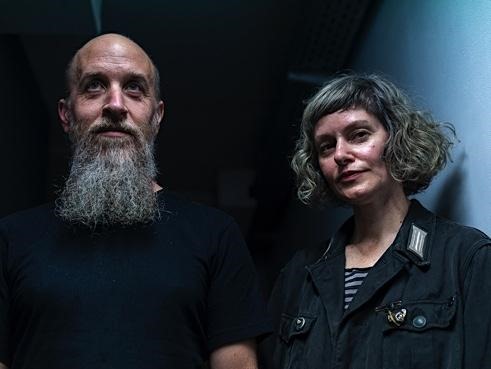
A new Nadja release is always cause for a pique of interest. Excitement doesn’t feel like quite the right term for an act who create such dense, dark, brooding soundscapes. Centred around the duo of Leah Buckareff and Aidan Baker, each release marks a shift thanks to the contribution of a range of guest performers, and cut is no exception – and this time, following the instrumental epic that was Labyrinthine (2022) – we have vocals, from not just Baker and Buckareff, but also Tristen Bakker, Oskar Bakker-Blair and Lane Shi Otayonii, among others. They certainly bring a lot of guests to a party which features just four tracks. But that is ’just’ four tracks which each occupy an entire side of vinyl on a double LP. As with Labyrinthine, these are compositions which span ten to sixteen minutes, and utilise that timeframe to maximum effect. They don’t hurry things, with slow, tapering drones interweaving, the emphasis on the atmosphere and the detail over the impact. And yet, despite this, or even perhaps because of this, the impact is strong, albeit in more subtle ways.

Their comments on the album are illuminating, explaining that ‘Thematically, cut explores trauma and physio-/psychological stress, as well as possible tools and means of overcoming these stressors, of which the music itself (sonic sublimation) might be one… Musically, while Nadja retains their signature wall-of-noise doomgaze sound, they also explore quieter, more introspective moments as well as new/different instrumentation, with harp, French horn, and saxophone featuring for the first time on one of the band’s recordings’.

‘It’s Cold When You Cut Me’ is stark, bleak, minimal. The air feels dead, it’s suffocating. The sparse percussion rattles along, but the drones are glacial. Five minutes in, rumbling bass and heavy beats roll in, and by the mid-point there are crushing waves of lugubrious noise worthy of Swans, but overlaid with trilling brass and woodwind, jazz in slow-mo, the honk of migrating birds and trilling abstraction.

But this is just a gentle introduction ahead of the thunderous grind of ‘Dark, No Knowledge’, which begins with atmospheric whirlings and even hints of Eastern esotericism, voices rising in the distance, atop wisps and rumbles, echoes and murmurings, before the dense, sludgy, post everything doom drone cascades in like a mudslide. It’s low and it’s slow, crawling like larva. buzzes and rumbles sustain for an eternity. You can actually feel your stomach drop in response to the bass frequencies.

The sound seems to get thicker and murkier as the album progresses, and if ‘She Ate His Dreams From the Inside & Spat Out The Frozen Fucking Bones’ isn’t nearly as abrasive as the title may suggest, its slow repetitious form is truly hypnotic as it trudges its way along.it possesses a rare density which matches its delicacy, and comparisons to latter-day Swans stand in terms of positioning the piece. There are thick, distorted tones grinding like earthworks through the airier overtones, and the contrast brings something magical and soothing. Then ‘Omenformation’ crashes in like a tsunami. The volume leaps, the density leaps, and you find yourself blown away by a sonic force strong enough to knock the air out of your lungs. The dingy, booming bass alone is enough to send you to the ground. The drums are immense. In fact, everything about this is almost inarticulable, as Nadja scale up the sound to beyond that of mere mortal beings. This is music with a physical force and a power beyond words, beyond contrivance. It’s archaic, occult, primal in its power. This is a track which treads through a series of movements, the last of which is crushing in its weight.

It’s true that cut possesses all of the sounds which are recognisable as being concomitant with Nadja’s distinctive dense, doomgaze stylings, and a lot of the vocals are as much additional layers rather than clearly enunciated words, and as such, add further depth – and a certain human aspect to the overall sound. The result is a work which speaks to that level of the psyche beyond words, which conveys trauma and physio-/psychological stress, and which offers a degree of relief through an experience which is wholly immersive and immensely powerful.

AA

a1598661613_10

Nadja2025

Photo: Hugues de Castillo

Cruel Nature Records – 6th September 2022

Christopher Nosnibor

These are interesting times for Nadja, the ‘ambient / experimental / doom metal’ duo comprising Leah Buckareff and Aidan Baker. Luminous Rot was recorded during lockdown, and found a home on the legendary Southern Lord label. Released in the spring of 2021, it’s a veritable beast of a work, which combined metal with post-punk, cold-wave, shoegaze, and industrial.

Lockdown feels like something of not so much a distant memory as an unreality, and if by May 2021 it felt like life was returning to normal, the truth is that the wounds were still raw, and any attempt to move on as if life was back as it was before was simply a wilful act of delusion to stave off the effects of the trauma.

And with every trauma, there is some residual hangover, and you might say that Labyrinthine is the product of that. As the accompanying notes detail, the material was recorded during the pandemic and concurrently with Luminous Rot, and ‘explores themes of identity and loss, monstrosity and regret, extreme aesceticism, the differences between labyrinthes and mazes, taking inspiration from Haruki Murakami’s Killing Commendatore, Ursula K. LeGuin’s The Tombs of Atuan, and Victor Pelevin’s reinterpretation of the story of the minotaur and Ariadne, The Helmet of Horror.’

When a band chooses to self-release an album, it’s no longer an indication that it’s substandard or not worthy of a label release, and the case here is that Labyrinthine, which ‘this might be Nadja’s heaviest, doomiest album to date’, it’s clear that rather than consisting of session offcuts, it stands alone as a separate project from Luminous Rot, featuring as it does, a different guest vocalist on each track, and it’s worth listing them here:

Alan Dubin – legendary American vocalist from O.L.D. and Khanate and, currently, Gnaw

Rachel Davies – vocalist and bassist from the British band, Esben & The Witch

Lane Shi Otayanii – is a Chinese multi-media artist and vocalist in Elizabeth Colour Wheel

Dylan Walker – American vocalist from grindcore/noise band Full of Hell

With such a roll-call of contributors, it’s in no way possible to fee short-changed by the fact there are only four tracks, and ‘only’ is somewhat redundant when the shortest of these is almost thirteen minutes in duration. This is an album alright, and it’s an absolute fucking monster at that.

And while the CD release is on the band’s own label, Broken Spine, there are limited cassette versions by several different indie labels from around the world: Katuktu Collective (US), Cruel Nature Recordings (UK), Bad Moon Rising (Taiwan), Adagio830 (Germany), Muzan Editions (Japan), WV Sorcerer (France/China), Pale Ghoul (Australia), and UR Audio Visual (Canada) – and it’s perhaps noting that the running order differs between formats,  and I’m going by the Cruel Nature tape sequence here rather than the CD. It may be more intuitive from a listening perspective, but limitations off format and all…

This co-operative approach to releasing music is highly commendable, and seems to offer solutions to numerous problems, not least of all surrounding distribution in the post-pandemic, post-Brexit era where everything seems on the face of it to be fucked for any band not on a major label with global distribution and access to pressing plants and warehouses worldwide.

The title track is a lugubrious droning crawl: imagine Sunn O))) with drums crashing a beat every twenty seconds in time with each pulverising power chord that vibrates your very lungs. And those beats are muffled, murky, and everything hits with a rib-crushing density, that’s only intensified by the squawking, anguished vocals that shred a blasted treble in contrast to the thick billows of booming bass sludge, and it’s a truly purgatorial experience.

And then, here it comes, and it all comes crashing down hard over the course of the most punishing nineteen minutes in the shape of the brutal behemoth that is ‘Necroausterity’. In a sense, the title speaks for itself in context of a world in lockdown, and it’s sometimes easy to forget just what terrifying times we endured, watching news reports of bodies piling up in New York and elsewhere while governments and news agencies fed a constant stream of statistics around cases and deaths. It felt truly apocalyptic. And ‘Necroausterity’ is the sound of the apocalypse, tuned up to eleven and slowed to a crawl, the writhing torture of a slow, suffocating death soundtracked by guitar and drums do dense and dark as so feel like a bag over the head and a tightening grip on the throat. The recording is overloaded, distorting, and it’s a simply excruciating experience. And it simply goes on, chord after chord, bar after bar, slugging away… and on in a fashion that makes SWANS feel lightweight in comparison. It’s relentless, unforgiving, brutal, and punishing.

‘Rue’ broods hard with dark, thick strings and a heavy atmosphere, but it’s light in comparison. It’s dense, and weighty, but Rachel Davies’ ethereal vocal drifts gloriously within the claustrophobic confines and conjures another level of melody that transforms the thick, sluggish drones into something altogether more enchanting. It builds to a throbbing crescendo that is – perhaps not entirely surprisingly – reminiscent of Esben And the Witch or Big | Brave.

Wolves howl into the groaning drone of ‘Blurred’ and the guitars slowly simmer and burn: no notes, just an endless am-bleeding distortion before the power chords crash in and drive hard, so low and slow and heavy so as to shift tectonic plates and shatter mountains. Amidst the raging tempest, Lane Shi Otayanii brings an otherworldly aspect that transcends mere words, making for a listening experience with a different kind of intensity as it trudges and churns fir what feels like a magical eternity.

The sum total is the sound of hellish desperation, and while Labyrinthine may offer absolutely no solace in the bleakest pits of deathly despair, you’ll be hard-pressed to find an album that better articulates perpetual pain and anguish better than this.

AA

cover