Posts Tagged ‘Khanate’

Portraits – 27th June 2025

Christopher Nosnibor

Stephen O’Maley will be forever synonymous with Sunn O))). However fervently fans revere Khanate, whatever the reputation of Burning Witch or KTL, however many solo albums he releases, and regardless of the outstanding work Ideologic Organ presets to the world, none of it will ever come close to the success of Sunn O))), which will eclipse anything and everything else he is involved ion for all eternity. It’s not difficult to grasp the reasons for this. It likely quite frustrating, but that band have elevated a niche not-really-a-genre to stratospheric levels, and have achieved more with a single, sustained chord than most could ever dream of.

When I saw him perform solo some years ago, he appeared quite comfortable with this, playing – just off stage – through a backline that was so immense it wouldn’t quite fit onto the stage of the 450-capacity Brudenell in Leeds. Better to have a reputation to play up to than not, and since bowel-churning guitar drone played at eardrum-shredding volume is what people want, delivering it seems like a fair trade.

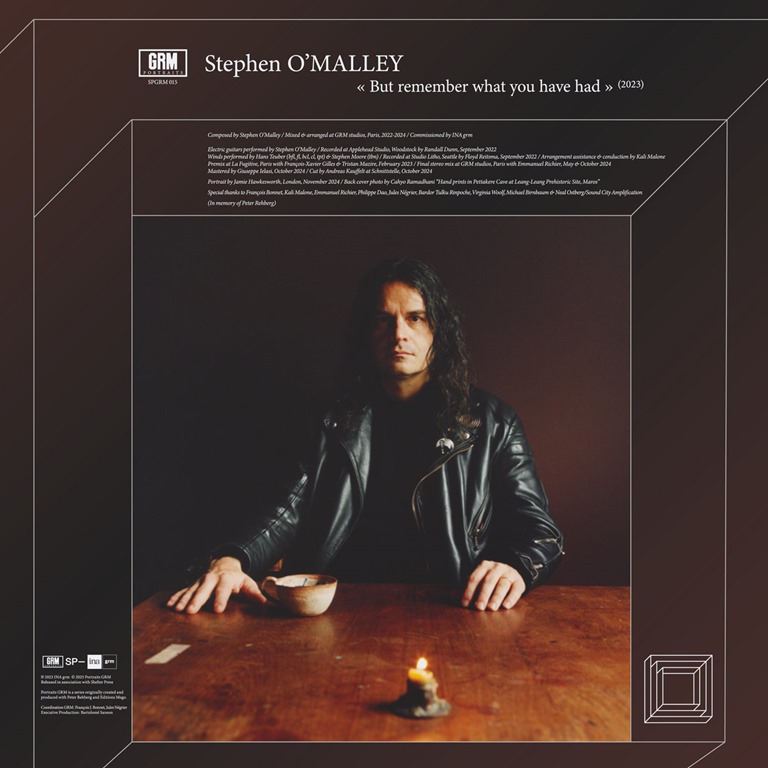
The blurb for his latest solo release suggests, however, something a shift, but by no means a departure, writing that ‘With But remember what you have had, Stephen O’Malley continues and expands his musical approach by transposing it to multiphonic electroacoustic writing and acousmatic listening. Drawing not only on his extensive experience as a composer and live instrumentalist, but also on the countless studio production and mixing sessions he has taken part in the course of his many projects (in solo, with SUNN O))) or KTL, to name but a few), Stephen O’Malley’s work on this new piece is ambitious, engaging in an inspired research that delves into the deep intricacies between polyphony, intonation and timbrality, enhanced by melodic motifs. To do this, O’Malley summons up his own very personal sound universe, constellated with amplified textures, instrumental sustained tones and raw energy, in order to diffract them into wavefronts, waves and blows that weave a complex, rich and fascinating matter. But remember what you have had stands out as an important work in Stephen O’Malley’s repertoire: it brings together the multiplicity of his musical approach in an exemplary way, while laying the foundations and promises for the future of an already extraordinary journey.’

But remember what you have had is a single, continuous piece, just over thirty minutes in duration. It begins with a parping drone that sounds somewhat like a didgeridoo. It lingers, resurging, cyclical hums and layers of sound and texture build atop of one another… and then what the fuck’s this? Bagpipes? It sounds like bagpipes. But then, it also sounds like guitar feedback and a single chord being struck and resonating for an eternity. And then another chord crashes like a giant Wave breaking over rocks at high tide with a stormy wind behind it.

Whereas the overall pitch and tone of the Sunn O))) sound is low and growling, But remember what you have had altogether more keenly favours the mid and upper ranges, and howls of feedback while whining engines fill the air as it heats up. There’s more discord as the sounds bounce off one another. It’s an exploration of the interaction between notes and frequencies, conducted in a way which can only happen at volume,

By the midpoint, the feedbacks are interweaving in such a way to form a huge reverberating howling drone, which in some respects shares common ground with Metal Machine Music, and it would be difficult – and inappropriate – to completely sidestep Earth 2 here, too. By twenty-minutes, O’Malley conjures an immense collision of sound, jousting and jostling amidst a sonic tempest, before gradually diminishing to a point of tranquillity which is more reminiscent of a string quartet than experimental wave of noise. It makes for an unexpectedly soothing finish, but once again shows the range of O’Malley’s musicianship, as well the breadth of his sonic interests, which extend far beyond all-out weight and sheer volume.

AA

AA
a3988746175_10

Sacred Bones – 1st December 2023

Christopher Nosnibor

Released simultaneously with the reissue of their eponymous debut, Khanate’s second album originally released in 2003 – which is, incomprehensibly, 20 years ago further evidences just how far out they were at the time. And the time is worth assessing: in 2003, Nu-Metal was in its final throes, and Post-Rock was in the early arc of its ascendency. It was something of a wilderness time in many respects, with no real dominant trend: it was the year Avril Lavigne and Evanescence broke and Muse exploded, amidst an ocean of limp indie and even shitter commercial pop and r’n’b. The underground was the only place of interest, but even in those underground circles, there wasn’t anything quite like this.

The bio accompanying the release points us toward the darkness that pervades the album and does so from the start: ‘“Pieces of us in my hands, on the floor, in my pockets/red glory,” Dubin howls on opener ‘Commuted,’ setting the stage for Khanate’s second installment of existential dread. Dripping in death, murder and desperation, the album is somehow less forgiving than its predecessor. Which was probably the point”.

On this outing, they really do seem to have gone all-out to engineer an album that’s as stark and brutal as is possible, and the four tracks are drawn out to torturous lengths to achieve maximum discomfort. The aforementioned opener, ‘Commuted,’ is over nineteen minutes long, and the instrumentation is sparse, minimal and heavy with lugubrious atmosphere, while Alan Dubin howls like he’s having his fingernails pulled out slowly and painfully, one by one. It’s as bleak and harrowing as one of Derek Raymon’s ‘Factory’ series novels. It’s not pleasant, not even slightly, it’s not even enjoyable, but it’s perversely compelling. When a rhythm and guitars do coalesce, it’s at a glacial BPM, the kind of crushing, feedback-strewn, bludgeoning grind of Swans around the time of Cop, but with the more paired-back, spacious sound of Greed and Holy Money. But Khanate didn’t simply take these as templates – they scrawled all over them and then trampled on them in order to forge something even more challenging and even more fucked-up. There are lengthy passages where there is little more than crackle and hum, and the occasional burst of percussion. It may employ the tropes of avant-garde jazz, but it ain’t jazz. But what it is is hard to define. It’s not industrial, and it’s not doom. It’s not really metal in any recognisable form. But it is heavy. And it is unsettling, harrowing, and an absolute endurance test.

By the end of ‘Commuted,’ you feel utterly beaten and find yourself wilting from the sheer brutality of it all. And then ‘Fields’ crawls in, lower and slower, taking obvious cues from Earth 2 and marking clear parallels with Sunn O))). This is sinister, chthonic, demonic, not so much other-worldly as nether-worldly. It’s almost ten minutes before the bowel-juddering billows of overdriven, low-tuned guitar slides in like a slow-crawling river of lava. It’s monstrous, ugly, explicitly outright horrible. The hovering hum that takes hold around the fifteen-minute mark isn’t in any way a calming pause, but a nuclear wasteland of tension that pressurises the skull. Dubin raves maniacally like a psychotic locked in a soundproofed cell, and there’s a sense that the whole of Things Viral is a prison, whereby the listener is trapped within walls of sound. ‘I did this for you’, he screams murderously. It doesn’t sound like a kind favour, but like it’s time for payback. It’s chilling and grotesque. This is a fair summary of Things Viral overall. Even the quiet segments – and there are many – are occupied by sections of such weight that make your body feel as if its being dragged down, not by gravity, but by a darker force, one which will suck your very soul.

‘Dead’, at ten minutes, is but an interlude, but it radiates serial killer raving lunatic mania vibes for its entire duration, as the guitars throb and burn. It’s messy, and so, so heavy: you feel the pressure in your ribs, a weight in your limbs. The final track, ‘Too Close Enough To Touch’ is an absolute monster, which sits more closely alongside the harsh noise and overt extremism of Whitehouse and the point at which industrial strains its mangled way into power electronics than anything even remotely metal. ‘Stay inside… stay inside’ Dubin snarls, his vocals distorted and crazed. You barely dare move a muscle, let alone leave the house.

Things Viral goes way beyond darkness, and plunges into purgatorial depths that would have terrified Milton, and 20 years on, still sounds like the dankest, nastiest thing you could hear in any given year.

AA

a2725064236_10

Sacred Bones – 1st December 2023

Christopher Nosnibor

The unexpected and unannounced arrival of Khanate’s fifth album, some seventeen years after they declared that they were calling it a day, and fourteen years after the release of the posthumous Clean Hands Go Foul caused quite a stir in certain circles – predominantly those occupied by black-clad beard-strokers. Although this is very much a stereotype, I’m reminded of the time I went to see Sunn O))) at The Sage in Gateshead on the same night one of Cheryl Cole’s X-Factor protégé’s was performing in the foyer of the three-stage venue. Incongruous doesn’t come close, and suffice it to say, I wasn’t hard to tell who was there for the ultimate lords of drone-doom and who was there for the cheesy mass-market commercial cash-in shit. There were a lot of beards and leather coats.

The reason Khanate are such big news on the underground is that the band is comprised of James Plotkin, Stephen O’Malley, Alan Dubin and Tim Wyskida, and according to their bio, ‘Together, they make terrifying music.’ Between their formation in 2001 and separation in 2006, they managed to find time out from their main projects to record four monumental albums, and the release of To Be Cruel earlier this year came with the announcement of the reissue of all four, both digitally and physically. And so this brings us to the first of these, their eponymous debut.

The press release sets the expectation, for those unacquainted or unfamiliar, telling of how ‘The cramped corner of hell that Khanate takes the listener to, sonically and psychologically, has almost nothing in common with the doom bands that populate stoner-oriented music festivals across the globe. Khanate is doom as a foregone conclusion, as merciless atmospheric pressure, as a blunt object to crack you over the skull with, slowly, repeatedly, and forever.’

Having only released some demos and their debut ØØ Void, Sunn O))) had yet to really break by the time Khanate came out, and in some ways, they beat Sunn O))) to the mark on launching blasting longform drone to the masses, with an album that featured just five tracks spanning a fill hour. And their colossally expansive duration is matched every inch of the way by the sonic brutality.

The album arrives in a squall of feedback before intestine-crushing low-end chords crash in and grind hard, immediately unsettling the lower colon. Thew gnarliest, most demonic vocals shriek amidst the raging infernal wall of noise, dredged from the molten mantel of deep down below. ‘Pieces of Quiet’ is punishing in every way, but not least in that while its devastating, annihilative work is done after about five minutes, it pounds and grinds on well past the thirteen-minute mark.

In context, doom and drone had both crawled out of the depths a good few years before, and with Earth 2: Special Low Frequency Version in 1993, Earth had defined a new form of metal with what will likely stand for all eternity as the ultimate heavy drone work. And yet, these guys believed they could add something further to this – and they were right. Drums, for a start. And vocals.

‘Skin Coat’ is every bit as nasty as the serial killer enthusiast title implies, the guitars mangled to fuck, combining to optimal effect the snarling nastiness of the most blackened of black metal and the sludgiest, most gut-churning doom, with 23bpm drum crashes at the crawling pace of Cop-era Swans. It’s dark and its overtly unpleasant, snarling subterranean oozing tar-thick blackness which crawls like larva and destroys everything in its wake.

‘Torching Koroviev’ is simply a brief interlude which fleetingly opens a portal into hell, before the eighteen-minute ‘Under Rotting Sky’ brings what is arguably the definitive representation of Khanate, again, a squall of feedback prefacing a shredding wall of downtuned and overdriven guitar, billowing and thick with a sludge-like density. It is, of course, an absolute copy of the Sunn O))) model, but with demonic vocals echoing, anguished and wracked with eternal pain through the crushing mesh of noise. It’s fearsome, deranged, the crazed vocal screaming into the abyss. There is no rational or clear way of exploring this: it’s scary, and there is no other way to look. This is the final pulverisation, pacing the way for the album’s brutally dark last track. ‘No Joy’ is appropriately titled, and as heavy as it gets. I crawl, cracked, from the crushing drone experience and as long an hour as nature evaporates from my weary body Slowly the lack-hole darkness takes its grip and begins to crush the very life from my limbs.

This album is twenty-two years old. Yes: twenty-two years. And yet it hasn’t aged a day or even a second. While so much music – particularly rock and metal – has aged and sounds of its time, Khanate froze time when they came together, and the result was like nothing else – and still stands to this day.

AA

a0016720513_10

Khanate, who recently ended their fourteen year hiatus with the surprise release of To Be Cruel (Sacred Bones Records), have debuted an experimental short visual for ‘Like A Poisoned Dog’, bringing the Karl Lemieux-created album art to life.

“These stills are abstract but depending on the context, they become objects and objective. And alongside Khanate, they have this strange organic feeling,” Stephen O’Malley notes. “They’re abstract, hand-painted film stills, not photos of organic objects or something, which I think is really interesting because it’s similar to our music. We put a frame around the music with a concept and it presents something, but otherwise, it’s abstract. This lined up very well with Karl’s work.”

“In addition to my other film work, I like to work with camera-less film techniques and paint directly on 16mm film,” explains Lemieux, whose resume includes films, installations and performances that have screened at a variety of venues including the Montreal Contemporary Arts Museum, MOMA San Francisco, as well as over a decade of collaborative work with Godspeed You! Black Emperor. “In 2021, Stephen asked if he could use some of those images for the new Khanate record. I’m someone who spends a lot of time flipping through the artwork of records, CDs, and cassettes…. It’s part of my listening ritual. I have always loved Stephen’s record design work and I was very excited about this collaboration and the way it all came out. The idea for a video came later. It’s not a film, it’s not a music video, but some kind of collision between an excerpt from the piece ‘Like A Poisoned Dog’ and the raw material that I used to make still images.”

Watch the video here:

AA

42TFpsUg

Sacred Bones – 19th May 2023

Christopher Nosnibor

It’s been fourteen years since there was new music from Khanate, the experimental doom outfit featuring members of Sunn O))), OLD, and Blind Idiot God. It’s perhaps not surprising that my social media feeds have been bursting with the news of the surprise arrival of their fifth album on digital platforms ahead of a physical release next month– and because it landed from nowhere overnight, you couldn’t say it was eagerly anticipated, but it’s got a lot of people excited.

As you would expect, given the members’ main projects, and the previous Khanate releases, To Be Cruel is an absolute monster, with just three tracks spanning a full hour. You don’t tune in to Khanate for snappy pop tunes.

The first chord hits like an atomic bomb, blasting from the speakers with such force it’s almost enough to floor you, and rising from the sustain, crackling synth notes, then another sonic detonation that’s so hard and loud it hurts. Many of the tones and tropes of To Be Cruel are heavily redolent of the crushing doom drone of Sunn O))), but as the first piece, ‘Like a Poisoned Dog’ abundantly evidences, Khanate are different. This difference may be less apparent to the casual listener, but the stop/start power chords and skewed, sinewy shards of feedback are cut from a different sonic cloth, and if Sunn O))) are renowned for their indebtedness to Earth, there are elements woven in here which seem to owe more to early Swans, and while I wouldn’t necessarily want to speculate on whether the album’s title is some kind of response to Swans’ 2014 album To Be Kind, there is some kind of contextual interface here, in that both acts are pushing parameters within a longform song format.

And then there are the vocals: it’s a good seven minutes before Alan Dubin makes his first contribution: the song takes another swerve, the blistering blast simmers down and as he howls and roars, the feel is a cross between the darkest of mangled metal and brutal hardcore. And his manic screams are powerful and affecting. He sounds troubled, but in a way that conveys the kind of tortured mental suffering that’s common to many: it’s a primal howl of rage ad anguish that we struggle to unleash, and so to hear this is to feel emotions channelled by proxy, and as much as it hurts, it’s a release.

‘It Wants to Fly’ takes it to the next level, presenting almost twenty-two minutes of pain. The guitar is slow, crushing, punishing. What can you say? It hurts. It’s also minimal in arrangement but maximal in volume: this is first-gear BPM, with decimating feedback between the crushing chords. At the same time, it’s doomy and ominous as well as raging, making for a powerful cocktail of weight and raw emotion. There is no question that Khanate bring both.

And so it is that the album’s third and final track, the twenty-minute title track, is twenty minutes of low drone and tortured screaming that sounds like a breakdown captured on tape as Dubin yelps and screams about spiders against a sparse backing of a distant rumble and clanging guitar. ‘Look! In the closet!’ he shrieks in what sounds like abject terror. You dare not look. You don’t even want to hide under the bed: you just want to leave the house. The composition takes its time, it hums and drones, and in time, it hits and it hurts, and in some way you wish you could be Dublin, you want this release to have a channel into the unhinged. But you’re stuck on the outside, an observer to what sounds like either the ultimate catharsis or mental disintegration.

Ground down to nothing beyond and anguished screams and squalling feedback, this is bare bones, the sound of desperation. It isn’t pleasant, and there is simply no room to breathe: this is dark, dense torturous, and it’s exactly what fans have been waiting fourteen years for.

AA

a3411741448_10

Cruel Nature Records – 6th September 2022

Christopher Nosnibor

These are interesting times for Nadja, the ‘ambient / experimental / doom metal’ duo comprising Leah Buckareff and Aidan Baker. Luminous Rot was recorded during lockdown, and found a home on the legendary Southern Lord label. Released in the spring of 2021, it’s a veritable beast of a work, which combined metal with post-punk, cold-wave, shoegaze, and industrial.

Lockdown feels like something of not so much a distant memory as an unreality, and if by May 2021 it felt like life was returning to normal, the truth is that the wounds were still raw, and any attempt to move on as if life was back as it was before was simply a wilful act of delusion to stave off the effects of the trauma.

And with every trauma, there is some residual hangover, and you might say that Labyrinthine is the product of that. As the accompanying notes detail, the material was recorded during the pandemic and concurrently with Luminous Rot, and ‘explores themes of identity and loss, monstrosity and regret, extreme aesceticism, the differences between labyrinthes and mazes, taking inspiration from Haruki Murakami’s Killing Commendatore, Ursula K. LeGuin’s The Tombs of Atuan, and Victor Pelevin’s reinterpretation of the story of the minotaur and Ariadne, The Helmet of Horror.’

When a band chooses to self-release an album, it’s no longer an indication that it’s substandard or not worthy of a label release, and the case here is that Labyrinthine, which ‘this might be Nadja’s heaviest, doomiest album to date’, it’s clear that rather than consisting of session offcuts, it stands alone as a separate project from Luminous Rot, featuring as it does, a different guest vocalist on each track, and it’s worth listing them here:

Alan Dubin – legendary American vocalist from O.L.D. and Khanate and, currently, Gnaw

Rachel Davies – vocalist and bassist from the British band, Esben & The Witch

Lane Shi Otayanii – is a Chinese multi-media artist and vocalist in Elizabeth Colour Wheel

Dylan Walker – American vocalist from grindcore/noise band Full of Hell

With such a roll-call of contributors, it’s in no way possible to fee short-changed by the fact there are only four tracks, and ‘only’ is somewhat redundant when the shortest of these is almost thirteen minutes in duration. This is an album alright, and it’s an absolute fucking monster at that.

And while the CD release is on the band’s own label, Broken Spine, there are limited cassette versions by several different indie labels from around the world: Katuktu Collective (US), Cruel Nature Recordings (UK), Bad Moon Rising (Taiwan), Adagio830 (Germany), Muzan Editions (Japan), WV Sorcerer (France/China), Pale Ghoul (Australia), and UR Audio Visual (Canada) – and it’s perhaps noting that the running order differs between formats,  and I’m going by the Cruel Nature tape sequence here rather than the CD. It may be more intuitive from a listening perspective, but limitations off format and all…

This co-operative approach to releasing music is highly commendable, and seems to offer solutions to numerous problems, not least of all surrounding distribution in the post-pandemic, post-Brexit era where everything seems on the face of it to be fucked for any band not on a major label with global distribution and access to pressing plants and warehouses worldwide.

The title track is a lugubrious droning crawl: imagine Sunn O))) with drums crashing a beat every twenty seconds in time with each pulverising power chord that vibrates your very lungs. And those beats are muffled, murky, and everything hits with a rib-crushing density, that’s only intensified by the squawking, anguished vocals that shred a blasted treble in contrast to the thick billows of booming bass sludge, and it’s a truly purgatorial experience.

And then, here it comes, and it all comes crashing down hard over the course of the most punishing nineteen minutes in the shape of the brutal behemoth that is ‘Necroausterity’. In a sense, the title speaks for itself in context of a world in lockdown, and it’s sometimes easy to forget just what terrifying times we endured, watching news reports of bodies piling up in New York and elsewhere while governments and news agencies fed a constant stream of statistics around cases and deaths. It felt truly apocalyptic. And ‘Necroausterity’ is the sound of the apocalypse, tuned up to eleven and slowed to a crawl, the writhing torture of a slow, suffocating death soundtracked by guitar and drums do dense and dark as so feel like a bag over the head and a tightening grip on the throat. The recording is overloaded, distorting, and it’s a simply excruciating experience. And it simply goes on, chord after chord, bar after bar, slugging away… and on in a fashion that makes SWANS feel lightweight in comparison. It’s relentless, unforgiving, brutal, and punishing.

‘Rue’ broods hard with dark, thick strings and a heavy atmosphere, but it’s light in comparison. It’s dense, and weighty, but Rachel Davies’ ethereal vocal drifts gloriously within the claustrophobic confines and conjures another level of melody that transforms the thick, sluggish drones into something altogether more enchanting. It builds to a throbbing crescendo that is – perhaps not entirely surprisingly – reminiscent of Esben And the Witch or Big | Brave.

Wolves howl into the groaning drone of ‘Blurred’ and the guitars slowly simmer and burn: no notes, just an endless am-bleeding distortion before the power chords crash in and drive hard, so low and slow and heavy so as to shift tectonic plates and shatter mountains. Amidst the raging tempest, Lane Shi Otayanii brings an otherworldly aspect that transcends mere words, making for a listening experience with a different kind of intensity as it trudges and churns fir what feels like a magical eternity.

The sum total is the sound of hellish desperation, and while Labyrinthine may offer absolutely no solace in the bleakest pits of deathly despair, you’ll be hard-pressed to find an album that better articulates perpetual pain and anguish better than this.

AA

cover