5th March 2025
Christopher Nosnibor
Steven Archer has been keeping busy: it’s barely three months since he landed the latest Stoneburner release, with its glorious Foetus-inspired cover art, not to mention a brace of EPs late last year, and a and lo, we have an album of steaming-hot brand new material. I often marvel at artists like this, who are so prolific. Do they even sleep? I do get that creativity is something that, more often than not, simply hits and you have to run with it, but…
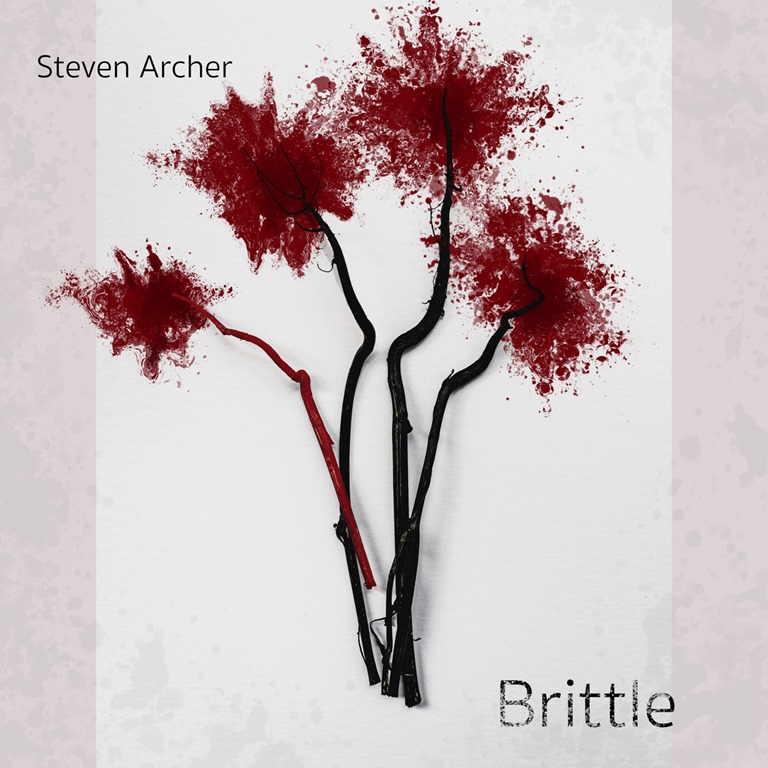
Brittle is a twisted mix of all sorts. First and foremost, it’s an electronic album, and one which leans toward darker territories – not in an aggressive or overtly industrial way, but more given to brooding, introspection, haunting reflection and melancholia.
‘Our Past is a Wasteland’ is a track which transitions and evolves as it progresses: initially, it’s kinda smooth, a bit epic, sedate in in its musical form, with soft synths and mellow beats presenting a low-temp dance vibe, but along the way it begins to develop a darker, harder edge, gets a bit more Depeche Mode. The gentle drift of ‘Tenuous Place’ steps into expansive mode toward the end, exuding anguish and pangs of pain. ‘Only the Young Die Good’ is decidedly heavier: a droning organ gives way to a twitchy drum ‘n’ bass beat and serrated synths that saw deep into the psyche.
With its piano-led instrumentation and popping drums, ‘The Human Void’ is bleak and expansive, dark electropop rubbing and against drifting ambience with sinister industrial undercurrents as the backdrop to a vocal that switches from almost spoken word to hypnotic repetition. Elsewhere, ‘Tiger Longitues’ shares borders with the kind of smoky trip-hop of Portishead, only heavier, bassier, beatier.
The vocals on Brittle are heavily processed, and there’s a strong technogoth feel to the album as a whole. There’s something of a juxtaposition here, in that lyrically, emotional turmoil and troubling psychological situations are the main focus. Yet, in contrast to the intense and personal nexus of the words, the processed feel, which diminishes the human aspect of the vocal delivery, renders a clear separation. Perhaps this is a part of a necessary distancing: it’s certainly easier to manage challenging personal matters by creating layers of separation, and a deliberate detachment. ‘A Love Song for Monsters’ is exemplary: it’s a straight-up stomping banger, with robotix vocals and a slick production, but there’s so much more beneath the surface.
On the surface, Brittle sounds anything but: with sturdy beats and throbbing basslines, it’s a set which concentrates on delivering dark bangers. But however much we lay ourselves bare, we tend to need for there to be some kind of buffer, some space in between, in the interests of self-preservation. Most of us are more fragile, more delicate, more brittle, than we are comfortable to admit, even through the most forthright of art.
Brittle is uncomfortable, pulling in different directions, the undercurrent dragging against the main current on the surface. But the tension at its core is what renders it so compelling. Take in the tension, let it course through you.
AA

 Aural Aggravation