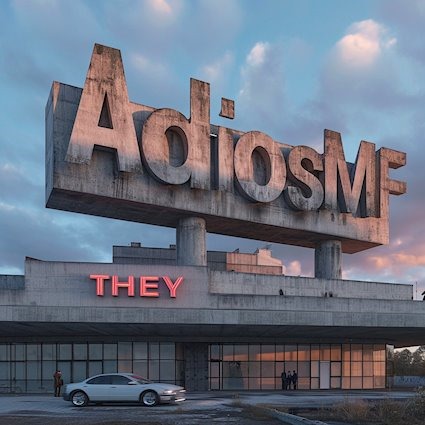
Adios MF is a musical collective spearheaded by Nathan Keeble carving fresh dark wave and electronica sound the underground of Sheffield. Their latest single, ‘They,’ was recorded between Brooklyn and Brixton, serves as a sonic manifesto of what’s to come. Their music defies categorisation, blending elements of post-punk, electronica, and avant-garde into a sonic tapestry that’s uniquely their own.
With sleek production by Nathan Saoudi and Richard Wilson yet coursing with enough detail and character to set it apart, with this impish 80s beat, sinewy guitars, metallic dapping keyboards, and sample loops, it forges a uniquely futuristic sound that’s at once both familiar and yet mirrors the churn of the cityscape.
With a sound that hints at the influence of acts like Human League, Depeche Mode, Kraftwerk and Molly Nilsson, the vocals are addictive and almost mechanical, driven with hooky melodic ticks that sink their nails into and won’t let go, and yet the lyrics reside with a disquiet at the creeping gentrification of urban redevelopment “They built a Starbucks on my street” and reference to shadowy figures who might take you away. It hints at a dark underbelly and Sci-fi dystopia where your every action is being watched.
ADIOS MF say “’They’ is a Kitsch byproduct of existence amid the constant churn of urban development and the persistent buzz of drilling. It was written as a tonic to the realisation that resistance is futile; you must simply acquiesce to the world of urbanism and let it carry you along on its unpredictable journey, set to a naughty 80s beat.”
We dig it here at Aural Aggro, and you can get your lugs round it here…
So I stumbled over Sex Cells by practically sticking a pin in last year’s Live at Leeds programme, and it paid off. Ok, that’s not quite true: while surveying the schedule, they looked interesting and probably worth a punt, so I took a gamble it paid off, with the their tense industrial-edged electronica that reminded me of Pretty Hate Machine era Nine Inch Nails, only weirder and sleezier. Coupled with the duo’s slightly oddball, even vaguely awkward, presentation, it was compelling. The same has been true of their releases to date, which lead us to this, their debut album.
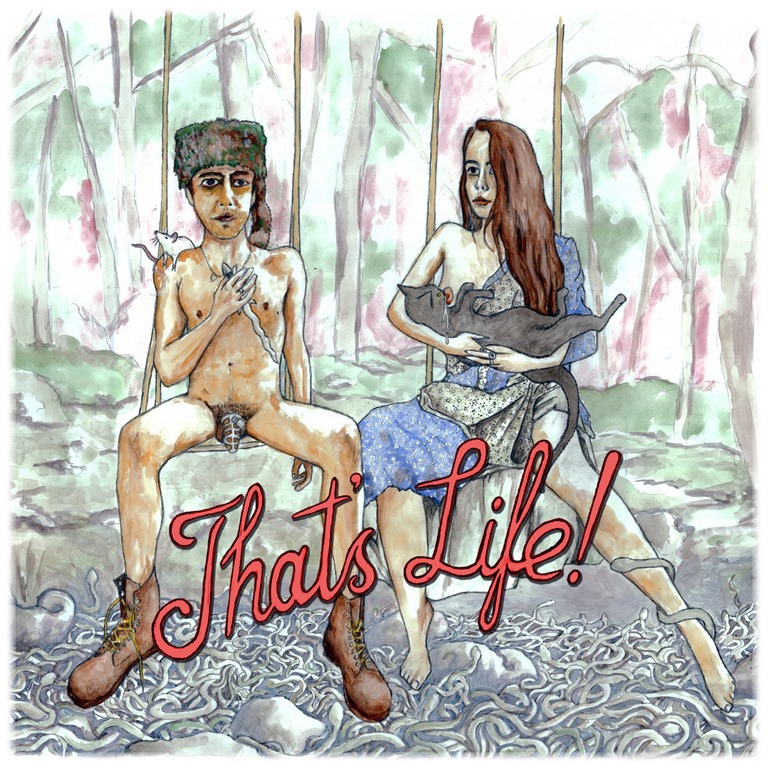
The album’s cover is a bizarre watercolour-style tableau of the pair, and on the one hand, it’s naff (and I’m being polite: the more you look at it, the more awful details reveal themselves. Like, is the cat really supposed to be licking her nipple? What’s that on his dick?), but on the other, it’s a perfect encapsulation of their perverse, quirky style. They don’t play by the rules. And if their name is a play on the adage and Soft Cell, then it’s entirely fitting. If it isn’t, it maybe ought to be.
The headline here should perhaps be that David M Allen is the lead producer here. Renowned for his work with The Human League, The Sisters of Mercy, The Mission, Depeche Mode, The Psychedelic Furs, Wire, The Associates, and The Chameleons, little more probably needs to be said here, beyond the fact that in terms of production, ‘That’s Life’ sounds like you’d probably expect.
‘That’s Life’ bridges the gap between The Human League and Nine Inch Nails, and doesn’t include any of their previous single releases apart from leader ‘Deranged’, which crashed in with a suitably salaciously shocking promo video in March, demonstrating their tenser, harder-edged side while at the same time nailing everything about the band into a box of two-and-a-half minutes.
Opening song, ‘Shimmer,’ is dominated by a low-slung oscillating bass and trudging drum machine that provides the backdrop to Matt Kilda’s monotone spoken word vocal and Willow Vincent’s lost, demented banshee shrillness that calls to mind Skeletal Family, early Siouxsie, and early Cranes.
‘We Are Still Breathing’ is a neatly-crafted reflective electropop tune. It’s got hooks, melody, and a dreamy quality. Things take a dark turn on the next song, ‘Human Costume’ a spiky post-punk electrogoth stomper that screams Hallowe’en and horror, with some pretty barbed lyrics that turn the mirror on society and the human psyche. And it still packs a killer chorus, too.
They go full death disco with ‘Cruel Design’, and Willow coms on all breathy and ice witch in the vocal department, bringing a contrast between the vibrant energy of the instrumentation and the cold detachment of the voice, in a role reversal between human and machine. It’s a complete contrast to the final song, ‘Hang the Flowers’, which is a sparse, folksy number that ripples dappled shade to fade.
The combination of shock tactics and neat dark-edged electropop is a well-established tradition that can probably be traced back as far as Suicide, but really became a thing in the 80s, and as such, Sex Cells should by rights be a yawn, their edginess predictable, their material laden with well-worn tropes, and the metaphorical shrug of a title does nothing to raise expectations. And yet they make it work, and make it exciting.
 Aural Aggravation