Posts Tagged ‘Hallow Ground’

Hallow Ground – 21st December 2025

Christopher Nosnibor

Ivan Pavlov has been releasing music as COH since circa 1997, and in the last twenty-eight years has amassed an immense catalogue which includes some thirty-six albums, often on respected experimental / avant-garde labels like Editions Mego and Raster-Noton. This body of work features a fair number of collaborations. This is his first with ‘the mysterious’ Wladimir Schall, who is no stranger to performing radically overhauled cover versions, not least of all his 2020 release on an endlessly looping cassette with his take on Satie’s Vexations. Suffice it to say, then, that none of the seven pieces on here could be described as ‘straight’ covers. Then again, given the nature of the selected material, how would one go about performing a ‘straight’ cover, and what would be the point, precisely?

As the accompanying notes explain, ‘the two multi-media artists are not content with the mere reinterpretation of their source material, but strive to reimagine it. According to them, the seven pieces on Covers were conceived as “a series of manoeuvres with an ambition to expose the machinery of Music in detail and with utter honesty, without making up for the faults of its traditional instruments or of the compositions themselves.”’

Perhaps the best known and most easily recognisable of the compositions is ‘Merry Christmas Mr Erik’, which opens the album by reworking Ryuichi Sakamoto’s ‘Merry Christmas Mr Lawrence’ as a sparse, almost jazzy work where it’s acoustic guitar which leads before the arrival of piano, which remains at a respectful distance. Not long after, we’re transported into a sparse, foggy trip of piano-led ambience. Perhaps one of the most audacious ‘covers’ is Soii Blanc’, an original COH composition which appeared on IIRON in 2011 – the album which was, in fact, my introduction to the world of COH. This version transforms the sparse electronic piece where experimental synth music meets early industrial grind into a soft piano work that’s as light as a feather but also mysteriously atmospheric through its subtle dissonances which grow with ringing, buzzing tones which gradually disrupt the delicate ripples with digital discord, creating the effect of some form of mechanical breakdown. Then again, ‘Snowflakes’ sees the pair ‘cover’ a ‘non-existent’ original’. It’s evocative: close your eyes and you may well visualise snowfall in your mind’s eye – but then glitches and scrapes cut through the reverie. In the main, it’s subtle, but enough to be disconcerting.

While there’s no clear or specific arc to the album, there is a sense that as it progresses, digital decay and interference gradually erode the graceful atmospheres conjured by piano and acoustic instruments alone – and by the arrival of the final piece, the brief bookend that is ‘Starost ne Radost’ – or ‘Старость не радость’ (joy and sadness), the juxtaposition of scratchy in the vintage sense and scratchy in the ersatz, manipulated digital sense comes to share a meeting and sensation.

AA
a1396191075_10

Hallow Ground – 7th February 2025

Christopher Nosnibor

If it’s got Norman Westberg on it, I’m in. The longtime Swans guitarist is – and I’m not ashamed to say it – something of a hero of mine in the league of guitar players. The discipline he displayed churning out sometimes just a couple of chord at a crawling BPM is beyond admirable, and those releases, particularly from Cop to Children of God were entirely reliant on punishing guitar monotony, and while his post-Swans solo works have been of a significantly more ambient persuasion, his brilliance as a musician still lies in his adherence to a ‘less is more’ approach, playing to achieve sonic effect rather than to showcase himself or his musicianship. There’s something refreshingly egoless about this.

The context of this release is that ‘Night Keeper is a collaborative album by New York City-based artist Aaron Landsman and former Swans guitarist Norman Westberg that is based on the former’s eponymous play. Westberg recorded it together with performer Jehan O. Young for the Swiss Hallow Ground label, with Landsman serving as the record’s producer. The original piece was first performed in the Spring of 2023 at The Chocolate Factory Theater in Queens and filled the stark industrial space with spoken text, choreography, projections, and music in dim light and, occasionally, complete darkness. Westberg and Young afterwards brought it to the studio to record it as a two-part album in whose course his textural sounds, based on loops and samples, set the stage for her soothing, sonorous vocal performance.’

In a sense, then, it’s a soundtrack album of sorts, and it’s also a spoken-word album.

The accompanying notes explain that ‘Night Keeper is a performance inspired by sleeplessness and the wanderings of the human mind at night—about time and memory… The initial spark for Night Keeper was a run of almost sleepless nights in different neighbourhoods of a city that is perpetually insomniac. Instead of trying to force himself to go back to sleep by any means necessary, Landsman started writing down his thoughts.’

I first experienced insomnia at the age of five while staying at my grandparents’. As the time wore on, I grew increasingly scared, and convinced that if I fell asleep I wouldn’t wake up in the morning. Bordering on hysterical, I went downstairs to see my parents, who told me not to be ridiculous and to go back to bed. I cried myself to sleep that night, But I did wake up.

In my mid-teens, I came to embrace the insomnia, spending my nights watching television and videos, drawing, writing, making music, and later, dwelling in internet chatrooms and talking shit till the small hours while writing a novel and downloading stuff from Napster and Soulseek, before perhaps embracing it a little too hard in my mid-twenties, reaching petrifying levels of paranoia and experiencing hallucinations, before collapsing and being off work for six weeks.

I recount this, because the spaced-out, dreamy, disjointed stream-of-consciousness un-narrative of Night Keeper feels uncomfortably familiar. The way the internal monologue flows on, and on… and sometimes spills out to external monologue without realising. The soundscapes forged by Westberg as a backdrop to this is abstract, unsettling. At the end of the first part, there’s a glitching loop, which starts with a thud. It’s an uncomfortable rhythm, akin to water torture and replicates, to some extent, that heightened sensitivity and self-reflectiveness which interrupts the flow of the monologue: what is that? Am I going mad? Oh my god, I’m going mad. What is it? Make it stop… And then, it does, and the silence feels strange.

‘I still can’t sleep. Am I sleepy?’ the narrator asks as one point, after picking through an alertness to a range of sounds. There are people out there, and not everyone is asleep. Sleep’s for wimps, and you can get so much more done if you sleep less, even if that’s starting a fight club. The narrator counts the hours – not with close attention, but suddenly, it’s gone form 2:15 to 4:15. ‘How did it get so late? When is it time to give up?’ are questions which resonate. It’s no longer a late night, it’s no longer tomorrow, it’s almost time to get up for work again. It’s not worth going to bed. Might as well get a couple of chores done and arrive a bit early at work in the hope of an early finish. As if.

In the main, the musical backdrop is supremely subtle: occasionally, ripples of chiming guitar ripple across the murky surface of the dark, misty drones. Sometimes, there are some stuttering crunches, thick scrapes, and they change the dynamic, create seismic shudders which break through the low, slow, undulations. It’s the perfect soundtrack: sympathetic, subtle, nuanced, detailed, textured, dynamic, and understated. You find yourself drifting in and out of the words, and drifting in and out of the backdrop, too – and this is the most fitting experience, in that it’s the most accurate representation of the insomniac life. If you’ve ever not slept for a prolonged spell, Night Keeper will feel familiar. If you’ve had the good fortune to habitually enjoy the luxury of quality sleep, then Night Keeper may provide some education and insight into the torment of what it’s like, you lucky bastard.

HG2407_Outer Sleeve_643x328.indd

Hallow Ground – 7th February 2024

Christopher Nosnibor

Silent movies provide a perfect inspiration for musical scores: unencumbered not only by pre-existing scores, but also dialogue or incidental sound, they offer a completely blank canvas and space for musicians to fully explore – and articulate – the mood of the movie, the moments of drama, to become both immersed in and enhance, even create, atmosphere.

Following the split of Siouxsie and the Banshees in 1996, Steven Severin devoted much time to writing scores for old movies, and performing them as live soundtracks in movie theatres, and I was fortunate to catch him in around 2012 when touring Carl Theodor Dreyer’s 1932 Vampyr. It was a powerful and haunting experience, and one which clearly brought new dimensions to a very old film.

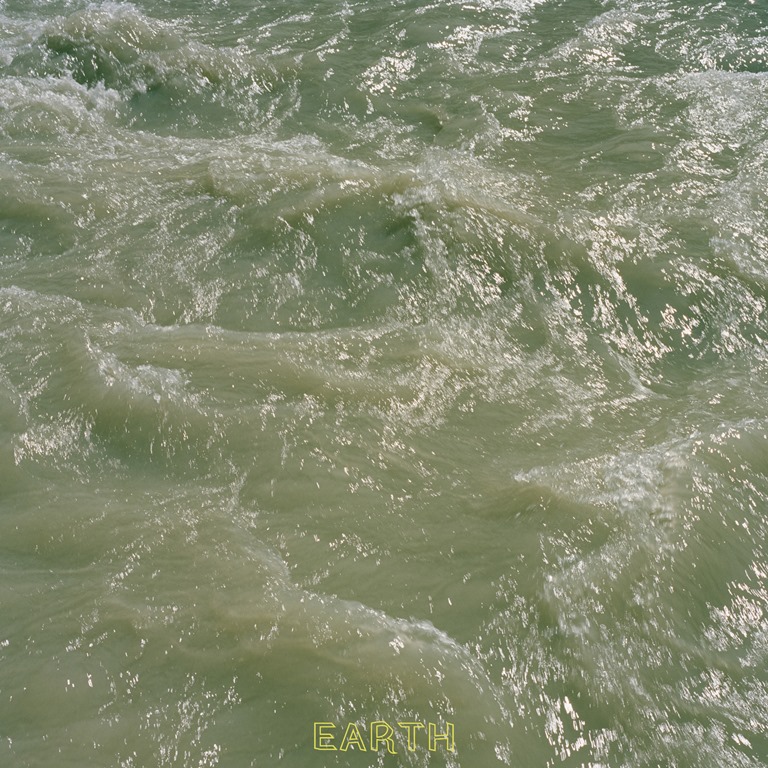
In the same vein, Musique Infinie – the collaborative project of Manuel Oberholzer a.k.a. Feldermelder and Noémi Büchi – present an improvised score for Alexander Dovzhenko’s groundbreaking 1930 silent movie Zemlya (Earth) created for the 24th edition of the VIDEOEX festival for experimental film.

For those unfamiliar – such as myself, the crib notes inform that ‘Frequently cited as a masterpiece of early 20th century filmmaking, the movie deals with the collectivisation of Ukraine’s agriculture.’

Now, the movie clearly holds up on its own to be so revered and still revisited almost a century on, but what of the soundtrack? How does it hold up without the visuals which inspired it?

The soundtrack is divided into two movements of roughly similar duration – ‘Creation’ (14:25) and ‘Destruction’ (12:54). It begins with big, bold, sweeping symphonia, synthesised choral soarings atop majestic, broad-sweeping synth tones. There is a palpable sense of grandeur, and with deep string sounds resonating low beneath big, emphatic surging drones, this feels immense and so strongly cinematic that it’s hard not to be caught up in the tide. A sudden droning downturn marks a temporary change of mood before we’re brought out into calmer waters and begin to regain our breath around the five-minute mark. Robotic, industrial glops and bleeps undulate and oscillate, cresting through the smooth surface. Over time, the piece transitions between organic-sounding orchestral manoeuvres to altogether more space-age sounding synthscapes, before fading rapidly at quite an interesting intersection.

‘Destruction’ – as one might well expect – steps up the drama and the dynamics, but perhaps less expectedly becomes more overtly electronic, with stuttering, glitching disturbances and cold, dark waves blasting in, bending and warping. At times haunting, disconsolate, others foreboding and unsettling, this is certainly the more challenging half of the album. But on the one hand, while it’s more exciting, in some respects, it’s also less fulfilling. Partly, it’s because of the way in which the organic-sounding strings rub against the more overtly electronic sounds, and as much as this juxtaposition and interplay is essential to the compositional form, it sometimes feels like a clash whereby the pair are seeking to achieve two separate ends. Given its improvised nature, this is perhaps to be expected, and the overall flow of the album as a whole is marked by moments of convergence and divergence.

There’s also the nagging sense of just how contemporary this feels in contrast to the visuals the sound is designed to accompany, although without being able to observe the intended setting, it’s difficult to fairly judge the level of success here.

One could – and probably should – see the film, and should also watch it with this accompanying it, as intended – but that isn’t this release, which must be judged on its audio content alone. And taken apart, in isolation, Earth is a stimulating and dynamic work, and one which demonstrates that Musique Infinie aren’t afraid to test themselves and to test boundaries, and to create a powerful and dramatic listening experience.

AA

HG2401_front

Hallow Ground – 10th September 2021

Christopher Nosnibor

Breathing is important. If this sounds flippant or facetious, well, perhaps it is a little, but there is a more serious undertone. It’s something we do subconsciously, and something we take for granted will just happen as our brain keeps the bellows pumping. We only really notice breathing when something disrupts it, it becomes laboured, or we’ve exercised hard.

And yet the importance and benefits of controlled breathing as part of meditation, for managing anxiety, and for dealing with panic attacks is widely documented and promoted. But even for those who have been taught the techniques, how often do we remember to deploy them at moments of peak crisis? Moreover, beyond those specific settings, breathing properly is something that’s chronically neglected as we slouch over our keyboards, taking short, shallow breaths that fail to fully expand the lungs and oxygenate the blood stream.

The ever-innovative and ever-intriguing Lawrence English’s Hallow Ground debut finds the composer working ‘exclusively with an organ for four compositions that are exercises in »maximal minimalism,« as their creator himself notes in a nod to Charlemagne Palestine, who coined this term.’ The liner notes explain further that ‘While it seems somewhat fitting that those four pieces based on a steady flow of air were conceived and recorded in a situation of accelerated standstill caused by a respiratory disease, the Room40 founder is not so much concerned with capturing the zeitgeist than rather incorporating the spirit of time itself. »It is a record about presence and patience,«’.

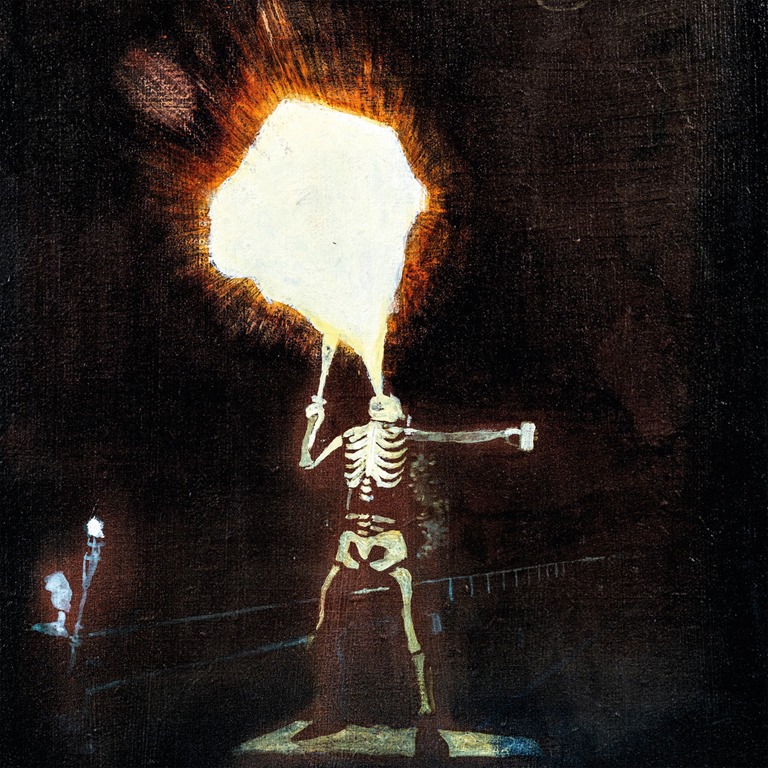
Patience is indeed required when listening to Observation of Breath. It stands to reason that there is a concerted focus on elongated, quivering drones, and the first of the four pieces, the ten-minute ‘The Torso’, with its dank, dark rumblings and extraneous interference carries sinister allusions, particularly when reflected upon in context of the album’s cover art. The torso may well house the lungs, the system of breathing, but all too often finds reference in stories of murder and dismemberment, and we’ve all wanted to strip off our own skin at some point, right?

The theme continues its trajectory in the titles of ‘A Binding’ and ‘A Twist’ which follow. These are short pieces, both sparse, droning works that are overtly organ, with the latter in particular taking the form of a gloomy funereal church recital. There’s nothing like a funeral to make you contemplate your breaths, and to consider how many you may have left in your body. Perhaps this is one of the reasons we ignore and avoid thinking about breathing: the moment we notice it, be it short or irregular, we worry, in the same way as we panic about palpitations. To become cognisant is likely to observe an irregularity, a difficulty, in a most fundamental function, and rightly or wrongly, doing so reminds us of our mortality. We hate to be reminded of our mortality: it terrifies us half to death. The irony.

In context, the album’s finale, the twenty-minute title track, which occupies the entirety of the album’s second side, on which all elements of the previous three compositions coalesce and distil into something monumental and epic. Not a lot happens: it’s simply a quavering continuum of sound that undulates and eddies slowly, unfalteringly, less like a stream than a crawling flow of larva. But to go with the flow is to fully engage with the album and its slow-shifting textures. It’s perhaps around halfway through ‘Observation of Breath’ that I finally realise I am becoming aware of my breathing at last. Conscious, I slow it, inhale to full expansion through the nose, hold, then equally slowly release out through the mouth.

Observation of Breath is a well-realised exploration of expansive territory in altogether smaller detail, and one that offers more the more you allow it to become a backdrop.

AA

HG2103_Cover_English_Final_def_def.indd

Hallow Ground – HG2104 – 13th August 2021

Christopher Nosnibor

There are few things in life you can really rely on, but Hallow Ground is one of them, if you’re seeking music from the darker side. The clue’s pretty much in the name here: this is pretty dark. Of course it is. It’s also quite an interesting and unusual blend of styles and sounds, for while this forty-minute, seven-track work is predominantly instrumental and ambient in its leanings, it pushes wider and deeper than that, to span a range of territories, with often quite unsettling results.

DarkSonicTales is a project by Rolf Gisler, who was granted an artist residency in a 300-year-old farmhouse in the Swiss countryside in autumn 2019, by the label. How this sort of thing comes about, I’m not really sure, but there it is. I am a shade covetous of artists who get dedicated time and space to work on their art in whatever medium, because the simple fact is that in ordinary life there never seems to be enough time. For anything. And creativity requires headspace and time, both of which are rare and precious commodities.

Rolf seems to have made the most of his time, and the result is an album that’s varied in terms of form and tonality, which makes for a fascinating listening experience. From the mellow chiming of the short intro piece, ‘Info Pandemie’, to the eight-minute drone-swirl of ‘Best Buddies’ that drags the album to a slow-simmering conclusion in a bilious fog of sonic drift, DarkSonicTales is a deeply exploratory piece.

‘I Still Believe’ is a long, slow-burning, low-key, low-tempo gothy tune, where Gisler whispers in a baritone croon over a delicately picked guitar that’s hauntingly atmospheric and pinned down by a distant but insistent drum machine, its cracking snare cutting through the sonic haze.

‘Best Buddies’ brings the finale, and there’s a stuttering heartbeat drum flickering like a palpitation against the slow, majestic musical backdrop.

In some respects, it’s a challenge, simply because however much the album leans towards electronics, the way the instrumentation is used is so widely varied this feels like an album that’s harder to accommodate far more than it actually is. Somehow, the pieces of the jigsaw fit together.

AA

a4220900238_10

Hallow Ground – HG2101 – 12th March 2021

Christopher Nosnibor

Norman Westberg, of Swans legend, has a long association with the cranking out of heavy noise. For over three decades, his style was a defining feature of one of the most singular bands, and a rare entity, namely a guitarist who was more than happy to bludgeon away at the same two or three chords for anything up to a quarter of an hour. I would even venture so far as to say that Westberg is a truly unique guitarist, and his appreciation and understanding of space is unparalleled – a player who isn’t only comfortable, but whose signature is a seemingly infinite pause between chords.

In more recent years, Westberg’s output has shifted towards a less abrasive angle, with a succession of solo releases from 2016 onwards exploring overtly ambient territory, through MRI¸ The All Most Quiet, (both 2016) and After Vacation (2019).

First Man in the Moon sees Westberg connect with double bass player Jacek Mazurkiewicz, who supported Swans on tour in Europe in 2014 under the moniker of his solo project 3FoNIA,.The result of their collaboration, recorded during some downtime ahead of Michael Gira’s two Warsaw shows toward the end of 2019, is five improvised tracks of richly resonant evocation. The pitch promises a work ‘beyond the boundaries of atmospheric drone, abstract jazz and experimental music [which] blurs the lines between the acoustic and the electronic.’

It’s all a blur: supple washes of sound painted in broad strokes provide the cloud-like ambient backdrop to clatters and creaks, and the occasional bleep and whirr. It’s very much about the contrast: Mazurkiewicz’s playing is versatile, with his double bass work ranging from deep, brooding sounds that are very much of the instrument, to sonorous booms, to the sound of a tree groaning and about to topple.

How deep do you delve into a work so overly ambient and abstract? At what point does dissection become futile? First Man in the Moon is an album that warrants space, and reflection, to breathe and to simply run its course – an album to bask in, rather than to pick apart. It creates a supple, evolving atmosphere of soft drone and a soporific soundscape in which to cut loose.

A hesitant bass emerges from the misty contrails of ‘That was Then’, and it’s ‘Falsely Accused’ is a slow, tidal throb that ebbs and flows… and not a lot else. First Man in the Moon is an album that drifts on, remaining in the background: it does not demand attention of focus. Attention and focus bring different rewards, but there is a lot to be said for simply sitting back, dimming the lights and sipping a whisky while the sounds of this subtle, nuanced work immerse you.

As collaborations go, Westberg and Mazurkiewicz make for a magnificent pairing, creating an album that shows a touching musical intuition: everything about First Man in the Moon simply flows, effortlessly, naturally, and creates a space in space – that is to say, a mental space in which to empty oneself. It’s rare, and it’s special.

AA

HG2101_front

Hallow Ground – HG2005 – 5th June 2020

Christopher Nosnibor

For this release, it’s worth laying out the context in detail, as provided in he press release, which explains that the album ‘was conceived as the soundtrack for the eponymous installation piece by the French artist Fanny Béguély.’

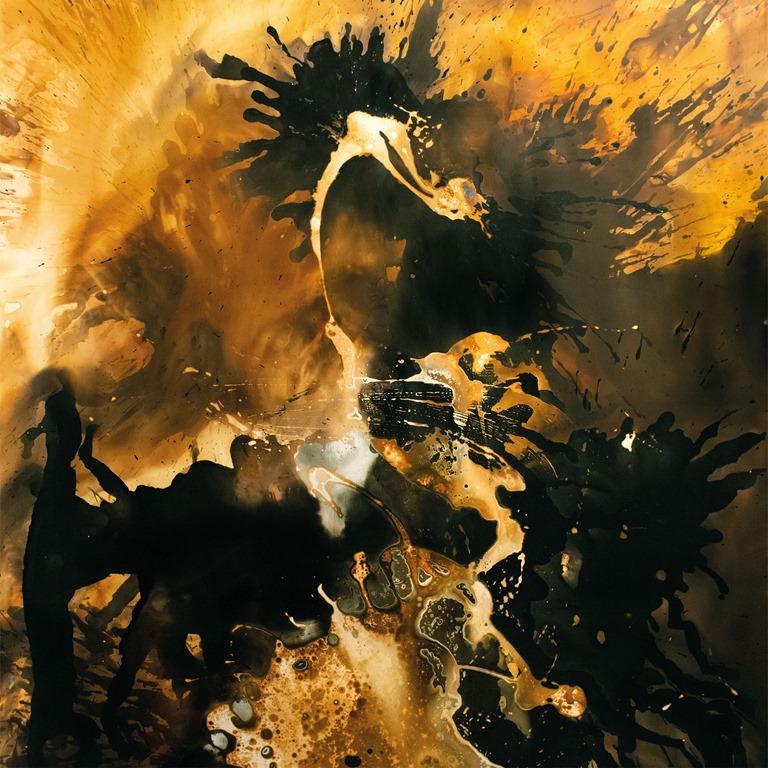
‘First presented as part of the group exhibition »Panorama 21 – ›Les Revenants‹« at Tourcoing’s Le Fresnoy Studio National des Arts Contemporains in December 2019, Béguély’s chemically painted photographs focused on humankind’s propensity for self-examination and its attempts to probe the mysteries of the past, present and future. Oberland’s heavily processed electric hurdy-gurdy, the »boîte à bourdons,« provides the foundation upon which the Borghesia member Tomažin unfolds her gripping vocal magic(k). Their dense mesh of soundscapes and singing mediate between the mystic and the modern, the natural and the all-too-unreal to further examine our persistent desire to decipher the signs we find in nature. As the first collaboration between these prolific experimental artists, ARBA, DÂK ARBA is as evocative and thought-provoking as the art that has inspired it.’

The hurdy gurdy is by no means a common or popular instrument. Not that you’d be likely to be able to discern any specific instruments on the five sparse, ominously atmospheric pieces presented here.

From a sparse, quivering tone surrounded by emptiness, ‘Grotta’ builds in density over the course of fourteen and a half minutes into dense bugle of sound, a deep, resonant thrum over which mournful sounds – voice-like but not voices – moan and groan as they drape elongates notes of sadness over an increasingly uncomfortable backdrop.

This is not an album so settle down comfortably with, and it’s not a comfortable kind of ambience: ‘Fumes’ brings a suffocating tension, heightened by the unintelligible vocals that speak – wordlessly – of an inner torment as they reverberate in an endless monotone, through which rumbles of thunder rupture. Ululations undulate evoking strange, distant lands and mystical esotericism. It culminates in a long, isolated drone, almost lost beneath a cacophony of shrieking, wailing, and crying. It’s difficult to hear: I feel my chest tighten: it’s the sound of pain of torture.

‘Hieromancy’ (brief research tells me this is a form of divination involving sacrificial remains or sacred objects) only heightens the anguish amidst more shrieking and wordless despair. It fades down to a defeated murmur and a hovering hum which drift into the more optimistic dawn of ‘Hereafter’, which offers a glimmer of light and hope. It’s late-coming, but welcome.

LP_Cover.indd

Hallow Ground – HG2001 – 28th February 2020

Christopher Nosnibor

Electric Sewer Age began as a collaborative project between Peter ‘Sleazy’ Christopherson (of Throbbing Gristle, Psychic TV, and Coil) and Danny Hyde, who continued the project together with John Deek, who subsequently passed away in 2013. It’s perhaps only natural that a sense of bleakness, of darkness, of a certain sense of grief permeates Electric Sewer Age, as a project strewn with loss.

Contemplating Nothingness is the third release by Electric Sewer Age, and the second one that Hyde finished alone, following on from Bad White Corpuscle, originally released in 2014, and re-released in 2016.

Contemplating Nothingness is pitched as ‘a lysergic tapestry culled from the deep end of the collective pop cultural unconscious’. It begins with some spaced-out trippy, doodly interweaving drones and some disorientating analogue latticeworks and shuffling electronic judderings providing the backdrop to some reverby, echoic vocals before transitioning into woozy dance territory, a stammering heartbeat bass beat fluttering beneath shifting layers of disquiet which collide with elliptical elisions to dance tropes.

‘Got some bad news this morning / which in turn made my day’, Hyde wheezes in a distorted Al Jourgensen-style vocal on ‘Whose Gonna Save my Soul’. I try not to wince too hard and the grammatical error and instead focus on the dark atmospherics the song conjured. Moreover, this single line encapsulates the contradictions which stand at the very foundations of this album, and the track itself delves into swampy dark ambience, dominated by a rhythmic wash, with Eastern motifs twisting in and out sporadically amidst a lower-end washing ebb and flow while the vocal, half-buried, is detached, distant.

Like its predecessor, Contemplating Nothingness is dark and difficult. Slow beats that land somewhere between heavy hip-hop, trip-hop and industrial drive ‘Chebo’, a delirious drag of chimes and electronic ululations. ‘Surrender to the Crags’ plunges into dark, dank, murkiness, but retains that eastern vibe that calls to mind both The Master Musicians of Joujouka and the otherness of the Tangiers scene in the 50s and 60s as depicted by William Burroughs.

‘Self Doubting Trip’ brings a dark intensity that will likely resonate for many: it’s claustrophobic and uncomfortable, and stands as something of a highlight in the way it attacks the psyche. You hate yourself enough already, but there’s a slight comfort in knowing your self-flagellation is not unique as you chastise yourself for simply living.

It makes the last track, ‘Dekotour’, feel like an electropop breeze by comparison, the chiming synth tones more early Depeche Mode than anything, but they bend, warp, twist and weave across one another to create a difficult knot of noise, with a thick, gloopy bass rising into the increasingly tangled textures.

There’s a certain nihilism at the heart of Contemplating Nothingness, which extends beyond merely the title and its implications of introverted emptiness, but it’s paired with a less certain and altogether less tangible levity which lifts it above dark ambience and into a space that’s given to contemplation and awakening. While ultimately minimal, there is variety and depth on display here, making for an album that deserves absorption and deliberation.

AA

Electric Sewer Age – Contemplating Nothingness

Hallow Ground – 16th November 2018

Reinier Van Houdt’s 2016 solo album Paths of the Errant Gaze was a collage of quiet, dark ambience, and Igitur Carbon Copies continues in a similar vein. The inspiration for this work is the unfinished gothic tale Igitur, a collection of texts ultimately abandoned by the author, the French symbolist poet Stéphane Mallarmé in 1869.

Considering the fragmentary nature of the incomplete work, not to mention Mallarmé’s tendency to incorporate theoretical aspects within his practise, the appeal to an artist like Van Houdt isn’t hard to see: a classically-trained pianist who’s collaborated with artists ranging from John Cage to Charlemagne Palestine and has been a member of Current 93 since 2012, he’s long been fascinated with ‘all matters that defy notation: sound, timing, space, physicality, memory, nose, environment’. This is one of those works that could very easily inspire a full-blown essay instead of a review, and there’s a temptation to write it – but does anyone actually want that? Does anyone have the time to read it, even if I had the time to write it – and I mean properly?

To reduce the experience and reflection to something manageable, with Igitur Carbon Copies, Reinier Van Houdt presents a work of immense theoretical depth in an accessible form, although obviously these things are relative. That is to say, it’s a challenging album, but one’s appreciation doesn’t require a priori knowledge of the theoretical concepts around authorship and originality, around chance and destiny, around temporality, and the myriad contexts behind it. On the surface – a deep, dark, rippling surface as it may be – it’s a dark ambient work littered with muttered speech. Beneath that surface, there’s a lot going on. And so what Van Houdt presents is in no way a carbon copy, but a corrupted, adapted interpretation of Igitur. And so begins the journey through the stages of copying and alteration, a question which lies at the heart of postmodern textual interrogation, and William Burroughs’ novel Cities of the Red Night. Text mutates. Even a carbon copy is a copy: it is not an original and therefore different.

The eerie and the uncanny reverberate around every shadowy corner of the album’s ten compositions, some of which are but the briefest, most fleeting sonic experiences, starting with the 40-second opener, ‘Annunciation’, which begins with dank and distant rumblings which expand into turning ambient tones, before segueing into ‘An Empty Set’ in a blast of static that lasts but a fraction of a second but completely fractures the flow.

Drawing source material from Mallarmé – revised by Van Houdt, and read by David Tibet in his best monotone – there is a distinct sense of narrative about Igitur Carbon Copies, however disjointed. The vocals are treated, albeit subtly, to render them with a certain trembling reverb that adds a disquieting edge. And there are extended passages that rumble and undulate, a simmering sonic soup. It doesn’t really go anywhere, and nor does it need to: it creeps around on the peripheries of the senses and pokes at the psyche almost subliminally. The effect, then, is difficult to define, but it’s nevertheless something that happens. One traverses Igitur Carbon Copies in a certain state of somnambulance and bewilderment. But one definitely traverses it, and its effects are definite.

AA

Reinier Van Houdt – Igitur Carbon Copies

Hallow Ground – 16th November 2018

James Wells

While the majority of the releases on the Hallow Ground imprint which have come my way have been pretty noisy, the Gloryland EP by PLYXY is notable for being extremely mellow indeed. Pressed into heavyweight red vinyl (and available digitally), with three tracks on side one and two on side two, it’s something of a vintage-style EP.

Nothing really happens over its duration, and one might conclude hat while the digital version achieves optimal immersion and absolute ambience, the vinyl version gives the listener reason to move in order to flip the record, meaning they’re tugged from their soporific torpor for a moment. With a digital promo, I find myself drifting… drifting… heavy-lidded and drowsy.

In keeping with the loosely-formed Aural Aggravation project to divide ambient works into background and foreground (and whatever shade in between seems appropriate), Gloryland is for me the apex of ambient: I enjoyed it, but was close to sleep around the mid-point. And this is no criticism: we need mellow, and Gloryland is a totally pleasurable listening experience.

AA

PLYXY – Gloryland