Posts Tagged ‘Experimental’

Clang Records – Clang 042 – June 10th 2016

Christopher Nosnibor

Hans Tammen’s Music for Choking Disklavier was one of the first albums to be reviewed here on Aural Aggravation, back in December last year. Deus Ex Machina finds Tammen continue to explore the possibilities of instruments when played in a fashion they were not designed to be played. Since 2000, Tammen has been working with the ‘Endangered Guitar’, and tirelessly developing its functionalities.

Tammen’s website summarises this ‘Guitar-Controlled Live Sound Processing’ in a fshion that’s more intriguing than explicitly instructive: ‘The Endangered Guitar is a journey through the land of unending sonic operations, an interactive hybrid between a guitar and a computer. The software “listens” to the playing, to then determine the parameters of the live sound processing. The guitar is the sound source, but the same sound is also used to control the software. Sounds of the guitar are processed in realtime, pitch and various other parameters of the actual playing serve as control source of the processing. Currently, additional control sources are provided by a Leap Motion Controller.’ Technical yet simultaneously vague, what it boils down to is that Tammen has devised a guitar / computer hybrid, and in 2004 her introduced a random element to the software.

Tammen’s collaboration with Lars Graugaard under the Infernal Machines moniker, which came out earlier this year, was more about utilising the Endangered Guitar in a tempered, moderated and counterbalanced way. In contrast, this live recording, the title of which references the theatrical practice of lowering a ‘god’ character on stage using a cable device in order to resolve a troublesome situation in the plot of a play, and in which Tammen casts himself the role of the actor, lowered to the stage to daringly intervene, is built on improvisation and a wide-ranging exploration of the hybrid instrument’s capabilities.

Tammen writes of the computer crashing while performing, and of how wildly unpredictable the whole setup is, and this very much translates into the audio captured on the album.

Scratched overdriven chords and discords splinter and snarl. Massive, distorted, overloading sludged-up Sunn O)))-like drones rumble on… and on… walls of sound collapse in on themselves. Pickups cut in and out intermittently, feed back and crackle. Occasionally, recognisable notes – albeit notes that sounds like a version of Metal Machine Music are distinctly audible. There are no tunes to be found here, and often, it doesn’t even sound like a guitar. On ‘Transaxle’, the guitar effects the sound of violin strings being scraped, against a droning, wheezing sound like a deflating bellows, while on ‘Interlude at Rake’, it conjures a techno sound, replicating synth stabs and booming bass beats. Rapid, looping modulations, bleeps and squiggles replicate the effect of analogue synths, with sounds which would be at home on a track by Factory Floor or Whitehouse, and elsewhere, dark ambient passages hum, rumble, grind and billow and grating industrial barrages relentlessly assault the senses. At times, it hurts. But it’s also entertaining and often enjoyable: Deus Ex Machina is sonically challenging and one can’t help but contemplate just how the sounds of a guitar can be mutated in real-time to create the diverse and sometimes utterly insane sounds captured here. It’s by no means a novelty album, either: the concept of the Endangered Guitar may sound like something of a gimmick, but Tammen demonstrates that his leading preoccupation is with innovation for the purpose of creating new sound, and more importantly, creating something with those sounds.


Hans Tammens - Deus Ex Machina

Front & Follow – F&F044 – 8th July 2016

Christopher Nosnibor

With this release, Front & Follow inaugurate a new series of split cassette and download releases. The premise is that the artists are given a side apiece, and while the idea is that they’re encouraged to collaborate, it’s essentially down to the acts involved. This first ‘Blow’ release features a total of nineteen tracks, with ten from Hoofus, seven from IX Tab and a brace of joint efforts.

The ten Hoofus track are first, and if the titles, in their evocations of ancient lore, mysticism and history, seem at odds with the bubbling synth cycles which form their fabric, then it’s a reflection of the infinite contradictions which define Hoofus’ enigmatic sound. Shimmering, throbbing and needling, the scratchy, fuzzy tones cover the full sonic spectrum in infinite, iridescent hues. Occasionally sliding into unusual time signatures and oddly dissonant passages – the wonky keys of ‘Twentythree Seven’ shouldn’t work, but instead it’s rather magical – their ten tracks are beautifully weird, and weirdly beautiful. The notes roll and bend, wobble and warp, layering up to form a rich latticework. The effect is to create music that transcends music, enveloping the listener in a thick, pulsating aural blanket. It’s an immersive, multisensory experience, akin to how I would imagine simultaneously being under water and watching the Arora Borealis.

IX Tab’s eight tracks are quite different in tone: more overtly electronic, bleeping, swooshing and rippling notes scurry across one another in vintage sci-fi style. The dizzyingly hectic compositions are contrasted by sedate ambient segments. Samples – snippets of dialogue and lopped phrases – feature heavily, and there’s an overtly experimental air to the tracks. Trilling pipes and rattling chimes flit alongside woozy, opiate drones and church song. The nine-minute ‘The Herepath Comes Away’ is a magnificently expansive, atmospheric work, and something of a standout as it leads the listener on a curious journey of the mind.

The two collaborative tracks, credited to Hoofus & IX Tab, work precisely because they sound like a hybrid of the two acts. ‘The Ministry of Ontological Insecurity’ features sampled voices repeating the statement ‘I don’t believe in me’ (occasionally interspersed with variants ‘I don’t believe in you / him/ her / them’) over a drifting dark ambient backdrop fractured with incidental sonic incursions. ‘The Ploughs & Machines’, which closes the album also incorporates samples and woozy electro oddness with shifting time signatures to mesmerising and disorienting effect.

Individually and collectively, Hoofus and IX Tab have conjured an album that reaches for the outer limits and transports the listener to them and then beyond.


Hoofus   IX Tab

17th May 2016

Christopher Nosnibor

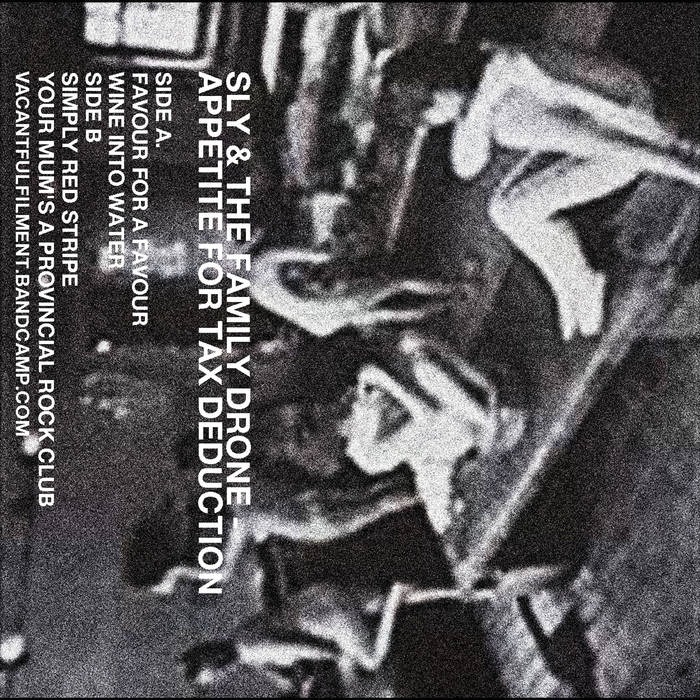
The ever-awesome Sly & the Family Drone return with another puntastically-labelled slab of awkward noise. Sticking to their staunchly DIY ethos (although, and I mean it as no criticism when I say that this may well be a choice but their options are likely to be limited), this latest effort is released on translucent green C33 cassette in a limited edition of 50, and digitally.

Apart from being a killer live band, their offbeat humour, not least of all as manifested in the referential titles have always been an integral part of their appeal (at least to me): 95 Minutes Over England documented their first tour, and all three of the recorded sets lasted longer than Suicide’s notorious show, and the band are willing participants in the ensuing percussion-led riots.

Understanding Appetite in any context of chronology is rather difficult, given that it originally appeared as a digital-only release a few months before their colossal full-length album proper, Unnecessary Woe. It’s not so much a companion piece but a contemporaneous standalone counterpart. But the main thing is that it contains a whole lot of dark noise.

While each of their other releases features at least one long-form sprawler, Appetite For Tax Deduction is an unusually concise work, with none of the four tracks crossing the ten-minute mark. Still, the first track, ‘Favour for a Favour’, is a dank, rumbling semi-ambient piece. Heavy, shuddering low-end sounds and growling vibrations sound like subterranean earthworks. It bleeds into ‘Wine into Water’. A mangling mesh of distortion and a continuous bottom-end drone that tears the air provides the gut-churning backdrop to extraneous electronic noise, shrieks of feedback and indecipherable, distorted to fuck vocals. It’s pretty sinister stuff, and its claustrophobic intensity is a world away from the cathartic and communal live performances.

With a title worthy of That Fucking Tank, ‘Simply Red Stripe’ is a classic example of the Sly humour. Its nine-minute sonic assault is built around an insistent, low-end throbbing, dense and immersive. Tonal shifts trick the ears into thinking there are fleeting moments of melody submerged in the hum, only for it to become apparent that it’s little more than a rising wail of feedback and the fizz of melting electrodes. It’s by far the most rhythmic track of the set, and, with nods to Suicide, Throbbing Gristle and Whitehouse, it’s magnificently uneasy listening.

‘Your Mum’s a Provincial Rock Club’ features what appear to be horse’s hooves – the only overt percussion to feature on Appetite – beneath a cement-mixer mess of collages sound, booming bass blasts and fractured tweets and flutters of treble spiralling in a vortex of echo and infinite delay, building and building until the sound coalesces into a vast tidal wae of white noise that ultimately swallows itself.


Sly and the Family Drone - Appetite

Someone Good – RMSG – 18th March 2016

Christopher Nosnibor

Reading the info accompanying the album, I was relieved to learn that it has nothing to do with football. Granted, it says more about me than it does anything or anyone else, but I’ve never been a huge fan of sport. It probably never helped that apart from being quite a handy medium-pace bowler with a nifty Yorker, and a decent cross-country runner (I discovered early on that by getting a move on, I could be back in the changing rooms, showered and reading a book before anyone else got halfway round the course. I loved reading, and hated communal showers), I was shit at sport. It also happens that many of the kind of people who are big sports enthusiasts simply aren’t my kind of people, and I consider fantasy football leagues the biggest, stupidest waste of time going. But let’s not focus too much on the cover art (I’m thinking that despite Tuttle’s Australian background that it’s baseball rather than Aussie rules, but what do I know? And what do I want to know? It could be squash or lacrosse for I care. What matters is that Andrew Tuttle’s fantasy league is about a utopian environment. Said environment sets social interaction against total isolation, self-reflexivity against self-confidence.

It’s an interesting proposition, and Tuttle plays an interesting and rather unusual array of instruments in order to create the sonic structures by which to explore this concept: computer, synthesiser, banjo, and acoustic guitar. Hardly your average configuration for music making. But then, Fantasy League is not an average album, in any respect.

Broadly speaking, it’s an ambient work. Banjo and guitar are present, but woven subtly into shifting, drifting soundscapes of drones and undulating widescreen sounds. Bubbling, bleeping electronics, ripples and swishes are all fundamental parts of the album’s sonic fabric. The strummed and picked strings add a unique slant amidst the burrs of fizzing treble bursts which erupt, wibbling every which way: with hints of hillbilly blues over a static hiss on ‘Forgtten Username?’ and gentle folk motifs informing ‘Forgotten Password? before insect scutters scrabble all over and devour them, the resultant output sounds like country music from another dimension. Elsewhere, there are Tangerine Dream-like moments, notably on ‘Public League’, where multiple time signatures pulse and interweave to form a sonic latticework.

What renders Fantasy League so intriguing and compelling is the way in which Tuttle distorts the familiar: the sounds themselves are no challenge to compute or comprehend, but the way in which they’re juxtaposed and twisted together is uncanny, as if Fantasy League is a soundtrack from a parallel universe. And it sounds like a place well worth visiting.


Andrew-Tuttle_thumb.jpg

Silo Rumor – May 2016

Christopher Nosnibor

Given the ubiquity of music, perhaps now even more than at any time in human history – and music has been an integral part of life for as long as we know, in ever-evolving forms – it’s something that is generally taken for granted. Few consider the function, or functions, of music, and those who do are more often than not academics: the average individual is unlikely to devote a great deal of time to dissecting precisely why they listen to the music they do, or what it is that specifically draws them to music. That said, the more avant-garde and theory-based the art becomes, so more consideration is given to its purpose, and in some respects, this seems somewhat paradoxical given that much of the work in this sphere is not what the majority would necessarily consider ‘music’. And so we have Jonathan Uliel Saldanha’s Tunnel Vision, a collection of pieces recorded in and around the tunnels of Porto. Part field recording collage, part abstract, part ambient soundwork, the album’s seven segments are not overtly musical, in that they do not feature any of the conventional features of ‘music’.

While the concept of ambient music is now well established, and the theories around it also representing well-trodden territory, it’s still worth considering the purpose of an album like this. What kind of experience does it offer the listener? Specifically, what is the point? After all, Tunnel Vision is, ostensibly, little more than drones, moans, hums and thuds with occasional snippets of voices. And if anything, it’s not really ambient: it’s far too tense and unsettling for all that.

‘I’m what some people call The Tunnel. Whereas most are drawn to what’s on the surface, in the skies, or in space, I’m drawn to what’s beneath the surface,” says the anonymous speaker on the tile track. He continues: “Space seems exotic, mysterious, because it’s distant, far away enough not to fear… the underworld is a void that sits right beneath our feet. It evokes fear…” And while Tunnel Vision is concerned broadly with the use of ‘resonant spaces’, the overall mood and texture is very much of the space below than the space above and around. The purpose of this music is to evoke the space which frightens us, which pricks those subconscious fears through the medium of sound. It’s about conjuring the unfamiliar and appealing to the senses in a way which unsettles them by means of the concordance of the rumbling of distant thunder which rolls beneath a shifting soundscape of mournful brass and unexpected clashes of sound.

The three tracks which occupy side two are noticeably longer, than the four on side one, and feel more formed, building on the atmospheres which emerge through the layering of long, low hums and drones, twittering flickers snippets of voices and thuds and clumps.

And so it is that one does not listen to Jonathan Uliel Saldanha’s Tunnel Vision for its musicality, or for entertainment. Nor does one interact with music on this level for relaxation purposes, but instead to confront subconscious and primal fears. To marvel at the mind which could create such sonic challenges, and to feel a sense of discomfort that’s essential to moving out of one’s comfort zone and instead be shaken into feeling something that evokes a response beyond immediate comprehension.


Silo Rumor

Jonathan Uliel Saldanha Online

Tavern Eightieth – TVEI24 – 29th April 2016

Christopher Nosnibor

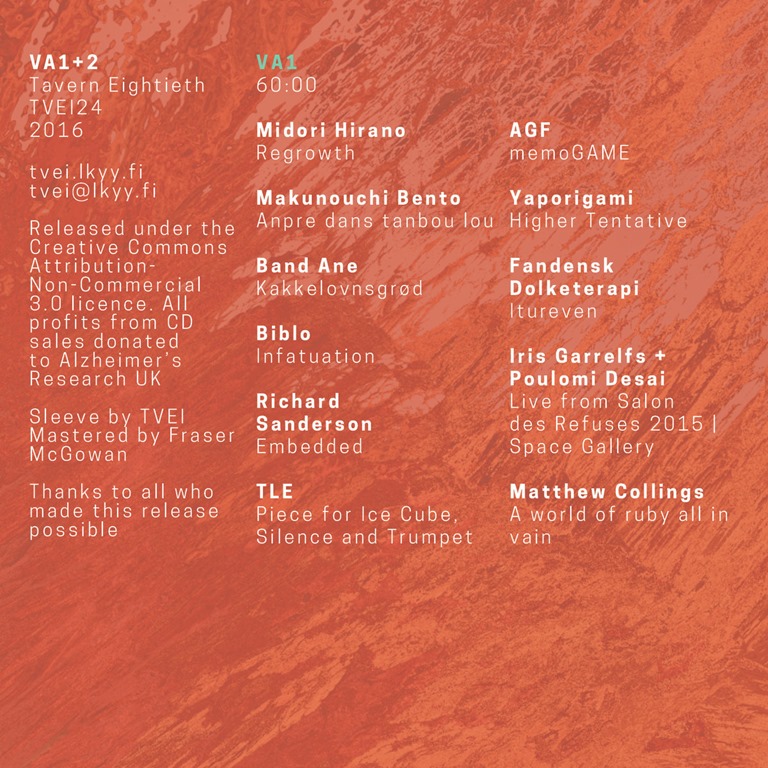
Described as ‘a large compilation of diverse and exciting music from new and exciting artists,’ VA1+2 is, first and foremost, a fundraiser for Alzheimer’s Research UK. Arguably, that’s reason to purchase it in itself, but of course, in truth, any compilation sells on the basis of the music. The immense range of music on offer on VA1+2 is its real strength, and offering over two hours of music (that’s 22 tracks by 22 different artists packing out a brace of discs), it’s a veritable boon of contemporary electronic, ambient, experimental, electro-acoustic, improvisational and more.

From the semi-ambience of Midoro Hirano’s ‘Regrowth’ and the swampy Latina stylings of Manouchi Bento’s ‘Anpre dans tanbou lou’, there’s much to soak in on disc one. Band Ane’s bleepy, space-age ambient Krautock is particularly intriguing.

Disc two spans the dolorous yet delicate piano-led instrumental of International Debris’ ‘Translucent Orb’ to the eerily ominous ‘Kiki and Bouba’ by Isnaj Dui, via the ethereal transcendental post-punk folk hymnals of ‘This Thought Won’t Last’, the contribution from Zelienople and Glacis’ elegiac epic ‘As long as water flows’.

One of the common pitfalls of compilations, and in particular compilations to raise funds for charity, is that they’re often a bit of a hotch-potch mess, no better than the naff giveaway discs that come with magazines (or used to come with magazines: I don’t know as I stopped buying magazines some time ago, at the point when the quality of features and reviews vs cover price became unfavourably skewed toward the latter) plugging whatever was hot at that moment in the eyes of that publication, with a bunch of album tracks and B-sides taking up the majority of the space. VA 1+2 feels – and sounds – very different. Tavern Eightieth haven’t just taken anything that’s been floating around, and while I despise the overuse of the word in our post-postmodern hipsterised word, there’s a sense that they’ve actually curated a compilation which represents the label. There’s clearly a lot of thought and effort gone into this, from the selection of material itself to the mixing and sequencing of the tracks. And so, while it is a fundraiser, and for an extremely meritorious cause (I’ll spare the lecture here on the underfunding of research into Alzheimer’s given the number of people it affects).

Finally, mastered by Fraser McGowan with an ear on optimal clarity and dynamic range over volume, there’s a sense that every aspect of this release is about doing the music justice. And in turn, they do the charity and the listener justice. Everyone wins.

Tavern Eightieth VA1 2

Tavern Eightieth – VA1+2 at Bandcamp

1empreintes DIGITALes – IMED 16137 – 5th May 2016

Christopher Nosnibor

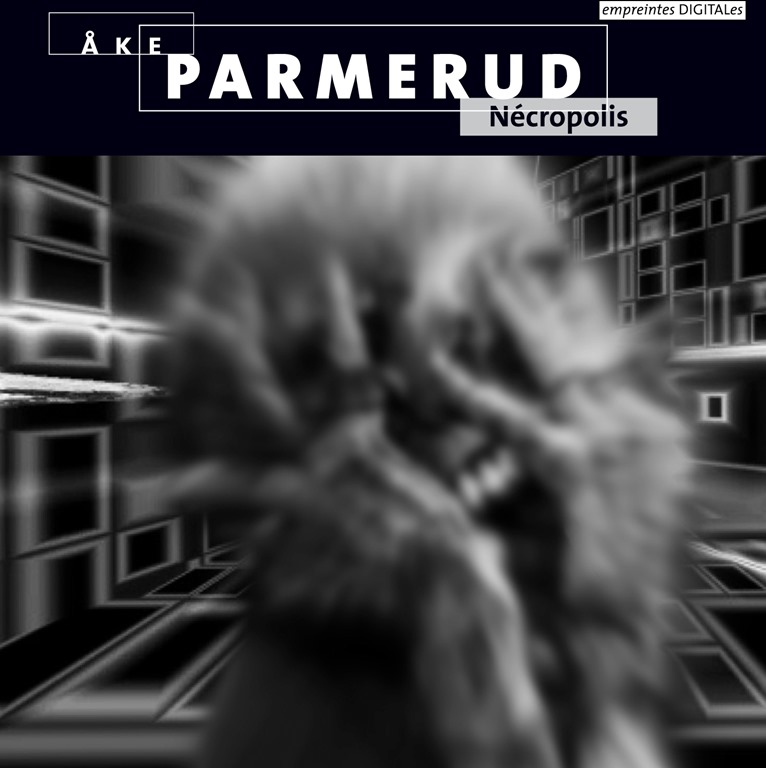
It looks like a box set. But it is, in fact, simply a CD in a box. A very elaborate box at that. It works a little like a matchbox, the interior of which folds out to reveal extensive liner notes in French and English, written by Parmerud himself, and which provide interesting and instructive insight into the four compositions. Created between 2005 and 2011, the extended pieces are united not so much thematically as compositionally, the sounds collected and collaged rather than being shaped into conventional musical frameworks.

‘Dreaming in Darkness’ is forged primarily from small sounds, spaced apart from one another. A chime, a chink or a clunk, and then silence before a scrape or a click or a bump. It’s fragmentary, the origins of the sounds unclear. Taking the question of what a person who cannot see dreams about, Parmerud explains that the piece is an attempt to create surrealistic fragments of a blind person’s dreams. As the piece progresses, the sounds become increasingly densely packed, and with longer durations and overlaid, building sinister abstract scenes: in fact, not so much scenes as shifting shadows and variations in light.

The bubble of conversation marks the opening moments of ‘Crystal Counterpoint’: a recording which sounds like a restaurant or party, the chinking of classes and general hubbub of people grows and stops abruptly with the chime of a glass. Inspired by the sounds of the parties Åke’s parents used to host, and which he would hear from upstairs, the piece uses the very same glasses to create a wealth of sounds, from long, low drones to higher hums, elongated undulations and quick, bright glissandos. Grand swells of sound rise and cease suddenly, replaced by strange, quiet drifts of sound: it’s very easy to forget exactly what you’re listening to. But if anything, awareness of the origin of the sounds only heightens the experience, as you’re likely to marvel and wonder just how glasses could sound like an oboe or high winds across mountain tops. In his notes, Parmerud notes that there already exist a large number of recordings which explore glass sounds, and it is, indeed, an interesting piece to place alongside Miguel Frasconi’s ‘Standing Breakage (for Stan Brakhage)’ (clang records, 2016).

‘ReVoiced’ moves away from musical abstraction and instead uses the voice as its instrument. A single voice is layered up on top of itself exponentially until a whole crowd of one voice is speaking. It’s actually quite a disconcerting experience. Voices are subject to all kinds of manipulation: sped up, slowed down, pitch adjusted, stretched, overlaid, echoed and delayed, in myriad permutations. Chants and dialogue and ululations, crowds and multiple languages meld together, and gradually, extraneous sounds – hard, heavy slabs of sound – crash in, while sharp-edged sounds slash for create a dull, percussive element to the slow-building torture of the familiar becoming twisted, distorted, abstracted and unfamiliar.

The final track, ‘Necropolis – City of the Dead’, is a musical tour through the catacombs of an imaginary city which contain the remains of some of the greatest music of all time. ‘But the condition of the musical bodies that rest in the crypts is unfortunately in various states of decomposition’. As such, in combining a well-worn joke (which is usually about Mozart when I’ve heard it) with a project to assimilate and deconstruct fragments of existing works, ‘Necropolis’ is a sort of a collage. Classical, jazz, film soundtracks, many renowned and bordering on recognisable, at least in essence, all fade in and out and collide against one another.

While the title track may pick over the bones of musical history, it equally breathes new life, and the same is very much true of the work as a whole: the parts are disparate, fragmentary, scattered in origin from around the globe and individually amount to not very much at all. But the sum is spectacular, an experience which is thought-provoking and which has the capacity to be quite unexpectedly affecting.

Ake Parmerud

Åke Parmerud  Online

Gizeh Records – GZH65DP – 18th March 2016

Christopher Nosnibor

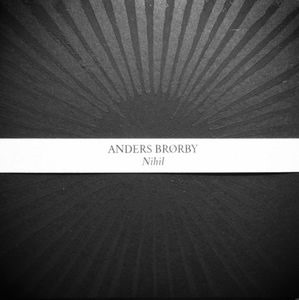
Gizeh is a label which grasps the importance of the complete music experience, and never stint on their packaging. Anyone purchasing their product can feel a tangible sense of both art and artefact, and Anders Brørby’s brooding instrumental album Nihil, the second release in their ‘Dark Peaks’ series, is no exception, housed as it is in a textured gatefold sleeve, the radiating sunburst design raised from the surface, in heavy black ink on a matt black background. How much more black could it be? The answer is none. None more black (the white paper band printed with the artist’s name and album title which much be carefully slid from around the sleeve in order to access the contents notwithstanding).

The presentation provides a suitable indication as to the sonic experience it prefaces. Nihil meaning nothing: while it has, since the 19th Century come to connote a negativity, manifesting as antagonism or rejection through the widespread use of ‘nihilism’, as of and in itself, ‘nihil’, or ‘nothing’ implies an absence. Neither positive or negative, it is simply a lack. Absolute nothing is beyond the human ken, and so, in artistic terms, there is a need to portray nothing, absence, with something. This is something Norwegian composer sound artist Brørby achieves on the 10 pieces which comprise Nihil.

Primarily, the music is dark. There is a lack, an absence, of light, at least in terms of the overall sensation it conveys. Melding elements of drone and dark ambient with more abrasive sounds, the compositions infer an experimental bent which places atmosphere at the fore. The structures are almost subliminal, the shapes of the pieces largely evolve and emerge briefly through a succession of transitions as layers of sound overlap and drift across one another almost imperceptibly. Musical forms are therefore explicitly absent, expounding the concept of ‘nihil’. As such, Nihil is a work of subtlety, and a work which bears theoretical scrutiny, and sits alongside works by the likes of Christian Fennesz, Lawrence English and Tim Hecker.

But subtlety should not be read as a synonym for sedate or tranquil. ‘As Dead as the Stars We Watched at Night’ builds layers of dark noise and swelling drones scrape and torment the nerves, and while the gentle, chimes which ripple in cadence through ‘I Will Always Disappoint You’ offer a glimmer of light and warmth, ‘Put Your Ear to the Ground’ finds a harsh, thick distorted fuzz that obliterates the smooths contrails beneath and accentuates the unrest on which Nihil is constructed. Likewise, the serrated howl of ‘From the Window Above the Lake’ conveys the anguish of emptiness.

Through the medium of sound, Brørby creates a conceptual absence (not to be confused with an absence of concept). There is no message, and Brørby does not purport to convey anything through the work beyond ‘raw atmospheres’. ‘Raw’ implies unfiltered, unadulterated, without manipulation nor refinement, and while this may not be strictly true of Anders Brørby’s creative process, Nihil nevertheless presents itself as being self-contained, a work about absence of anything but the sounds it contains. It is not ‘about’ Anders Brørby, and if anything, the artist is, if not completely absent, then very much hiding in the shadows.

It’s an album that’s best appreciated in a semi-present state, to allow the sounds to slowly wash over the senses and most of all, to be heard without preconceptions or expectations. Because nothing can often leave you with so much more than something.

Anders Brorby - Nihil


https://bandcamp.com/EmbeddedPlayer/album=4022471447/size=large/bgcol=ffffff/linkcol=0687f5/tracklist=false/transparent=true/


Anders Brørby Bandcamp

keitkratzer productions (zkr0020) (CD) / Karlrecords (KR027) (Vinyl) – 26th February 2016

Christopher Nosnibor

Reinhold Friedl’s keeping it in-house with this one, with the Zeitkratzer collective which he helms performing a reworking of one of his own pieces. Kore is a development of his earlier Xanakis [a]live! (2007), which was an homage to French-Greek composer Iannis Xanakis. Originality may be dead, but artistic evolution is not, and here we see Friedel engage fully with the organic processes of influence and appropriation, and the idea that a work is never complete but continually subject to re-evaluation, reinterpretation, reconfiguration.

Pained screeching of tortured strings, form long, agonized screams and wails. On the lower register, cavernous rumblings and ominous echoes. It quakes and trembles and teeters and bucks, crashing and lashing, a sustained and calamitous wall of sound akin to how one may reasonably imagine a galactic storm. And it goes on for what feels like an eternity, light years of shuddering textural depth stretching out and fully enveloping the senses.

While the CD track-listing shows ‘Kore’ as being presented in just two parts, its mastering in fact replicates the vinyl edition’s four sides, with each piece between 11 and 16 minutes in length. As a single entity, it crashes and grates, squalls and shrieks, grunts and groans. And it never lets up, a sustained crescendo of sonic and psychic disturbance, a tempest of clashing noise, a raging storm.

The segmented arrangement works well: for while ‘Kore’ is clearly a single body of work, there are distinguishable differences between the four tracks. The second is comparatively quieter and less intense than the first, but the tones still forge sharp shards which slice into the cerebellum. Trilling and tweeting shrilly in the upper reaches of the spectrum, dark scrapes create perilous undercurrents which build in density.

Vast crashes of sound, immense gongs of violence slice the atmosphere in the third, more percussively-orientated part. It shudders and heaves, before finally screaming onwards through the tumultuous final 11 minutes. A blasting wall of noise which assails the listener with all sounds all at once, it’s an immense sound and an immense sensation that sounds like no orchestral work you’re likely to have heard before, and, quite conceivably, nothing else you may have experienced, period.

Zeitkratzer - Kore

zeitkratzer Online

Britney – Britn3y

Posted: 16 February 2016 in Albums
Tags: , , , , , , ,

Superstar Destroyer – 11th March 2016

James Wells

Not so much a drone as a collective groaning sigh prefaces the thunderous barrage of brutal rage that splits the speaker cones with pummelling drums and bursts of screaming vocal anguish and stop/start guitar judders. ‘Fully Ben’ assails the lugholes like Truman’s Water having been tortured, brutally murdered, butchered and cast forth to crawl around in purgatory. Fuck me. Three minutes in and I’m dizzy, punch-drunk, giddy and utterly bewildered – in the kind of way I like. And that pretty much sets the tone for this most manic, frenzied albums.

Where do you even begin with this white-hot torrent of noise? The tempos, man! The jolting, jarring, spasmodic guitars! What is this? It’s not metal, that’s for sure. Noisy math-rock? Math-rock is about intricacy, and this is intricate in terms of structure and changing tempos and time-signatures, but at the same time, it’s violent, frenetic. The vocals aren’t your regular shouty, screamy effort, either– this is the sound of pure mania, derangement to the power of 10. Not so much psychedelic as psychotic, the songs – the majority of which clock in at under two minutes – melt into one another, a crazed blur of spasmodic noise.

It’s intense, but not conventionally heavy: the guitars are warped, elastic, and don’t rely on hefty distortion. ‘Neon Python’ sounds like a collision of early Pulled Apart by Horses and second-album These Monsters – only with more drugs. Seriously, what are these guys on?

There are occasional breaks – ‘Sleep Now Dogman’ provides two minutes of respite in the form of some woozy percussion-free experimentalism while someone chunders their guts up, presumably a physical reaction to the exertion of the preceding track – but ultimately, this is beyond full-on, Especially after the, er, ‘interlude’.

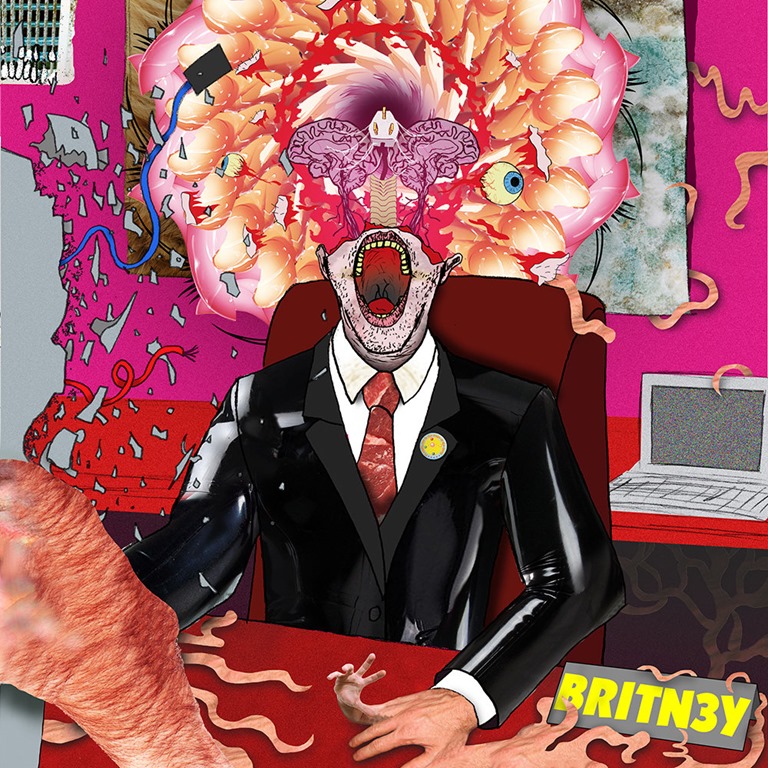
‘Boss Moggy’ goes electro-math-screamo – or something and ‘Gum’ ups the tempo and the racket even further, achieving the effect of a sonic blizzard. You don’t know where you are or what you’re listening to, it’s a total whiteout. Britn3y isn’t an album – it’s a convulsive, abrasive explosion of noise, the aural equivalent of someone’s brains bursting from their skull while they twitch uncontrollably having been connected to an open mains electrical circuit. In short, it sounds exactly the way the cover looks.

If you’re in any doubt, I mean it’s good. Mental, but really, really good.

Britn3y

Britn3y by Britney Online