Posts Tagged ‘Experimental’

Front & Follow – F&F046 – 1st September 2017

Christopher Nosnibor

Having followed Mark Kluzek’s Doomed Bird of Providence for some time now, I was keen to hear the latest instalment. Over the last six years, he and his collaborators have produced a series of concept albums centred around Australian history, all using the medium of dark folk with heavy echoes of Nick Cave. Burrowed into the Soft Sky is very much an album devised as being suited to a vinyl release, and is perhaps the most challenging Doomed Bird release yet, consisting as it does of just two tracks each with a duration of some twenty minutes. While still pursuing what the bio refers to as ‘Kluzek’s obsessive and singular foray into early colonial history’, Burrowed into the Soft Sky discards the vocal element, meaning the narrative, such as it is, is purely musical.

To understand the objective and the context of the album and the individual tracks, it’s beneficial to quote liberally from the accompanying press release.

‘The underlying themes for each track are contrasting yet tie together via their historical context; a period where indigenous Australian belief systems and day-to-day lives were irrevocably assaulted. The song Burrowed into the Soft Sky is based on a passage from Patrick White’s novel Voss. The book is very loosely based on the final (and fatal) journey through the northern regions of Australia by German explorer Ludwig Leichardt. Kluzek took a passage from the book where a comet passes over and Voss, his team and a tribe of Australian Aboriginals engage with and interpret the experience until it is ‘burrowed into the soft sky’.’

How this manifests is in a piece which exits as a sequence of gradually-shifting transitions, sparse and haunting woodwind drifting across an urgent acoustic thrum, while percussion builds, and then draws back again. Around the mid-point it bursts into a sustained crescendo, with sweeping strings cascading over an insistent, energetic beat, but for the most part, it’s less about overt drama and more about the brooding. The closing segment is a dolorous fanfare, with nostalgia-evoking horns sounding out over a slow march that finally tapers to a twinkling glockenspiel that does evoke something approximating a soft sky.

Mark Kluzek- The Doomed Bird of Providence8

The press release provides the following explication for the track which occupies side B: ‘The Blood Dimmed Tide is Loosed takes a significantly darker turn shining a light on a pattern of atrocity that took place in the north east of Australia at a time where a dynamic of back and forth, invariably initiated by colonists, took place and culminating in a “dispersal” of a tribe, “by shooting them down – men, women and children, the object being to destroy as many as possible.” This is based on accounts of such events in the book Exclusion, exploitation and extermination: race relations in colonial Queensland (Raymond Evans, Kay Saunders, Kathryn Cronin). Attacks of this nature on tribes were commonplace.’

As indicated, the track immediately plunged into darker territory, uncomfortable, tense tones forging a claustrophobic atmosphere. Strings scrape like nails down a blackboard over ominous fear chords before a militaristic imperial march emerges from a tempest of percussion and screeding feedback. This in turn coalesces into a repetitious throb, imposing and intense, which bludgeons the listener’s senses as cymbals crash violently, and by the mid-point it’s collapsed into a wash of hums and drones, interrupted by clattering flickers and subterranean moans and skitters. The closing section again builds an oppressive mood, the thudding percussion partially submerged by a swell of ever-thickening noise.

A priori knowledge of the context is by no means essential to the appreciation of Burrowed into the Soft Sky. It does of course benefit the listener to have a sense of placement, but given that the correspondence between the tracks and their inspiration / meaning is far from obvious in any case, it’s an album which can readily be heard – if not necessarily ‘enjoyed’ – on its own merits. As a work which wanders through a number of instrumental musical territories, Burrowed into the Soft Sky is interesting and rewarding.

DBOP_coverFINAL

Christopher Nosnibor

Perhaps I need a break. I love music and I love reviewing it. But looking through my to-review pile and my groaning inbox, I feel overwhelmed and despondent, disinterested even. I look at the tiles and the artists, knowing instinctively that some will leave me cold and others will irritate me. Perhaps stirring my frustration with break the ennui, but it’s almost 11p, and

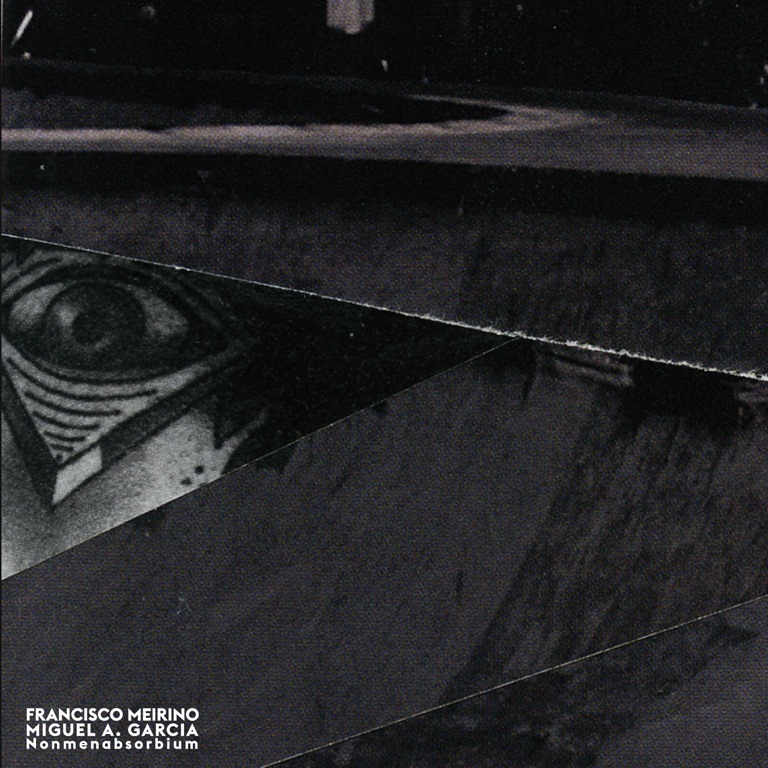
I pick up Nonmenabsorbium on a whim. The dark cover, not so much black and white as many shades of grey, from mostly within the darker end of the greys spectrum, tells me nothing. I can’t locate the accompanying press release. I’m flying blind, with only my senses and my instinct to guide me.

It’s pleasing to discover that Nonmenabsorbium contains no music in the conventional sense. No songs, no singing. No chords, no melodies, no tunes. No identifiable shapes or structures, no instruments or rhythms. Sparse, minimal drones and high-end tweets trill and hover. Thuds and thumps, sounds recorded seemingly too close to the microphone and booming through disproportionately loud against the barely-there backdrop jolt the senses. These are sounds without context and without overt structure or direct relation to one another. Often, the incidentals are disproportionate in volume to the ever-shifting grain of the backdrop, booming and crackling mic and speaker distortion as single notes ring out and resonate.

During ‘Abholicater’, the churning clatter coalesces to create a sort of arrhythmic percussive form, hammering and beating amidst a swirling swell of amorphous grey sound, which gradually dissipates to be replaced by the fizz and pop of electrostatic, shrieking diodes and the grumbling grind of low-end hum. #

‘2nd nalicii – 197degree5’ sounds very like R2D2 building for a breakdown, an electronic work based around rising frequencies which threaten to burst the tension. But it doesn’t happen. Sonar pulses radiate amidst the crackling clatter and wowing incidental of the eleven-minute closer ‘Horrorrydclowses’, as a rain of static pink noise showers down on electronic Catherine wheels. Monitor bleeps blast into cerebral flatlines amidst a relentless whupping churn and grind of static noise which owes a clear debt to the lineage which brought us early 80s Whitehouse, Prurient, Merzbow et al. Meirin and Garcia may belong to a different musical heritage, but Nonmenabsorbium is an intense sonic assault that requires a cautious approach.

The atmosphere is one of building expectation, and tension builds with the growing sense that there must be a point at which the threat of all-out noise is realised. But such cathartic release fails to materialise. Instead, the bumps and clanks are nerve-fraying after a time, and it becomes increasingly difficult to distinguish from the sounds on the disc the possibility of someone ascending the stairs, moving in the next room, stumbling around between plant pots and dustbins in the back lane or the yard outside. Consequently, the pleasure to be derived from listening to Nonmenabsorbium is perhaps a rather perverse one. Nonmenabsorbium provides an unsettling distraction, a removal from the humdrum and the sonic wallpaper of the everyday / mainstream. But, by way of escape, and also as an example of difficult but rewarding listening, Nonmenabsorbium offers an immersive and awkward sense of entertainment.

Francisco Meirin Miguel A. Garcia

23rd June 2017

Christopher Nosnibor

Ashley Reaks’ relentless release schedule continues apace with the arrival of Track Marks, his eleventh album. Because it’s an Ashley Reaks album, it’s characterised by off-kilter experimentations in dub and socio-political commentary. But whereas jazz provided the core influence on 2015’s Growth Spurts, it’s spectacularly spacious prog-rock wizardry that arrives fresh on Track Marks to bring the all-important new, unexpected and so-incongruous-it-shouldn’t-work-but-somehow-does feature of the material.

‘Stale Mate’ opens the album with a suitably eclectic mix of ingredients, with the blippy electronica of the opening bars immediately being submerged by one of the wandering basslines that define Reaks’ output regardless of what he’s doing. Somehow it moves from here to ultimately culminate in a knowingly gratuitous guitar solo.

‘I’ll Take My Pilgrimage’ is seemingly about as much a yearning to find faith as a criticism of religion per se, and melds a stormy, rolling drum to another phat bassline and some progtastic guitars and synths, while packing in some jazzy sax too. The jazz direction, which came to the fore on previous album, Growth Spurts, becomes increasingly dominant as Track Marks progresses. ‘Exposing Fiona’ gets pretty wild in its horn-parping intensity.

‘Stick Thin Worms’ pitches a stomping rhythm beneath some more abstract lyrical content, while poet and bluesman Paul Middleton (who hails from Reaks’ hometown of Harrogate) provides spoken word on ‘Tank From Grimsby’, which continues the extending thread of collaborative efforts which have become stablished as a feature of Reaks’ receny output. It’s actually a piece about some musicians, and marks a departure into mellow flamenco guitar.

If it all sounds like overload, it’s credit to Reaks that somehow, it all hangs together with a remarkable cohesion. It’s not immediate: one has to first surrender to the strangeness, the otherworldliness that Reaks creates. But there are some – many – undeniably great musical moments here. They’re not preoccupied with hooks or choruses, but there’s a certain atmosphere that envelops Track Marks – an album where the darker second meaning is (wisely) left unhinted at in the cover art. And once again, it’s Reaks’ refusal to pursue any obvious avenue which is the key to his success as an artist. Whether it’s a detriment to him in commercial terms, well, who knows? But that’s not what he’s about, and precisely why he deserves respect and attention.

cover

Ipecac Recordings – 7th July 2017

Christopher Nosnibor

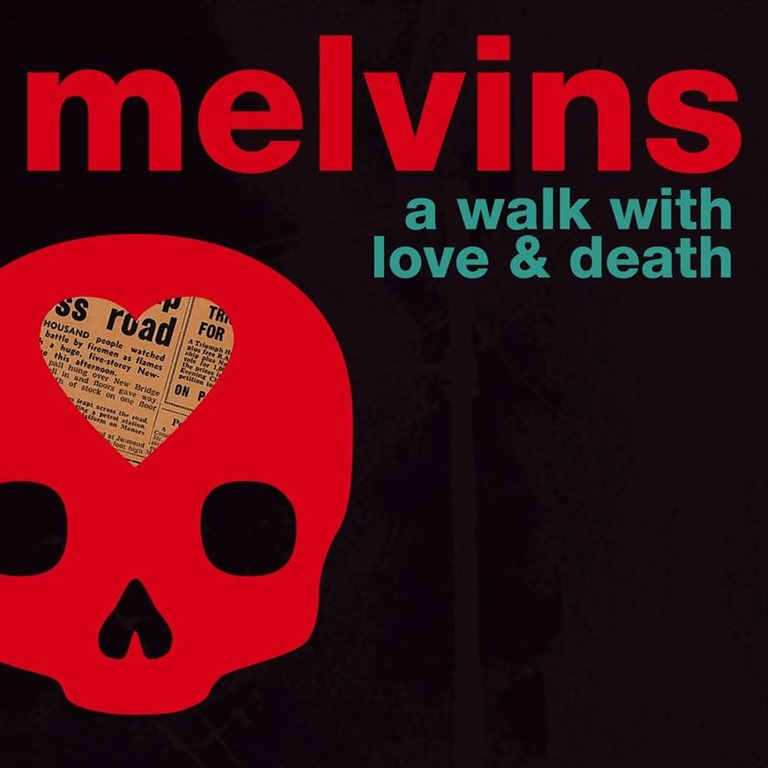
Melvins’ 415th album since their formation in the Mezozoic era is a double: their first. As if the founding sludgelords, the masters of the megalithic, needed to take it to another level of epic indulgence. A Walk With Love and Death isn’t exactly a concept album, as much as an album of two halves. So says the press release. If anything, it’s actually two distinct albums released together: Death, a proper Melvins’ release and Love, the score to the Jesse Nieminen directed, self-produced short also titled A Walk With Love and Death.

But of course, it’s a Melvins album. Which means that, fundamentally, it sounds like a Melvins album. That’s no criticism: I want a Melvins album to sound like a Melvins album but then, would it ever sound like anything else?

They really make full use of the double-album format for this outing. It begins with a slow-building, expansive six and a half-minuter that has echoes of ‘Mine is No Disgrace’ from The Crybaby, but instead of erupting into a blistering wall of noise, keeps the focus tight on a proggy trip with a vaguely psychedelic hue.

‘Sober-delic’ follows, a mid-tempo trudge which also stretches beyond the six-minute mark and ‘Euthanasia’ is vintage Melvins, a hefty sludge trudge with heavily treated vocals. ‘What’s Wrong With You?’ is a warped psychedelic stoner rock tune with a twisted pop edge, propelled by a thumping bassline and wild guitars. The nine songs which make up the Death album don’t exactly offer up any surprises (which is arguably a surprise in itself given the band’s wildly varied output over the last 30 years), but do deliver a Melvins album that’s as solid as anything they’ve done. It brings the grind. It hammers with the riffs. It’s sludgy, grungy, yet packs some great pop moments. And what at times it lacks in terms of attack, it compensates in scale, with the prog leanings of ‘Flaming Creature’ partially submerged by the low-end churn that they’ve made their own.

Commencing with a vaguely experimental intro track, in which mellifluous piano notes drift through the sound of chatter, the Love set is a very different proposition. The fourteen tracks are shorter and stranger, leaning toward noisy ambience, and find Melvins revisiting the kind of territory explored on Prick and the playfully perverse ‘Cowboy’ single from the mid ‘90s.

When they do actually play tunes, it’s whacked out, trippy psychedelic pop or fucked -up jazz: ‘Give it to Me’ is a zany, mess of doodling Hammond organs and theramins duelling with thumping percussion that’s pure 60s garage. But mostly it’s weird shit like ‘Chicken Butt’ and ‘Halfway to Bakersfield’, and it’s all very much ‘what the fuck’?

It’s Melvins’ eternal capacity to confound which is an integral aspect of their enduring appeal. It would be so easy, and no doubt more career-savvy to work to their tried and tested formula and to put out an album of straight ahead sludge rock every two to three years, instead of going off on infinite tangents and releasing two albums a year. But the fact is, they’re actually very good at producing weird, far-out experimental shit, and the results of some of their collaborations have been as strong as unexpected. It’s their drive to create, and to endlessly push in so many different directions which keeps Melvins fresh, and above all, relevant.

Melvins - Love and Death

SOFA – SOFA 557 – 21st April 2017

Christopher Nosnibor

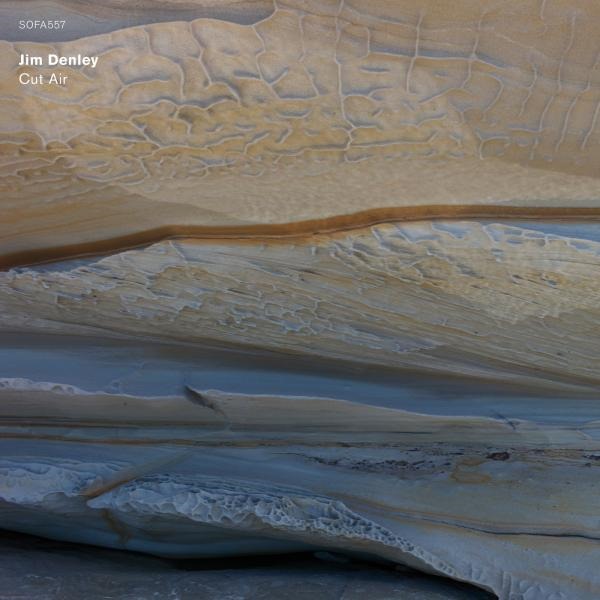
Antipodean multi-instrumentalist, composer and experimentalist Jim Denley has been playing the flute since 1969 and has a formidable reputation in his home territory, not to mention an extensive resumé.

Denley has a preoccupation with location: as there is no flute tradition in his native Australia, his aim – according to his biography – is to situate his music within a global outlook, and takes is cues from flute traditions from other parts of the world, spanning Europe, Papua New Guinea, the Far East and the Amazon, and, in particular, the flute traditions of the Solomon Islands. There is always something to learn: with a background very much rooted in western music, particularly of the post-punk period and beyond, the fact that there are specific regional flute traditions is something I was unaware of. I suspect this is not something unique to me.

Denley is clearly immersed in his research of the traditions which inform his work, in particular this album, with the album’s second longform track, ‘For Celina Rokona’ dedicated to a flautist from Ataa in North East Malaita, who played the Sukute, described as ‘a curious combination of flute and percussion’. Who knew that the flute had such a lengthy and diverse, pan-continental history, or that there were so many hybridisations across the continents? This does perhaps explain why the two nineteen-minute compositions on Cut Air sound precisely nothing like any flute I’ve ever heard.

I’m unclear, after listening to Cut Air, if my knowledge and understanding of these various traditions is any more advanced. Aside from moments of fluttering, tweeting, looping harmonics much of Cut Air consists of quiet. It consists of interloping notes which quiver and quail, tremble and tremor. The air isn’t explicitly cut, but subject to soft, massaging vibrations which alter its movement, softly, subliminally, imperceptibly. This is not an immediate or direct work, and it’s very much an album which requires a degree of patience as it hangs, unobtrusively, in the background.

Jim Denley - Cut Air

Drid Machine – DRM27 – 21st March 2017

Christopher Nosnibor

Having looked over all of the tabs I had open on my computer I had to pause the disc three minutes into the first track. I was confused, I was convinced there were two songs playing at once – one woozy ambient piece, drifting and warping, and a whacky jazz-grunge effort. My head was beginning to spin. Jungle drumming and scrawking bass undulations collide with tearing guitars, weird synth incidentals and all kinds of other extraneous sound effects to create a sonic experience that’s quite bewildering on ‘The Approaching of the Disco Void’. It’s ten minutes of musical mayhem.

The golden oriole is a type of bird, binomially known as oriolus oriolus (which is considerably more pleasant-sounding than the ‘turdus’ genus of the thrush species). According to the go-to source for all information about everything, the call of this extremely common migratory bird ‘is a screech like a jay, but the song is a beautiful fluting weela-wee-ooo or or-iii-ole, unmistakable once heard.’ There’s nothing beautiful or fluting about this freeform chaotic din. This is not a criticism: freeform chaotic din is better than good with me.

The album’s shortest track, ‘The Chrysopoeia of the Trilithon Ass’ is also it’s wildest, a Beefheartian frenzy of discord and multiplicity (I’m recalling the traumatic experience of hearing ‘Trout Mask Replica’ for the first (and only) time, a record that sounds like standing in a hallway listening to seven people, all drunk, playing different tunes in seven different rooms which all open onto said hall.

The hectic percussion drives through a wall of feedback and a grinding, deliriously unpredictable, stabbing bass on the third and final track, ‘The Pyrite Wink’. It’s a nine-minute exercise in working a wonky groove with relentless and increasingly wayward energy, until it collapses in a crackle of overdrive and howling trails of feedback.

As freeform chaotic din goes, Golden Oriole stands as a cacophony of quality, but likely best absorbed in small doses.


golden-oriole-golden-oriole

ti-Records – TIRECS004

Christopher Nosnibor

What do you need to know about this album? Well, GIW is the solo project of trumpeter & performer Pablo Giw. He hails from Cologne, Germany, and Never is Always is his debut album.

‘Morning Machine’ finds Pablo spin some rhythmically-intoned spoken word that’s archetypally beat in its style and delivery. Slow, subsonic trip-hop beats glitch beneath warping free jazz parps which cut their way across spaced-out drones.

A nagging looped motif provides the core of the framework of ‘What’s Outside Isn’t There’, and it’s around this that changes in tempo and tonality, force and spirit that the atmosphere and mood of the piece shift over its duration. The blurb describes GIW as ‘having electronic music in mind, but creating it by acoustic and instrumental means’, and while there are times when his plays the trumpet like a trumpet, over the course of the album’s eight tracks, he demonstrates a stylistic eclecticism and inventiveness that’s hard not to admire.

Never is Always finds GIW striving to ‘redefine his role as a trumpet player and us[ing] his instrument as sound generator for complex harmonic layers, a drum machine or as a filter for his voice. It’s when GIW pushes his boundaries the furthest that he’s most impressive and successful compositionally, and while the more obviously trumpet-led, jazz-flavoured compositions like ‘The Golden Calf’ aren’t short on late-night hot city isolation tension and atmosphere, even with the swaying rhythms which underpin its loose groove. Far more interesting are the swelling cathedrals of unsettling noise which form the fabric of the short but intense cracking blast of ‘Right Endeavour,’ which forges a dense noise which is both electro and other-wordly in its manifestation.

If the dreamy soul which occupies the first half of ‘I Saw You – Trouble’ is unremarkable s of and in itself, the fact it sounds like it’s a synth tune is indicative of Pablo’s technical abilities, and when it skips into darker, glitchier terrain around the mid-point, the context is rendered even more impressive.

‘Hain’ barrels into avant-garde technoindustrial territory, with clattering, clanking percussion and blasts of white noise that calls to mind the experimentalism of early Cabaret Voltaire or Foetus.

Never is Always is nothing if not varied in its approach and style, and in being something of a mixed bag isn’t wholly consistent. However, it would be wrong to be overly critical, and not only because it’s GIW’s first effort but because it’s the work of an artist willing to explore, to experiment, and to throw it all out there. It’s less a matter of variable quality as a matter of taste, and while I abhor anything that whiffs of ersatz Beatnick bollocks, that’s just me, and what really matters is that Never is Always is an ambitious and eclectic effort which shows that we’re looking at an artist with substantial and possibly unique potential.

TIRECS004_front

Sub Rosa – 6th March 2017

Christopher Nosnibor

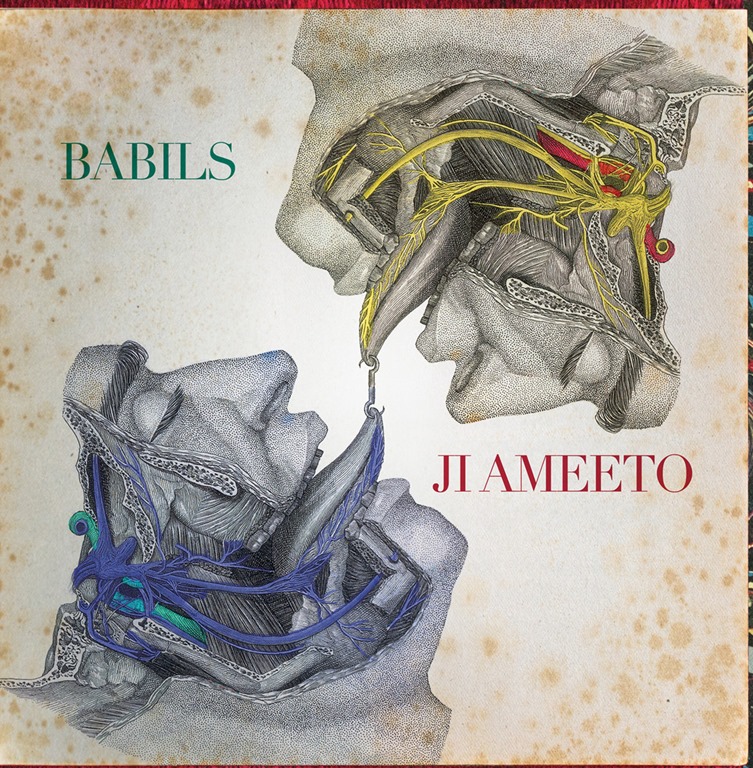
Hey, I’m a sucker for any band who mixes rock, new wave, psyche, kraut, experimental and repetitive music. Consequently, I was sold on the pitch or Babils’ fourth album even before I’d slipped the disc into the player. Reduced to a five-piece following the passing of co-founder Michel Duyuck in November 2014, Ji Ameeto represents the first release of the Brussels-based collective without Duyuck.

The album contains just two tracks, each around the sixteen-and-a-half minute mark. The title track is one of those swirling psych-hued expanses which find layer upon layer of sound emerge, converge and diverge at an infinite array of angles. And all the while, the rhythm section keep on plugging away, thumping out a hypnotic, motoric beat and locked-in bass groove. If my opening sentence reads sarcastically or as being somehow facetious, that’s only partly the case. There is something about long songs that go on and on and on that I find hard to resist. Perhaps it’s an extension of Henri Bergson’s theories on comedy, whereby he suggested that repetition was a key facet of successful comedy, to music that render such heavily repetitious grooves so compelling. Or perhaps it’s the fact there are effectively two songs going on here: the unstinting, relentless rhythm section which hammers on down an unswerving path, countered by everything else, not so much a hotchpotch of incidentals but a succession of fragments and slivers of songs overlaid in top of said rhythm section.

‘C’est la raison pour laquelle nous ne cesserons jamais de recommencer’ throws together a spaced out baggy bassline and shoegaze guitars – and production values – with dark, gothic overtones. Honking horns bleat wildly at incidental junctures, while spiralling guitar breaks rupture from the vast foggy vistas conjured from the swirling sonic depths. At times a cross between The Cure’s Carnage Visors and early Ride, but at the same time altogether more immersive and ‘druggy’ sounding, it’s a disorientating composition which not only celebrates but positively hinges on the contrast between the dissonance and weirdness of the lead lines, and the consistent solidity of the bass and drums as they drive onwards towards the horizon, holding down the same grove for an eternity and more.


Babils

Nakama Records – 27th February 2017

Christopher Nosnibor

You think of the human voice and you’ll probably immediately cast your mind to speech and singing. But the extremity of the range of the human voice is truly remarkable, and extends far, far beyond these limited parameters. Index sees Oslo-based Agnes Hvizdalek explore, over the course of forty-seven minutes – mastered as a single track – the potentials and possibilities of her vocal cords. The CD’s packaging offers nothing but a fingerprint by way of an explanation, but thankfully, the accompanying press release assists with the provision of context and framing the ‘pure vocal sounds that oscillate between fragility and levity, in the most well-shaped musical manner’ by explaining the way in which they’re ‘interwoven with, and set in contrast to the buzz of the city sounds and the building acoustics’. That city buzz is São Paulo, and the album was recorded at the bottom of a 60-metre-high chimney at the old factory “Casa das Caldeiras” in the heart of the city with the world’s largest helicopter fleet. As such, Index captures the correspondence between the individual and environment as well as exploring the limits of the individual themselves.

It perhaps goes without saying that this is about as far into avant-garde territory as it possible to get: a work of pure experimentation, of parameter-pushing and prioritising process over end product. That doesn’t mean that Hvizdalek’s concept is entirely original: Mike Patton’s Adult Themes for Voice (1996) stands as a bewildering document of one man’s immense vocal capabilities. It’s largely unlistenable, at least in anything more than small doses, but at least it’s broken into bite-sized chunks of sonic derangement. Hvizdalek makes no such concessions to accessibility, and while many of her vocal acrobatic are less extreme than Patton’s, Index is nevertheless a hugely challenging album, a morass of saliva and tongues and brain-bending bleating and blowing.

To describe the various sounds would be essentially pointless – not only dull, but abjectly failing to convey the actual experience of the album. So, Hvhizdalek hums and drones, wheezes and moans, ululates gutturally and breathes like a bellows. She squeaks and snarls and snarks and spits. But what’s remarkable is that while at times she sounds perfectly human and natural, oftentimes the sounds issuing forth from the speakers sound like no creature on earth. And yet the bewildering polytonal rasps and drones sound like no instrument known to wo/man either.

There’s no way in the world anyone is ever going to sit down and play this album for pleasure. I write as someone who’s actually spent the best part of an hour with these sounds rippling and bouncing from the speakers wired to my laptop wearing pyjamas and a bemused expression. A part of me feels obliged to give the album at least one more run-through, but the fact is, while I have absolute admiration for Hvizdalek’s artistic commitment and vision, I simply can’t face it, at least not now. This is absolutely no sleight on Hvizdalek’s work: Index is a true work of art. It’s a work to ponder, to reflect on and to sample when the mood takes. This may not be often, but in a world cluttered with sonic wallpaper, there’s a real need for an album like Index.

Agnes Hvizdalek – Index

Play Loud! Productions – PL063LP

Christopher Nosnibor

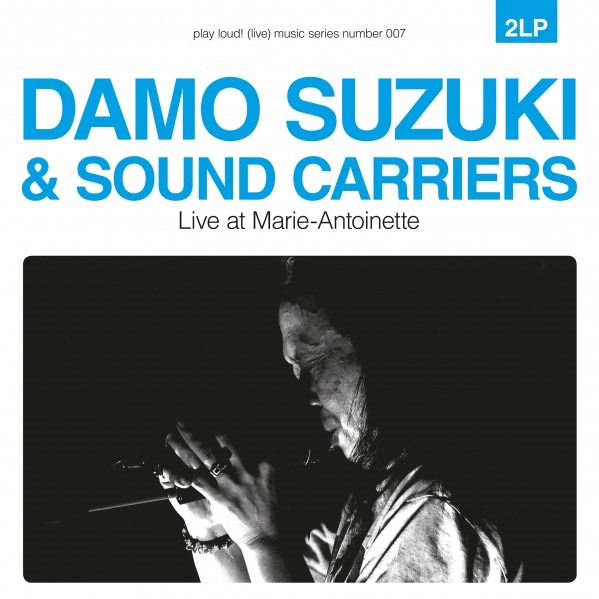
Mark E Smith is not Damo Suzuki. Only Damo Suzuki is Damo Suzuki. Damo Suzuki requires no introduction, of course. However, his vast and almost immeasurably influential output seems to exist almost in the ether, his own name and that of CAN being names to conjure with, but perhaps carrying more connotations than actual connection.

Suzuki’ status as an innovator and a one-off requires no comment, either. The fact he’s been going for multiple eternities, and continues to perform sets that are completely off the wall means his reputation remains unharmed, and this release – one more addition to already impressive body of work which essentially stands to define Krautrock – won’t dent that.

As the title suggests, this set was recorded live at Marie-Antoinette, Berlin, Germany, on 24th November 2011. Damo Suzuki was joined on stage by a stellar lineup, consisting of Dirk Dresselhaus (Schneider TM, Angel) on electric baritone guitar and effects; Ilpo Väisänen (Pan Sonic, Angel) on electronics and effects; Michael Beckett (kptmichigan, Super Reverb) on electric guitar and effects; Claas Großzeit (Saal-C) on drums and percussion, and Tomoko Nakasato (Mio, JINN) on dance and electric rake. No, I have no idea what an electric rake is, but on vinyl, each of the album’s half-hour tracks occupies a side of the two-disc set.

Ordinarily, live releases take the best cuts, or the single best night of a tour. Dirk Dresselhaus’ comments which accompany the release suggest that this recording doesn’t necessarily follow that rule, and instead presents an honest account of a singular event: “I find it fairly difficult to say something about how the music in this concert came about, cause we didn’t plan or rehearse anything and hardly were able to hear each other on stage. Wherever it came from, the energy and course of this concert is very much based on group dynamics and an almost telepathic sort of communication, like a swarm of fish. When I mixed the sound later on in the studio I discovered a lot of weird things on the separate tracks: for example Kptmichigan’s guitar signal is changing level for about +/-30 dB once in a while which is a lot and was probably caused by a broken microphone cable. Luckily the fucked up parts made the sound even heavier and more distorted instead of destroying it,” he says.

At times the lack of planning and rehearsal is apparent, but in the main, Live at Marie-Antoinette captures a collective who are capable of a rare musical intuitiveness. And whatever it may have sounded like on stage, and regardless of the occasional stab of feedback and errant extraneous intrusion, the recording captures a tense, atmospheric musical soundscape which transitions across the various parts with a creeping stealth.

To draw attention to any one passage would be to entirely misrepresent the overall arc of the performance. From the tribal chants to the undulating synth-like tones to the slow-building crescendos and the sustained sonic blitzkriegs which absolutely tear through the curtains of sonic decency, each and every aspect of the set is integral to the overall experience, which is built around a series of ebbs and flows, often rising from next to nothing to a whorling tempest quite unexpectedly. And it’s true that the colossal peaks are accentuated by the shuddering volume and crackling distortion they produce. Sometimes, fucked up is good.

This is all part and parcel of the live medium: while the studio affords total control over every aspect of every element of the sound, when playing live, anything can happen. The real test of a band’s capabilities is how they deal with the unexpected eventualities and how they deliver the show to a crowd under adverse circumstances. There is no audience sound on Live at Marie-Antoinette, which means it’s impossible to gauge the audience reaction to the show. But the sound balance suggests the audience were subjected to a punishingly loud and challenging set. It’s probably one of those rare live albums where the recording is more pleasurable than the actual event.

http://playloud.org/archiveandstore/trailers/damosuzuki/trailercode.html


damo-suzuki-sound-carriers-live-at-marie-antoinette