Posts Tagged ‘Environment’

‘Mars On A Half Moon Rising’ is the first video from The Sound, the solo debut of much-travelled musician / producer / arranger / painter Knox Chandler. This project is a musical / visual memoir depicting the shift in his surroundings from the urban to the rural, specifically the Connecticut shoreline off the Long Island Sound and the impact of this dramatic change of environment on his consciousness and the art-work that leads to.

At The Sound’s core is Chandler’s “Soundribbon” style of meditative, powerfully cinematic instrumental performance on guitar, accompanied by upright bass and percussion which comprises the audio component of the release. The visual portion is a book of paintings, photographs, sketches and written meditations, interpreting nature through technology. The blending of these mediums is Knox’s attempt to make the diaristic intent of his music explicit. The Sound is being released on Knox’s new label Blue Elastic on May 30. The album is available on digital download and on streaming platforms on its own, or the book comes with a download code. I hope you’ll consider covering Knox with an interview, feature, news story or album review.

Knox Chandler’s career has spanned for over four decades including long stints as a member of The Psychedelic Furs, Siouxsie and the Banshees and the Cyndi Lauper band, extraordinary experiences in recording and performing live around the world. Chandler’s also performed, recorded, arranged and produced, working with acts such as REM, Depeche Mode, Grace Jones, Marianne Faithful, Natalie Merchant, Tricky, The Creatures, Dave Gahan Paper Monsters and The Golden Palominos etc.

Knox spent a decade residing in Berlin, Germany, while he explored sound-scaping. He developed a technique he calls “Soundribbons”, which he recorded and performed in its own right as well as applying it to different genres and mediums . He composed, recorded, toured, produced, and wrote string arrangements for Herbert Grönemeyer, Jesper Munk, Pure Reason Revolution,The Still, TAU, Miss Kenichi and the Sun, Mars William’s Albert Ayler Xmas, Rita Redshoes, Them There, The Night, etc. While living in Germany received a Post Graduate certification in education and was the head of the guitar department at BIMM College.

AA

Knox Chandler

Room40 – 3rd January 2025

Christopher Nosnibor

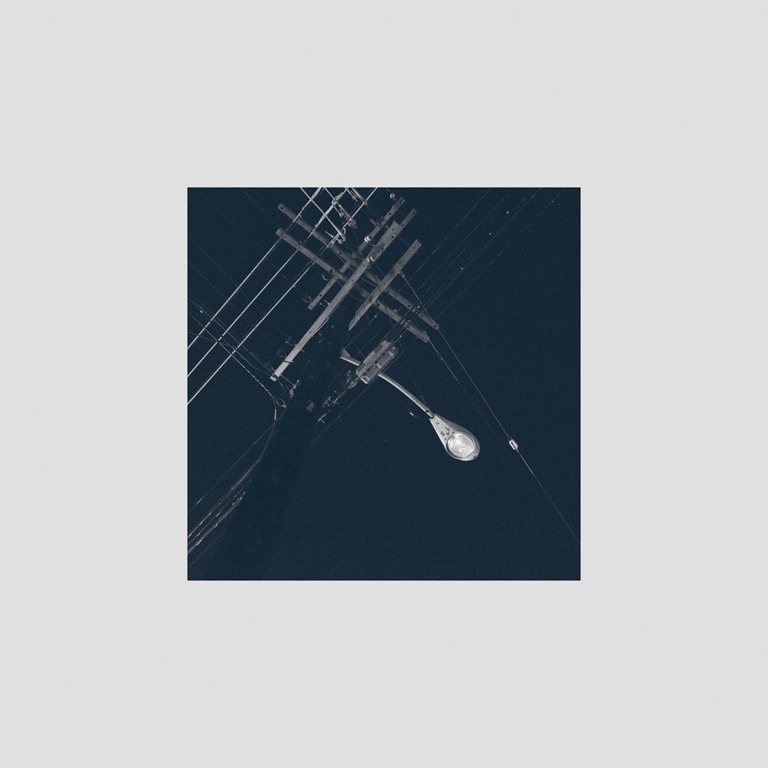
Ian Wellman’s works are usually responses to environmental issues, be they derived from articles covering global matters or more immediate or personal situations. His latest, Can You Hear The Street Lights Glow, sits very much in the latter category, as he details in the accompanying notes, which I shall quote in full:

I moved to Pasadena during the fall last year. One of the first new sounds I noticed were the mercury-vapor street lights that filled the air as the sun went down every evening. Under the sidewalks, exhaust vents hummed along to the song of crickets and the rumble of traffic. Being away from the inner city, more individual details in the soundscape emerged.

As a way to explore the new area, I walked around at night with my equipment. I placed geophones and contact mics on every metal surface I could. I ran electromagnetic sensors across electronics accessible by the sidewalk. I put mics out on quiet streets, behind shopping areas, and in parking lots. I felt very compelled and inspired to listen and learn about my new home. Can You Hear The Streetlights Glow? is the result of these listenings.

Certainly, the first part of this is something I find quite specifically relatable – not due to relocation, but to finding myself suddenly discovering a heightened awareness of my immediate surroundings. Like many people, I used to walk around with earphones in, listening to music to cut out the noise around me. This was essential on my daily commute, as listening to music as I walked through town created a separation between home and work, and while on the bus from town to the office, it shut out the babble of other people, and created a barrier between myself and anyone from work on the bus who may have been inclined to strike up a conversation. And on the way home, the same was also true but listening to music also helped me decompress – or mirror my angst – after a day in a noisy open-plan office. Lockdown changed that. I suddenly felt the need to be alert in case of approaching runners or cyclists or people kicking off in queues for the supermarket because someone wasn’t observing the two-metre rule or otherwise losing the plot over COVID restrictions. In short, I was scared – terrified, even. Not so much of the virus, but other people. I felt I needed to be on high alert at all times, because people are simply so unpredictable. One byproduct of this was that when I left the house form my allotted hour of exercise, I became acutely aware of the quietness – the absence of the thrum of traffic, the absence of chatter, and in their absence, I could instead hear the wind, birdsong, my own footsteps. In fact, I could hear everything. In the quiet, the small sounds were suddenly so much louder. The quiet wasn’t nearly as quiet as it first seemed. It was the aural equivalent of one’s eyes growing adjusted to the dark.

The auditory voyage of discovery Wellman charts on Can You Hear The Streetlights Glow bears clear parallels to my experience, but takes things a step or three further with his use of an array of equipment in order to capture sonic happenings in these spaces and his interrogation of the sounds in order to reach a deeper, more intimate understanding of his environs.

The results are quite fascinating, and range from a cluster of brief snippets, of under a minute and a half to just over two minutes, to more expansive segments – 5G Antenna Power Box is almost five and a half minutes, and ‘Mercury-vapor Lights’ is a full twelve and a half minutes in length. The titles of the pieces are location-specific, and some are quite evocative in themselves – notably ‘Time Depleting on Bird Scooter’ and ‘Gas Pipes Behind Smoothie Shop’. On the one hand, they’re utilitarian in their descriptions; on the other, they create an image of a filmic world in which sound events happen in particular places.

Most of those sound events are different levels of hum and drone, but these varying levels of low-level throbbing serve as reminders of how mankind has interfered with the naturally-occurring sounds which are the true sounds of the outdoors. While I am likely to note the hum of the power lines as I pass a pylon, and so on, I am still attuned to the wind in the trees, the scurry of squirrels. The sounds on Can You Hear The Street Lights Glow are all entirely man-made, mechanical, and despite Wellman’s relocation to a more rural setting facilitating the opening of his ears, the locations are all noteworthy for their constructed, non-natural nature. People may interpret this differently, and Wellman’s intentions may have been different again, but the leading thing I take away from this is just how hard it is to truly escape the mechanised world we’ve made. But equally, Can You Hear The Street Lights Glow is a document which highlights the extent to which even in silence, there is sound – lots of it.

AA

a1805176232_10

Anyone who has been paying attention will know that the human race is in a perilous position. We inhabit a planet that is overheating and being drained of the resources needed to sustain a healthy balance for the life which exists upon it, while our politicians indulge in pointless regional wars, or blinkered domestic bickering; anything to avoid having to make the unpopular decisions which may help mitigate the effects of humanity’s selfish excesses. We can’t last forever, so what happens after we’re gone?

Williams’ new single is a journey (literally, in the case of its dazzling video) – hard, hyperactive synthetics melt into Duane Eddy guitar licks, before the choirs and orchestras (several of each) join the stampede to a coruscating climax.

The earth will heal just fine without us. That’s what will happen after we’re gone.

AA

e146118021b521fe2c2d4566bbe3a4bba918d565

Neurot Recordings – 23rd February 2024

Christopher Nosnibor

The band’s website contains, if not exactly a manifesto, an eye cast over the world in which we find ourselves here in the early weeks of 2024: ‘Human singularity, a third world war, scorching deserts, rising seas – it’s all coming for us. The slow grind is already in motion, pushing concrete, bodies, Teslas, skyscrapers, shacks, banks and bitcoin into a collective abyss. Piles of discarded trash will inherit the earth. It’s anyone’s guess as to what happens next. Is this the end of the world? Who knows. Who cares? Stand by with the rest of us and watch it burn. We’re all guiltless. We’re all blameless.’

Here, then, we come to learn the origin of the band’s name, a grim, grimacing irony condensed into a single word. This articulates the sense of pit-of-the-gut despondency we should all feel when we look around us. The drivers to take to the roads in their SUVs to drive five minutes up the road for the school run because it’s raining doing their bit to ensure it’s going to rain a hell of a lot more; the moneyed who jet off for their annual skiing holidays who bemoan the lack of snow without for a second considering the fact that they’re the reason there’s no snow, may be small-scale compared to Shell declaring profits which are double the UK’s climate funding and being pressured to can their ‘green’ strategies in order to siphon off even more for their shareholders, but the point is, we could all do better, much better, but simply none of us is truly willing to sacrifice comfort and consumerism for a future they can’t comprehend.

The accompanying press release delivers a similarly positive pitch, telling how ‘Guiltless creates apocalyptic soundscapes in their imaginings of the surreal return to proto-human civilisation, as well as what life might be like for the survivors of the next mass extinction event on Thorns.’ Prepare to be harrowed, people, prepare to be harrowed. But also, prepare to take a look in the mirror: do you need to buy products from Nestle and Unilever? Do you have to shop at Tesco and Amazon, or are their local business you can buy from? How about loose fruit and veg instead of packed in plastic? And do you actually need that thing, the latest phone model, the delivery from McDonald’s? It’s a tough one: the majority of people who are most driven towards such basic convenience choices are on the lowest wages and are the ones generating the wealth for the rich cunts who will happily watch the earth burn rather than pay tax. You might think they’d grow a conscience for the future their children will find themselves in, but they’re banking on shipping off to Mars before the half of the world that isn’t incinerated is under water. Hey, they can probably take a few polar bears and pandas along, too.

Thorns is twenty-four minutes of hellish bleakness. It’s an EP to play when you’re in the mood for basking in bone-breaking blackness. ‘Devour Collide’ begins deceptively gently, a hum of extraneous noise which is overtaken by some gentle guitar and an understated bass, propelled by rolling toms – then forty-six seconds in, everything slams in, hard and heavy, the distortion rages and the snare crashes like a tectonic event. The riffage grinds to a crawl and churns it way to crushing lows, while Josh Graham’s raw, ravaged vocals sound as if his larynx has been scorched by fire and pollution. It makes for an utterly punishing six-and-a-half minutes, and sets the tone for a truly monstrous set.

It’s a thick blast of flanged guitar which powers in on a wave of thunderous drums on ‘All We Destroy’. It’s a criminally underrated and underused effect, and one which is far more versatile than is perhaps appreciated, with the capacity to create brittle metallic tones with quite the old-school goth vibe as well as sweeping swirls – and it’s a bold ‘whoosh’ which yields to a thick, sludgy grind, as dense and heavy as a mudslide. ‘Dead-Eye’ delivers repeated punches to the gut with its lurching, lumbering low-end tumult, jarring, sinewy guitars and clattering, slow, slow, slow drumming reminiscent of early Swans, but with a doomy metal aspect. It makes for a long and challenging five-and-a-half minutes, which leaves you drained, physically and mentally, weak in the limbs and gasping for air in the wake of its devastating intensity.

The EP’s closer, ‘In Radiant Glow’ starts slow and low, and as such, it’s vibe is classic Neurot. And then, just around a minute in, BOOM! Everything slams in and hits like a tsunami. It’s utterly punishing – and rightly so.

It’s perhaps fair to say that everything is fucked. As I write, the UK government is adamant that it’s bombing of Yemen and a growing number of countries in the Middle East is ‘not an escalation’, while continuing to give support to Israel’s ‘right to defend itself’ against Hamas. No-one would reasonably deny any state’s right to defend itself, but can anyone really justify 25,000 deaths and rising daily as ‘proportionate’ or ‘defence’? Meanwhile, Russia continues to pound Ukraine, and shareholders in weapons manufacturers like BAE Systems are making a killing from all the killing. Well, might as well make as much as you can while you can, eh?

And so, here we are. Twenty, twenty-five years ago, you’d have been labelled an apocalyptic nutter for stressing out over the future and over climate change. Sadly, big business and cunts like Trump and his supporters still will, raving about the ills of wind farms and favouring fracking and nuclear power instead. Even when Venice becomes the new Atlantis, they’ll still be saying the same. But there’s no escaping now that we are fucked. Guiltless know it and they’re not here too win anyone over or to change anything, because they recognise that it’s too late and it’s all utterly futile. Thorns is a dark document which faces the grim reality. Its purpose is not to offer solace, but simply solidarity for those who also realise that we’re on a one-way road to oblivion.

AA

527031

Christopher Nosnibor

Live music tends to follow a fairly standard format, namely where artists perform on a stage either in a conventional venue, or outdoors if it’s a festival. Punters traipse in, stand around, talk (sometimes through the performances) and file out again, and judge their enjoyment based on the merits of the performances and the sound and perhaps the company. Music performed in conjunction with art tends to be installation-based in some sense, and the music then finds itself relegated to a secondary position. It was only on arriving at the Leeds Industrial Museum in glorious sunshine that I began to consider the fact that while field recordings are an essential part of a huge array of musical works in the more experimental and avant-garde fields, and that there’s a huge body of musical work which is concerned with responding to and working with specific environments, it’s rare for an audience to experience the music and the environment from which it originated simultaneously.

Having seen the event – and it is an event, not a mere gig, not even simply a night of music, but something that, as the evening progresses, I realise is something that will stay with me as an experience, something different and really rather special – was in the museum, I assumed it would simply be in the museum. To arrive at the PA required walking the full length of the labyrinthine factory space, packed with weird machinery and other abstruse-looking contraptions. Some were operating, clanging and banging away. Following the arrows, we arrived at the sewing room, where NikNak is spinning discs and adding some wild flavour to the established tradition of scratching. I assume the bar is just around the corner and that we’ll be assembling in or near here, so move on with a view to returning. Follow the arrows. Follow the arrows. I try not to panic that getting out again is going to add quarter of an hour to my walk back to the station, and instead marvel at the displays. I’m not really digesting: the museum is looking like a full day’s exploration, and I make a note to return before too long.


DSC_0560DSC_0558

Eventually, we stumble into what appears to be some kind of old engine house. Past that, the bar and toilets. A nice array of local beers, bit in cans and kegs. No commercial piss on offer here.

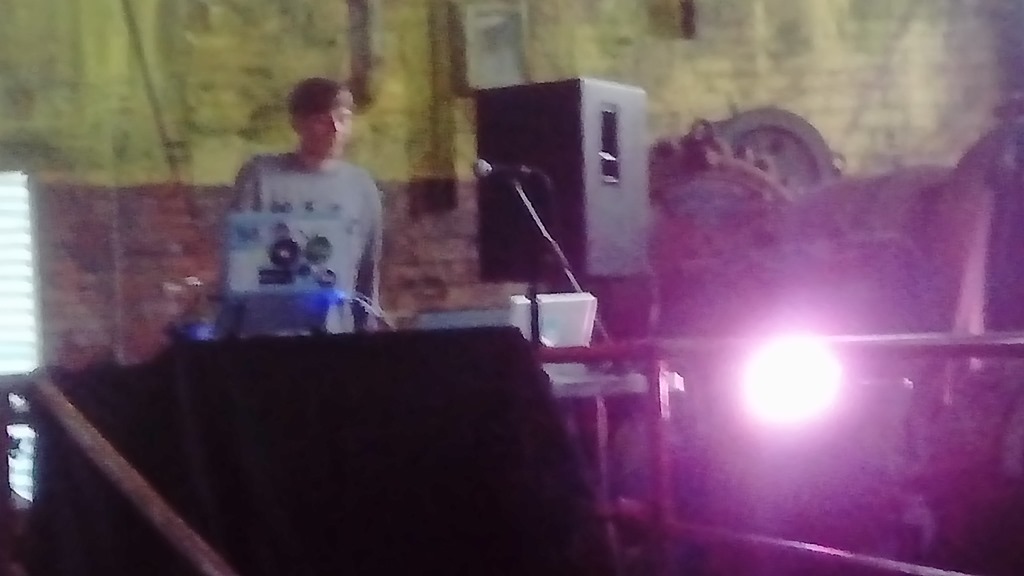
The sun is slowly sinking, but still casting a fair bit of light as Bambooman delivers his ‘site-specific’ set, which is built predominantly around field recordings captured around the museum in the weeks ahead of tonight’s show. He throws some solid beats, and bass loops and samples in abundance. Light, skipping motifs that hint of the orient and extraneous industrial sounds – repetitious mechanical clankings which forge heavy marches dominate, and are overlaid with oddly folky vocals. The incongruity actually works in its favour.
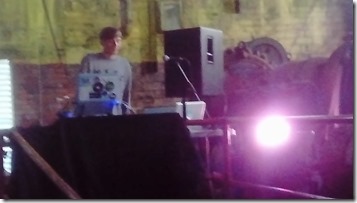
DSC_0556

Bambooman

And it’s here that I begin to really experience – and to appreciate – the synergy of sound and space. It isn’t because the music isn’t engaging that I find myself casting my eyes around the space I’m standing in: it’s because the music compels me to do so. I cast my eyes upwards, and wonder what caused the various punctures and tears in the corrugated roof, through which the fading light seeps, purplish. People begin to pack in with greater density, legs and pelvises moving in time with the rhythms. A woman comes and stands too close to me, and keeps knocking my shoulder as she moves to the music. I let it pass.

My notes thin in density: a trip to the bar results in my missing the front end of Object Blue’s set, but time is already beginning to warp before her altogether more abrasive set assails my senses. Abrasion may be relative, but in any context, Object Blue packs some attack. The bass frequencies register around the pelvis, while the treble hits around the upper reaches of the cranium: the cymbal work is almost sharp enough to slice off the top like cutting open a boiled egg. The sounds are pushing the limits, fraying at the edges, and tug ant the nerve endings, but the PA is supremely crisp and clear and despite the respectable volume, I’m not feeling any need to get the ear plugs out. Object Blue’s approach to ‘industrial’ may be less literal than that of Bambooman, and more conventional in terms of genre, but with contrast comes impact. As a performer, she’s understated and demur, but sonically, her set is combative, aggressive, every frequency tweaked for optimal discomfort. I absolutely love it, and instead of raising the blood pressure, the sheer quality of the compositions and the attention to detail is uplifting. And with any uplifting uplifting experience comes a sense of quiet joy.
DSC_0562

Object Blue

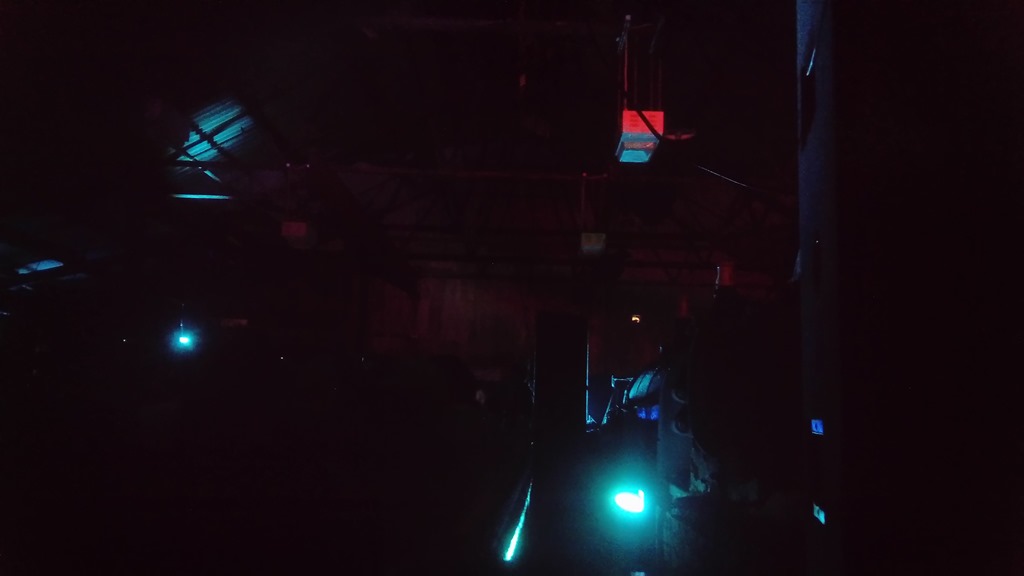
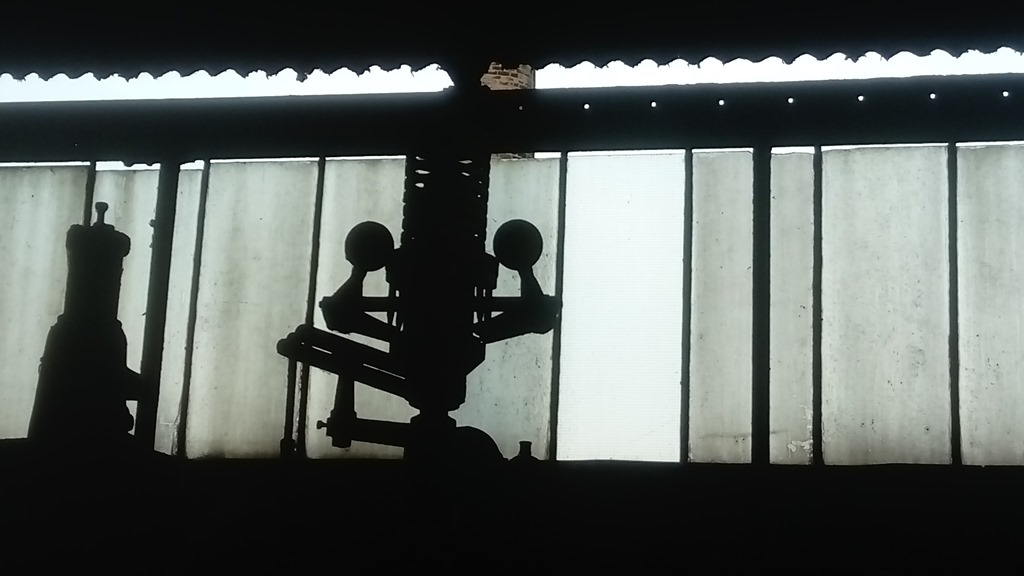
Time really begins to slip now, and it’s not about the alcohol consumed. I’ve actually been pacing myself, for a change against recent outings more immersed in the experience than the quest for obliteration. During the space between acts, and as the beats knocked out by the DJs echo out into the night, I talk to my friend about mental health. It seems oddly comfortable and in come ways appropriate: I’ve spent the last few months operating at a frenetic tempo, which has resulted in wild fluctuations in mood. Tonight, at one with my surroundings, immersed by the music, stepping out of my life and engaged by everything that’s going on and the sense of something different something new, I find I’m reattenuating, becoming once more aware of the details of my environment – the sky, the details of chimney tower, the rusted engine, the imposing hulk of the mill on the hill, the skeletal frame of an engine tunnel or something, rusty and covered in ivy, the inexplicable machinery at every turn. I’m breathing at a slower pace. I’m back in life.
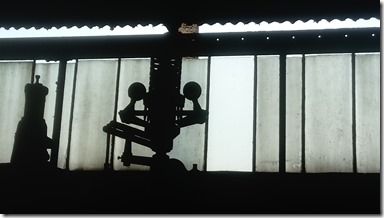

DSC_0557DSC_0561

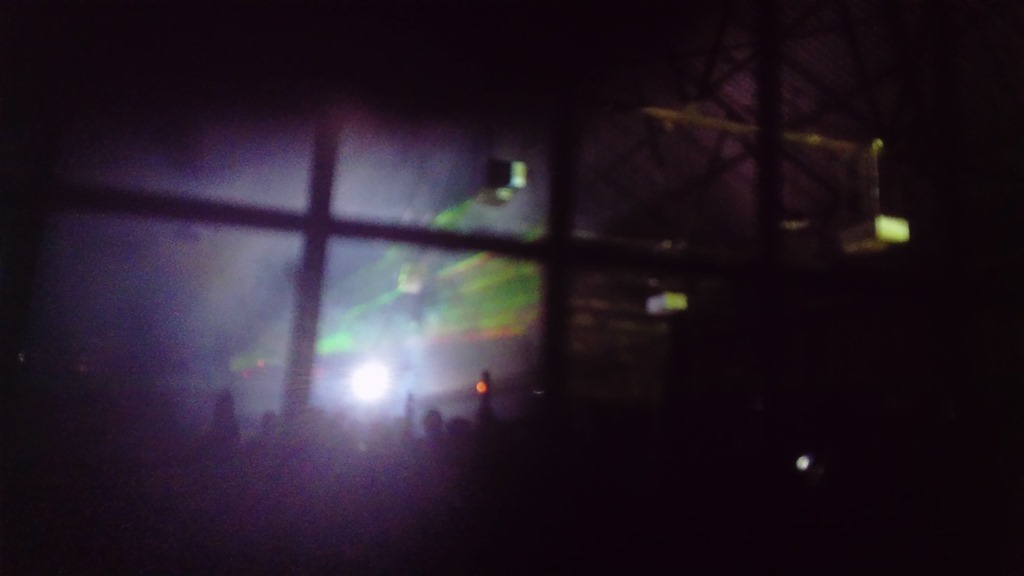
Pye Corner Audio delivers something special. The downtempo focus of the set is key to its hypnotic effect. One moment, I’m engaged, observing the laser lighting and the drift of illuminated smoke across the space where he performer is situated, attuned to every last nuance of the surroundings, from the wire fence to the way the other members of the audience engage. The next, I find I’m swaying on my feet, eyes barely ajar, in something approaching a hypnotic trance. It’s the best I’ve felt in months – zoned out, but not completely out of it – the music becomes a throbbing wash that envelopes my body and every last one of my senses. THIS is what immersion feels like. The moment is all, and nothing else matters.
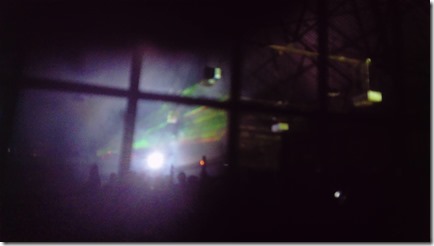
DSC_0567

Pye Corner Audio

I remember, jerking alert between lengthy spells of complete immersion, that this is a life experience. For the first time ever, it’s one I feel comfortable being only semi-present for.

Nakama Records – 27th February 2017

Christopher Nosnibor

You think of the human voice and you’ll probably immediately cast your mind to speech and singing. But the extremity of the range of the human voice is truly remarkable, and extends far, far beyond these limited parameters. Index sees Oslo-based Agnes Hvizdalek explore, over the course of forty-seven minutes – mastered as a single track – the potentials and possibilities of her vocal cords. The CD’s packaging offers nothing but a fingerprint by way of an explanation, but thankfully, the accompanying press release assists with the provision of context and framing the ‘pure vocal sounds that oscillate between fragility and levity, in the most well-shaped musical manner’ by explaining the way in which they’re ‘interwoven with, and set in contrast to the buzz of the city sounds and the building acoustics’. That city buzz is São Paulo, and the album was recorded at the bottom of a 60-metre-high chimney at the old factory “Casa das Caldeiras” in the heart of the city with the world’s largest helicopter fleet. As such, Index captures the correspondence between the individual and environment as well as exploring the limits of the individual themselves.

It perhaps goes without saying that this is about as far into avant-garde territory as it possible to get: a work of pure experimentation, of parameter-pushing and prioritising process over end product. That doesn’t mean that Hvizdalek’s concept is entirely original: Mike Patton’s Adult Themes for Voice (1996) stands as a bewildering document of one man’s immense vocal capabilities. It’s largely unlistenable, at least in anything more than small doses, but at least it’s broken into bite-sized chunks of sonic derangement. Hvizdalek makes no such concessions to accessibility, and while many of her vocal acrobatic are less extreme than Patton’s, Index is nevertheless a hugely challenging album, a morass of saliva and tongues and brain-bending bleating and blowing.

To describe the various sounds would be essentially pointless – not only dull, but abjectly failing to convey the actual experience of the album. So, Hvhizdalek hums and drones, wheezes and moans, ululates gutturally and breathes like a bellows. She squeaks and snarls and snarks and spits. But what’s remarkable is that while at times she sounds perfectly human and natural, oftentimes the sounds issuing forth from the speakers sound like no creature on earth. And yet the bewildering polytonal rasps and drones sound like no instrument known to wo/man either.

There’s no way in the world anyone is ever going to sit down and play this album for pleasure. I write as someone who’s actually spent the best part of an hour with these sounds rippling and bouncing from the speakers wired to my laptop wearing pyjamas and a bemused expression. A part of me feels obliged to give the album at least one more run-through, but the fact is, while I have absolute admiration for Hvizdalek’s artistic commitment and vision, I simply can’t face it, at least not now. This is absolutely no sleight on Hvizdalek’s work: Index is a true work of art. It’s a work to ponder, to reflect on and to sample when the mood takes. This may not be often, but in a world cluttered with sonic wallpaper, there’s a real need for an album like Index.

Agnes Hvizdalek – Index