Posts Tagged ‘Dragon’s Eye Recordings’

Dragon’s Eye Recordings – 23rd January 2026

Christopher Nosnibor

The facetious part of me reads the title of this as being a greeting to a pane of glass. I should probably get my coat after such a shameful revelation, but never mind. I’m here with my ears for this complex and detailed release, and will share the standard biographical info to provide much-needed context here:

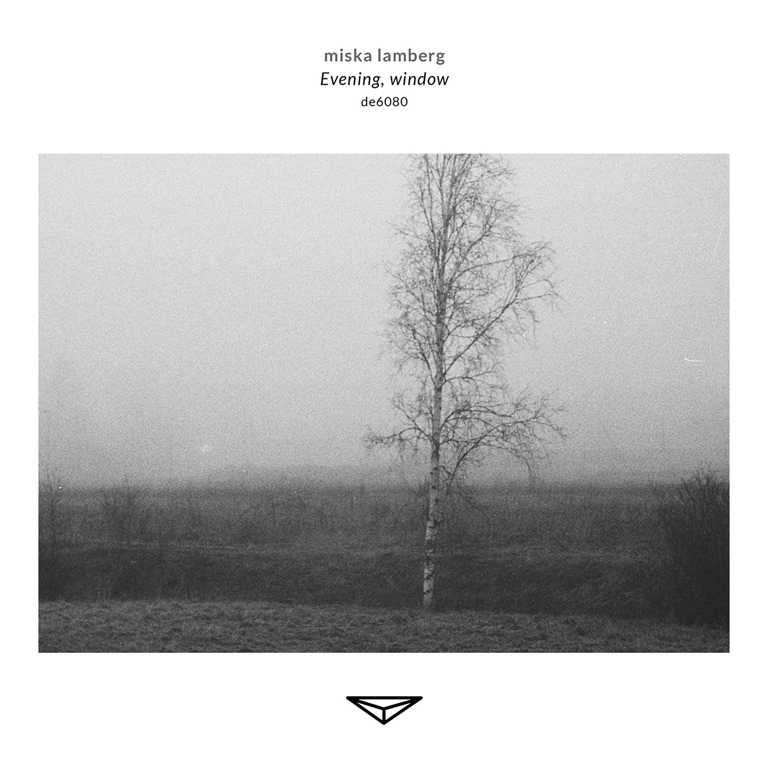
Evening, window is the debut full-length album by Helsinki-based sound artist and ambient composer miska lamberg. Working with intricate field recordings that gather the overlooked moments of daily life – rainfall, distant traffic, animal calls – lamberg threads these textures into compositions that ache with personal memory. On Evening, window, the familiar becomes spectral: fragments of sound blur into melody and mood, capturing the stark melancholy of Nordic winters and the soft violence of remembering.’

The album features some long pieces: four of the six compositions are over eight minutes in duration, and this allows the pieces the appropriate and necessary time to build.

It begins with a metallic clattering. Heavy rain on a tin roof? Perhaps. Then there is a rumble – possibly thunder – but chattering abstract voices and soft, gentle synths drift in a cinematic spatiality and an organ swell gradually comes to dominate as it drifts… Evening, window is a sonic diary of sorts, a compilation of recordings captured in everyday settings as she goes about her life. The nine-minute opener, ‘Half-memories absorb us’ is both immersive and transportative, provoking contemplation. In some respects, the title does more than speak for itself, and also speaks of the way our minds work. And how do our minds work, exactly? Erratically, unpredictably, leaping from one place to another. And we’re thinking one thing while looking at another.

From a certain perspective, Evening, window can be seen to operate within the same field as William Burroughs’ cut-ups, and in particular the tape experiments he made with Iain Sommerville, although the collaging of field recordings and various layers of sound aren’t nearly as extreme here, blending the field recordings and decontextualised samples with carefully-crafted layers of ambience, which maked for a rather more listenable experience. Different objectives through similar intentions, one might say.

There are some haunting, unsettling motifs which cycle through Evening, window: ‘Seeing only faces turned away’ is dark, and listening to the ghostly swathes of ambience which hang dark and heavy is uncomfortable, a repetitive chord sequence conjuring, if not outright fear, then a sense of tremulous trepidation and unease. While Evening, window is a work of lightness and air, it’s also a work of slow, dense weight.

There are children’s’ voices. There are supple strings. At times, the atmosphere is soothing, sedative, but more often than not, there are undercurrents of tension, befitting of a dystopian thriller. Some may consider this to be something of a disconnect from the concept of presenting, or representing, fragments from the everyday life of the artist. But life is strange; the world is strange, and scary.

‘I remember the day the world lost color’ is bleak, barren, conveying the murky gloom of a blanket of fog, while ‘Its monotony is unrelenting’ is the drudgery of life – at least some periods of it – summarised in four words. Anyone who has endured a crap job will likely be able to relate to the sense that life is slipping by while days evaporate trudging through eternal sameness and feeling a sense of helplessness and a loss of identity, a distancing from the self. The sound is muffled, and very little happens over the course of eight minutes of crafted stultification during which the chord sequence of ‘Seeing only faces turned away’ is reprised, only slower, more vague, somehow tireder-sounding. It’s the soundtrack to hauling your living corpse through another dead, empty day – and another, and another, and another.

Evening, window isn’t depressing as such, but it is not light or breezy, and the mood is low and melancholy. It’s a slow, gradually unfurling work which drags heavy on the heart, an album which radiates reflection and low mood. It’s a dose of stark and sad realism, and an album which speaks so far beyond words.

AA

a0509711029_10

Dragon’s Eye Recordings  – 22nd August 2025

Christopher Nosnibor

A year on from my review of Yorkshire Modular Society’s Fiery Angels Fell, I find myself presented with another release of theirs on LA label Dragon’s Eye Recordings, and I can’t help but contemplate the circuitous routes by which music travels, since the release landed in my inbox courtesy of a PR based in Berlin – while no-one in my sphere of acquaintance, which includes a broad swathe of electronic artists around York and, indeed Yorkshire as it spreads in all directions – appears to have even the first inkling of the existence of YMS, despite their connection to Todmorden. But then, I often observe that what holds a lot of acts back is confinement to being ‘local’, and it’s a lack of vision, or ambition – or, occasionally, practical matters – which prevent them from reaching the national, or international, audience they deserve.

Yorkshire Modular Society clearly have an audience, and it’s not going to be found at pub gigs in their native county. This is true of most experimental artists: there’s no shortage of interest in niche work globally, but it’s thinly spread. There are places, predominantly across mainland Europe, and like Café Oto, which cater to such tastes, but they’re few and far between, which explains why most such projects tend to be more orientated towards the recording and release of their output, their audience growing nebulously, more often than not by association and word of mouth.

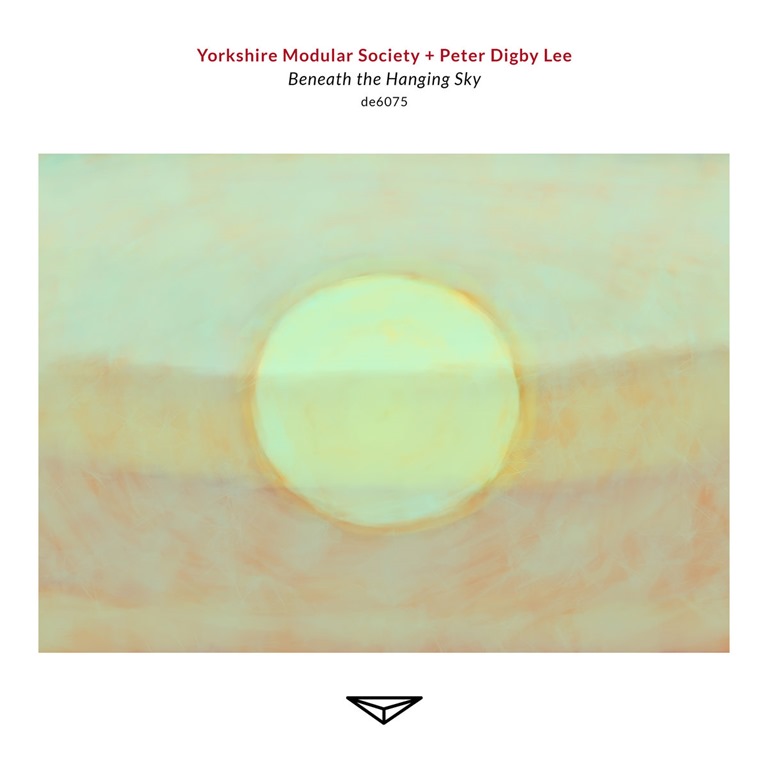
This release – which is the first collaborative album from Yorkshire Modular Society with Peter Digby Lee – could only ever really be a download. With ‘a suite of four ambient compositions shaped by intuition, ritual, and shared resonance’, it’s over two hours in duration, giving recent Swans a run in terms of epic.

The story goers that ‘The artists first crossed paths not through conversation, but through shared vibration — at the resonance Drone Bath in Todmorden. A quiet alignment. Some time later, Peter sent over a treasure trove of sound: samples he had recorded and collected over many years — textures, fragments, and moments suspended in time. From this archive, Dominick Schofield (Yorkshire Modular Society) began to listen, to loop, to stretch, to shape… What followed was a process of intuitive composition—letting the materials speak, revealing what had been buried in the dust and hum. This album is the result: four pieces, each unfolding from the source material with care and curiosity, a shared language spoken in tone, breath, and resonance.’

The title track is soft, gentle, sweeping, lilting, serene, floating in on picked strings, trilling woodwind and it all floats on a breeze of mellifluousness, cloud-like, its forms ever-shifting, impossible to solidify. With hints of Japanese influence and slow-swelling post-rock, it’s ambient, but also busy, layered, textured, thick, even, the musical equivalent of high humidity. It moves, endlessly, but the breezy feel is countered by a density which leaves the listener panting for air. The sound warps and wefts in such a way as to be a little uncomfortable around the region of the lower stomach after a time, like being on a boat which rocks slowly from side to side. ‘Beneath the Hanging Sky’ lays for almost thirty-six minutes, and it’s far from soothing, and as a consequence, I find myself feeling quite keyed up by the arrival of ‘Glass Lung’, another soundscape which stretches out for a full half-hour. This is more conventionally ambient, softer, more abstract, but follows a similar pattern of a slow rise and fall, an ebb and flow. Here, the application is emollient, sedative. I find myself yawning, not out of boredom, but from relaxation, something I don’t do often enough. And so it is that this slow-drifting sonic expanse takes things down a couple of notches. You may find yourself zoning out, your eyes drooping… and it’s to the good. Stimulation is very clearly not the objective here.

Third track, ‘Echo for the Unseen’, is the album’s shortest by some way, at a mere twenty-two minutes in length. It’s also darker, dense, more intense than anything which has preceded it, and as ambient as it ss, the eternal drones are reminiscent of recent both latter day Swans, and Sunn O)). The epic drone swells and surges, but mostly simmers, the droning growing more sonorous as it rolls and yawns wider as the track progress. There are harsher top-end tones drilling away in the mix as the track progresses. It makes for a long and weighty twenty-two minutes, and we feel as if we’re crawling our way to the closer, ‘Spiral of Breath’, which arrives on a heavy swirling drone that’s darkly atmospheric and big on the low-end. Instead of offering levity, ‘Spiral of Breath’ is the densest, darkest piece of the four, as well as the longest. With no lulls, no calm spells, no respite, it’s the most challenging track of the release. It’s suffocating. There is no respite. There is, however, endless depth, and eternal, purgatorial anguish.

AA

a1425387917_10

Dragon’s Eye Recordings – 7th June 2024

Christopher Nosnibor

There isn’t really anything funny about Yorkshire Modular Society, conceptually or otherwise. But one never really fully appreciates one’s own locale, especially not when it’s in the north of England, a region renowned for its pithy, gritty nature rather than its glamour. People will tell you that Yorkshire folk are welcoming and friendly – and tight – and as a non-native whose lived in Yorkshire the majority of my life now, it’s probably a fair summary. The county boasts some of the most magnificent countryside, and I only need to walk ten minutes from my house to be in woodland or fields – not bad considering I live twenty minutes from the centre of a cathedral city, not to mention twenty minutes from the train station, which will land me in Leeds in under half an hour. But for all that, and despite the huge number of outstanding bands to have emerged from Leeds over the years, mention Yorkshire and people will probably think of brass bands, cobbles, and Hovis, flat caps and equally flat brown beer. People tend not to think ‘Yorkshire, the county of experimental electronica’. They’re missing something significant.

There is a thriving modular / electronic scene in Yorkshire, notably with electronic music open mic (EMOM) nights in Leeds, York, and Halifax, all giving platforms to acts who aren’t necessarily on the main gig circuit, although venues like Wharf Chambers in Leeds and The Fulford Arms in York will often feature weird and wonky stuff from across the electronic spectrum.

Like many electronic experimenters, the YMS BandCamp page presents a prodigious self-released output, so if you’re wondering where to start, a release selected by a label seems like a fair point.

Of this continuous hour-long ambient work, Yorkshire Modular Society says, “As the cityscape pulses with electric fervor, oscillations emerge like whispers in the rain-soaked streets. LFOs, like elusive shadows, guide the listener through a maze of sonic intrigue, each modulation a glimpse into a world of mystery. Within the depths of digital tape modules, time unravels and reconstitutes, casting a veil of uncertainty over the sonic landscape. Reverb and delay wash over the senses like urban decay, adding depth to the sonic architecture that surrounds.”

Fiery the Angels Fell is a lot calmer, more soothing, and less apocalyptic than its cover art suggests.

As is often the case with ambient works, I find my mind – like the music – drifting, and my contemplations following divergent trajectories. Here, I found myself wondering what the end would – or will – really look like. Growing up in the 80s, I envisaged the white light of nuclear annihilation, but on recently watching Threads, came to realise that this may not be the spectacular moment of silence prefacing perfect oblivion my younger self had fantasized. But no part of me ever envisaged an globe, or an egg, colliding and splitting in half with molten flames as something I may witness. The cover art, then, harks back to pure 60s / 70s sci-fi vintage. The artwork propagates tension. The sound soothes it.

While there are some billowing clouds along the journey that is Fiery the Angels Fell, this is a delicate, graceful work dominated by organ-like drones and soft sounds which ebb and flow. If this is the soundtrack to the end, I will likely sleep through it, and awake pure nothingness.

AA

de6063_art