Posts Tagged ‘Cronica’

Crónica – 1st July 2025

Christopher Nosnibor

Only yesterday, I expended considerable contemplation – and verbiage – on the matter of press releases, and the level of detail they contain nowadays compared to the old A4 1-sheet – which sometimes contained just a few lines under the heading and the logo. It’s wasn’t really a complaint, as much as an observation, although there is, sometimes at least, a sense that most of the reviewer’s job has been done for them in advance.

However, there are other ways in which the detailed press release can prove to be a double-edged sword, and this is one of them. And so it is that I’m plunging into unknown territory with this release. Not in that I haven’t spent many hours immersed in ambient recordings, and not that I’m unaccustomed to postmodernism, in theory and its application, how it applies to the world as we experience it. But sometimes, a work is so inspired and invested in something specific, specialised, and conceptually-focused that it feels like I’m not fully qualified to approach it, much less critique it.

Before I do dive in, this is the context. Are you sitting comfortably?

At the end of the 1990s, Hakim Bey wrote a book about the then-emerging possibility of the virtual. With the lucidity for which he is known, he recognized at the time that the virtual was nothing more than a new avenue for the expansion of capitalism. He introduced the concept of temporary autonomous zones as a kind of Foucauldian heterotopia — spaces that existed only for as long as they could evade capture. Today’s reality reflects a radical intensification of what Bey was referring to in the 1990s. Temporalities have changed completely. We are now almost overwhelmed by an incessant pursuit of instantaneity, accompanied by the mounting impatience it inevitably breeds.

The temporalities of sound, therefore, are naturally different too.

Time must be disobeyed.

The sounds of our autonomous zones aim to be the opposite of what technology offers us today: fascination and dazzle through excess — more buttons, more effects, louder… AI. These are bare sounds, defiantly rejecting the paraphernalia that surrounds them. They are simple yet perhaps carry the greatest complexity of all: turning their backs on spectacle and presenting themselves as they are: unmasked.

This work is the outcome of a series of studio sessions recorded during the summer and autumn of 2024. We followed an exploratory approach grounded in clearly defined premises and a pre-conceived compositional outline shaped by three key notions that are central to us: repetition, silence, and duration.

There is no post-production manipulation. What you hear is what was played. Inactual by conviction, this represents an utterly contemporary mode of being. These are sounds that seek to endure as a resistant, autonomous possibility — even if only fleetingly. Suspended between silences. Those marvelous, singular, sounds that Cage taught us to hear. They are there to last for as long as they can.

The title Horizons of Suspended Zones is inspired by a book from Hakin Bey.

I find that I’m sitting rather less comfortably now than I was a few minutes ago. I’ve never read a word by Hakim Bay. I’m aware of him and his work, but have never got as far as investigating. Therefore, I’m deficient. And so, in my head-swimming uncertainty, bewilderment and state of flaking confidence, I arrive at this fifty-five minute articulation of time-challenging theory/practice feeling weak, overwhelmed. Where do I even begin? Can I relate it to my own lived experience?

I struggle, because it doesn’t communicate that postmodern overlapping and disruption of the time / space continuum in a way that I can relate. For me, cut-ups and collage works convey how I experience life: the eternal babble of chatter and time experienced in terms of simultaneity rather than in linear terms.

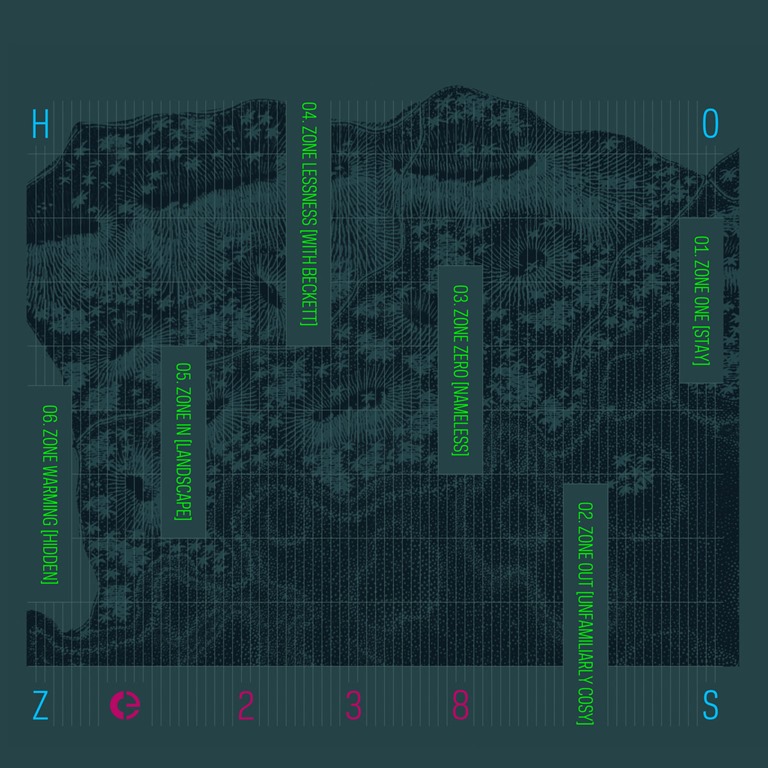
‘Zone One [stay]’ is a drifting, abstract, ethereal ambient work, and while over ten and a half minutes in duration, the time simply evaporates. It drifts into ‘Zone Out [unfamiliarly cosy]’, which is appropriately titled, and I find that I do as instructed, as the slow chimes and resonant tones hover in the air like bated breath. There’s a sense of suspense, that something will happen… but of course, it doesn’t.

For all of the detail around the concept, there’s very little around the construction by comparison. But perhaps a bell chime is simply a bell chime and an echo simply an echo. But those echoes matter. I find myself wading through the echoes of time, how it passes, how we lose time. How did we get to August? How did we – my friends and I – get so old? How, how, how is the world so utterly fucked up right now?

Each extended abstraction turns into the next, and so ‘Zone Zero [nameless]’ arrives unushered, unannounced, and unnoticed. There are whispers, the sound of the wind through rushes, and there’s something dark in the atmosphere. It’s only on returning to this after some time to reflect that I come to note the squared brackets in the titles. It’s an unusual application of this punctuation, which is more commonly found in academic work, and which I assume isn’t accidental – but why?

Anyone who’s read Beckett will know how painful and challenging, and, above all, how his work can be, and so ‘Zone Lessness [with Beckett]’ certainly reflects the emptiness of many of Becket’s works – the sprawling nothing where there are no events, no… nothing, and how life itself bypasses us as we wait. Life, indeed, it what happens while we’re making plans. It has a painful habit of passing us by. Life is not the Instagram shots or ‘making memories’ moments. It’s the trip to the supermarket, it’s endlessly checking your bank balance, it’s the dayjob and the cooking and washing up. It’s the dead moments that count for nothing. Those moments occupy the majority of time. And on this track, a low laser drone slowly undulates throughout, and over time, fades in and out, along with incidentals which allude to lighter shades, and ultimately, the nine minutes it occupies simply slip away.

‘Zone In [landscape]’ is sparse but dense, moody and atmospheric in its rumbling minimalism, and the last cut, ‘Zone Warming [hidden]’ chimes and echoes, bells ringing out into endless silence, without response, before tapering contrails of sound slowly and subtly weave their ways in and out. There are spells of silence, and the silence casts spells, and the spells float upwards in suspension.

Perhaps an appreciation of the context and theoretical framing of Horizons of Suspended Zones is advantageous, but it remains accessible as an abstract ambient work without that deeper comprehension. And it still feels as if there’s a sadness which permeates the entirety of the album. It’s by no means heavy, but it does have an emotional weight that drags the listener in, and then drags the listener down. And then leaves them… simply nowhere. Caught with their thoughts, and nowhere to take them.

AA

AA

a4170718585_10

Crónica – 5th November 2024

Christopher Nosnibor

Simon Whetham’s latest work is a fascinating hybrid which incorporates found sounds and elements of layering in order to create a whole other world, a different dimension. The album itself is part of a larger project, which is more readily explained through quotation than a stumbling stab at paraphrase:

Successive Actions is an iteration of the larger kinetic sound performance project series Channelling in which various motor devices, salvaged from obsolete and discarded consumer technology, are activated by playing sound recordings through them. In turn, this produces new sounds from the devices, which are amplified using various microphones and techniques. The title comes from Dirk Raaijmakers’s "The Art of Reading Machines" as a term for mass production processes. As such, the recordings played through the devices are recordings of other devices used in previous versions of Channelling, in which the sounds used were seemingly mundane sound phenomena that occur unpredictably and irregularly in everyday life, as passing traffic, wind, doors closing. So now the sounds of devices malfunctioning and breaking from their programming are causing further action and disruption.

Successive Actions contains sixteen pieces, although only four extend beyond four minutes in duration, with the majority sitting only a short way over the two-minute mark, giving the album a fragmentary feel. But there’s a strong sense of cohesion, too: the title of each of the pieces ends in ‘action’, from ‘Action’ to ‘Protraction’, via ‘Inaction’, ‘Impaction’, and ‘Abstraction’.

While much of the album takes the form of abstract ambience and general murk, there are moments which stand out with levels of heightened discomfort: ‘Reaction’ conjures the bleak whistling wind of a nuclear winter. ‘Inaction’ scrapes and buzzes; it’s unsettling, but it’s not uncomfortable to the point that it’s unbearable: it just makes you feel tense, awkward. You want to seem a less stressful environment. But there s no less stressful environment, and life is stress: to escape that is to deny the reality of the everyday, for the majority. Under capitalism, we are all stressed, and on Successive Actions, Simon Whetham gives us a soundtrack to that stress and anxiety.

Mass production is, arguably, a fundamental source of our woes in the modern age. The Industrial Revolution brought so much promise, but as capitalism has accelerated and expanded at a pace which exceeds our capacity to assimilate, so it has become an ever-greater source of alienation. And here we are, overwhelmed by the road of the big machine as it continually whirrs and grinds. Sometimes its but a crunch and a gurgle, a hum and a thump. A buzz of electricity, a mains hum, as dominates both ‘Retroaction’ and ‘Counteraction’. It’s a cranial buzz and pushes frequencies which are uncomfortable, and as the album progresses it plaiters, and turns dark.

For myself, I feel a certain sense of release while immersing myself in the textures and layers of Successive Actions. There are moments when the album really achieves a heightened sense of – and in panic, of anxiety, of intensified reality. Other moments are altogether more sparse, steering the listener inside themselves into a the depths of an interior world.

Successive Actions is deep, dark, difficult. And so is life. On Successive Actions, Simon Whetham captures it, all elements of life that is. It crackles and fizzes with tension, and tension is high.

AA

a0457389705_10

Crónica – 26th April 20222

Christopher Nosnibor

Having seen various videos of Gintas K’s improvisations, involving a keyboard and a dusty old Lenovo ThinkPad running some custom software, it’s apparent that his approach to composition is nothing if not unusual, and it’s matched by the results.

His Crónica debut, Lengvai / 60 x one minute audio colours of 2kHz sound was sixteen years ago, and his return to the label is a very different offering, although as has been a common factor throughout his career, Lėti – Lithuanian for slow – consists of comparatively short pieces – and here, the majority are four minutes long or less. Less is more, and what’s more, Gintas K invariably manages to pack more into a couple of minutes than many artists do in half an hour. Here, we have a set of eleven short pieces ‘created from recording and improvising in studio followed by extensive mixing and editing using software.’ There’s no more detail than that: some artists accompany their releases with essays explaining the creative process and the algorithms of the software and so on, but Gintas K simply leaves the music for the listener to engage with and to ponder.

Where Lėti is something of a departure is in the emphasis on the editing and mixing of the material and the fact that, as the title suggests, the arrangements are a little more sedate. The signature crackles and pops, chines and static are all present and correct, but there’s a sense of deliberation as we’re led through ethereal planes of delicate chimes and tinkling tones that resonate and hang in the air, drifting in open expanses, with time and space to reverberate and slowly decay. With this more measured feel, melodies become more apparent, with simple motifs, repeated, giving ‘Hallucination’ a sense of structure and, I suppose you might actually say ‘tune’.

It isn’t that Gintas’ works lack tunefulness as such, but that any tune is surrounded by froth and extranea, and so much is going on it’s often hard to miss. Listening to Lėti is a fairly calm, even soothing experience, at least for the most part, conjuring a mood of reflection, of contemplation. The album’s longest piece, the seven-minute ‘Various’ brings a dense wave of sound that surges and swells slowly like a turning tide. There’s almost a stately grandeur to it, but then, there’s a rattling kind of a buzz that’s something of a distraction, and a glitch that nags away and seems to accelerate. These little headfucks are quintessential Gintas K, and Lėti isn’t all soft and sweet: ‘Savage’ brings thick, fuzzing distortion and discomfort.

The flurries of sound, the babble of bubbling bleeps and bloops that are his standard fare are slowed to sparse, irregular drips in a cave on ‘Variation’, and the application of reverb is impressively nuanced, to the point that the reverbs almost become music in their own right. ‘Atmosphere’ and ‘Ambient’ are appropriately titled, while ‘Nice Pomp’ would comfortably serve as a soundtrack to a slow-motion film of a moon landing or somesuch, and again none of the pieces are without depth or detail, as the layers and slivers of sound that intersect create so much more than mere surface.

Lėti is a genuinely pleasant and pleasurable listening experience, but is most certainly isn’t straightforward or simple in what it delivers. There are many sonic nuggets to unearth, and so many tones and textures along the way, that what is, superficially ‘less’ is, in actual fact, a whole lot more.

AA

Crónica185_front

Crónica 166 – 19th February 2021

Christopher Nosnibor

From the very opening seconds, Francisco López’s latest offering assails the ears and scorches the brain: the first track – which hits the magical running time of twenty-three minutes – is nothing short of explosive – literally. Opening with a roaring blast of brutal harsh noise, it soon separates into a series of samples and sounds, whereby propeller engines swoop low, spitting machine-gun fire and dropping detonations all around and bomb blasts tear the air. I’ve previously described certain noise works as sonic blitzkriegs, but this is actually nothing short of total war – captured in audio.

DSB is the accumulation of a decade’s work, which was, apparently, created at ‘mobile messor’ (worldwide), 2009-2019. Mixed and mastered at ‘Dune Studio’ (Loosduinen), 2020.According to the press release, López’s objective over the forty years of his career to date is to ‘Destroy boundaries between industrial sounds and wilderness sound environments, shifting with passion from the limits of perception to the most dreadful abyss of sonic power, proposing a blind, profound and transcendental listening, freed from the imperatives of knowledge and open to sensory and spiritual expansion’.

But with DSB, López doesn’t just destroy boundaries. It destroys everything in an obliterative sonic attack that’s sustained for some forty-five agonising minutes.

When it does pull back from the eye-popping extremes, it presents a dank, ominous atmosphere, and one minute you’re underwater, as if being drowned, the next, your head’s above water and you’re surrounded by a roaring sonic assault that lands blows from all sides. The quieter moments are tense and oppressive, and with unexpected jolts and speaker-shredding blasts.

A low rumble and clodding thuds and thunks, like slamming doors and hobnail boots create a darkly percussive aspect that dominates the start of DSB-B… but then you’re under water again and everything is muffled… you can’t hear or breathe, but all around there are bombs and you’re feeling the vibrations in your chest. It’s all too close and you’re terrified. It’s eighteen and three-quarter minutes of ominous atmospherics and tempestuous crescendos of noise, raging storms with protracted periods of unsettled turbulence in between as strong winds buffet away. The dynamics are extreme, as is the experience.

Something has clearly shifted here: López’s work a decade ago was predominantly experimental, wibbly, electronic ambient in its leanings, predominantly layerings of drones, hums, and scrapes. Interesting enough, exploratory, but not harsh. Yet DSB is so, so harsh, it’s positively brutal. But these are harsh times, and when everything is a grey monotony, same news on a roll on every outlet, the instinct is to slump into an empty rut.

DSB will kick you out of that and kick you around unapologetically, landing boots in the ribs, and then more. It will leave you dizzy and drained. But it will make you feel. And that’s essential.

AA

a2805823699_10

Crónica – 9th April 2019

Christopher Nosnibor

Useful points worth noting by way of a preface: Unwritten Rules for a Ceaseless Journey

documents three pieces composed for dance, commissioned by Ballet Teatro for the play Revoluções (Revolutions) by choreographer Né Barros. The in three parts are designed to embody formal idealisations of the three decisive layers of time — past, present, and future.

The three tracks each span around fifteen minutes, and the first, ‘Something’s Missing (Utopian) begins with elongated, scraping drones… and continues onwards with ominous hums that swirl and eddy around a barely-audible hissing buzz. A rolling organ while emerges from a clamour of shuffling intangibility to provide a vague semblance of form and instrumental musicality, but the it’s sad and sinister in equal parts, conveying a sense of loss while reminding us that the past is dark. The muttering voices, inextricable individually: are those the voices of the dead?

It seems entirely fitting that the pieces should melt into one another: time always transitions seamlessly, and in terms of life lived, it’s difficult to appreciate the fact that every passing second is stacking up the record of time past as the present slips away instantaneously. It’s also fitting that the present, as represented by ‘The Pulsating Waves (Reality)’ flattens into an indistinguishable mid-range hum that groans and sighs and whispers. Metallic sparks hiss way off on the horizon, forever out of reach. There’s a sense of emptiness and despondency about this inhospitably bleak sonic wasteland, even as it swells into an altogether smoother, denser, broader droning hum. It’s the sound of absence, a dulled absence that lacks dynamism or detail. So much positive, pro-mindful life-coaching material and contemporary self-help verbiage tells us that we should live in the moment; but the fact of the matter is that the moment is invariably empty, bleak, depressing.

‘Don’t Look Back, Run (Trauma)’ is solid advice: it’s impossible to retreat to the past, or to recreate it, despite the booming nostalgia industry’s suggestion otherwise. To commit too much time to reflection is to lose oneself to the past and deny the possibility of progress; but, to run to the future without due attention to history is to be doomed to repeat the mistakes of the past. There is a balance to be found. The album’s final track suggests a certain degree of balance: it’s slow, its form emerging from dragging pulsations drawn out in bowed strings – or ersatz assimilations thereof – which gradually diminish into a rumbling gust of wind, blowing grey, blurred particles into a formless mass. The future is, and will forever be indistinct, unclear, as unpredictable as the weather, fashion, and our fragile emotions. And in the dying minutes, it crumbles to a cloud of grey obscurity, lacking shape, form, and tonality, a vaporous viscosity of… what? Uncertainty. Murky, messy, abstraction. What the future holds, we know not: the present is unsettled, dangerous, turbulent. The present is well out of hand, and the future yet more so.

AA

H_CE_ARTES_FINAIS

Crónica 138 – 6th February 2018

Christopher Nosnibor

Mark E Smith has died. It shouldn’t come as a surprise. In fact, the surprise should be that he didn’t die sooner. But I can’t help but be shaken by the news. It doesn’t feel appropriate to post any music reviews: my social media streams are aclog with tributes to Smith, and it feels wrong even to add to the noise. Part of me feels I should revisit a slew of the old favourites, but they’re so engrained in my mind, I don’t really need to hear them, especially not now.

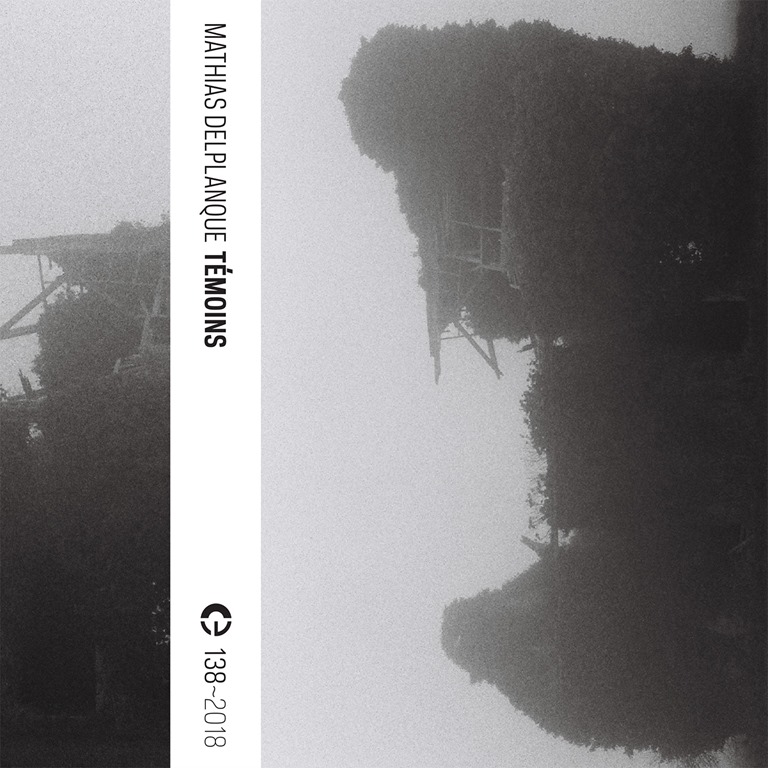
And so I immerse myself in Témoins, the latest offering from Mathias Delplanque, whose work I’ve previously enjoyed. The three sections of Témoins (including the digital bonus track ‘TU)’ are a world away from the ramshackle three-chord stomps and lyrical derangements of The Fall: these instrumental works – sound collages laid over difficult hums and drones – present a very different kind of abstraction. And it reminds me, vitally, that life goes on. Music goes on.

The sparse arrangements – often, they barely feel like arrangements – are as much about space and silence as sound. The sounds – the whirrs, the drones, he hums, the hisses – are interrupted, disrupted, broken – by seemingly random elements. Birdsong, lowing cattle, slamming doors, clatters and bangs, thumps and crackles. These are amidst the irregular extranea which form the fabric of the material of Témoins.

The atmosphere shifts and moods emerge most unexpectedly from seemingly innocuous sound pairings and juxtapositions. Late in the second piece, ‘Bruz’, thin, tentative notes hover long in the air, needling the senses while unexpected bumps and knocks at close proximity are enough to make you jump. Muffled conversation carries on all around. Here, Delplanque expertly recreates the conditions and sensations of the anxiety of agoraphobia. It grows chill, and it’s difficult to not feel tense are wary. On ‘TU’ – by far the shortest piece running for less than ten minutes – a ghostly piano drifts into the damp air while scraping footfalls combine to create an unsettling, spine-tingling atmosphere.

With Témoins, Mathias Delplanque delivers an hour of understated yet quietly compelling ambient dissonance.

AA

Crónica138_front

Crónica – 10th January 2017

Christopher Nosnibor

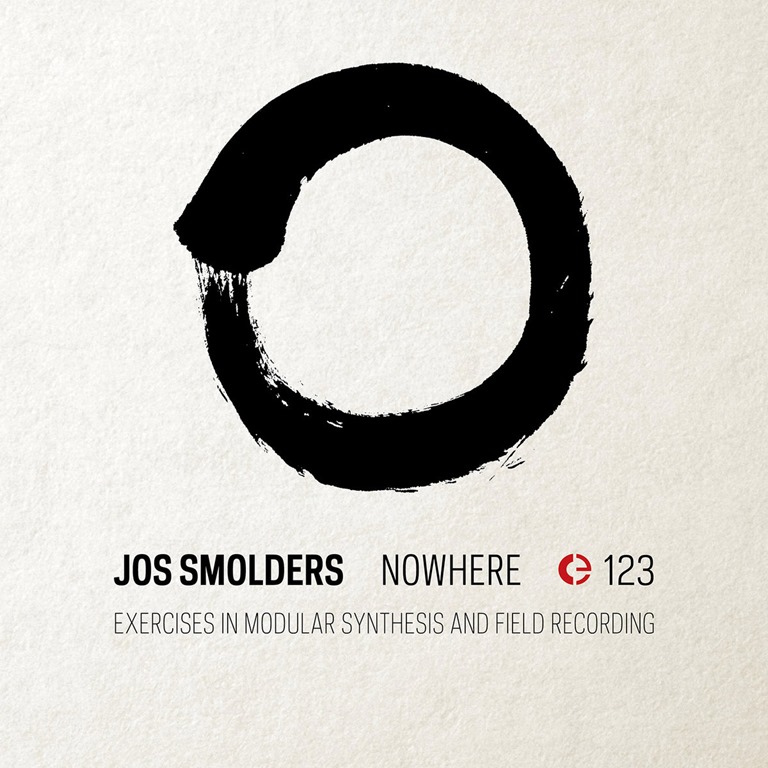
In the sphere of experimental and what one may reasonably term ‘fringe’ music, there is something of a propensity for descriptive titles. I’m quite a fan of these kinds of titles. Picking up Exercises in Modular Synthesis and Field Recording, I have a reasonable idea of what to expect. Granted, there’s no detail as to how these elements manifest sonically, I know I’m not going to get black metal or orchestral pop.

Smolders likens his process to that of the calligrapher, working with speed and precision. Operating with minimal interference or reworking once the process is under way, he is, he says, guided by the flow and the ‘here’ and ‘now’.

‘Incident at Ras Oumlil’ is constructed primarily from long, low rumbling drones interspersed with clicks and fizzy bursts of static. Voices rise; the words inaudible, but the tones of the clamourous crowd conveys a sense of agitation. Introducing an element of wordplay which reminds us that even nowhere is somewhere and is located temporally in time and space even if not geographically, ‘NowHere’ approximates the sounds of engines; trains and planes and whistling lasers. It’s evocative of something, but something so vague as to be an empty vessel from which echoes notions of travel, departure, passing through. We’re here, now, but where is here and when is now? Counterpart and companion piece, ‘NoWhere’ is barely there for the most part, with delicate chimes and rings hovering on the fringes of audibility, gradually building in its tonal range and density. The seventeen-minute ‘Up, Up and Back to 1982’ deals in sonic abstractions, shimmery analogue bleeps and twitters flit through a composition which transitions through a succession of seemingly independent segments.

These are sparsely arranged pieces, with emphasis on tone, texture and above all, space. Wibbly oscillations funnel between screeding noise, feedback and distortion. Slow, atmospheric swirls drift blankly against a backdrop off hums and crackles. At times manifesting as a sound which approximates little more than the rumble of a vinyl groove, at others bursting with sound on sound, Nowhere is attentively executed with a rare precision, navigating a route through a succession of temporo-spatial zones which linger long in the mind.


Jos Smolders - Nowhere

Crónica – CRÓNICA109

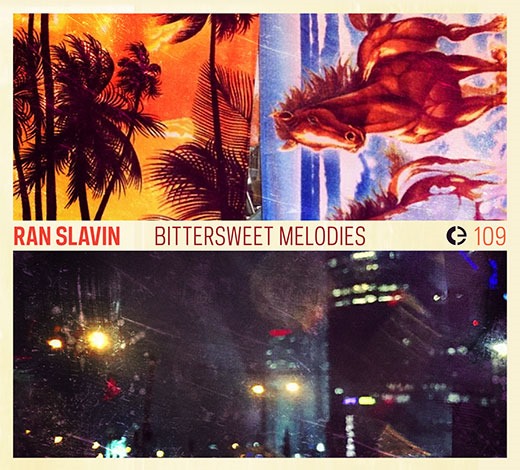
Given Ran Slavin’s broad artistic pursuits, which span video installation, sound and film, and his far-reaching interests which manifest in the exploration of the tensions between opposites, Bittersweet Melody is something of a summation of his preoccupations.

Just as ‘bittersweet’ is one of those words that encapsulates contradiction and juxtaposition, so Slavin’s latest album is built on contrasting sounds and forms. Culled and curated from pieces of work from Slavin’s archives and a release from over a decade ago, the material which comprises Bittersweet Melodies has been disassembled, reassembled and generally re-rendered.

A mellow organic drone hovers and hums through ‘Saturday’s Dress’, but the ambience is disrupted by very mechanical-sounding pings and spring and microtonal bleeps by way of irregular rhythms. A repetitive thrumming hum provides the framework for the minimal yet dense and sinister ambient hip-hop of ‘Category: Murdered Entertainers’, with distant snippets of exotica adding a heightened sense of the unfamiliar to its curious texture. Elsewhere, polyrhythmic percussion collides with stuttering trip-hop beats and eastern-flavoured scales entwine luscious soundtrack strings. Frenetic drum ‘n’ bass ballasts against shimmering electronic froth and looped vocal fragments wash in and out of rumbling scrapes, fear chords, dissonance and a rich soup of sound from all corners of the globe and of the recesses of the mind. Woozy ambience and glitchtronica waft into passages dominated by dank pulsations and murky, shadowy shapes.

The fragments evoke neither nostalgia nor excitement, but a sense of displacement, or alienation. How else does one respond to pan-cultural motifs overlaid and strewn with dancehall music and digital blips but with a sense of vague bewilderment? Slavin does not contrive to create a typical collage mash-up: Bittersweet Melodies is something altogether more subtle in many respects. Moreover, the contrasts and oppositions are moulded and melted into one another to as to become complimentary. Strange, disorientating and uncomfortable, with a lot happening simultaneously, but complimentary nevertheless.


Ran Slavin


Ran Slavin Online

Cronica – CRONICA 111

James Wells

The sixteenth album from @C, like its predecessor Ab Ovo, began as a soundtrack for puppet theatre play Agapornis, inspired by the life and works of Anais Nin, and as such, has nothing to do with the kind of Three-Body Problem Elton John has. It also isn’t a soundtrack album per se: the soundtrack was rewritten after the play’s premiere, and as such, Three-Body Problem is a satellite work which evolved from the original concept.

So, what is the problem around the three bodies? It transpires there are in fact two distinct but related problems: the first descends directly from the production of the play itself, which is centred around two main characters, played by puppets, and a third character with several spoken lines, played by an actor. The challenge of representing the characters in sound was core to the development of the album, the actor being replaced by musicians.

And then there was the process of developing the album itself, from the initial soundtrack, through the album, to a third, ongoing process, of creating video pieces to accompany the album’s tracks. As such, the problem is concerned with both physical bodies and with body of work.

The nine pieces are sparse, static crackles, hisses and fizzing sounds spin in co-ordinates around dank, gloopy bass rumbles. Creating a spooky kind of ambience, it’s darkly atmospheric, ominous and unsettling. Toward the end, trumpet squawks and honks add additional texture and discord, and introduce further contrast to the squeaks and scrapes which flitter and twitter. The final track marks a change of direction, drifting toward the horizon on a wash of delicately strummed harp chords which ultimately evaporates in a wash of noise, far removed from the original starting point.

It’s this gradual, subtle progression that proves to be the album’s ultimate success, because it’s a work that confounds the expectations it sets. Intriguing and quietly compelling, the problem is solved.

https://player.vimeo.com/video/161043546

TRANSCENDENCE 115 from Lia on Vimeo.


Three Body

Crónica – Crónica 105 – 8th March 2016

Christopher Nosnibor

It’s not a criticism to state that oftentimes, the material on Roha feels more like a collection of sounds than a succession of actual compositions. There’s a certain randomness about the sounds, which range from clanking, arrhythmic percussive sounds, squeaks, tweets and flutters, groans and drones and distant, barely audible and completely indecipherable speech. There are rhythmic elements, but these are more emergent than overt or focal to the eight pieces. The listener is likely to find themselves pondering the connections between the sounds, or subconsciously creating, ways on which they relate to one another, the ways that certain juxtapositions affect the effect of the individual sounds.

Often delicate, subtle and quiet, if not exactly calming, there are passages which build from nowhere to great sonic density. ‘tuul’ brings great hefts of doomy overdriven noise that could as easily be a sludgy guitar as a synth sound, and is more metal than ambient, and elsewhere, the tropes of traditional folk music drift into the album’s eclectic sonic pallet. Trobollowitsch is something of a magpie, and while it would be a mistake to suggest he takes from a range of sources indiscriminately, there is a very strong sense of organicness and fluidity in the way he treats the material assembled here.

The overarching mood of the album is dark and sombre, with the funereal ‘ssbeat’ sounding a dolorous death knell, but Trobollowitsch manages to avoid creating a work that’s completely oppressive. It’s a form that takes a little acclimatisation, but in its ever-changing nature Roha is an album that deserves exploration.

Roha

Andreas Trobollowitsch Online