Posts Tagged ‘covid’

Gizeh Records – 4th April 2025

Christopher Nosnibor

Returning for their eighth album, A-Sun Amissa, purveyors of drone-centric ambience centred around founder Richard Knox pull back from the rather larger avant-rock sound of 2024’s Ruins Era to concentrate once more on ‘unsettling drones and claustrophobic atmospheres’. Knox is joined for the third successive release by Luke Bhatia and Claire Knox, indicating that this is a fairly stable lineup, and perhaps this has been a factor in the album’s exploratory, evolutionary approach.

The promise is that the record’s ‘washed out and ethereal sound drags electric guitar, clarinet, voice and piano through pillows of reverb and distortion to build heaving, desolate dronescapes. Moving through dense, oppressive passages of sound and diffusing into sections of gloomy, haunting restraint. We Are Not Our Dread is filled with majestic, textural detail. It envelops and, at times, smothers you before releasing just at the right moment, resolving in a billowing, melancholic, distorted reverie.’

The first thing that strikes me – as is often the case with any project centred around Knox – is the evocative nature of the title. Perhaps I’m feeling uncommonly sensitive right now, but this one in particular lands with an unexpected impact, and as much as the implication is one of positivity – no, we are not our dread, our dread does not define us or dictate our lives – there is equally the emphasis on the fact that we have that dread. And not you, or I, but us, together, collectively. And so it is that dread become the focus, that thing which looms large over not only the title or the album, but our lives. Why do we have this dread? It would not be an overstatement that the pandemic changed everything: the world that we knew lurched on its axis and no-one knew how to handle it. And since then, insanity has run free. 9/11 may have rattled the rhythm of life for a time, but not it seems that the entire world spent the pandemic years just waiting to wage war, and now nothing is safe or predictable – not your job, your home, your ability to post stuff online. You don’t need to be a prominent protestor or social agitator to attract the wrong kind of attention. The dread hangs over every moment now. We thought we had seen the worst when COVID swept the globe and lockdowns dominated our lives, and began to breathe a collective sight od relief when things began to retract, as we looked with optimism toward the ‘new normal’. But who ever anticipated this today as the new normal the future held?

We Are Not Our Dread consists of four fairly lengthy instrumental compositions, and ‘Electric Tremble’ arrives in a dense cloud of ominous noise which immediately builds tension, and if the rolling piano which drifts in shortly afterwards is gentle, even soothing, the undercurrents of rumbling discord and distant thunder which persist maintain a sense of discomfort which is impossible to ignore.

Ever since his early days with Glissando, melding post-rock with ambient tropes, Knox has had an ear for the unsettling, deftly manoeuvring elements of the soft and gentle with the spine-tingling. And while the eleven-minute ‘All The Sky Was Empty’ is a quintessential work of epic post-rock abstract ambience, rich in texture as it turns like a heavy cloud billowing and building but without an actual storm breaking, instead dispersing to offer breaking light and a sense of hope, the wandering clarinet brings a vaguely jazz element to the sound.

‘Sings Death or Petals’ arrives on trails of feedback and rumbling guitar noise, and is immediately darker, and those dark undercurrents continue with crackles and rumbles and elongated drones which persist beneath the ghostly, ethereal voices and reverb-heavy piano and picked guitar notes. At times, this bears the hallmarks of latter-day Earth, but at the same time there’s a less structured, less motif-oriented approach to the composition, which leaves much open space. I still can’t choose between death or petals here. It builds to a churning whorl, before the final track, ‘Our Hearts Bent As Crooked Lightning’ stirs from a rippling array of simmering noise and evolves into a colossus of rumbling drones, and, over the course of ten-and-a-half minutes, grows supple with softer waves of expansive synth which remind you to breathe again. For all the fuzz and broad swells of abstract, buzzing noise that’s equal parts gripping and soothing, the overall effect is sedative, and welcome.

We Are Not Our Dread leads the listener through some challenging moments, and as each listener experiences works differently, as I hear the final soaring strains of ‘Our Hearts Bent As Crooked Lightning’ this strikes me personally as dark and challenging. The intentions may be quite different, but this is undeniably a work which is sonically ambitious, spacious, resonant. Even as the tension lifts, the mood remains, like a dream you can’t shake, like the paranoia that persists even when you’ve dome nothing wrong.

That We Are Not Our Dread is true, and so is the fact that, to quote from Fight Club, you are ‘not your job. You’re not how much money you have in the bank. You’re not the car you drive. You’re not the contents of your wallet. You’re not your fucking khakis.’ And you are not your dread. It may at times possess you, but this, this is not it. This, however, is a great album.

AA
a1068739543_10

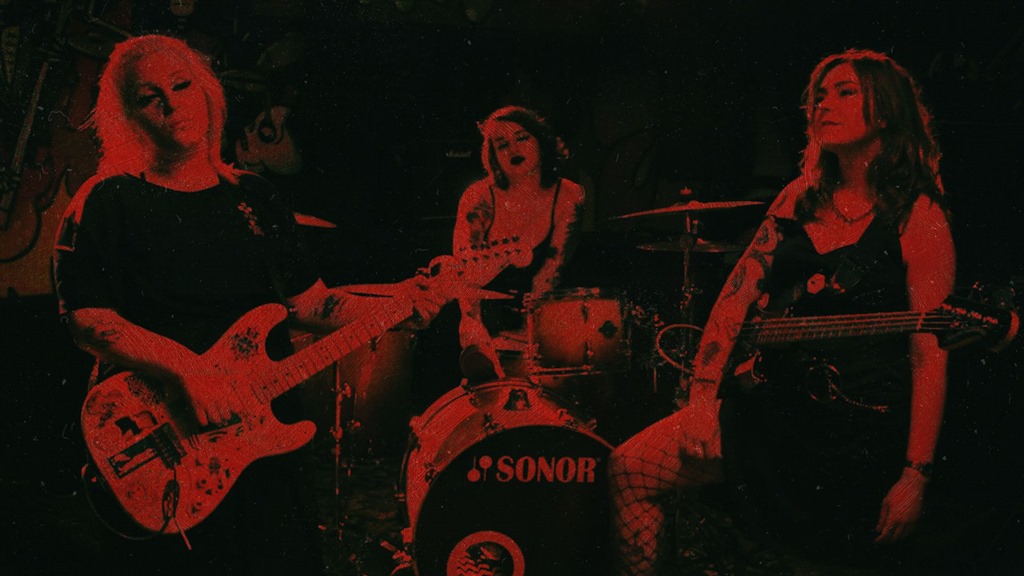
Death Pill, the hardcore punk trio from Ukraine, released their debut album on 24th February, a year to the day that Russia invaded their country.

Tracking started during Covid and was completed in late 2021, only three tracks were mixed before the war hit. However the band and their production team were able to somehow continue and finished everything including the artwork in 5 months whilst the Russian invasion rolled on. A testament to their drive and single mindedness.

The band are currently mid-way through their ‘Over My Dead Body’ European tour, which defiantly began in Kyiv, Ukraine on 20th May. Now the band have shared a new video for ‘Would You Marry Me’ with the bassist Natalya commenting, “This is a song about a rejected wedding proposal. Mariana wrote it after she proposed to her boyfriend and he turned her down. I shot this video when I moved to Barcelona and my best friend came to visit me. She became the main character, and I did the whole production. It took me about 72 hours to finalize the idea, shoot and edit it. I put my pain and suffering into this video, it’s a reflection and experience of personal rejections, dedicated to all the broken hearts.”

Watch the video now:

AA

DEATH PILL ‘OVER MY DEAD BODY TOUR’


JUNE

2nd – Germany, Bochum, Wageni

3rd – Germany, Ellerdorf, Wilwarin Festival

9th – UK, Bradford, 1 in 12

11th – UK, Manchester, Retro

12th – UK, Bristol, Louisiana

13th – UK,  Brighton, Green Door Store

14th – UK, London, Lexington  w/ Shooting Daggers

ld0C4Vqs

Death Pill by Tementiy Pronov : Slippy Inc.

Room40 – RM4163 – 3rd December 2021

Christopher Nosnibor

Field recordings are rarely something one would consider ‘contemporary’, although if you think about it, they invariably capture a moment in time in some way or another, be it the morning of the dawn chorus or the grind of machinery which is firmly post-industrialisation; the sounds committed to tape all document history in sound.

Ian Wellman’s latest release is quite specific in its focus on present times. It is almost impossible to avoid the pandemic; it has, after all, affected all of our lives, and in myriad ways. As the accompanying text states, ‘If this past couple of years has taught us anything, it is that to hold someone closely is not something we may take for granted. The bonds of friends and of family are tenuous, as tenuous as the world that we find ourselves in.’ While most attention has understandably been given to the vulnerable, the bereaved, and the sufferers of long covid, there have been long—terms and slow-evolving effects on everyone. And this is what Wellman soundtracks with subtlety and care here.

The parenthetical ‘(Police Helicopter Activity Increased – Jul 2020)’ is brief, but it’s impactful. On the one hand, it’s a simple snippet of the sound of rotors; on the other, it’s the kind of conglomeration of low-flying helicopter buzz that makes you duck and look up and feel paranoid: police helicopters hovering or circling overhead always do, right?

The final moments of ‘It Crept into Our Deepest Thoughts’ bursts into shards on abrasive noise in the final moments. It’s on ‘The Toll on Our Daily Lives’ that Wellman really encapsulates the struggle. The first four minutes are dislocated ambience, which reflects the general sense of detachment and distance, but the last minute is dominated by a rising tide of noise, a surging swell. And it speaks because it really is the sound of swelling tension and anguish. The reality is that living through this is not something that belongs to a ‘model’, there is no fix by means of re-engagement. This resonates because it speaks to and of the building anxiety, and it builds because maintaining that level of alertness, that level of fear, actually has a cumulative effect in real terms, and we’re simply not designed to process life in the now. There is nothing normal about this, old or new, and ‘The Toll on Our Daily Lives’ encapsulates this perfectly, both in its title and the sonic smog that ambulates broodingly, again growing in density and becoming more oppressive and heavy and harsh as it progresses. You feel not only the weight, but the tension. It’s real, it’s palpable, and it’s a direct reflection of life as lived.

The interludes, too, are so very visual and evocative: a cock crows and what sounds like rainfall and passing cars crackle and splash on ‘(Ash Falling on Power Lines – Sept 2020)’ (the ash of wild fires burning), and there’s a post-apocalyptic feel to ‘(Wind Against Decaying Bus – Jan 2021)’, and they all combine to create what the blurb describes as ‘a devolving diary of unsteady moments and the assurance of change as the one constant in our collective times’.

‘As The Beast Swallowed Us Whole’ veers between ominous rumbling and near-ambience and surging, cracking textured distortion that borders on noise, and there is nothing comforting about this album. Even the final track, the optimistically-titled ‘The Light at the End’ is woozy and disorientating, and evaporates into a crackle of static that ends abruptly, and feels more like the light being snuffed out. You want to be wrong… but life… it’s a killer. Swear all you like, but whether or not it’s going to be okay remains to be seen.

AA

a0173304686_10

27th August 2021

Christopher Nosnibor

Who would have thought in the middle of March 2020, we would be living in such different – and fucked-up – times a full sixteen months later? Many of us who work in offices left thinking we’d be back in a few weeks, and surely no-one predicted the decimation of so much retail and hospitality. While the most unprecedented thing about the pandemic in the UK was the overuse of the word unprecedented, it is true that this is the first time in history that the healthy have been quarantined en masse alongside the sick and the vulnerable.

In many respects, the vulnerable have been the hidden sufferers and forgotten people during this time. As the band write, ‘People with learning disabilities in England are eight times more likely to die from Covid than the general population, according to research that highlights a “hidden calamity” of the coronavirus crisis. At a time where arts centres are critically underfunded, and the disabled community will be the last to come out of lockdown, we want to offer solidarity and support to our artists and friends.’

The communal and collaborative element of Sly’s work is integral to their ethos: anyone who’s seen them live is as likely to have been implicated in the set as simply spectated, with the band among the audience, the audience becoming part of the band and banging drums… and this is no corny, manufactured communal clap, a contrivance to mask government bullshit, this is a real in-the-moment collectivism that’s life-affirming and enriches the soul. Their music may be murky and weird, but Sly and the Family Drone very much do use music for the power of good. And so of all the bands who would perform at the ICA with Jamaica!!, they were always the most likely candidates. Jamaica!! is less a band than a group musical session operating out of The Gate, an arts centre for adults with learning disabilities located in Shepherds Bush, London. The Gate write, ‘out of efforts to make the music sessions we facilitate there as inclusive as possible which we found by necessity entailed abandoning notions of what makes sense musically; an extension of the central ethos at the gate of reshaping the round hole to allow the square peg to fit rather than the unfair expectations of the inverse’. Their sessions are entirely improvised, and the band is whoever turns up on the night.

Jamaica!! Meets Sly and the Family Drone is a document of this particular night, and it’s being released as a special art edition with the aim of raising money for The Gate. It’s clear from the two expended workouts that occupy a side each of this c46 cassette that the two units readily come together as one in their improvisational stylings

Side one of Celebrating The End Together In The Good Time Swamp is an immense exploratory piece: twenty-one minutes of wild, percussion-heavy, industrial jazz noise. What, that’s not a thing? Yes, yes it is: it’s precisely Sly & The Family Drone’s thing, and the joy of their live work is that the only thing you can predict is that will be percussion-heavy industrial jazz noise.

It begins quiet and atmospheric, picked notes ringing out over a misty murk, drones and croaks of horns groan and yawn like a slumbering beast in dream, perhaps on the brink of awakening… You feel you should tread carefully. But clattering percussion swells unevenly, and there’s a building tension as well as a building volume. It sounds ominous.

And then, off-key notes ring from every whichway. Is it free jazz or is it simply chaos? Perhaps it’s both. Rising up momentarily, a big-band swinging beat that dives some kind of shape and spine to the seemingly formless sonic mass that’s swirling all around.

Ten minutes in, there are some indecipherable vocals shouting, while whizzes and whooshes enter the mix and it’s like a space rock rendition of a Throbbing Gristle performance. And then it gets really fucking drummy. It’s a full-on barrage, a solid wall of percussion. The final few minutes are truly cathartic, as the pace picks up and we hear the sound of ALL THE DRUMS. EVER. ALL AT ONCE. It’s beyond thunderous – it’s positively volcanic.

Side two is, in many respects, more of the same, only it’s slower, denser, more undulating, dronier. It’s a swirling, seething mass of sound, a glorious twenty-three minutes of mayhem, a surging hammering on of drums and drums and drums and drums, battering out a loping march while horns, kitchen sink and cement mixer churn out a heavy grind of weighty discord. There’s a lull around the mid-point, where it delves into an almost shuffling beat, and there’s even a brief paise while there’s some kind of bass break. Then the rhythm shifts again, and things are almost funky for a while – but mostly, it’s noisy and drummy. I mean, this lot are drummier than Boredoms, and they actually lock into a mean groove near the end. As the track powers onwards to its climax, the energy radiates from the speakers and it makes you feel good – because music really is always the best therapy.

AA

a2922480183_10