Posts Tagged ‘covers’

Hallow Ground – 21st December 2025

Christopher Nosnibor

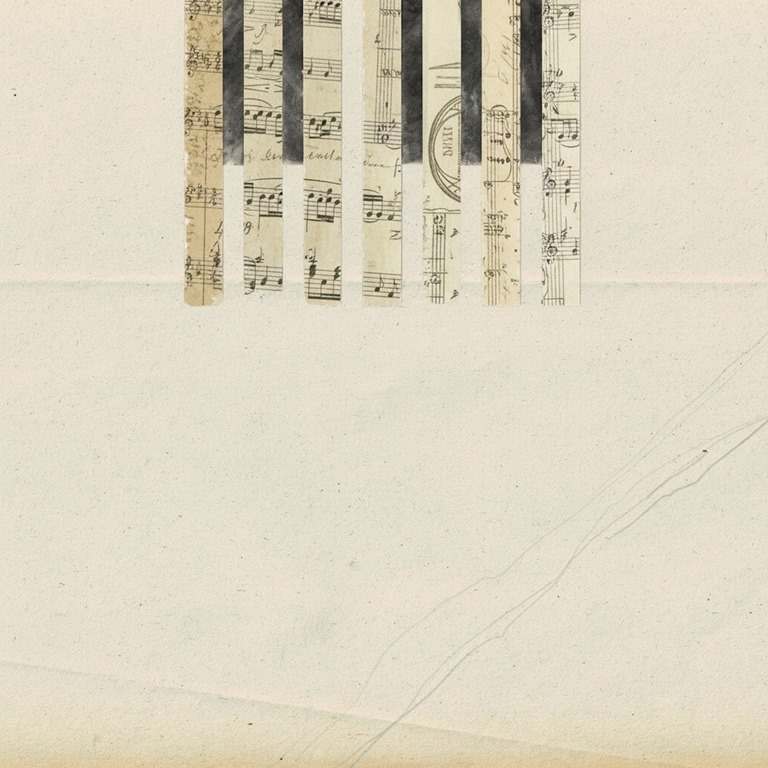
Ivan Pavlov has been releasing music as COH since circa 1997, and in the last twenty-eight years has amassed an immense catalogue which includes some thirty-six albums, often on respected experimental / avant-garde labels like Editions Mego and Raster-Noton. This body of work features a fair number of collaborations. This is his first with ‘the mysterious’ Wladimir Schall, who is no stranger to performing radically overhauled cover versions, not least of all his 2020 release on an endlessly looping cassette with his take on Satie’s Vexations. Suffice it to say, then, that none of the seven pieces on here could be described as ‘straight’ covers. Then again, given the nature of the selected material, how would one go about performing a ‘straight’ cover, and what would be the point, precisely?

As the accompanying notes explain, ‘the two multi-media artists are not content with the mere reinterpretation of their source material, but strive to reimagine it. According to them, the seven pieces on Covers were conceived as “a series of manoeuvres with an ambition to expose the machinery of Music in detail and with utter honesty, without making up for the faults of its traditional instruments or of the compositions themselves.”’

Perhaps the best known and most easily recognisable of the compositions is ‘Merry Christmas Mr Erik’, which opens the album by reworking Ryuichi Sakamoto’s ‘Merry Christmas Mr Lawrence’ as a sparse, almost jazzy work where it’s acoustic guitar which leads before the arrival of piano, which remains at a respectful distance. Not long after, we’re transported into a sparse, foggy trip of piano-led ambience. Perhaps one of the most audacious ‘covers’ is Soii Blanc’, an original COH composition which appeared on IIRON in 2011 – the album which was, in fact, my introduction to the world of COH. This version transforms the sparse electronic piece where experimental synth music meets early industrial grind into a soft piano work that’s as light as a feather but also mysteriously atmospheric through its subtle dissonances which grow with ringing, buzzing tones which gradually disrupt the delicate ripples with digital discord, creating the effect of some form of mechanical breakdown. Then again, ‘Snowflakes’ sees the pair ‘cover’ a ‘non-existent’ original’. It’s evocative: close your eyes and you may well visualise snowfall in your mind’s eye – but then glitches and scrapes cut through the reverie. In the main, it’s subtle, but enough to be disconcerting.

While there’s no clear or specific arc to the album, there is a sense that as it progresses, digital decay and interference gradually erode the graceful atmospheres conjured by piano and acoustic instruments alone – and by the arrival of the final piece, the brief bookend that is ‘Starost ne Radost’ – or ‘Старость не радость’ (joy and sadness), the juxtaposition of scratchy in the vintage sense and scratchy in the ersatz, manipulated digital sense comes to share a meeting and sensation.

AA
a1396191075_10

Nocturnal Rainbow Recordings – 5th September 2025

Christopher Nosnibor

One significant downside to digital music formats is that is reduces the dimensions of the experience. With a record, and even a CD, there is a physicality which is in many ways integral to the experience. I’m not here to sell the whole multi-sensory experience and tactility of vinyl line: yes, I grew up with vinyl, and in the 90s, a new LP was maybe £7.50 while a CD was £11, so I would often buy vinyl simply because I could get more music for my money. And records do scratch, sleeves get bent, and generally, vinyl requires more care than a CD, so I’m as much a fan of 5” silver discs as I am 12” black ones. And now, vinyl has become something of a fetishised luxury item: as much as there’s still pleasure to be had from sliding a thick chunk of wax cast in whatever hues from a glossy, heavy card sleeve, there’s sometimes a sense that they’re all trying too hard, and the £30 price tag takes some of the shine off the experience. There are a few exceptions – recent Swans releases have been works of art in every sense, and the physical formats have added essential dimensions to music which is something more than just some songs, recorded.

Had Ran Slavin’s latest offering been given a vinyl release, it would have been a triple LP, containing as it does thirty tracks, with a running time of almost two hours. It would have been epic. But despite having released previous albums on esteemed labels including Mille Plateaux, Cronica, and Sub Rosa, it’s unlikely that Ran Slavin has the kind of fan base that could justify, from a label perspective, a triple-vinyl release. But what Nocturnal Rainbow Recordings have done here is interesting, and utilises the digital format in a novel way, by offering alternative artwork in recognition of the album’s multi-faceted nature. Yes, it’s been done by major artists who’ve released physical albums with variant covers, with a view to enticing hardcore fans to buy multiple copies and thus increase sales and enhance the chart position (The Rolling Stones’ Hackney Diamonds probably wins the award for the pinnacle of pisstake on this score), but the idea of buying an alternative digital cover for a nominal price isn’t something I’ve seen before.

As the notes on the Bandcamp page explain, ‘Just as the music migrates across genres, the visuals migrate across states of being, extending the album into a network of parallel identities. Together, they construct a fragmented yet coherent cosmos, where each image is both an entrance and a deviation, multiplying the ways Neon Swans can be seen, heard, and inhabited.’

Appropriately, Neon Swan doesn’t quite sound like anything I’ve heard before, either. To unpack that, it contains many elements which are common and familiar. There’s sparse techno, minimal dance cuts with sped-up vocals and swathes of space between low-key beats and glitchy grooves, as represented by single release and album opener ‘tell///me///now’ – one of many titles which reflect the sense of fragmentation and juxtaposition which define the album (‘s4dert1ac’ and ‘d3xr3rity’ provide other examples, but then there are the likes of which also disrupt the conventions of language in the same way Slavin disrupts the language of genre tropes).

‘audio ease my pain’ plunges into darker territory, while introducing rap vocals atop heavy hip-hop beats (although there’s an instrumental version as well further on, which offers a different perspective again on the same material). Elsewhere, ‘c-r-i-m-s-o-n-schema’ brings spacey, spaced-out bleeps, heavy percussion that has a late 90s feel, a blend of The Judgement Night soundtrack’s melding of rap and rock, and the Wu-Tang Clan.

For all of the space, the reverb, the minimalism, something about tracks like ‘searching_heart’ is quite claustrophobic: the intense repetition and synthetic feel, paired with crackling fizz, brain-melting glitches and some grinding bass tones. It may be constructed using the fundamental elements of dance music, but this is not dance music. Electronic music to induce uncontrolled spasms and twitches isn’t a genre, but if it was, Ran Slavin would be a leading exponent.

It’s a long album, with a lot to digest, and as it thumps and wobbles and glitches away, snippets and fragments collaged across one another, there are times it all feels a but much, a bit bewildering. At times it’s draining, exhausting, at times you simply zone out, and often, I find myself questioning the wisdom of persisting with it. The vibe is that of the kind of underground clubs I never got on with in the 90s and early 00s, and I’m particularly reminded of the time Whitehouse played an Optimo night in Glasgow in 2003: I was there for Whitehouse, who played for forty minutes starting around midnight, and the music being played was rather in the vein of the more groove-centric cuts on here. The people there for the DJs weren’t happy for the low-key electro pulsations to be paused for the noise and antics of Bennett and Best, but for my part, I struggled to get into the low-key electro pulsations. But the other reason I recount this experience, challenging in its incongruousness, is that in places, Neon Swans feels incongruous with itself, an album riven with unreconciled contradictions.

The execution of Neon Swans is hard to fault, and it does cover considerable ground, with range, over its expansive duration. But it is sprawling in its scope, its focus is variable, and it is very long. And it’s maybe better with drugs.

AA

NRR38 art 1

The second advance single taken from the forthcoming MER Redux Series release Marc Urselli’s Ramones Redux features a stylish collaboration with a creeping groove of Icelandic artist Daníel Hjálmtýsson and Norwegian dungeon synth pioneer Mortiis. These Nordic musicians have taken on the track ‘Beat on the Brat’ and truly made it their own, with the punk-worshipping new Redux Series installment scheduled for release on June 6, 2025.

AA

Daníel Hjálmtýsson comments: “Ramones made me love making music the way I wanted to make music", the Icelander writes. "No excuses. No rules. Taking chances and learning to love the imperfections. Just straight up. Fearless. With this track being a personal favorite, I really wanted to do a kind of 180 spin on it and take a lot of chances. The theme of the song is very dark and hits home for me in many ways, and I wanted to explore the disturbing themes in a darker, moodier way. I’m so grateful to be a part of Marc Urselli’s group of incredible artists on this one!”

Mortiis states: “Needless to say, when you’re asked to work on something as legendary as a Ramones song, even if it’s just a cover, it can be pretty nerve-wracking stuff", the Norwegian muses. “I just rolled with what came natural to me, and hopefully I won’t be lynched by the masses. Marc has always been awesome to work with, and so far he hasn’t tried to kill me, which I think is a good sign.”

It has been said about Icelandic artist Daníel Hjálmtýsson that he “embodies a sonic fusion reminiscent of the likes of Nick Cave, Mark Lanegan, and Depeche Mode, set against a Leonard Cohen afterworld”. With his debut single ‘Birds’, Daníel introduced his dark, neo-goth and atmospheric approach to alternative rock music in early 2020. The late Mark Lanegan wrote: “Daníel makes icy neo-goth music that brings to mind the forbidden landscapes of his native Iceland”, the legendary US-musician stated. “One can envision him on a stage of a church-turned-dungeon, somewhere in the Reykjavik underbelly.”

Iconic Norwegian musician Mortiis has just signed a deal with Magnetic Eye sister label Prophecy Productions. After parting ways with the Norwegian black metal pioneers EMPEROR, Mortiis embarked on a solo career, the so called ‘Era I’, that lasted from 1993 until 1999. In this highly creative period, the Norwegian released six full-length albums (including the “The Song of a Long Forgotten Ghost” demo and “Crypt of the Wizard"). His music during this phase was entirely composed on synthesizers. In the next decade, Mortiis evolved into a band that marked the beginning of the short-lived ‘Era II’, which only consists of the rather electropop oriented 2001-album "The Smell of Rain”. When ‘The Grudge’ came out in 2004, the album had a hard impact of the scene and started ‘Era III’. The Norwegian and his band had turned to heavy industrial rock and as a result made many new friends. This was followed by a factual hiatus between 2011 and 2015, although it was never officially announced. In 2016, the next full-length "The Great Deceiver" surprised global followers of the band that had long hoped for a new release. Although the style of the previous phase is largely continued, it is named ‘Era 0’. On the gargantuan remix album The Great Corrupter, Mortiis again teamed up with a host of exciting artists including musicians from GODFLESH, FRONTLINE ASSEMBLY, DIE KRUPPS, MERZBOW, and APOPTYGMA BERZERK among a multitude of others. Currently, the Norwegian is preparing to release a new album.

Christopher Nosnibor

Goths are the most knit-picking pedants and harshest critics of their favourite bands of any genre’s fans I know. Actually, that’s not quite true: fans of The Sisters of Mercy are the worst knit-picking pedants and harshest critics of their favourite bands. I preface this review with this observation as a Sisters fan first and foremost, and contestably as a goth second.

Y’see, most of the bands which emerged after that initial post-punk crop which included The Sisters, Siouxsie, The Cure, Bauhaus – disparate bands who have little in common sonically and stylistically beyond reverb, dyed hair, and studded belts – and sure, The March Violets, The Danse Society, UK Decay, and a handful of others, were toss. By the time ‘goth’ was formalised as a ‘genre’ it had gone to shit, mostly with every other band ripping off the guitar and bass for ‘Walk Away’ and diluting it to a pissweak rehash, and all too often with ghastly theatrical booming vocals. And they all started wearing waistcoats and frilly cuffs and appropriating ‘gothic’ imagery to boot. That was circa 86, by which time – that’s which time, not witch time – The Sisters and The Cure and Siouxsie had very much evolved, so we can probably as much blame The Mission for the start of the rather more naff second wave. By the 90s, derivative cack like Every New Dead Ghost was crawling out of the woodwork, amplifying the cliches on top of simply being laughably bad.

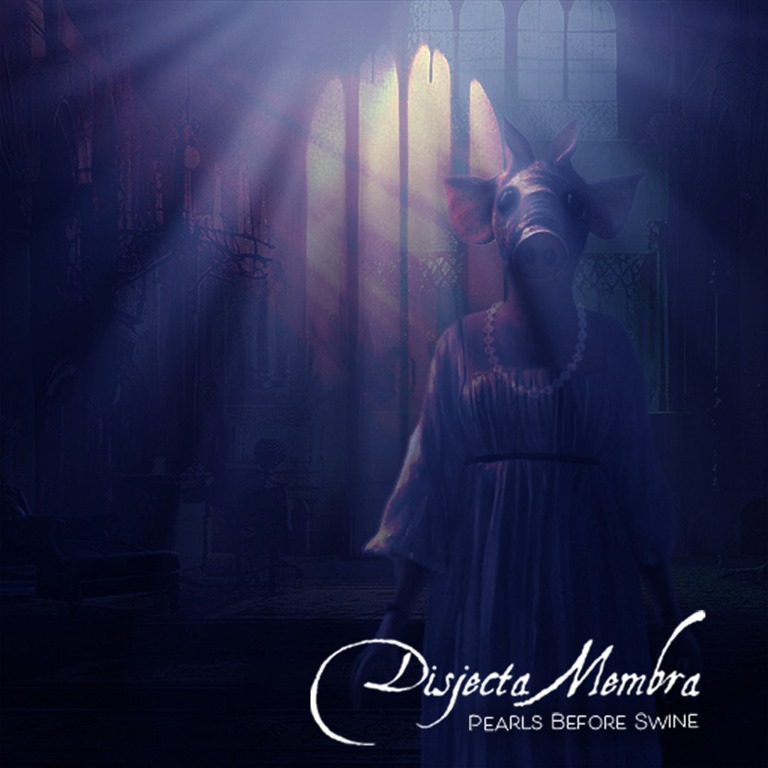
It so happens that Disjecta Membra have been going 30 years, emerging from that early 90s milieu of corny goth revivalism – presumably pining for 1985 and sobbing into their baggy sleeves when The Sisters went cock-rock with Vision Thing. This release is a career-spanning retrospective, which they’re giving away free on their Bandcamp. And this is the first I’ve heard of them.

I kinda wish it had stayed that way. It starts off with the single version of ‘Whakataurangi Ake’, which features Rob Thorne, and it’s a preposterous, pretentious semi-ambient new-age effort with over-the-top dramatic vocals. I mean, fair enough in that it draws on their New Zealand heritage, but it’s pretty obvious and cheesy as. And it’s all downhill from there.

‘Lilitu’ might actually be quite exciting if X-Mal Deutschland had never existed. But as it is, it might as well be a cover of ‘In Der Nacht.’ Talking of covers, there are a few here. And again, after The Sisters broke the ground of taking songs that didn’t obviously sit with the style – like ‘Jolene’, and disco faves ‘Gimme Gimme Gimme’, and Hot Chocolate’s ‘Emma’ and made it their schtick, every other goth band thereafter just had to toss in some quirky covers… and lo, we get a take on Boney M’s ‘Rasputin’ and covers of other goth bands, because they obviously add so much more. ‘Rasputin’ sounds like you’d imagine, of course: drum machine with a head-splitting snare and spindly guitars. It’s cack, but the worst thing is that it doesn’t really bring anything new and doesn’t even sound like it’s done vaguely ironically, meaning it’s neither cool nor funny.

And while we’re in the realms of cliche, what’s the obsession with marionettes in contemporary goth? ‘Antoinette Marionette’ is as obvious as it is lame as wordplay goes., and with its crashing snare and chilly synths and spindly guitars, the best that can be said for it is that it’s uptempo. I did kinda wish that ‘Skin Trade’ was a Duran Duran cover instead of the po-faced and predictable goth-by-numbers that it actually is.

Apparently, ‘Madeline! Madeline!’ and ‘Death by Discotheque’ are both good enough to warrant two versions on a thirteen-track compilation. They aren’t, and it suggests a lack of material of a quality to fill a single album over the course of thirty years. The latter, especially is a derivative disappointment, a stab at rambunctious goth-country in the vein of Fields of the Nephilim while attempting to create their own take on Suspiria’s ‘Allegedly, Dancefloor Tragedy’- one of the few decent songs to come out of the early 90s revival. This isn’t a patch on it, and just seems to think it’s amusing bashing cybergoths. I mean, they have a point, in that cybergoth was a ridiculous thing, but of all the audiences to alienate in their position.

The last track, ‘Walking in Light’ is quite interesting, marking a shift in tone towards droning guitar ambience, at least initially, but then it descends into a glam-infused rock stomp which turns out to be a cover anyway.

30 years, and this is the best they’ve got.

AA

a0980357481_10

Christopher Nosnibor

The Fall’s ‘Fiery Jack’ is blasting from the PA as I line up behind a cluster of gothy / alternative types: promising signs, always, and Wire and Sleaford Mods feature on the playlist while we’re waiting for Balcony Plants.

York has suddenly begun sprouting a new crop of indie / alternative bands, and tonight’s event showcases three of them.

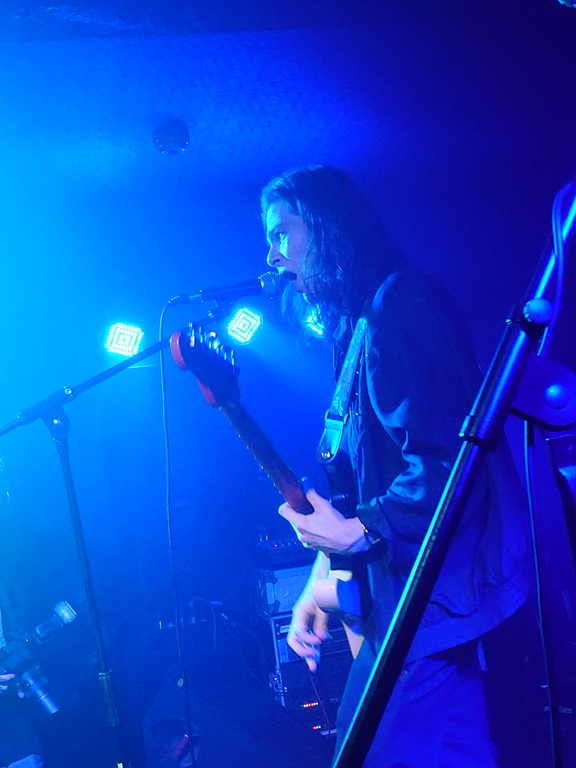
First impressions? They’re kids. Of course they are. And they’ve brought a lot of mates along. They all congregate and hug in the front rows as the band take the stage. Second impressions? Jesus. Balcony Plants are into introducing the band members and making and calls to make some fucking noise while they’re still tuning up, before launching into some lame-assed rap-rock with elements of early Beastie Boys, with songs about house parties and nightclubs. Then something happens mid-set. After tinkering with some pedestrian Kerrang! flavoured alt-rock that shows they’re as stylistically coherent in their music as their image, they lunge towards ever grittier punk as the set progresses, and improve exponentially as they do, and there’s lots of moshing, especially to their cover of Nirvana’s ‘Breed’, which, is undeniably storming. They do know how to build a set to a climactic finale, I’ll give them that, and by the time they’ve orchestrated some tidal waves of crowd action during their signature song, they’ve convinced me. They’ve work to do, but it’s early days and they’ve got clear potential.

DSC_4622DSC_4660

Balcony Plants

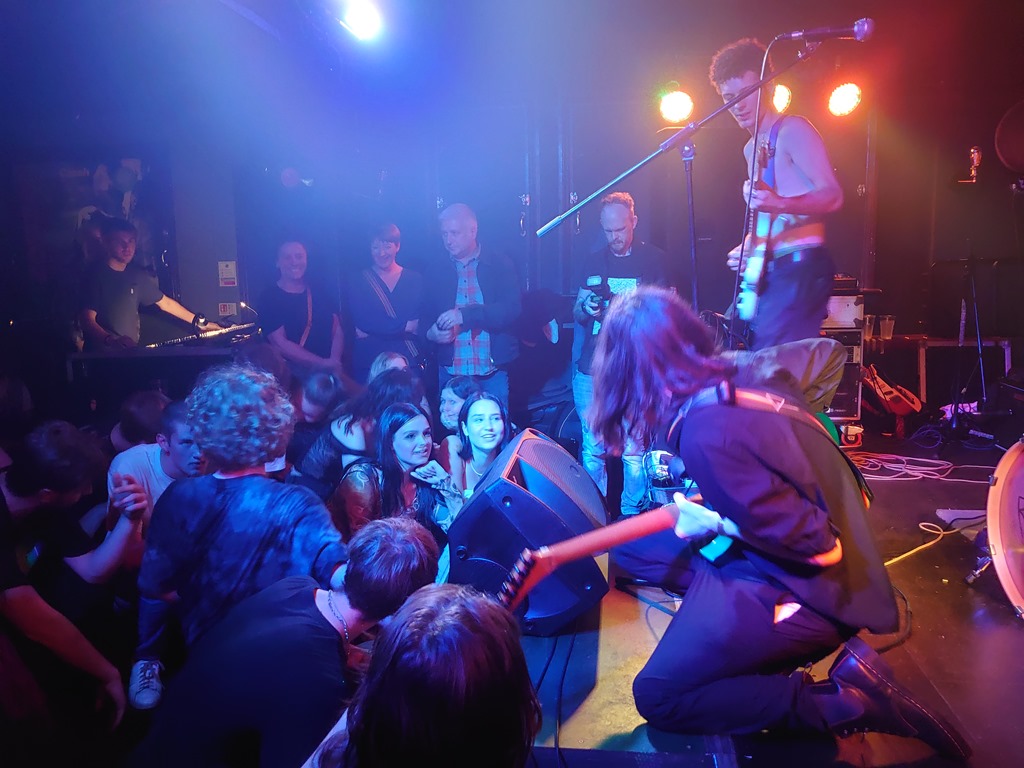
So the guitarist in Balcony Plants is also the bassist in The Rosettas, a more visually and sonically coherent proposition. The singer makes an entrance….and it kinda takes a brief nosedive there. The riffs are meaty and the drumming is particularly tight, but the vocals merely so-so. I’d always question throwing in a cover as the second song of any set, but especially one of The Foo Fighters’ ‘Everlong’, however well played.

That tonight’s bands – all clearly made up of millennials (and I mean that factually rather than in any way disparagingly)– scatter their sets with choice 90s cuts is interesting; I suppose in context it’s the same as young bands of the 90’s dredging up songs of the 70s from their parents’ collections, or every band of the 80s covering ‘Sister ray’ and ‘Louie Louie’; there seems to be a two-decade loop which essentially corresponds with the emergent generation gap.

‘Save Your Time’ may be their idea of heavy, but… Still. They play with energy and are decent enough in a middling gruge-tinged alt-rock way. They probably need to work on the between-song chat, though, since “We’re about to play a song some of you might know. It’s on a thing called Spotify” is about as good as it gets. Blur’s ‘Song 2’ is the second cover of their set, and they seem to play the covers better than their own songs, but also manage to deliver a strong finale.

DSCPDC_0001_BURST20220930213403406(1)DSC_4666DSC_4676

The Roosettas

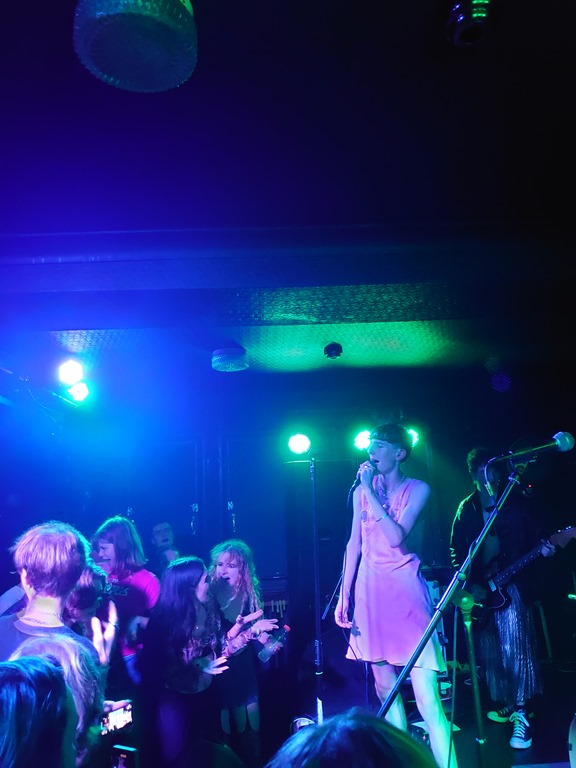
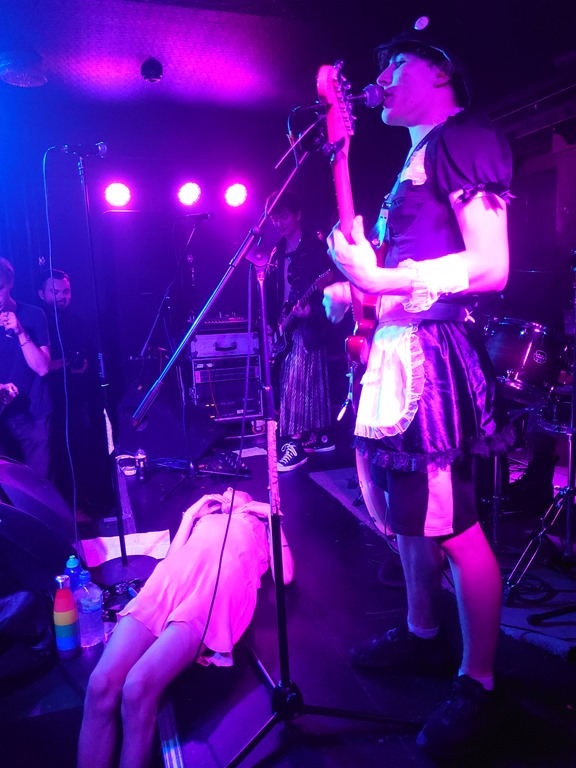
The Rosemaries exude an air that they’re a cut above from the second they walk on. Tonight, they’re all wearing dresses, but still look the most rock ‘n’ roll of tonight’s acts. The 90s covers continue as they open with a passionate cover of ‘Killing in the Nam’, and it again seems an unusual choice. The squawking vocal uplifts are unexpected. But there’s a lot that’s unexpected about this bunch, and it’s all good. They’re political, they’re tight, and they’re solid. Sprechgesang verses bounce over buoyant baselines before breaking into mega choruses. ‘Pogo pogo pogo’, say my notes. Those squeaks are an interesting post-punky vocal quirk that seem to reference early Fall more than anything, but then also make a nod to Siouxsie.

Overall, The Rosemaries land between The Sex Pistols and Yard Act with a dash of Pulp, although ‘Easy Peas’ bludgeons away at two chords Fall style. The singer heckles the audience in classic northern style: “Are ya gonna do some proper moshin’ or what?”

DSC_4696DSC_4692DSCPDC_0003_BURST20220930223248160_COVER

The Rosemaries

They slip into a three-chord punky thrash with sneery, shouty vocals that call to mind Jilted John and hammer out as their second cover – the most contemporary of the night – Fontaines DC’s ‘Boys in the Better land’, which had been aired over the PA earlier. It’s a faithful rendition that’s delivered with zeal, and one can’t help but feel its relevance to bands knocking around in York. There are some decent pub venues to be grateful for, but there’s a world outside, starting just a few miles up the A64.

If this seems critical of the bands or local scene, it really isn’t: bands have to start somewhere, and with grassroots venues closing by the dozen, it’s a joy to witness nights like this – bands cutting their teeth in venues what are happy to give them a platform, and what’s also encouraging is the embracing of the ramshackle, rough and ready. I’m tired of a scene where bands strive to sound like arena acts in pub venues. It’s just not punk, and what we need is to hear live music that sounds and feels live. This is what tonight brings. It’s unpolished, unfinished, work in progress. But it’s great fun, and this is the next generation coming through. Just wait.