Posts Tagged ‘Contrast’

Klonosphere Records – 7th March 2025

Christopher Nosnibor

What is it about prog bands and Greek mythology and space? Sure, both are inspiring for their expansive and epic qualities, but it does seem to be almost a requirement for prog acts to be quite obsessed about mythology or space – or, in the case of March of Scylla, both. Indeed, Scylla is a man-eating monster which features in Homer’s Odyssey, while the French progressive metal quartet’s debut album’s title may refer to the galaxy, or daughter of Cassiopeia in Greek myth, after which said galaxy was named. I suppose there’s some intertwining there, which works. On the one hand, it’s mystical, it’s deep, and its seriousness manifest.

These guys do bring some ultra-chunky riffs which straddle nu-metal and technical metal, and they alternate these with huge, arena-friendly choruses which are impressive in the anthemic heights they scale, and no, that’s no sarcasm, believe it or not. But it does flop headlong into the template trap which is the curse of so much metal of the twenty-first century – and again, it’s something that emerged and came to prominence with the advent of mu-metal and then seemingly seeped into other strains of metal, alternating full-throated roaring verses with melodic choruses. At first, to my ears, at least, it sounded less dynamic or thrilling, and more like bands trying to please everyone by being everything all at once. And I suppose the formula must work, because a quarter of a century later, they’re still doing it, even though it’s tired and ultra-predictable now. Sure, it’s fundamentally the same form as the quiet / loud structure that defined the grunge sound in the 90s, but the difference is that with the quiet / loud thing, it felt like build-up and release, whereas this is more like splicing two different songs together. It’s Jekyll and Hyde. And a sudden turn works when it’s out of the blue, but when every song is structured around a ball-busting riff and raw-throated guttural vocals which abruptly give way to some big emotive burst of white light you can sing along to, it’s not only predictable, but feels as if one segment undermines the other. Like, c’mon, make up your minds! None of this is to say that I think ‘heavy’ bands should only do ‘heavy’: contrast is a vital element in giving a composition impact, and besides, I would simply never prescribe that music should be one thing or another. My point is that when things become overly formulaic, they risk losing that impact.

So ‘Ulysses’ Lies’ does the raging riff thing alternating with the anthemic chorus thing. I’m not sure if the lyrics are being delivered from the perspective of a protagonist from the canon of Greek mythology, or it it’s simply a framing for some introspective moan about relationships or whatever, and no doubt if I was willing to spend hours straining my ears to decipher it all, I’d find the answer, but I can’t say I’m that invested. It sounds like some introspective moan about relationships or whatever, though. Way to diminish the potency of epic tales of gods battling and whatnot.

‘Death Experience’ stretches out for a fill seven minutes, and if it’s not necessarily a full epic, it’s most certainly an epyllion, and with some tight and detailed guitar-work and a well-executed atmospheric mid-section, it delivers everything it promises, including a sense that the ‘death experience’ is one of a dazzling ascension beyond this plane. And if it seems as if I’m being unreasonably critical of March of Scylla, there’s no questioning their musicianship or capacity for solid compositions. They pack in some megalithic, churning riffs and know exactly how to hit the hammer on intensity, just as they absolutely nail the huge, hooky choruses. But it just feels so studied, and you know how it will go as each song plays out.

‘To Cassiopeia’ is an interlude which combines space and mythology in one processed, predictable but atmospheric piece, before ‘Dark Matter’ goes Metallica’ before it goes You Me At Six… and it’s a sonic identity crisis to my ears, although it’s precisely what they were going for. What to say? It’s wrong to criticise a band for what they’re not, but this is difficult for what it is – namely conflicting and predictable, but perfectly executed. The heavy segments hit hard, and the light, melodics parts are well done but ultimately a bit lame. It’s yin and yang.

AA

a2477402970_10

Fabrique Records – 18th June 2021

Christopher Nosnibor

Berlin-based composer and sound artist Jana Irmert has approached her third album for Fabrique with a view to exploring the way in which sounds have a certain sensory aspect. There’s a way in which music touches us, not just aurally, nor emotionally: some music you really do feel. Beyond music at the louder, harsher end of the spectrum – be it electronic or more conventional in its instrumentation, this is something that is perhaps more common to experimental forms, where contrasting sounds and the shapes and textures of those sounds are more the focus than the unity of a collection of instruments for create ‘songs’.

Articulating how music makes you feel is one challenge, but articulating how music itself feels – or moreover, how the sounds themselves feel – is an immense challenge. Because writing, like any other art, can often reveal its authors limitations, however well they’re working. Every artist has their own personal limitation. Francis Bacon was unable to paint feet, for example. The greatest limitation is invariably the disparity between concept and execution, and often, for musicians, it’s articulating the sound in their head using actual instruments – or, if not articulating the sound, conveying complex emotions through the medium of sound.

Jana Irmert’s challenge here was to render one sensation through another. “I felt I wanted to get closer to the sounds, feel their structure and surface and how they contrast each other,” she says. And, during the process, her recordings yielded some quite unexpected results: “It turned out the processed sounds resulting from hard materials would often have soft and tonal qualities whereas those made from ‘soft’ materials like water or air would ultimately be of percussive or harsh and noisy character.”

The opening bars of the first piece, ‘Lament’, are unexpectedly dense and heavy, a rugged, grainy tone that grinds from the speakers before slowly tapering down to something rather more tranquil, yet draped with the weight of melancholy. Moving into ‘Against Light’, Irmert creates a much more upbeat ambience, a shimmering, shuffling stuttering of sound, and it’s gentle, but not entirely calming or comforting, like being stuck in a tractor beam, a glitching loop that affords no forward trajectory.

With the sounds of the sea, the title track initially seems like it will fulfil the description, offering something soft, soothing, immersive. But as layers build, darker sounds clunk and rumble and loom and lurk in thickening shadows.

There is a certain sense of progression over the course of the eight compositions, with more percussive sounds coming increasingly to the fore. In doing so, the album gradually moves from intangible to something altogether more substantial, its physicality developing an almost corporeal tangibility.

Listening to The Soft Bit, one feel as though one is somehow in nature, and surrounded by nature, from the clouds, and the air – invisible, yet capable of substantial force when moving as a wind – to solid objects – stones, trees, the ground beneath the feet. Listen, inhale it all in, and feel it flow.

AA

FAB088_front

27th April 2020

Christopher Nosnibor

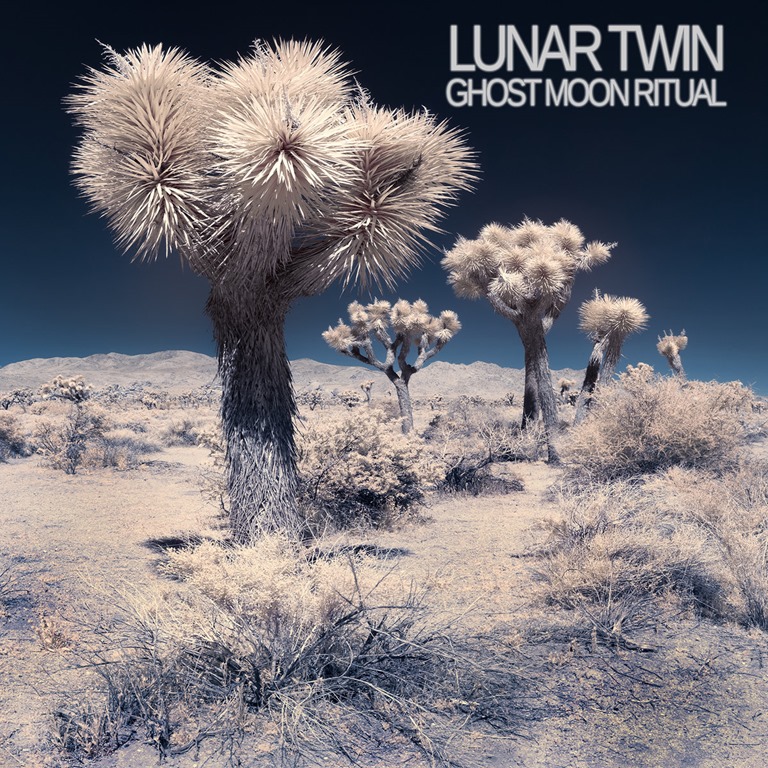
Ghost Moon Ritual follows its predecessor, Night Tides, after three years in the making. It’s easy to forget that most musicians have actual day-jobs, and things like families and normal lives to operate, too. It’s not easy to pack in creative activity alongside normal life.

Since lockdown, everyone seems to have delivered a new release, and, bizarrely, and most unexpectedly, a world without live shows is suddenly a world brimming with new music not so much ins spite of, but because of circumstance.

All of our circumstances are different, of course. Balancing dayjob, parenting, and an all-consuming state of anxiety, I’ve found less time and energy than ever available to review more material than I’ve ever received in over a decade of doing this.

Ghost Moon Ritual is pitched as ‘a song-cycle influenced by redemption, hope, failure and endurance’, and while the creative contexts isn’t immediately apparent, the attention to detail, not least of all atmosphere, is.

As the band write, ‘During the three years of writing and recording the album, several people close to the band passed away bringing a heavy mood to the proceedings. During this time, two beautiful children were born as well, bringing with them a reminder of the joy that still exists and is always enduring. Realizing that all there is now and that the outside world at large seemed to be teetering more and more on the edge of a cliff Work moved slowly, tuning this out and retreating into the studio with heavy hearts, the duo worked to channel the grief and hope and joy into what has become Ghost Moon Ritual.’

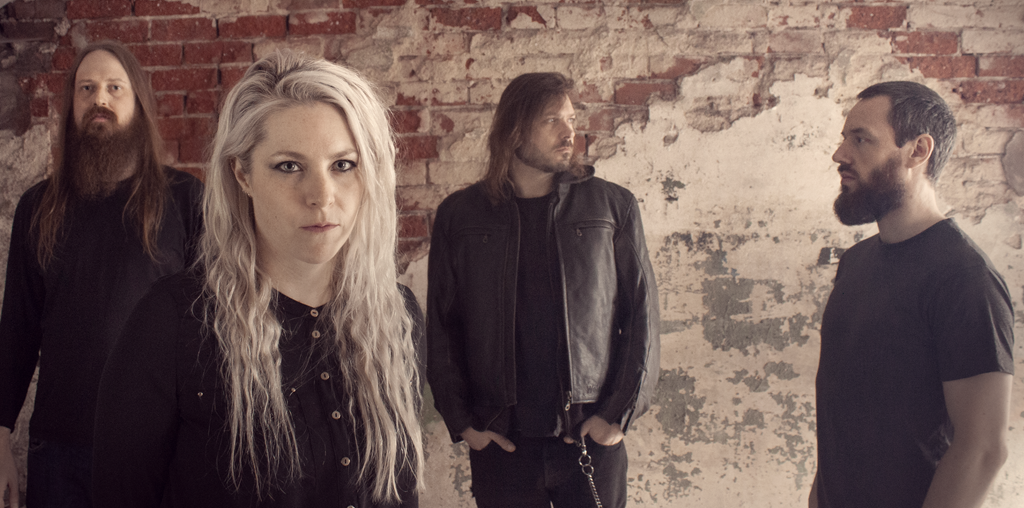
While Night Tides contained six songs, Ghost Moon Ritual contains thirteen, and as such is an altogether more substantial document. It’s also a document which renders with crystal clarity the way in which Lunar Twin’s work is built on contrasts: specifically, Bryce Boudreau’s baritone vocals that call to mind Leonard Cohen, and as such belong to a rock / folk world, while Christopher Murphy conjures sonic drifts that meld dreamwave and sparse folk with a laid-back, rippling dance vibe.

The album’s first song, ‘Drunken Sky’ is a slow, swaying semi-comatose crawl of drum machine and synth bass, and calls to mind some of the doomy, reverby-but-claustrophobic material on The Jesus And Mary Chain’s Barbed Wire Kisses. The drums burst into D’n’B near the end, which is unexpected, but then there’s a lot that’s unexpected about this set.

All of the Mark Lanegan comparisons are entirely justified: ‘Leaves’, and, indeed, several other cuts, could easily pass as outtakes from recent Lanegan albums, with Bryce Boudreau’s world-weary gravel-heavy croon laying breathy over sparse backing, picked guitar and spectral synths drifting over minimal percussion. ‘Neon Room’ is subtle, combining chilled dance grooves with a deep-carved rock growl: the result is quite unexpectedly affecting.

As a collection it’s sparse, dolorous, dark. It’s also gentle in its bleakness, but bleak it is, as well as understated and graceful, and as such, it reaches all the parts.

AA

a3899811576_10

Sacred Bones Records – 31st August 2018

Christopher Nosnibor

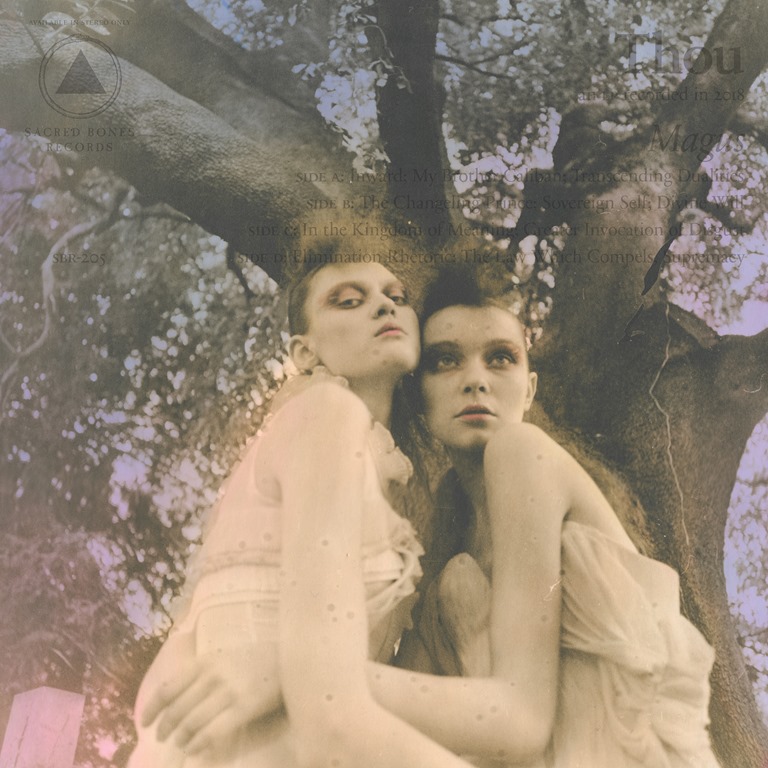
Magus is Thou’s first full-length since 2014’s Heathen. It’s perhaps fair to say that the three EPs which preceded it – which they forewarned would be ‘a complete sonic departure from Magus and from each other’ – which effectively constituted albums in their own right – did nothing to prepare us for this.

But what exactly is this? As the album’s press blurb acknowledges, they’re ‘often lumped in with New Orleans sludge bands like Eyehategod and Crowbar, [but share] shares a more spiritual kinship with ‘90s proto-grunge bands like Nirvana, Alice in Chains, and Soundgarden’, while ‘the band’s aesthetic and political impulses reflect the obscure ’90s DIY hardcore punk found on labels like Ebullition, Vermiform, and Crimethinc’. All this makes them hard to place.

The album’s opener, ‘Inward’, provides just over ten full minutes of snarling fury that carries enough weight to crush weaker souls who may venture forth expecting any of the soft musicality of the Inconsolable EP (which revealed Thou to be capable of extreme gentility, and, indeed, extreme beauty).

Things turn very black and very sludgy and very heavy on ‘Transcending Dualities’; and while it’s a snarling, low-tuned mess of slow-creeping sludge, there are stray notes that break free to squeal to break the trudging oppression. Bryan Funck’s twisted vocals draw every ounce of excruciation into the mix.

‘The Changeling Prince’ brings grace and grandeur to proceedings, and the hushed intro and expansive sound of ‘Sovereign Self’ (the second of three songs to cross the ten-minute mark) calls to mind Amenra, but his is a whole other level of gnarly, demonic savagery, and the overall sonic density is suffocating.

But Magus does find Thou continue to expand and explore in all directions, and there are three shorter tracks that serve as interludes between the towering monoliths which are the songs themselves: the cacophonous racket of ‘My Brother Caliban’ contrasts sharply with ‘Divine Will’, with its ethereal female vocals and pounding tribal drums. Elsewhere, the sprawling epic that is ‘In the Kingdom of Meaning’ introduces a psychedelic twist to the doomy trudge. And there are passages of extreme delicacy, rich in evocative atmosphere, which draw the lister into quiet clearings with dappled light where an air of calm radiates before the shadows loom, the clouds gather and the next tempestuous storm breaks. Such tension-building passages and contrasts of mood and volume create a compelling dynamic and makes Magus a mighty album which requires attention and exploration of the detail.

AA

954503