Posts Tagged ‘Ashley Reaks’

2nd October 2025

Christopher Nosnibor

The context for Ashley Reaks’ sixteenth solo album – and his third in three years (not counting the compilation of demos released earlier this year) – is weighty. He has written openly and extensively of his health issues, while sharing images and commentary nocturnal wanderings, and these both inform At Night The World Belongs To Me, of which he writes:

The looming spectre of death and loss haunt the album: Reaks survived two major health scares and a misdiagnosed terminal illness over the last 18 months, experiences that inform the reflective, poetically gloomy lyrics, and the 4 am downtempo grooves. Adding to the sense of loss, guitarist and long-term collaborator Nick Dunne died suddenly at home just one week after completing his guitar parts for the record.

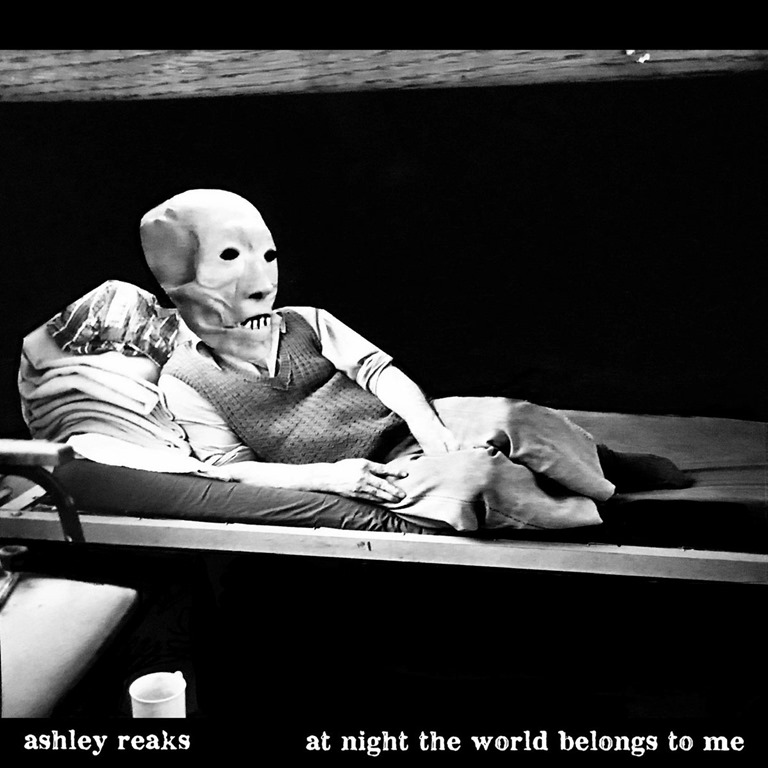
Through all of this, he has continued to collage and write prodigiously, but At Night The World Belongs To Me marks a distinct change of tone from its immediate predecessors, The Body Blow of Grief (2024) and Winter Crawls (2023). The usual elements are all present and correct – the sense of experimentalism, the collaging of genres, melding post-punk, jazz, and dub – but this feels darker, more introspective. The cover art, too, reflects this. While it has the same rather disturbing, grotesque strangeness of his usual work, the grim-looking figure in repose has connotations of ailment, frailty, even the deathbed.

The first track, ‘Playing Skittles With The Skulls and Bones’ has a bass groove that calls to mind The Cure’s early sound, melded to a rattling rhythm reminiscent of ‘Bela Lugiosi’s Dead’. The smooth sax that wanders in around the mid-point provides something of a stylistic contrast, but at the same time, it’s minor-key vibes keep the song as a whole contained within a bubble of reflection, evoking the stillness of night. I know, I’m sort of dancing about architecture here, but something about Reaks’ work prompts a multi-sensory response.

‘Rimmed With Yellow Haloes’ brings soaring post-rock guitars atop of an urgent ricochet of drumming and solid bass. On the fact of it, it’s almost poppy, but it soon shifts to take on a folksy aspect, while Reaks sings of death and funeral pyres, and the refrain, delivered with lilting, proggy overtones, ‘The Lord gave the day to the living, the night to the dead’. In context of the album’s title and theme, there is a tangibly haunting foreshadowing here, a suggestion that Reaks has not only accepted his mortality, but has assumed his place. It’s powerful, and deeply moving. Of course, Reaks can’t help but introduce incongruous elements, with some horns which are pure ska and some super whizzy 80s pop synths providing a pretty wild counterpoint to it all. It’s hard not to smile, because there’s an audacity to this approach to composition and arrangement – a lot of it simply shouldn’t work, but it does, and it’s uniquely Reaks.

The album’s shortest song, ‘Things Unseen’ is snappy, poppy, Bowie-esque, an amalgamation of post-punk and electropop, a standout which is succinct and tight, and consequently, the dark connotations of the bleak shuffle of ‘Life Forever Underground’ – a rippling synth-led tune – are rendered more profound. The sequencing of this album is such that the shifts between songs accentuate their individual impact.

‘Mask the face, unmask the soul…’ he sings softly on ‘Mask The Face’, which has a somewhat spacey Krautrock feel to it – before a guitar solo that worthy of Mark Knopfler emerges most unexpectedly. And as dark as things get here, Reaks never ceases to bring surprises. At Night The World Belongs To Me perfectly encapsulates the reason he’s so respected and critically acclaimed, but orbits light years outside the mainstream. In a world defined by an exponentially reducing capacity for sustained attention, Ashley Reaks makes music that requires real engagement, the musical equivalent of complex carbs and high fibre foods in a processed, white bread culture. But also, contemporary mainstream radio music favours short songs which cut straight to the chorus, where the hook has to land in the first twenty seconds. Here, we have eight songs, all but one of which are over five minutes long. They take their time, they’re expansive and exploratory, there’s atmosphere, there’s depth. And as ‘Eyeing Up The Sky’ tapers away on a buzzing drone, we’re left with much to chew on, much to consider.

AA

a2008509738_10

21st May 2025

Christopher Nosnibor

Ashley Reaks first came to the public’s attention under the guise of Joe Northern, fronting promising turn-of-the-millennium dark synthpop act Younger Younger 28s, a head-on collision between The Human League and Clock DVA, who released their sole LP, Soap in 1999. Since then, the Harrogate-based Reaks has expanded his field and is now as known for his disturbing collages as he is for his eclectic musical output, which spans dub, postpunk, and whatever other genre concepts come his way. Reak’s creative diversity, while very much an artistic strength, has likely been an obstacle to his achieving more commercial success, because the sad fact is that polyartists who venture into the domains of oddness are extremely difficult to market, because, well, how to you pigeonhole or genre categorise someone who works not only in a host of media, but does stuff which is, at times, quite disturbing and impossible to place in a given bracket? Of course, another likely, and more obvious, obstacle to commercial success is that the fact that a lot of his work is what a lot of people would likely consider plain fucking weird.

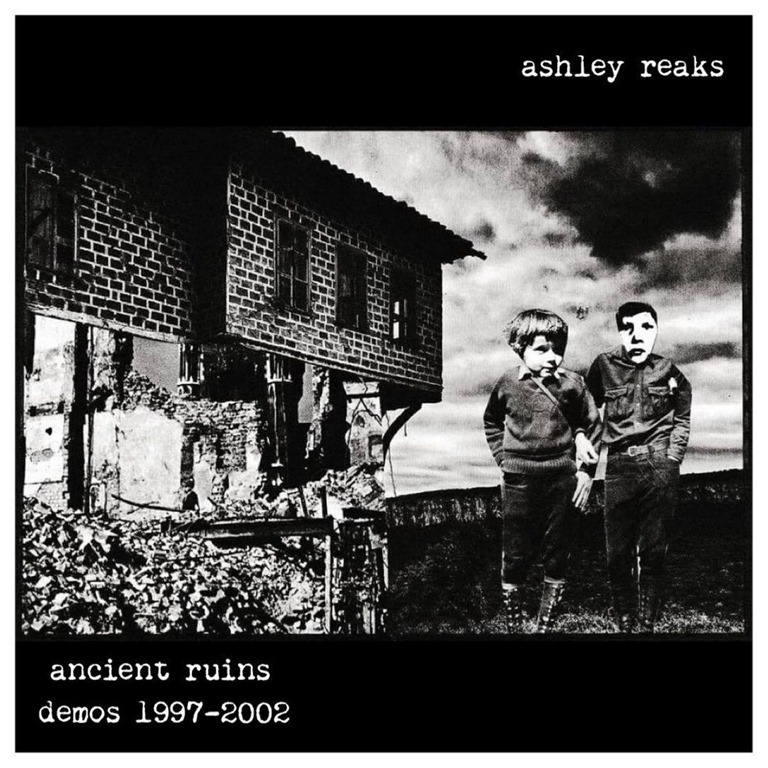
But even before Younger Younger 28s, Reaks – whose appreciation of The Sisters of Mercy and the like is widely-stated on his social media – was dabbling with the gothier aspects of post-punk, and would continue to do so for some time. His decision to release Ancient Ruins may only be for the sake of posterity, as a document, but here it is, and it’s not bad either.

Because this is Ashley Reaks, it’s not a set of songs which adhere to straight-up genre conformity, as is immediately apparent from the first track, ‘A God in the Devil’s World’, which has a certain swagger and a swing to it, the female vocals not only providing a counterpoint to the growling baritone Reaks adopts, but also a pop shimmer that’s still more Human League than The March Violets.

‘No Man’s Land’ offers picked guitar and jittery synths melded to an insistent drum machine, and comes on with the trappings of mid-80s rock, and a bit Prefab Sprout. ‘Disconnected’, however, plunges into darker territories, an echo-heavy bass-driven blast of angst that’s more the sound of the underground circa 1983. And it’s good, but then you realise how anachronistic it is for the time it was recorded.

Between 1997 and 2002, Britpop died a slow and painful death and Nu-Metal exploded. The post-punk revival was still some time off, and simply no-one was making, or listening to, anything that evoked the spirit of The Batcave. But then, they weren’t really digging 80s synth pop, other than the original stuff in a kitsch or nostalgic way, and the much-touted 80s revival hadn’t really gained any traction. To top it, in keeping with Reeks’ other output, thew songs on here are littered with lyrical observations and kitchen sink vignettes, pithy pairings, and couplets which are wilfully wordy and awkward.

‘Christiane’ is a campy goth pop effort that’s wistful and theatrical, with hints of late 80s Damned woven into its fabric, while ‘I Always Wanted to be You’ brings some indie jangle and… brass. Then again, there’s the chugging industrial blast of ‘Swimming Against the Tide’ which sounds a bit like Therapy? circa Nurse but with an overtly ‘baggy’ beat and a Prodigy-influenced midsection. Oh yes, it’s all going on here.

If nothing else, Ancient Ruins provides some insight into the evolution of Reaks’ compositions, from oddball pop to off-the-wall melting-pot madness, with loads of ska brass and a whole lot more besides. The dubby closer ‘Ghost Town In My Heart (Version 2)’ is particularly illuminating.  If only all history lessons were this interesting.

a3128964198_10

25th October 2024

Christopher Nosnibor

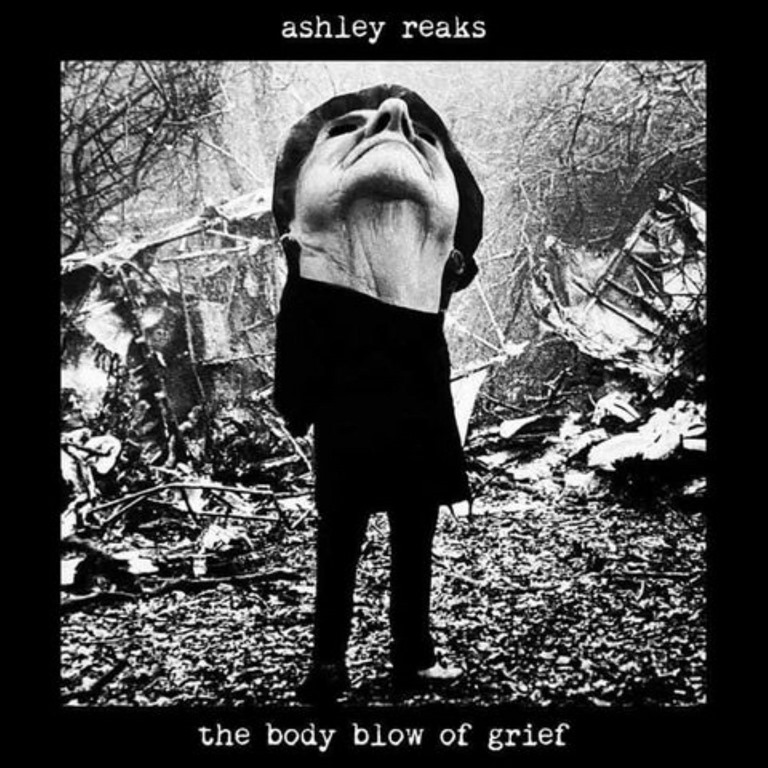
As is the case with his collage artworks, there is a sense of physicality about Ashley Reaks’ recorded work. His album titles tend to be brief but evocative, visually or otherwise: Compassion Fatigue; Track Marks; Growth Spurts; Winter Crawls… these are titles which evoke a sensory response – a shudder, a shiver, a skin crawl. The Body Blow Of Grief – Reaks’ fourteenth solo album – lands with an impact before you even arrive at the music itself.

I suppose – as is often the case when it comes to any music – there’s a personal element to my response here, and I make no apology for this. As I have touched on elsewhere, art is personal, in that it elicits a response which is unique based on a multitude of factors, ranging from life experience to emotional state and the mood of the moment. But the very phrase, The Body Blow Of Grief, lands like a punch in the stomach, and I’m aware that, while recently bereaved, having lost my partner of twenty-two years and adjusting to life as a single parent to a twelve-year-old, I am acutely sensitive to things which many others wouldn’t be. And yes, grief hits like a body blow. It knocks you, hard, socks the air out of your lungs and leaves you feeling weak, dazed.

Reaks’ music very much sounds like his artwork looks: a collage, a collision of styles, disjointed elements overlayed unapologetically; instead of smoothing over the joints, Reaks revels in the ruptures. Because this is where the vitality of life is found.

‘Home is Where the Hurt is’ may be a fairly obvious piece of wordplay, but the album’s opener digs deep into this seem, one which is a rich source of material in Reeks’ exploitation of trauma and its effects. ‘I can’t really feel what’s real’, he confesses against a backdrop of dubby bass and honking horns, before a shuffling beat settles into a tidy groove. It’s a bit Interpol meets Madness before lurching into post—rock territory and tapering out in a rippling tingle of layered guitar.

While the topics may be heavy, The Body Blow Of Grief is remarkable for its levity, its musicality, it’s easy tunefulness. I don’t mean necessarily that it’s all air and light – because it really isn’t.

There’s some quite tight, choppy, indie guitar on ‘No Place In The Nature Of Things’, a song that squirms and twists its way through almost seven-and-a-quarter minutes.

‘Somewhere To Hide Among The Swarm’ takes the bold step out into the swarm to offer some-full-on progressive rock flavours.

Across the course of the album’s eight tracks, Reaks walks through the familiar territory of previous albums with leaning toward dub and post-punk, but ventures into altogether newer territories with some spaced-out prog-inspired explorations, and ‘Hobbling Like A Refugee’ has an eighties feel that unexpectedly delves into electropop and AOR. It’s not polished to the levels of the 80s rolled-up jacket sleeve bands, but it alludes to the slickness of the era, but the dark lyrics are a stark and uncomfortable contrast. ‘Mongrel Nation’ is a slice of chunky post-punk laced with the bombastic excesses of Muse and a few jazzy twists.

The last track, the eight-minute epic ‘I’m Not a Fossil’ is a multi-faceted, multi-headed monster propelled by some strong technical dtrumming.

As always, Reaks presents us with an album that’s complex and layered, but The Body Blow Of Grief feels like a step up in the ways it opens horizons to new levels of boldness and ambitious sonic vistas.

AA

a1473578772_10

Christopher Nosnibor

Ashley Reaks’ second album of the year is his second (not of this year) with Hull poet Joe Hakim (who I sadly didn’t get to see perform at Long Division Festival in Wakefield the other month due to my ongoing failure to clone myself.

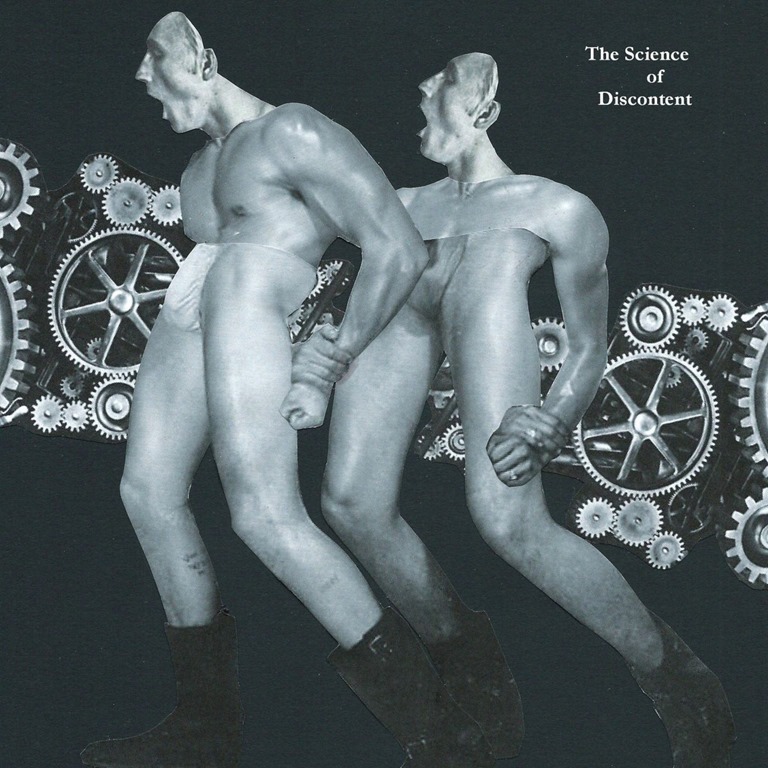
The Science Of Discontent – furnished with one of Reaks’ typically warped collage-art covers – returns to the bleak sociopolitical seam of its 2015 predecessor, Cultural Thrift. Reflecting on this, who would have thought that things would be even worse four years on from 2015? Back then, austerity was grinding us down in Britain as the world continued to drag its way along in the wake of the financial collapse that spanned 2007-2011.

2019, 11 years after the Conservative government announced their first austerity measures, and nine years after the programme was introduced, we’ve still ruled by austerity, and now we’ve got fucking Trump and Brexit on top. Small wonder we’re discontent.

Musically, it’s a classic Reaks cocktail of dub reggae, ska, post-punk, and – as have been coming into increasing prominence in his melting-pot-of-everything compositions – prog rock and jazz. The individual arrangements are comparatively minimal – or, more specifically, the music is kept in check during the spoken passages. This means that the instrumental segments, where the band cut loose, really stand out. By stand out, I mean like the proverbial sore thumb. That’s no criticism: it’s Reaks’ MO, and his revelling in rendering spectacular incongruities that somehow work that’s his primary superpower.

The subject matter Hakim explores on The Science Of Discontent is bleak and a times harrowing: ‘Dead Legends’ is less a celebration of posthumous recognition and the route to artistic immortality as a bitter dissection of the plight of the artist, for whom getting fucked up and committing suicide is likely the only career option that’s likely to yield any kind of success.

Death, damage, and decline are recurrent themes across the nine pieces here, and they’re all delivered in a twangy but downbeat monotone. The apparent dispassion of the delivery does nothing to detract from the lyrical impact: Hakim’s enunciation is crisp – and dry – and contrasts with the buoyant brass and thick Jah Wobble-style basslines that bounce and stroll.

‘New World Order Evangelists’ finds Hakim venting his spleen over government and conspiracy theories and contemporary culture and ‘Orwellianism’ over some seriously jazzy jazz that somehow drifts into some post-rock guitar, while the spacious soundscapes that create an oddly flat atmosphere on ‘The Customer is Always Wrong’ provides a stark and dislocated backdrop to Hakim’s monologue delivered from the perspective of a long-suffering shop worker. ‘Saturday Night Sob Story’ is more depressing still. There’s a degree of crossover in terms of territory with Sleaford Mods, but Hakim doesn’t hector, he just puts it out there in snippets of dialogue and tightly-penned vignettes.

There’s precious little joy here – and yet the quality of the wordsmithery, compositions, and musicianship – do provide reasons to be cheerful. In the face of unapologetically direct depictions of ‘broken Britain’ – minimum wage, zero-hours, shit nightclubs, drugs, booze, ruined communities, dog-eat-dog, social division – Hakim’s craft and Reaks’ crazy hybridization offer a glimmer of hope that however crushed, however fucked, however domed we all are, the imperative to creative art under the worst of circumstances remains a fundamental human trait. Ashley Reaks and Joe Hakim have (again) created an album for our time. And in such desperate times, The Science Of Discontent is precisely what we need.

AA

Science of Discontent

30th January 2018

Christopher Nosnibor

On the strength of the cover, with its sombre-looking black and white image of a fledgling gull (I think – I’m not David Attenborough) perched atop a post with the sea behind it, all the way to the horizon where it meets a brooding sky, you would expect The Earth Swan Sings Again to mark a turn towards serious, introspective and altogether less hectic approach to music-making. And in some respects, it is.

While still incorporating the wildly disparate elements of his recent previous albums – of which there are many, and then some (he’s put out a full dozen in the last decade) – The Earth Swan Sings Again feels less manic, more refined, but no less magpie-like in its amalgamation of a broad range of genres. And on this outing, Reaks has gone even further out on the jazz trip he embarked upon with Track Marks last year. This may seem strange for an artist who doesn’t really like jazz, but Reaks is an artist who doesn’t allow genre prejudice to contaminate his creative process. This is postmodern art at its intertextual best: everything is equal, and it’s all material. What counts is how that material is used, recycled, adapted. Etc.

This all makes for a more accessible set of material, but of course it’s all relative, and songs with titles like ‘I Stroked Her Like a Leper’, ‘Her Body Convulsed’ and ‘Today Hurts More than Mercy’ are never going to have the commercial appeal of the mediocre shit of Ed Sheeran or Bastille or whatever cal R1 is spinning on an endless brainwashing loop these days, and that’s before you even get to the music itself. ‘She stretches open like a parasite’s echo,’ Reaks sings by way of a refrain on ‘She Stretches Open (Like a Parasite’s Echo)’. It’s vaguely disturbing, and entirely surreal, but in keeping with his abstract / cut-up approach to the creation of art.

Bringing a more low-key vibe that’s dominated by a post-punk atmosphere, The Earth Swan Sings Again is darker and challenges in different ways from preceding efforts. The basslines are still dubby but less rampantly wild, and more about driving by stealth. The guitars are still choppy, but veering toward the picked and understated – apart from the immense and brain-meltingly OTT jazz/prog wigouts that splurge all over the place unexpectedly and incongruously – they’re altogether more subtle. Well, the guitars, maybe: the OTT jazz/prog wigouts are maybe less so, but they work, and there’s a sense that Reaks knows all of this. As one of the most singular artist practising at this moment in time, Reaks knows what he’s doing, and also knows that one chooses art of commercial success. And this is art.

The Earth Swan Sings Again is dark and stark, low-key yet eclectic, and at times inexplicable. Of course it is: it’s an Ashley Reaks album, and when it comes to walking the line between genius and madness, Reaks has forged a career by joyously straddling it and raising two fingers to convention of any kind. Outré creative talents like Reaks are few and far between, and while the mainstream grows ever safer, ever more diluted, ever more background and by-numbers, the need to artists who rub hard against the grain grows ever greater.

AA

Ashley Reaks – The Earth Swan Sings Again

23rd June 2017

Christopher Nosnibor

Ashley Reaks’ relentless release schedule continues apace with the arrival of Track Marks, his eleventh album. Because it’s an Ashley Reaks album, it’s characterised by off-kilter experimentations in dub and socio-political commentary. But whereas jazz provided the core influence on 2015’s Growth Spurts, it’s spectacularly spacious prog-rock wizardry that arrives fresh on Track Marks to bring the all-important new, unexpected and so-incongruous-it-shouldn’t-work-but-somehow-does feature of the material.

‘Stale Mate’ opens the album with a suitably eclectic mix of ingredients, with the blippy electronica of the opening bars immediately being submerged by one of the wandering basslines that define Reaks’ output regardless of what he’s doing. Somehow it moves from here to ultimately culminate in a knowingly gratuitous guitar solo.

‘I’ll Take My Pilgrimage’ is seemingly about as much a yearning to find faith as a criticism of religion per se, and melds a stormy, rolling drum to another phat bassline and some progtastic guitars and synths, while packing in some jazzy sax too. The jazz direction, which came to the fore on previous album, Growth Spurts, becomes increasingly dominant as Track Marks progresses. ‘Exposing Fiona’ gets pretty wild in its horn-parping intensity.

‘Stick Thin Worms’ pitches a stomping rhythm beneath some more abstract lyrical content, while poet and bluesman Paul Middleton (who hails from Reaks’ hometown of Harrogate) provides spoken word on ‘Tank From Grimsby’, which continues the extending thread of collaborative efforts which have become stablished as a feature of Reaks’ receny output. It’s actually a piece about some musicians, and marks a departure into mellow flamenco guitar.

If it all sounds like overload, it’s credit to Reaks that somehow, it all hangs together with a remarkable cohesion. It’s not immediate: one has to first surrender to the strangeness, the otherworldliness that Reaks creates. But there are some – many – undeniably great musical moments here. They’re not preoccupied with hooks or choruses, but there’s a certain atmosphere that envelops Track Marks – an album where the darker second meaning is (wisely) left unhinted at in the cover art. And once again, it’s Reaks’ refusal to pursue any obvious avenue which is the key to his success as an artist. Whether it’s a detriment to him in commercial terms, well, who knows? But that’s not what he’s about, and precisely why he deserves respect and attention.

cover

6th December 2016

Christopher Nosnibor

Some reviews are seemingly fated. This is one such review: I was slow to get started, and then, having spent several evenings working on a detailed critical analysis, exploring the album’s wild eclectism on a more or less track-by-track basis in a discourse of some eight hundred words, my laptop crashed and most of the work was lost, with the only available version being a collection of notes which were days old. How it happened, when my word processor is set to autosave every five minutes, I have no idea. Thanks Microsoft.

Still, this is an Ashley Reaks album, and a man who can produce three albums in a year – and continue to produce art, and to gig relentlessly, under difficult personal circumstances – deserves the same kind of unbowing attitude from a reviewer.

Because it’s an Ashley Reaks album, anything can happen. And it will. And it does. Following on from Reaks’ ‘punk album’ This is Planet Grot (and a remarkable credible and impressive punk album at that), Growth Spurts, on the one hand, could be considered a return to more familiar territories. But then, on the other, it could justifiably be tagged his ‘jazz album’. The familiar elements of reggae and post-punk inspired dub are present and correct, but this collaboration-based collection of tunes also brings in some wild jazz stylings. The collaborative element is also key here, not only to appreciating Growth Spurts, but to understanding Reaks as an artist, at least as much as it’s possible to grasp such an idiosyncratic and singular individual.

Like his collage artwork, his music is a mish-mash of elements drawn from here, there and everywhere, often bolted together at weird angles and demonstrating incompatible proportions and lines of perspective. He has very much his own slant on things, and his approach is also very much his own: Reaks is one of the few artists who consistently produces work which has the capacity to surprise, to confound, and, occasionally, confuse – which is a healthy response to something which is so staunchly unconventional. You get the impression that Reaks’ raison d’être is to produce art which surprises and confounds himself, as much as any notional audience. His mindset appears to be that if it’s not fresh, unexpected, and if it’s not sincere, then it’s worthless. Collaboration, when done right, yields an output which is greater than the sum of its parts, and draws out facets of each contributor which may not otherwise be known.

As such, Growth Spurts is a world away from his previous collaborative effort, Cultural Thrift (2015) with poet Joe Hakim, on which Reaks stepped toward the rear portion of the stage to provide a background accompaniment (which in itself was a departure given Reaks’ propensity for dizzying soundclashes). Five of the ten pieces – it would be wrong to refer to this as a collection of songs, given that they feature spoken word and poetry – feature writers and poets from a broad and diverse range of backgrounds. They’re disparate characters, as varied as Reaks’ own sources of input, hand-picked to contribute to the album.

The result is dizzying, a rollercoaster journey through a vast swathe of cultural terrain. Each of the collaborative pieces is distinct and different, and finds Reaks attentive to the style of the different speakers. And as the strange, strangles vocal cacophony which introduces the album’s first track, the oddly ominous prog-dub drum‘n’bass neoclassical jazz mixup that is ‘Divorced from the Body’ shows, he’s digging deep to locate new and unexpected hybrids. And yet, amidst the chaos, he still whips up some killer hooks – something so many experimental / genre-smashing artists completely overlook in their quest to innovate, to dazzle with their imagination and technical prowess.

‘The Gentle Art of Ignoring’ with Sylvie Hill is the most outright jazz track on the album, and her sassy vocal delivery and confident Canadian accent brings another sharp dimension to an album which displays almost infinite dimensions, but there’s just so much to take in. But if you need a pointer for where to start, start with the basslines. The crashing jazz-influenced drum ‘n’ bass drumming, the wild brass, the myriad perspectives of the different vocalists all slot into place over those low-down basslines that stroll and groove and leap and boogie. Get on down.


Ashley Reaks - Growth Spurts

Christopher Nosnibor

Does Ashley Reaks ever sleep? Continuing his prodigious output with his ninth (?) album, his second of the year and his third in just twelve months, This is Planet Grot sees him shift from his distinctive anarchic blend of dub, ska, punk and experimental mash-up with a straight-up punk album. It’s a style that suits him well, and somewhat ironically, may stand as his most commercial album to date. Reaks’ dissatisfaction with people, politics and the world at large has been vented extensively over previously releases, but to hear him actually singing and yelling over driving guitars and thumping drums really pushes it all home.

Having recently toured as support for The Dickies (and covered vocal duties on occasion), Reaks’ knowledge and appreciation of the school of ’77/’78 is displayed abundantly here, and his knack for a chorus while still spitting bile over choppy chords owes everything to the likes of 999, The Vibrators and The Adverts and nothing to latter-day pretenders of punk like Green Day. ‘Freaks of the World Unite’ is a perfect example of an accessible yet fully punk, fist-pumping, pogotastic song which has ‘single’ written all over it, while the terrace chanting ‘Manipulator’ is, quite simply, a quintessential punk song, and clocks in at under two and a half minutes.

The production captures the vibe, too. There’s an indefinable quality to the way the instruments and vocal are mixed which (not being an engineer or producer myself) that recreates the ragged sound of the seventies without sounding artificial.

Some of the zanier, off-kilter guitar lines, coupled with the cover (one of his deranged collages) share common ground with the dark derangement of Rudimentary Peni, but for the most part, This is Planet Grot plays it straight, hard and fast, and is abrim with nifty bass runs and straining guitars. And, because it’s Ashley Reaks and because it’s a proper punk album, This is Planet Grot is unswerving in its sociopolitial contents, the anti-establishment sentiments delivered with sincerity and rabble-rousing gusto.


Ashley Reaks - This Is Planet Grot Cover Art

Christopher Nosnibor

The phenomenally prolific Ashley Reaks – musician and collage artist with a left-leaning anarchic streak – follows up Cultural Thrift (September 2015, with Joe Hakim) and Compassion Fatigue (February 2015) with what you might rightly call a concept album. True, the aforementioned releases from 2015 were both marked by thematic unity, but this approaches things from a different angle, with each song being about a different serial killer.

That serial killers inspire a certain morbid fascination cross many sectors of society requires little qualification: the popularity of both real-life crime and fictional crime TV and literature speaks for itself. Serial killers are, in truth, extremely rare.

The industrial scene’s fascination with serial killers feeds into the broader picture of a fascination with inhuman perversions and brutality of every shade: Throbbing Gristle’s ‘Very Friendly’ is anything but, and Whitehouse’ early career was largely based on an obsession with sadism and serial killers, notably Peter Kurten and Dennis Andrew Nilsen, to whom their fourth and eighth albums respectively were dedicated to; but then there were also tracks like ‘Dedicated to Albert de Salvo’ and ‘Ripper Territory’ (that’s the Yorkshire ripper, Peter Sutcliffe), and ‘Fritz Haarmann’.

Ashley Reaks is no purveyor of industrial noise or one to employ base shock tactics. His weirdly psychotic collages are shocking enough, while the music on his latest album presents his now-trademark multicultural mash, with a heavy leaning toward anarchic dub reggae and post-punk. And in terms of his subjects, he’s shown a lot more imagination than most, drawing inspiration from an array of lesser-known killers. Should we be impressed by his research or concerned by his dedicated research? Probably, yes.

There’s no mistaking the fact Reaks is a complex character and an intriguing, multi-faceted artist, and as much as the album’s title caries an element of humour, it may equally carry more than a grain of autobiographical truth. Suffice it to say more troubled individuals of no artistic bent commit suicide than become murders. And Reaks’ interrogations of socio-political situations seems to be the primary motivation here. Curiosity, rather than glorification is what this is all about. And it’s a great album.

Over shuddering, throbbing dub basslines and some fairly easy-going grooves, Reaks explores the backgrounds and circumstances of a range of men – all men – convicted of heinous crimes, more often than not with a sexual element.

Amongst them, James Gregory Marlow, aka The Folsom Wolf – a white supremacist drug user with a body count five in a spree which ran from July to November 1986, and Robert Black, aka Smelly Bobby Tulip, a Scottish serial killer and paedophile convicted of the kidnap, rape, sexual assault and murder of four girls aged between 5 and 11 in a series of killings committed between 1981 and 1986, and suspected of 12 other unsolved child murders committed between 1969 and 1987. The album by no means glorifies any of its subjects, and instead serves as a narrative exploration.

The blurbage points out that the album features the improvised Eastern-tinged vocalizations of Norway’s Maria Jardardottir, prog-punk polyrhythms, as well as a guest solo from Jackson 5 and Commodores trombonist Frank Mizen. This is significant, not because of the namedropping it facilitates, but because of the artistic connections it highlights: Reaks has enlisted some admirable artists here, and the end result is quirky but accessible. Indeed, the sonic vibes stand at extreme odds with the dark and disturbing subject matter of the songs. But this is precisely how Reaks excels artistically. Balancing darkness and light, concept and execution, he leads the way through a warped alternative world of his psychic creation.


Ashley Reaks - Serial Killer