Posts Tagged ‘Architecture’

Room40 – 31st January 2024

Christopher Nosnibor

It begins with a rumbling roar, like a persistent strong wind rushing over moorland, before ripples of piano delicately drift over it to altogether calmer effect – although the roar continues beneath. The juxtaposition brings a balance of sorts.

Just a few days ago, I wrote on Circuits From Soft Frequencies by Jamie Lee, which was recorded among the sound mirrors at RAF Denge, in Kent, and touched on the fascinating nature of these structures, and opined that ‘often, the most alien and seemingly otherworldly creations are, in fact, man-made’.

Lawrence English’s latest work seems to contribute to this dialogue, albeit approaching from a different perspective.

‘I like to think that sound haunts architecture,’ he writes, and goes on to remark, ‘It’s one of the truly magical interactions afforded by sound’s immateriality. It’s also something that has captivated us from the earliest times. It’s not difficult to imagine the exhilaration of our early ancestors calling to one another in the dark cathedral like caves which held wonder, and security, for them.’

English also writes of the relationship between space and place, and how ‘Spaces hold the opportunity for place, which we create moment to moment, shaped by our ways of sense-making… Whilst the architectural and material features of space might remain somewhat constant, the people, objects, atmospheres, and encounters that fill them are forever collapsing into memory.’

The album comprises eight numbered segments, ETHKIB I – VIII, all formed using fundamentally the same sound palette, and which flow into one another seamlessly to create a single, continuous piece, which is best experienced without interruption.

The piano and the undercurrents, which evolve from that initial roar to altogether softer drones which drift, mist-like, develop an interplay whereby the dominant sound switches, sometimes with one or the other fading out completely – but this happens almost imperceptibly… It isn’t that you don’t listen to the music, but the preoccupation of the listening experience is absorbing the atmosphere, and it possesses almost a physicality. By ‘ETHKIB V’ the sounds has built such a density that the sensation is like being buffeted. Amidst the deep drones, there are, in the distant, whirring hums and elongated scrapes which evoke images of disused mills and abandoned factories. Perhaps there’s an element of the power of suggestion, but it’s difficult to contemplate purely abstract visualisations, or nature without some human aspect somewhere in the frame.

The soundscapes English creates are evocative, and in parts, at least, haunting – although ultimately, what haunts us is our own experience, our thoughts, our memories. And in this way, from space, we create our own sense of place, and tie things to them in an attempt to make sense of the world as we experience it.

By ‘ETHKIB VIII’, it’s the piano alone which rings out, in a reversal of the opening, and some of the mid-sections, ending on a single, low note, repeated, held, reverberating, leaving, ultimately silence, and a pause for reflection.

AA

RM4245 front

Christopher Nosnibor

It doesn’t get much more goth than a gig in a graveyard. Through the wrought iron gates, the approach to the chapel, the venue for tonight’s performance, is set either side and as far as the eye can see with headstones. Fulford cemetery is immense. The chapel is an appropriately imposing building: designed by James Pigott Pritchett and completed in 1838, it’s a grand neoclassical structure and considered possibly one of the greatest cemetery chapels in the country, with huge doric columns outside, while its interior, white with gilt trimmed faux-pillars which only accentuate the incredibly high ceiling is spectacular to behold.

The room – a neat oblong – is packed out with a broad array of people, but there’s a strong showing of what I’d call Whitby goths, that is to say, the kind who dress to impress rather than your biker jacket and boots type. There’s a lot of lace, silk, and taffeta to be seen, meaning that for once I feel rather less conspicuous sporting a knee-length velvet coat. But equally, the audience is notable for its broad spectrum and diverse demographic, and while details of the event in advance had been purposefully scant, there is clearly a keen interest for something different, and not specifically in York. There are people who have travelled to be here tonight.

The bar, such as it is, is offering red and white wine, bottles of Stella, and Coke, and taking a seat toward the back – the front ten rows were full and by the time the lights go down, leaving the space illuminated by mellow candlelight, the seats are pretty much all occupied. It’s pleasing to see, especially knowing that this event coincides with the annual nighttime walk for cancer, and a metal gig not five minutes up the road.

First, we were treated to some operatic vocal accompanied by piano. It’s not only exquisitely performed, but it’s absolutely perfect for the setting. And in this moment, it becomes crystal clear that this is going to be an event like no other. To describe it as an evening of culture would be to downplay all of the other music events and spoken word nights and more on offer, but when it comes to high culture, there’s most certainly a gap – but the greatest gap is in events which bridge the divide between your regular gig and a night at the theatre or the opera or a night at the proms. This, however, is a superbly curated event which achieves precisely that.

Immediately after this introduction, host and co-ordinator Stephen Kennedy leads an ensemble consisting of bass guitar and percussion through a set of three songs, starting with a brace of deep cuts from Fields of the Nephilim’s catalogue, with ‘Celebrate’, and then ‘Requiem’ from Mourning Sun, with the trio joined for the second two songs of their set by a cellist who remains on stage to play a solo set after. Kennedy’s vocal is strong, and he really does a remarkable job of reproducing Carl McCoy’s gravel-heavy growl.

DSC00069

After a handful of cello instrumentals, Kennedy returns to the stage – although technically it’s the floor, but wonderfully lit – to provide vocal accompaniment to her graceful strings.

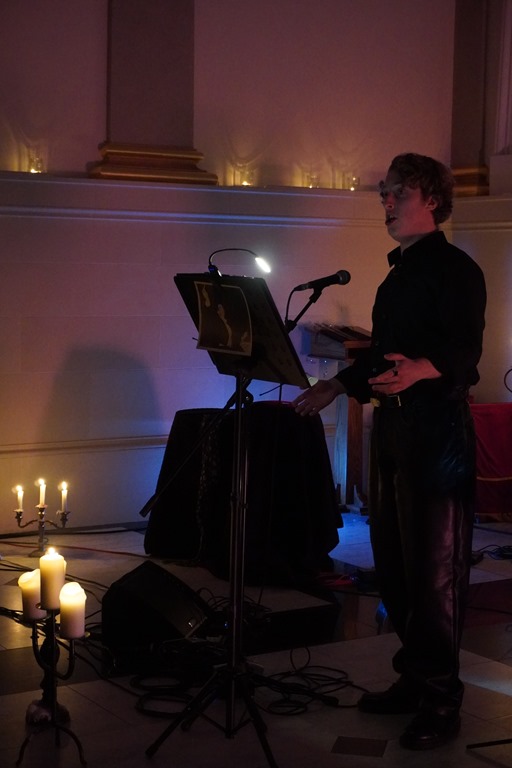
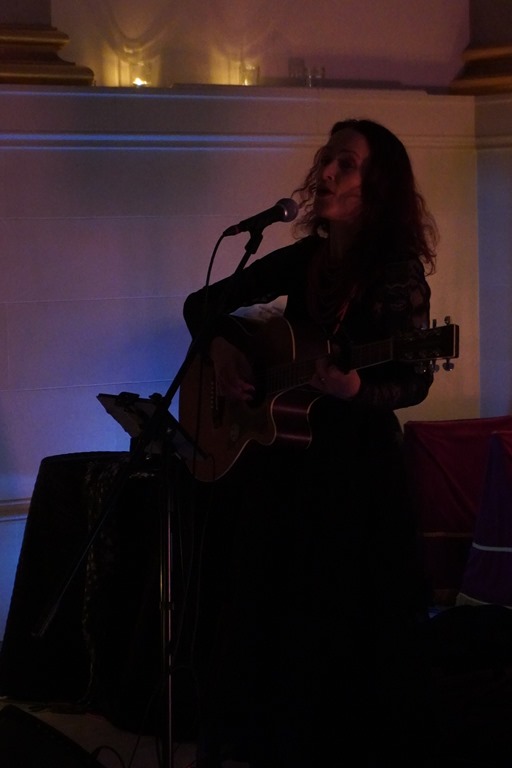
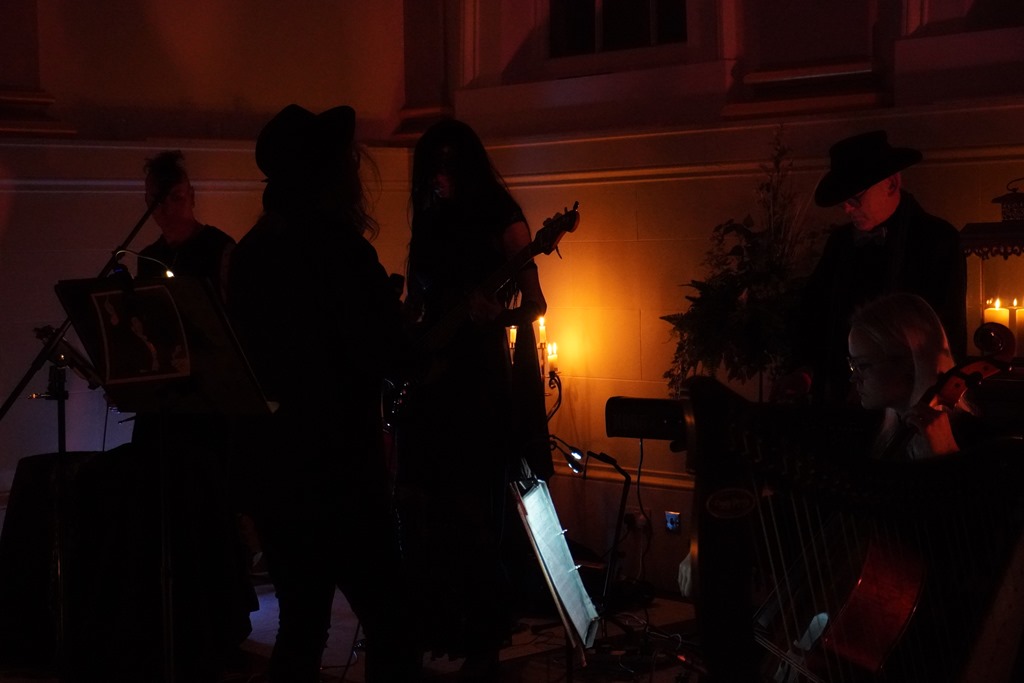
The switches between performers are near-instantaneous, with no announcements as to who’s who and no-one informing us who they are. There is a programme available at the merch table, but in a way, the individual credits feel of little import: this is very much a collective work, an ambitiously grand collaboration, striving to create a unique experience of an ever-shifting sonic smorgasbord. Individual names and egos are put aside in the name of this being Gothic Moth. There’s harp – moving – and powerful, and an emotive vocal while makes for a stirring performance, which is rapturously received, a solo acoustic-guitar led performance with folk-hued vocals, before the first half of the evening is rounded off with a piano and tenor recital, Benjamin Staniforth’s impressive voice matched only by his impressively voluminous leather trews.

DSC00093

If the second half offered more of the same, with some of the performers getting a second set, it also gave us a while lot more. During a longer harp and voice set, the rendition of Metallica’s ‘Nothing Else Matters’ was a clear standout of the night, but then again, Iryna Muha’s Ukrainian folk performance, with acoustic guitar – with some effects to really fill out the sound – and hurdy-gurdy was mesmerising, and was equally well received.

DSC00094DSC00108

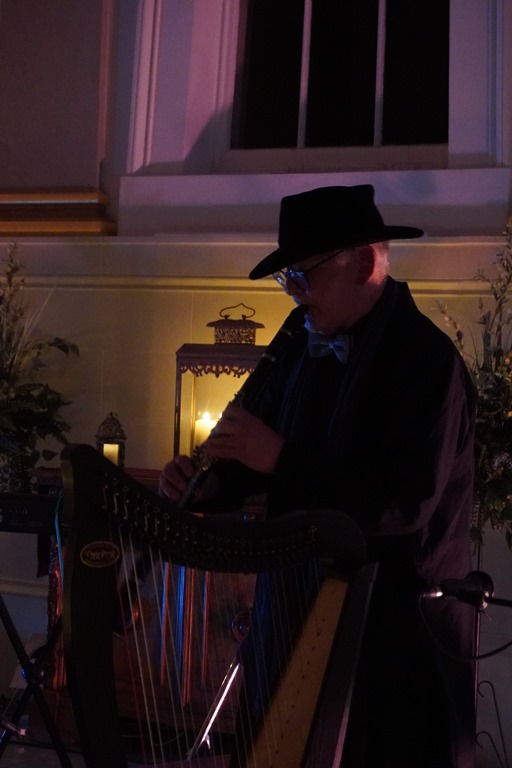
After a clarinet interlude from a man in a hat and long coat (there are a fair few of those this evening) who turns out to be Ian Karlheinz Taylor from Skeletal Family, Taylor moves to the keyboard and the full band return for a magnificent and moving rendition of The Mission’s ‘Sweet Bird of Passage’ followed by ‘Island in a Stream’. Close your eyes and it could be Wayne Hussey dinging: Kennedy, it seems, is truly a vocal chameleon, bringing the night to a close with a remarkably close approximation of Ian Curtis on an impressive version of Joy Division’s ‘Atmosphere’ – something this event had in copious amounts.

DSC00121

Stephen Kennedy needs to take a bow: this, the first Gothic Moth event, was an incredibly ambitious coming together of a staggeringly eclectic range of artists, and many of those collaborating hadn’t even met one another until the day. This is unquestionably testament to their individual and collective talent, but also to Kennedy’s aptitude as a curator in bringing them together. Everything about this evening was stunning, and it’s pleasing to see future events are already being booked, filling a niche few knew even existed.

London-based musician/composer Ian Williams has released a new single entitled ‘Chronopolis’ today. Taking its title from a J.G. Ballard short story, it is an edited version of a track from his current album, Slow-Motion Apocalypse.

An accompanying video was shot in Canary Wharf in London. It highlights the clock-watching and surveillance of the workforce (facial recognition, keystroke logging and anything else they can think of) that makes the vast multinational corporations located in this financial heart of the beast untaxed billions, leaving crumbs that the average worker is supposed to feel grateful for.

The epic soundtrack to this scenario perfectly encapsulates the colossal architecture and human hive of activity, with hyperactive sequencer lines agitating under soaring lead synths as towering piano chords and immense drumbeats propel the whole machine along.

Ian Williams began his music career in Edinburgh in the mid 1980s as a founder of Beautiful Pea Green Boat, whose ethereal, atmospheric sound pre-dated the vogue for dream pop by at least twenty years. Several collaborations with Lebanese choreographer Joumana Mourad and her contemporary dance company Ijad saw him fuse Arabic/classical/techno/ambient styles, following which he changed tack to work with singer Claudia Barton as Gamine, releasing two albums of dark, piano-led torch songs and lullabies.

Williams’ own releases include THE DREAM EXTORTIONISTS (2019), a debut solo album of dark piano and electronics; LES BLESSURES INVISIBLES (2019), an eclectic electronic soundtrack to a documentary film by French director Eric Michel, and ALL BECOMES DESERT (2021), an album of minimalist ambiences and warm analogue soundscapes.

Williams has also composed the soundtrack to Michel’s new WW2 spy documentary, LE MYSTÈRE LUCIE (Code Name Lucy), which will be released in July. Further details will follow in due course.

Watch ‘Chronopolis’   here:

AA

ec73bf5906ba2863ed94ad6bddc0377869b6acb9

Edition RZ

Christopher Nosnibor

Returning to a brace of recurrent themes, including that of process as touched on in my write-up of Laurent Perrier’s latest collection of ‘one-way collaborations’, process and place are again key factors in the making of Michael Moser’s sprawling double album, Antiphon Stein. The majority of the sound featured on the album derives from Klaus Lang playing organs in various churches – although the sounds here are very different from those featured on Stefan Fraunberger’s recent album.

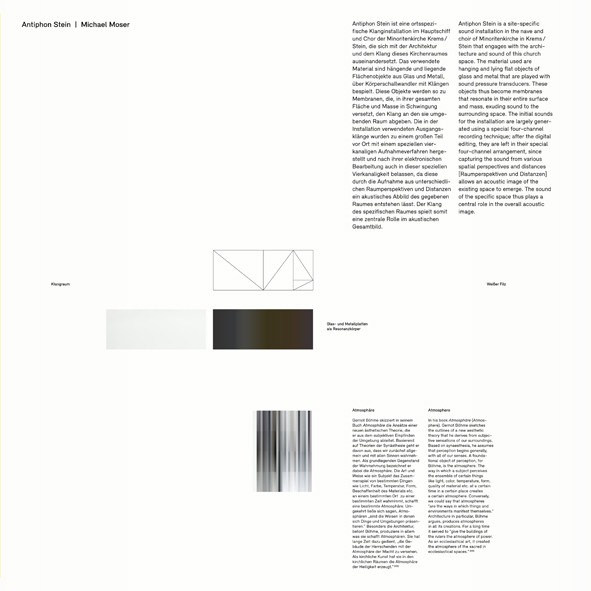
As the album cover explains in notes replicated in the press release, Antiphon Stein is a site-specific sound installation in the nave and choir of Minoritenkirche in Krems/Stein that engages with the architecture and sound of this church space. The materials used are hanging and lying flat objects of glass and metal that are played with sound pressure transducers. These objects thus become membranes that resonate in their entire surface and mass, exuding sound to the surrounding space. Of course, the album release is not site-specific, but serves the purpose of transporting the listener to that space, and a degee of visualisaion does enhance the listening experience.

The organ sounds on Antiphon Stein are as much a product of their places, the architectural structures and the decorations within them being integral to their textures. In addition to the organ recordings are drums and percussion courtesy of Berndt Thurner, while Moser himself adds glass plates and electronics. But of course, Moser’s primary contribution is the process. Each source sound exists as a ‘compositional miniature’ of three to seven minutes in duration, but processed digitally to form four pieces each with a running time of approximately twenty minutes. The process is therefore absolutely transformative, and as such integral to the realisation of the end product which bears little semblance to the initial input.

In context, the importance of process is not only significant but central, and the process is many ways is about amplification. The input is relatively modest, in that this large-scale work is constructed from an assemblage of much smaller scale recordings. Specifically, the material itself consists of compositional miniatures of three to seven minutes in duration, which have subsequently been fed through a computer to yield four untitled long-form pieces, each occupying a side of vinyl and running for some twenty minutes each.

The scale of the final work is grand, and it’s not simply about the length of the tracks. The atmosphere is immense, and while there are dark shadows, the overall sensation Antiphon Stein inspires one of awe. The sounds, described as ‘small compositional miniatures of a duration of three to seven minutes’, having been combined digitally to form a vast sonic mass, coalesce to create something which sounds entirely natural. And yet, the work is structured, the realisation of an ambitious project of sonic architecture.

Cavernous echoes amplify the depths of slow, low rumbles. Subtle chimes roll and glissando, throb and whistle. Hums hang heavy in slow-turning air. There is nothing hurried about the way the sounds layer and unfurl, and this deliberate, considered approach to the sculpting of the sound is extremely effective in terms of how the engages the listener.

Perhaps a limitation of the format is the fact that a work that readily lends itself to existing as a single, continuous piece is interrupted by the need to turn the record over. Yet, by the same token, this very act necessitates a physical engagement, and render the tactile qualities of the music tangible.

And so it is that the listener becomes engaged in the process, adding a layer to the process beyond the product itself, namely that of participation, of engagement. And ultimately, this is the level on which the album succeeds. It’s impossible to avoid the sequence of process with Antiphon Stein. And yet the process does not render the material sterile: far from it. If anything, the process is vital to bringing the material to life and is precisely what engages the listener.


moser-antiphon-cover