Posts Tagged ‘Ambient’

Fabrique Records FAB073 – 17th January 2020

Christopher Nosnibor

As the press text summarises, ‘Cusp is a collection of compositions taken from the soundtrack for the film STRESS by Florian Baron. The feature-length documentary gives voice to five young veterans, their experiences and trauma’. It was never going to be light or upbeat, and immediately, the sounds emanating from the speakers are unsettling, disturbing: blasts and reverberating crashes echo all around over slow, elongated drones, and ‘It’s Happening’ washes into the slow ebb and flow surges of synth that form ‘Them or Me’.

It may be good to talk, but those of us who haven’t been there simply cannot relate, cannot compute or comprehend the meaning, the pain, the anguish. It’s a world beyond and it would be a mistake and an insult to pretend otherwise. Anything, from sympathy to empathy feels like an underestimation and an undersale, a devaluement. Perhaps it’s an act of solipsism: the suffering in the mind of another is unknowable. This renders the territory Cusp and the film it soundtracks difficult on a number of levels.

Trauma is by no means entertainment, and while I haven’t seen the film, Irmirt’s handling is impressive in its subtlety, and it’s understandable why she was awarded the German Documentary Film Music Award in 2019. The jury remarked how in her soundtrack, she ‘dissolves the boundaries between sound design and musical composition in a virtuoso and at the same time self-evident way, thus creating a sound cosmos that, through uncompromising reduction, generates brutal knowledge.’

The best soundtracks are always understated, and compliment, rather than dominate the visuals they accompany, and Cusp, which takes fragments of the soundtrack as a whole – with eight tracks, half of which are only around the two-minute mark, this is a distillation of a broader experience, and it works well.

It is dark, unsettling, but nothing is overdone. And that’s why it works.

AA

Jana Irmirt - Cusp

Karlrecords KR073 – 24th January 2020

Christopher Nosnibor

Aidan Baker and Gareth Davis are no strangers to Aural Aggro: both feature in the roll-call of post-rock collective A-Sun Amissa, led by Richard Knox, and Baker’s myriad collaborations and contributions have received coverage here, and with good reason. Their contributions to the field of post-rock / ambient / brooding neoclassical orchestral avant-garde are substantial, to say the least.

It was two years ago that Canadian guitar player Aidan Baker and Belgian clarinettist Gareth Davis came together to release Invisible Cities, which, as the press release notes, ‘the duo explored the calmer side of things – from chamber jazz to ambient / drone and back, giving much space and air to breathe to their respective instrument’.

And so to the sequel: more of the same, yes, but different. Because there is always evolution, and never stasis.

Ominous. Unsettling. Slow-moving. Atmospheric. Resonant. The adjectives bubble up through the mist of ‘Hidden’, the album’s first composition as strings scrape and moan through a gauze-like haze and layers build and drift. Everything is vague, the elements fading into one another, with brief incidentals bringing tension and disquiet to an otherwise tranquil but strangely indefinable atmosphere.

‘Eyes’ rumbles into darker territory, rumbling, billowing darkness providing an undercurrent for wisps of otherworldly drones – forged on strings, but detached from the context of specific instrumentation

When listening to ambient works, I do, at times, find myself pondering the source or the various sounds. ‘That’s a violin’; or ‘that’s a cello’; or ‘that’ll be the clarinet’. It’s a distraction I could do without, especially when effects – and sometimes just reverb and the way notes and sounds rub against one another to create seemingly unnatural sounds – mean that instruments don’t sound like the instruments they are, and often don’t even sound like conventional instruments. It’s better just to let it all wash over you, and to let the sound swell and envelop your being.

This is very much true of the dense, malevolent sonic swirl of ‘The Dead’, which tapers down seamlessly into ‘Continuity’, where drones hover and piano notes crash as if sliding down a staircase and metallic drones slide and it’s a minimal approach to instrumentation that creates the greatest tension, which ultimately dissipates in the altogether warmer climes of ‘Names’.

Baker and Davis bring out the best in one another, combining their creative capabilities to forge ambience with depth and the power to affect mood rather than merely hover, and Invisible Cities II is strong, moving, and evocative while at the same time conjuring a perfectly distracting aural fog.

KR073_front

Midira Records – MD080 – 13th December 2019

Christopher Nosnibor

It’s new year’s day, 2020. Like many, I’ve spent the last few weeks reflecting on the passing year: I usually do around this time, remembering where I was a year ago, two, three, five, ten years previous. Wondering precisely what I’ve got to show for it. that slow, sad, weight of nostalgia as the images captured in memories fade and curl around at the corners. Wondering: was I actually happier then, less prone to panic, or is this simply rose-tinting, psychological refuge in the comfort of the known, the life lived, rather than the fearful prospect of the unknown future? Such conflict, such dichotomy and dilemma.

And so, another year is indeed over, and here we are, staring into the void. Teetering on the brink of the abyss of a new decade in a post-fact, post-truth world where the capitalist world teeters on the brink of self-induced collapse and global climate catastrophe. And there is no success like failure.

We’ve failed as individuals, and as a species. The year is over… so what is there in prospect?

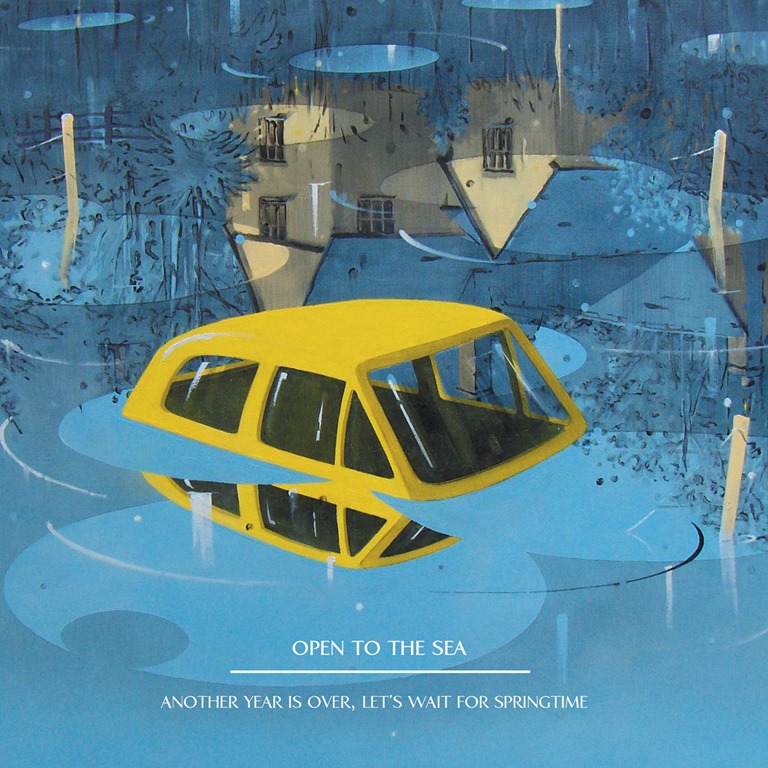
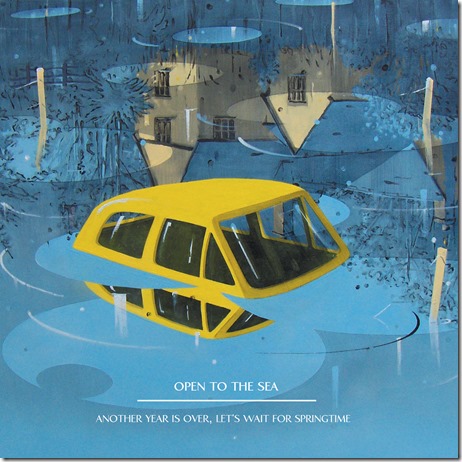
Open to the Sea’s new album, released late December provides the soothing backdrop to my existential strife, and it’s barely there for the most part. And yet, it’s there just enough: understated, yet still clearly stated.

The press release provides some useful insight into the album’s origins and its creators: ‘Open To The Sea is the collaboration project of Matteo Uggeri and Enrico Coniglio and Another Year Is Over is their second album. While Coniglio focusses on guitar, synths and other instruments, Uggeri adds samples and field recordings to create a soundcosmos full of tiny melodies and themes with appereance by some guest musicians on drums, trumpet and cello. That would make a perfect experimental ambient album with jazzy moments, but Uggeri & Coniglio push this release further by adding some vocals to most of the tracks by inviting guest singers like Dominic Appleton (This Mortal Coil) or Lau Nau from Finland.’

Minimal post-rock forged from sparse piano notes which drift into a rarefied air, spun with subtle, near-subliminal swirls of ambience, and stammering, glitching beats that hammer like a palpating heartbeat rattling in a tense ribcage, and picked guitar notes waft into the ether.

With different vocalists contributing to the various tracks, the tone and feel changes: ‘Heavy Like a Falling Leaf’ is soft, airy, yet poised, while ‘Uninvited Ghost’ and ‘Crystal Dog Barks’ feature a spoken word lyrical delivery, which in some respects changes both the dynamic and balance, and the function of the musical accompaniment, rendering the piece less a song and more of a narrative with instrumental backing.

‘Duduk Confession’ is hushed, brooding, with haunting strings and ominous hums lingering in the shadows, and on ‘Tapes and Cows Pt 1’, lonely brass wails softly over low notes to produce the most forlorn jazz imaginable. Scraping strings and frosty synth flickers accompany the deepest woe, which gradually evolves into warped space-age electro that melts into some warbling jazz trumpet.

The penultimate composition, ‘facing the waves’ is by far the most conventionally ‘songy’ of the ten, with a straight-ahead drum rhythm and solid piano providing the primary instrumentation on a whispy indie/shoegaze work. The fading refrain of ‘time now to start again’ is sung by a layered-up vocal set and, unexpectedly, Interpol come to mind.

The final song, ‘Another Year is Over, Let’s wait for Springtime’, with its whispering dialogue and soft dulcimer shimmers and soft, snowy strings that glide smoothly into the darkest corners, reminds me of my urge to hibernate, but also the fact that everything passes in time and everything is cyclical. Yesterday, today, tomorrow – they’re all points on a circle, and as linear as life lived is, as sure as birth and death, one year will follow the last, and so it will go on, whether we’re here or not.

AA
MD080_front

Panurus Productions – 22nd November 2019

Christopher Nosnibor

Newcastle-based cassette label Panurus really don’t have a particular house style, genre r aesthetic beyond releasing stuff that’s different and obscure. A lot of music that languishes in obscurity does so not because it’s not good, or even necessarily because it’s inaccessible, but because it simply doesn’t receive the ‘right’ exposure – or any at all.

In Dreams is a sharp contrast with the last two Panurus releases, in the for of the ultra-harsh blackened hardcore torrent that was Mineshaft’s VENUM LUXDOR DISCOVERY SUPER NOVA and Whelmed, a deluge of sluge and nose courtesy of Lump Hammer and Bodies on Everest, in that it’s an electronic work that promises ‘a serene soak in this sonic pool – an oneiric rendition of water and submersion’.

The majority of the titles share an aquatic theme, and the albums ripples in gently with ‘Floating’. The soft, easy notes tinkle softly like summer rain on the surface of a kale, with a soothing effect. It segues seamlessly into the broader sonic wash of delicate hums which form ‘With the Tide.’ This is not the surge of waves breaking on rocky outcrops, but a steady, low-ebb lapping.

Deeper currents begin to build on ‘Awash’, and for the first time, there are hints of tension and an indication of the potential power a body of water may possess. This dissipates as the listener is carried almost subliminally into the otherworldly space of ‘Drifting Slowly’, a strange and almost silent sonic realm that calls to mind Blue Planet scenes, the serenity of the deep, a vast expanse occupied exclusively by strange and silent creatures. The final two compositions, ‘Out of Body’ and ‘Descent’ merge together in a soft, muffly suspension.

In Dreams is almost quintessential in its ambience, almost formless, the amorphous shapes impossible to capture or define. It’s undemanding, and it’s pleasant.

AA

cover

Buzzhowl Records – 24th January 2020

Christopher Nosnibor

Masks are generally used to either obscure, hide, or otherwise present an alternative identity. The press blurb which accompanies the debut release by Masks, which arrives in the form of a two-track (lathe-cut) seven-inch gives little away, beyond the ‘fact’ that Masks is a New Zealand based artist. Singular. Although this is immediately thrown into question by the statement ‘We’re very excited to be putting out Masks’ debut release. We’ve been fans of the people involved for some time now.’ This doesn’t discredit the singular aspect, but does compel questioning. Toward the end of any interrogation, it’s perhaps worth asking ‘does or should it matter?’ Probably not, although our instinct is to seek something upon which to pin an identity or similar concrete elements as identifiers, as a means of basing experience and engagement.

Most songs about weekends I’m aware of are jaunty, jubilant, celebratory tunes. Take Michael Gray’s 2004 chart smash ‘The Weekend’, accompanied by a video with a sultry secretary busting moves around a photocopier, for example Reverend and the Makers’ ‘Living for the Weekend’ was irksome wank, and ‘The Weekend’ by Interpol is one of their weakest tracks by yards. The emphasis is very much on the separation pf the working week, and the weekend, which for many is not the reality of how work and life balance.

Masks sounds like their weekend contains back-to-back funerals as they grind and hammer their way through a murky mess of guitar that’s more about atmosphere than definition or tune. The percussion is pure punishment, industrial-strength pounding, while a synth howls an anguish-inducing drone around a monotone vocal that carries hints of Brian Molko. Yes, ‘Our Weekend Starts Tomorrow’ comes on like a bleak industrial / post-punk Placebo and packs some serious punch in a lugubrious, mid-tempo but thunderously dense sense.

There’s a change of mask for ‘Broken Glass’, a drifting, beat-free swell of instrumental ambience. It’s pleasant, but dark and contrasts starkly with ‘Our Weekend Starts Tomorrow’ in its overt formlessness. Is it a different face of the ‘band’ / ‘artist’, or another identity altogether? It’s unquestionably a departure, and if nothing else, suggests that Masks are multi-faceted.. complex. Unpredictable. Subject to change. What lies behind the mask? Maybe all will be revealed in good time…

Artwork Credit_ Sven Soric

29th November 2019

Christopher Nosnibor

For me, there are few things worse than a story untold and only alluded do. Tell it or don’t! The press release for Cologne-based Roman Jungblut’s solo debut tantalisingly informs us that ‘His mainly improvisational musical live performances – in varying constellations since 1996 – are temporarily reduced to a few selected appearances in Cologne since 2009, due to reasons’. First and foremost, of course, my thoughts are with the artist: we all have our reasons for done – for not doing – things. Sometimes, they’re painful, or we simply don’t want to talk about them. But a story-half-told can lead to speculation. Not that I’m about to speculate on anything here, and shall instead focus on the sonic document presented in the form of Back To Where It Never Started, which comprises four pieces which explore a broad territory in a short span of time.

The blurb goes on: ‘After a ten-year full abstinence of recorded output besides contract work – and only ever having released music as a member of bands or collectives – Roman finally found it to be inevitable to not only release some music, but to do it as a solo artist, not hiding behind a pseudonym, an ensemble or even ironic distance. “Back to where it never started” is the first product of a long time filled with lots of artistic and personal moments of growth, of finding the courage for imperfection and embracing the potential of constraints’.

The most striking thing about the EP is its diversity.

‘Detox – Retox’ packs a lot into just five minutes, as a trilling top synth that surges and builds tension suddenly gives way to a plunging, thumping bass pulsation that’s low and low, and registers around the lower abdomen, before spiralling scraping drones evolve around it, conjuring a cinematic, texture-heavy soundscape that resonates in ever-expanding ripples.

‘78-7-88’ is radically different, a piano-led piece that’s almost jazzy in its stylings – but not so jazzy as to be irritating. Long, drawn-out notes hang and taper over the jaunty, mellifluous babbling backdrop, while ‘Einsicht’ is a space-age bloop-out, with whistles, bleeps, and whirrs hovering in zero-gravity slow-mo.

The final composition, the eleven-minute ‘Two for Tooth’ takes the form of a sparse yet layered ambient work that gradually grows warmer as it develops, slowly and subtly, around a rippling repetitive wave.

In some respects, the fact the set tapers out after so many shifts and ups and downs feels vaguely disappointing, but ultimately, its slow ebbing departure seems fitting as the listener’s journey ends with Jungblut meandering toward the horizon.

AA

RJ01_front

29th November 2019

Christopher Nosnibor

Ahead of the release his seventh solo-album, Exo, in January next year, Swiss electronic artist Bit-Tuner indicates a significant change in direction with this single release. The two pieces on offer here are brief and – here’s the headline – beatless, as Bit-Tuner goes fully ambient.

It’s also a surprisingly succinct sonic document, the two tracks combined clock in at a mere fraction over seven minutes. ‘Passage’, the press release tell us, is ‘based on field-recordings, synthesizer pads and fluttering arpeggios,’ and ‘resembles a winding descent into a weightless but fragile science fiction world.’ The music in itself conveys almost nothing of this yet at the same time, succeeds in creating its on psychological space through the language of sound. It’ hushed, subdued, fragmented. Sounds like seagull calls drawl across ethereal twistings. Sometimes, abstractions conveys more than anything concrete or specific.

Virtual flipside / counterpart ‘Irisia’ is described as ‘a call from way below’ in which ‘a thunder-like growl from the underworld wraps itself around a floating choir-drone’. At a mere two-and-a-quarter minutes, and consisting of echoed notes and a mist-like sonic mist swirling directionless, it’s barely an interlude. And yet, despite its lack of substance, it has atmosphere and a certain depth.

I am left pondering the oddity of a ‘single’ release in the context of an ambient work that’s most likely designed to be consumed as a single while, but this showcases Bit-Tuner’s latest work in a digestible and readily accessible, bite-sized format, and it works nicely.

AA

OUS022_cover

Kranky – 16th August 2019 (rarely)

Increasingly, I’m finding a need for ambience in my life. We live in an extreme world, and in that context, a barrage of extreme metal and heavy-duty industrial makes sense – because release. We all need catharsis, an outlet. You’re never going to get that from Ed Sheeran so I can only assume his fans are so numb, so oblivious, so distanced, so disconnected, so braindead that the hell that is modern life simply doesn’t register with them.

This morning, feeling somewhat stressed by life and battling with some flatpack assembly to a soundtrack of sit 90s dance tunes and tannoy hollering being blown through my window from the Race for Life event with its start at York Racecourse, just up the road, I decided it was a good time to check out – a shade belatedly – Loscil’s latest offering.

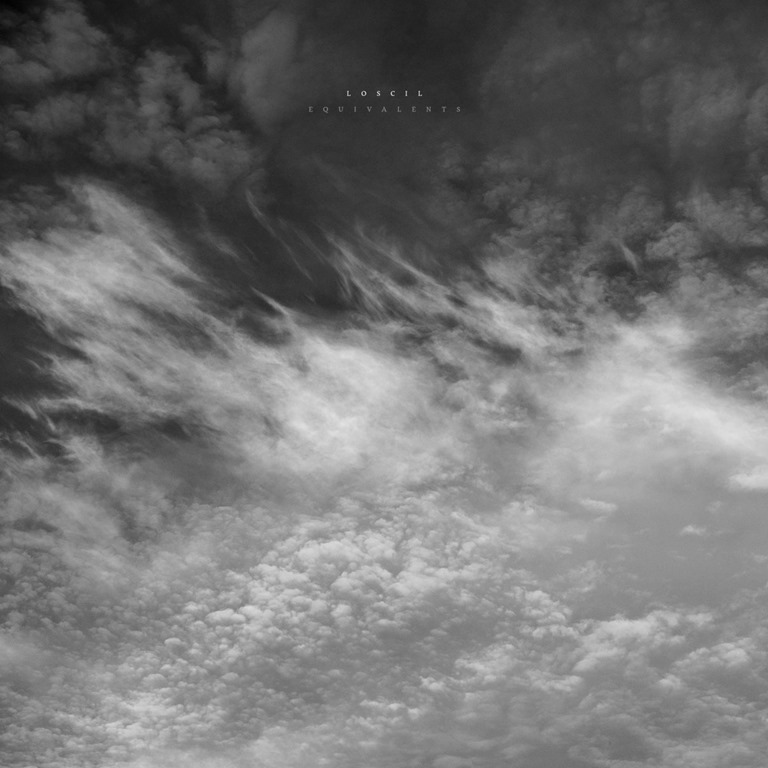
Equivalents is what you might call quintessential contemporary ambient. The compositions are formed with layers of broad, soft sounds that sweep and drift and swish and drone, eddying abstractly to soothing effect. But there are tones and textures which break the soft, vapour-like surfaces and disturb the tranquillity: not brutally so, not to violently or abrasively as to damage the atmosphere, but sufficient to prick the listener’s senses back to attention as stuttering disturbances interrupt the delicate flows.

These moments shift the album – which I’m playing at sufficient volume to drown out the pumping beats from the racecourse wafting through the window – from background to foreground, and do so in a way that isn’t jarring.

It’s the subtleties and timings of the changes that highlight Loscil’s skill as a musician. Equivalents is more than the perfect antidote to modern life and noise stress: it’s a wonderful album.

AA

Loscil - Equivalents

Opa Loka Records OL1904 – 14th September 2019

Christopher Nosnibor

Seeking a vehicle by means of which to explore the more ambient and experimental aspects of industrial music, Fire in the Head’s Michael Page began recording as Sky Burial in 2006. Thirteen years on, The Forcing Season: Further Acts of Severance is his sixteenth album under this guise. Owing more to the gnarly noise of Throbbing Gristle than the mellow sonic swathes of Royksopp, The Forcing Season isn’t what many fans of more populist contemporary ambient would consider ambient. The subgenre classification of dark ambient, with its industrial connotations is perhaps a closer demarcation, but it’s still not entirely accurate, as there are extensive passages of levity and tranquillity within the album’s ten tracks, simply titled I through X.

Progenitor of the ambient music, Brian Eno said that ‘Ambient music must be able to accommodate many levels of listening attention without enforcing one in particular; it must be as ignorable as it is interesting,’ and The Forcing Season certainly meets this criteria: its strength lies very much in the exploration of contrasts. There are stretches where it is extremely easy to zone out, and the lack of clear structure accentuate the drifting, amorphous nature of the compositions. ‘VII’ and ‘VII’ are exemplary, as slow-turning crystalline drones eddy in a rarefied air form smooth, soothing sonic expanses that somewhere along the way build levels of turbulence or otherwise jolt the listener out of that fugue-like state with jarring tonal incongruities. In short, it’s also interesting, imbued with a sort of suspense over when the next unexpected turn will come, when next there will be a sudden switch from background to foreground, from comfortable to uncomfortable and challenging.

‘I’ opens the album gently with soft waves of sound, but soon takes a turn for the more attacking, with smooth, chilly synths layering down over abstract washes and muted beats consumed by juddering bass undulations and wailing mid-tone pulsations that rub against one another at differing frequencies and echo in different times to disorientating effect.

‘II’ moves into more murky atmospherics, with a low, throb providing the backdrop of incidentals that scrape and scatter like breaking glass. There are flickers of discernible melody in the conventional sense for a brief moment on ‘IV’, as tinkling keys ripple tunefully and offer a certain relief. But this isn’t about relief, at least not sustained relief: The Forcing Season is an album built on turmoil.

The final track is the definition of ‘sprawling epic’: twenty-seven minutes of dissonance, as flickers and whistles of bat-pitch feedback and twitters flutter around dank low-end drones, clunks and a mid-range hum that hovers like mist in a graveyard. Over time, a grating, grinding swell of sound grows in volume and density and immense thunderous crashes punctuate the sustained surge… before it too tapers away to be replaced by an ominous hum rent with thumps and crashes. And from hereon it gets darker, denser, more unsettling as difficult drones with serrated edges eddy around beneath dungeon door thuds and whip-crack explosions of noise. And gradually the tempest abates, simmering down gradually to spacey waves of cinematic spaciousness that ebb and flow.

Because it’s truly ever-shifting, The Forcing Season: Further Acts of Severance is difficult to place and difficult to digest – which ultimately renders it an artistic success.

AA

ArtiosCAD Plot

Front and Follow – 2nd August 2019

Ever-evolving and always finding new angles Front and Follow’s latest release is the second in a new series celebrating the present and past of some of their favourite artists. The premise is simple, and in some respects, it’s remarkable it hasn’t been done before: ‘For each volume in the series we ask artists to create a new project of their own choosing and present it alongside a retrospective of their past output.’ Unusually for F&F, this release is available as a CD as well as cassette and download.

What this means is an album of new material, which comes with a bonus album (to download with all physical copies, and available separately to download) which for this release features tracks from Michael’s previous releases plus new remixes by Pye Corner Audio, Polypores, Kemper Norton, Psychological Strategy Board, Basic House and Elite Barbarian.

Longstanding Rothko member Donnelly has quite a career span and output to his credit, with myriad projects simmering simultaneously, and this latest offering promises ‘new worlds of beats and rhythm, sound collage, ambience and noise using random borrowed equipment, broken gear and household appliances’ – which it delivers, with gloopy synths and scratchy, insectoid microbeats paving the way for chunky disco grooves and funk-tinged minimalism.

Across the span of seven instrumental tracks, Donnelly explores a range of sonic territories, from semi-industrial gloom to stealthily-creeping dark ambient, with swathes of static and extraneous noise that shimmers, shudders, grates, grinds and crashes and bucks like tectonic plates in collision, occasionally propelled by hypnotic and unconventional rhythms.

‘Thick Skull’ closes off with a heartbeat drum and quivering, quavering stun drone with serrated edges and overloading frequencies played in 360˚ stereo.

The bonus album, Pardon Error contains eleven tracks, leading with seven remixes. The first four are various interpretations of ‘Mole Man’, which appeared on 2013’s I’ve Come to Love You Forever and also resurfaces later as both a remix and in its original form, but rather than reduce Donnelly’s extensive body of work to essentially one track, it serves to demonstrate the adaptability of his compositions. It’s hard to tell they’re the same track, and the spooky ambience of the ‘Basic House Mix’ couldn’t be further from the wheezing swirl of the Polypores interpretation, let alone the drilling drone assault of the Psychological Strategy Board Exercise of Impalement mix’, while the Elite Barbarian remix of ‘Laburnum’ goes full techno dance. ‘Behind the Laburnum’ sounds like a dub mix of Soft Cell on LSD crossed with ‘Carnage Visors’ by The Cure. It really is al going on here.

The gurgling ‘Root about the Carcass’ and minimal wooze of ‘Urge to Swarm’ again mark further departures as they bring the curtain down on the compilation. And once again, Front and Follow have given us something different – and of exceptional quality. Everything’s ‘curated’ now and 99% of it’s wank and cobbled together or otherwise simply misnamed, but F&F have developed a distinct style and now what works, and as such, they’ve established themselves as being dependable in the quality stakes. Why So Mute, Fond Lover? is no exception, and while Pardon Error may not be the expansive career summary one may have hoped for, it has a twist of innovation that makes for a listen that’s engaging and enlightening, offering a new insight into Donnelly’s work instead of cobbling together an easy best of.

AA

Michael Donnelly - Why So Mute, Fond Lover