Posts Tagged ‘Ambient’

Fabrique Records – 29th April 2022

Christopher Nosnibor

On her latest project, Jana Irmert shrinks the focus of her thoughts and her music on the microcosmic – although that certainly doesn’t extend to the microtonal. What Happens At Night is an intensely-focused work that places the lens onto textures and tones, and an examination of the relationship between the physical and the cerebral. You may call it a celebration of overthinking, but ‘philosophical’ feels a more appropriate term for her musical meditation on life and death – specifically death and beyond, the part of the life journey no-one has ever reported on and will, one assumes, be forever unknown and unknowable.

The liner notes set out the granular nature of the album’s composition: ‘Like layers of sediment, sounds are being pushed up from underneath, floating away or sinking back to the bottom. At the core of the album lies a question: What will be left of us? While Earth melts, we go on. But eventually, there will be a point in the future where all that will be left of humanity is a thin layer of rock. While this may seem like a deeply gloomy prospect, it also carries a great deal of comfort: the reminder that we are only a small particle in a vast system so big that we can never fully grasp’.

This is the limitation we all live with: the inability to comprehend life without us, what it would be like to not exist. Much of it’s ego, but perhaps it’s also a preprogramed limitation. Everything is dust, and once we pass, ashes to ashes, dust to dust, we become desert, and nothing changes: the world goes on… and on. And that’s a disheartening prospect; for the majority, our legacy won’t extend beyond our lifetimes, and the world at large is unaware of our existence while we’re here, let alone likely to experience any ripples in our wake. But even the world will be finite, ultimately. It will be swallowed by the sun in supernova. But none of us will be here to report on it by then.

What Happens At Night is dark and stark, and with just four tracks and a running time of less than half an hour, it’s perhaps technically only an EP, but feels like an album in every respect.

There’s a dolorous chime of a bell and a shrieking anguish of tortured spirits trailing like comets fading through the sky at the start of the album’s first piece, ‘Particles’, and everything simply floats and drifts. It’s ambient in the conventional sense: it’s background, you don’t really pay close attention while it’s playing, but it does subtly slant the mood.

‘Ashes’ is but a drifting fragment between the megalithic pieces on either side: it’s barely three minutes in duration. If ‘Dust is the Rust of Time’ is sparse it’s also dense, and a sedated heartbeat pulses uncomfortably throughout, amidst shuddering, gasping breaths of panic. You feel the anxiety at the passing of time; what have you achieved, and what will be your legacy? How will you be remembered in a world without you? It’s a tense, dense, gloomy sound, and you come to realise you are nothing, you’re simply here to go, and one day you will be but dust. Deal with it. And yet… It’s not a question of there being something more beyond, as such. And yet… ‘Stratum’ closes, and it’s the splash of waves and the quiet roar of a buffeting wind and the slow sound of the dust settling as incrementally, life returns to earth in slow, sedimentary layers, and each layer fossilises a period in time for all eternity. You may be dust, you may be forgotten, but in some form, are eternal in the earth.

Irmert articulates nothing specifically or directly here, but instead, What Happens At Night provides a sonic backdrop which invites contemplation.

AA

FAB097_front

Crónica – 26th April 20222

Christopher Nosnibor

Having seen various videos of Gintas K’s improvisations, involving a keyboard and a dusty old Lenovo ThinkPad running some custom software, it’s apparent that his approach to composition is nothing if not unusual, and it’s matched by the results.

His Crónica debut, Lengvai / 60 x one minute audio colours of 2kHz sound was sixteen years ago, and his return to the label is a very different offering, although as has been a common factor throughout his career, Lėti – Lithuanian for slow – consists of comparatively short pieces – and here, the majority are four minutes long or less. Less is more, and what’s more, Gintas K invariably manages to pack more into a couple of minutes than many artists do in half an hour. Here, we have a set of eleven short pieces ‘created from recording and improvising in studio followed by extensive mixing and editing using software.’ There’s no more detail than that: some artists accompany their releases with essays explaining the creative process and the algorithms of the software and so on, but Gintas K simply leaves the music for the listener to engage with and to ponder.

Where Lėti is something of a departure is in the emphasis on the editing and mixing of the material and the fact that, as the title suggests, the arrangements are a little more sedate. The signature crackles and pops, chines and static are all present and correct, but there’s a sense of deliberation as we’re led through ethereal planes of delicate chimes and tinkling tones that resonate and hang in the air, drifting in open expanses, with time and space to reverberate and slowly decay. With this more measured feel, melodies become more apparent, with simple motifs, repeated, giving ‘Hallucination’ a sense of structure and, I suppose you might actually say ‘tune’.

It isn’t that Gintas’ works lack tunefulness as such, but that any tune is surrounded by froth and extranea, and so much is going on it’s often hard to miss. Listening to Lėti is a fairly calm, even soothing experience, at least for the most part, conjuring a mood of reflection, of contemplation. The album’s longest piece, the seven-minute ‘Various’ brings a dense wave of sound that surges and swells slowly like a turning tide. There’s almost a stately grandeur to it, but then, there’s a rattling kind of a buzz that’s something of a distraction, and a glitch that nags away and seems to accelerate. These little headfucks are quintessential Gintas K, and Lėti isn’t all soft and sweet: ‘Savage’ brings thick, fuzzing distortion and discomfort.

The flurries of sound, the babble of bubbling bleeps and bloops that are his standard fare are slowed to sparse, irregular drips in a cave on ‘Variation’, and the application of reverb is impressively nuanced, to the point that the reverbs almost become music in their own right. ‘Atmosphere’ and ‘Ambient’ are appropriately titled, while ‘Nice Pomp’ would comfortably serve as a soundtrack to a slow-motion film of a moon landing or somesuch, and again none of the pieces are without depth or detail, as the layers and slivers of sound that intersect create so much more than mere surface.

Lėti is a genuinely pleasant and pleasurable listening experience, but is most certainly isn’t straightforward or simple in what it delivers. There are many sonic nuggets to unearth, and so many tones and textures along the way, that what is, superficially ‘less’ is, in actual fact, a whole lot more.

AA

Crónica185_front

17th April 2022

Christopher Nosnibor

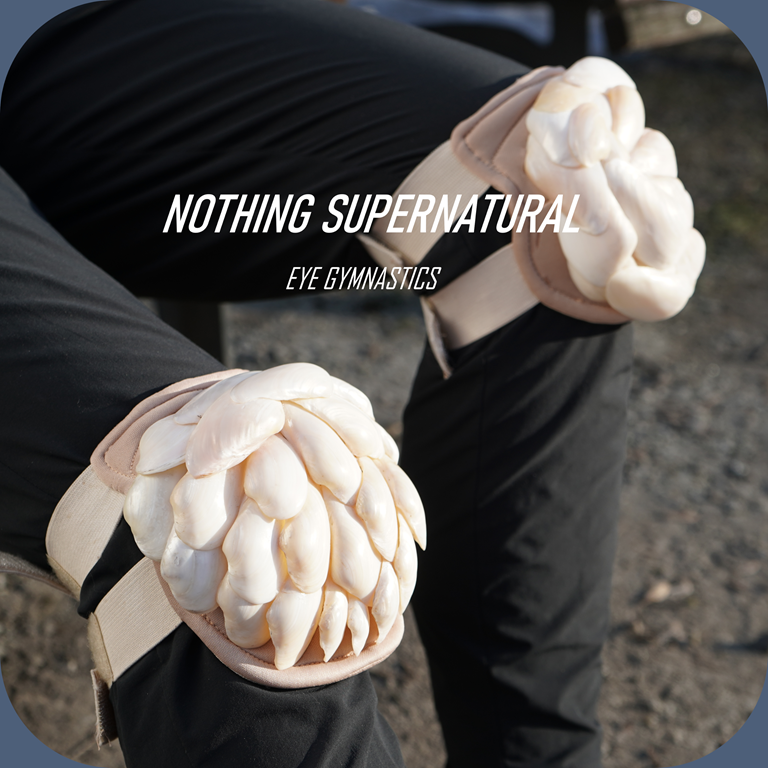
There’s something quite surreal about the imagery of ‘eye gymnastics’: it’s highly visual, yet at the same time, beyond physicality, and as such, it possesses a cartoon-like quality. This surrealism extends to the cover art, too: what exactly are we looking at here? It’s the debut album from a Lithuanian duo consisting of Viktorija Damerell and Gailė Griciūtė, who first came together in 2018.

And so it is that these clues are also representative of the music: the words are strange, fragmented, abstract – but also not, with improbable and incongruous images, and the album’s first piece, ‘Eye Gymnastics’ could be something of a signature tune for the pair. It’s sparse, the beats subtle, distant, subdued, yet insistent as they pulse through eddying swirls of semi-ambient synth drifts, through which a spaced-out, vocal dreamily intonates lyrical abstractions. If surrealism has a certain preoccupation with dreams and the subconscious, then on Nothing Supernatural, Eye Gymnastics plunder that inner realm for inspiration and render it in such a way as to remain to the vagueness, the indistinct focus of the fugue state, the disconnects and strangeness of dreams, and recreates the way those sensations and images echo, hauntingly, in the waking hours which follow those most vivid of nocturnal experiences.

The title feels vaguely ironic in the context of the disconcerting, dislocated vocal treatments of the ominous and eerie ‘Tree Tops’, where a glitchy, industrial beat clatters in thick and leaden. Then again, it’s dark pulsations feel as much the product of a troubled mind as of anything supernatural.

While there are some significant leanings towards ambience and hypnotic drifts imbued with an ‘otherly’ feel, elsewhere, snarling, growling electronics dominate a number of the tracks, with ‘Sadness and Joy’ being really quite heavy, with a gloopy bass that whips and whirs and fizzes. ‘You Destoy Me’ epitomises this industrial darkness: the murky drumming pumps away with the palpating tension of Nine Inch Nails’ ‘March of the Pigs’, while the multi-layered vocals whisper and echo dark thoughts, and the relentless pulse of ‘Let it In’ is harder and harsher still, the bass drum a booming throb, the snare – such as it is – a smash of distortion. You don’t want to let it in: no, you want to shut it out, make it go away. It’s not pleasant, it’s uncomfortable, claustrophobic, suffocating. Sparse and spooky, ‘Bitter Night’ bridges the territory between Young Marble Giants and Throbbing Gristle.

It’s unsettling, a creeping burrowing into the brain, as if overhearing someone’s internal monologue. This is not what you’d really call a ‘relatable’ experience, at least for the majority. It’s not full-on horror, but it is chilling, challenging, eerie, unsettling. But it’s also compelling, hypnotic, and a quite remarkable debut.

AA

Nothing Supernatural art

Kohlhaas Records – 22nd April 2022

Christopher Nosnibor

Simon Whetham’s notes which accompany (II)ntolerance – the sequel to his 2017 collection, InTolerance – are informative, albeit perhaps more so when reading between the lines: ‘InTolerance consisted of a selection of combined scenes and activities in various global locations. Through the process of constructing the piece, it became clear that it was as much about my ability and fortune to be able to travel and cross borders with relative ease as it was about the situations I was able to document. (II)nTolerance is a sequel and a response to InTolerance. It is a personal reaction to the global pandemic and its wide-reaching effects through suffering, fear, misinformation as much as confinement and curfews. It is a personal response to the (somewhat incorrectly named) United Kingdom leaving the European Union and all the resulting events that are continually unravelling.’ He continues: ‘Travel has been limited when not impossible. Cultural exchange is only possible through mobile, online, remote communication. Tactile contact is feared. Families and friends have been divided physically, mentally, politically.’

The pandemic but a block on everyone’s lives, but everyone was affected differently, and while I struggle to find sympathy for those bemoaning their inability to take their 204 kids on their half-term skiing holidays and the like, touring artists who depends on mobility for their livelihood, it’s a different matter, especially as that transit and a shifting geography is integral to the creative process. Reading Whetham’s notes, it’s clear that his obstacles have not been purely pandemic-related: The ‘United’ Kingdom has degenerated into a cesspit of division where not only ‘tactile contact’ is feared, but so is anything from ‘outside’. Never has this felt like a smaller, more isolated, island, and not just geographically.

Tolerance is something many of us – mostly those of us who wanted to remain – can now only dream of, as we hide our faces behind our hands as we peep at Twitter and Facebook, where it’s bordering on a virtual civil war.

Whetham describes (II)ntolerance as a personal response to all of this, and ultimately, that’s the only real response any artist can make. The idea that we’re all in the same boat has been proven untrue, for while we all endured the pandemic, everyone experienced it so very differently: home schooling while working from home was, for example, in no way comparable to living alone or in a shared house while on furlough. Similarly, the effect of Brexit for a container driver, versus that of, say, a hedge fund manager is simply not comparable. But this in itself is an issue: increasingly, it seems people have become unable to relate to experiences and situations which differ from their own.

As an artist, of course, one can really only represent oneself, and hope that through the personal there is an element of universal therein, and on this level, (II)ntolerance succeeds, containing as it does fourteen abstract compositions that state nothing explicitly, and yet convey so much implicitly.

There are a number of pieces that form sequences, namely the ‘Angry Earth’ pieces and the three ‘Kinetic Readymade’ pieces, which give the album a sense of cohesion and thematic unity (while making a small nod to avant-garde greats like Marcel Duchamp). And (II)ntolerance is an album of movement, of turbulence: the first piece, ‘Angry Earth Seething 1’ sounds like a harsh deluge of rain, and the lashing precipitation sets the tone for a stormy sonic journey, riven with growls and gulps and crashes of static and ominous drones and clicks and stammers.

(II)ntolerance marks a shift from field recordings and a focus on geography to shift the focus inward in a response to a shrinking environment, and the result is claustrophobic and uncomfortable. ‘Moving Sentry 2 – Angry Earth Seething 3’ is a gurgling mess of abrasion, while ‘Reception – Windpipes’ whips and gurgles in a fog of phase. Oftentimes, such as on ‘Angry Earth Seething 4’, Whetham conjures a dark, gravel-shunting grind of uncomfortable noise, while ‘Kinetic Readymade (Turbine)’ embraces all shades of difficult, dominated by churning, scraping noise – and as a whole, (II)ntolerance is not an ‘easy’ album. It’s noisy, with serrated edges and low-end growlings that unsettle the intestines. A difficult album for difficult times.

A

Simon W

Kranky – 15th April 2022

Christopher Nosnibor

Well, this is nice. No, it’s not sarcasm or some kind of snide semi-criticism wrapped in a vague compliment. Jacob Long’s third Earthen Sea outing for Kranky, Ghost Poems, was composed and created in New York during the first wave of lockdowns, and conjures a sense of calm , of tranquillity, and captures a sense of the hush that descended over life during this time. For many, there as an underlying rush of panic, of anxiety, as we struggled to comprehend what the hell was going on. The rolling news was little short of terrifying, and from my own vantage over the pond, New York looked like a dystopian movie. People weren’t only dying, but there were queues around the block just to get people into hospitals.

And yes, while all of this madness was going on, all other aspects of life were on hold. This was true of every town and city around the globe, but New York, the city that doesn’t sleep, was held still by a giant pause button. The very idea of New York without bumper-to-bumper traffic, packed sidewalks and parks rammed with joggers and dog walkers seems inconceivable. And yet, it happened.

Ghost Poems soundtracks empty streets, slow air currents and a general absence of everything – people, activity, life. As the title suggests, this is a collection of works which are haunted by the echoes of life, of activity, or movement, and listening it reminds me of my ventures outside in those early days and weeks of lockdown here in (old) York, England, a city usually populous withy workers and tourists, reduced to a ghost town. Social distancing was no issue on leaving the house: you could walk for half an hour is see maybe three other people. It was eerie. It was weird. It felt apocalyptic, like I was one of the last people on earth.

Slow, vaporous synths ebb and flow like a slow tide, dragging back and forth against a sparse, heartbeat pule of a beat on ‘Shiny Nowhere’, and it sets the sparse tone perfectly, and ‘Felt Absence’, with its slow backward-swelling remind into deletion encapsulates the mood perfectly. It’s not about what there is, but what there isn’t: that absence, that lack. It doesn’t feel right; even the air quality is different, and listening through an open window, there is birdsong, there is stillness… and so little else.

Elemental themes run through Ghost Poems: ‘Snowy Water’; ‘Rough Air’, and similarly, the sky is at the heart of the vistas which present themselves: ‘Ochre Sky’; ‘Deep Sky’; ‘Slate Horizon’. Looking out, and looking up, there was a strange stillness, an emptiness, above as below. Where did the time go? Two years have evaporated into this expanse of sky, and life has returned. Talk of ‘the great pause’ and ‘new normal’ have drifted away on the breeze. For all the fear of the pandemic, there was a certain optimism that something fresh and new may rise from the silence, from the space; perhaps a new green dawn, perhaps a kinder capitalism, a world without endless traffic, where the work/life balance may lean more towards life. All of these contemplations are spun into the soft, gentle airiness of Ghost Poems, an album suffused with calm, with a quiet optimism. This may have already been lost, buried in the clamour of the return, but Earthen Sea has captured that moment when there was a reserved sense of hope.

Listening to Ghost Poems compels one to sat back, and breathe in, slowly, deeply, to fully expand the lungs, and then exhale, again, slowly. Perhaps there is still hope after all.

AA

888016

This is it Forever – 25th March 2022

Christopher Nosnibor

There are many artists who can boast bodies of work that are solid, and illuminated by outstanding gems along the way, but there are few artists with bosies of work as consistent as worriedaboutsatan. Fifteen years into the project’s existence, that’s a significant achievement. Some artists go off the boil or seem to struggle with maintaining that level once they achieve a certain degree of success, whether it’s simply through a perceived pressure to deliver something or create something that will replicate whatever it was that achieved that success, or simply diminishing returns, but worriedaboutsatan, despite having tracks featured on Coronation Street and Adam Curtis’ Hypernormalisation documentary, not to mention radio play on both 6Music and Radio 1, and the very vocal support of one Ian Rankin, remain unstinting in their path.

Operating solo since 2019, Gavin Miller has maintained a constant flow of output: so constant that since Providence last May, Miller’s slipped out a brace of album-length single track releases (Circles I and Circles II) and an EP Live from the Studio that entirely bypassed me while I was, well, I don’t know, what was I doing?

The thing about consistency is that it absolutely does not equate to sameness, and worriedaboutsatan’s output is defined by its evolution, incorporating wide-ranging stylistic elements from delicate post-rock to pounding beats within the overall sphere of haunting, reflective ambience of varying shades of darkness and light. And while satan’s sounds exist in a rarefied space all of their own, no-one lives in a complete bubble. We live in dark times, and not insensitive to this, this latest offering finds Gavin channelling that global turbulence through his work.

Bloodsport promises a departure, and it delivers. Miller describes it as ‘still very much a worriedaboutsatan album, albeit a fairly angry one.’ It’s a fair summary. The intro piece, ‘Je Suis Désolé’ is a classically ‘electronic’ composition with oscillating waves cutting across one another, but the treble tones sound like sharpening knives, and it has an edge that scrapes at the skull quite unexpectedly.

Making a linguistic and stylistic switch, ‘Bis Ich Komme’ is slow and dubby, a dense bass and backed-off beats holding the structure of a drifting ambience, before it solidifies and hardens around the mid-point. There’s a tension, a simmering aggression in the tone of the barbed synths, something uncomfortable and uncertain in the samples, before jungle beats hammer through the woozy, stomach-clenching undulations like machine gun fire

Released ahead of the album as an EP with three remixes, ‘Sigourney Weaver Fanclub President’ is the theoretical lead single, and it’s a brooding eight-and-a-half minutes of echoes guitar sustain and crashing sheet metal. It’s the sound of shattering destruction and trepidation. It’s classic ‘satan in that it’s all the layers, all the atmosphere, but it’s also steelier, with a certain bite previously unheard.

The two parts of the centrepiece, ‘An Absolute Living Hell’ are definitive and are a statement in themselves. Dark, dank, oppressive, bass-heavy and bursting with shards of extraneous noise, rippling in deep, deep echo, this diptych is the soundtrack to this bleak moment in time. ‘Part 2’ goes full industrial with a throbbing bass and crashing percussion worthy of Test Dept or Neubauten.

The stark robotix of the brief but claustrophobic ‘Perfekt’ makes for possibly the least WAS-like track of their career, before the metronomic thud of ‘Slur They Words’, dives headlong into the territory darkest hi-hop: the origins of the vocals are unclear, but they’re abrasive, and ‘Apex Redditor’ draws the curtain in a bleak fashion, but with a redemptive hint of a rippling piano and twitchy percussion that – I hope – alludes the prospect of a new dawn. Because surely, surely, there has to be a light at the end of this tunnel.

AA

a2575977490_10

Dret Skivor – 4th March 2020

Christopher Nosnibor

Swedish DIY microlabel Dret Skivor continue their steady programme of a release a month – and while the number of physical copies of releases are minuscule, it makes for a sustainable model, and those who obtain them have a bona fide rarity. The noise scene loves this kind of thing, but then, so does the market of the arts more broadly: limited editions are certainly nothing new as a selling point, but here it’s also a practical consideration.

Consequently, Dret 13, Fern’s Illustration of Sound Waves, which was released early February, is sold out now in physical format – but then there were only eight cassettes dubbed, so it’s hardly surprising.

Dret 14 sees Claus Poulsen and Dave Procter reunited once again, with experimental duo PP creating sound both indoors and outdoors last autumn to celebrate the imminent onset of winter. Being in Sweden, they have proper winters worthy of celebration. The release features two versions of ‘Drone for Autumn’ – a studio and a live take, with the latter being edited to 14:49 to fit on one side of a C30 cassette. It’s a nice detail for trainspotters (and as someone who has obsessively collected ‘versions’ from back when multiple formats was the cash-cow of choice for record labels, I consider myself among them).

It’s droney, alright. It’s a thick, quivering, mid-range oscillation that shudders away at the heart of the composition, and it rings out solidly on the studio version, while murky wisps and whirls and vaporous incidentals intersect and bisect the continuous stream of rough-edged sound. It creates a certain tension, but mostly, it creates a rich atmosphere: not overtly dark, but more shadowy, twilit. The drone wheezes on and on. Stars shoot across the darkening sky – or are they lasers or satellites falling out of orbit? There is some loose semblance of linearity, through a succession of, if not specifically crescendos, then swells and ebbs, and the arrival of a grinding organ amidst the whistling winds adds further texture. It may not evoke any specific seasonality, but in adhering to a core drone and building around it, P and P imbue the work with a bleak monotony that reflects the slow passage of time.

The live ‘version’ is less a performance of the same piece and more of a further exploration of a theme, starting with a looped vocal snippet that fades into a slow, rolling electric piano. The notes decay into crackle and there’s much more by way of extraneous noise, distant radios and chatter and rumbling here – not to mention the absence of that central continuous drone that defines and dominates the studio piece. With so many random sounds fading in and out, it’s more or less a cut-up / collage piece (some well-known 80s tunes drift through before being swallowed by a churning noise like a toilet flushing), and it’s quite bewildering in its effect on the senses and general orientation. There’s even some gentle acoustic folk guitar near the end. It’s hard to draw anything solid from it, or even really define the experience, but as an experimental electroacoustic work, it’s nicely done, with a clear sense that the artists are revelling in the process of working together to draw this array of source materials together, and it works well.

0027884458_25

Earth and It’s Decay is one of the few releases Déhà is planning on releasing this year and this release sees the Brussels-based multi-instrumentalist collaborating with Polish dark ambient artist Marla Van Horn to craft a sound that is equally engaging and menacing, elegant and melancholic.

There is an overarching sense of hurt and decay that pervades throughout these six tracks, as the duo focuses on slow-moving rhythms, bleak ambiances, angelic voices, and anguished screams that result in a genuinely harrowing and gloomy atmosphere.

The duo has shared a music video for opening song ‘Purification Ritual’. Watch it here:

AA

090523d3-2802-f905-fa4c-c18066632df1

Southern Lord – 25th February 2022

For many, the days of the longest, hardest lockdowns are, it would seem, behind us. And yet the shadow of the pandemic continues to hang long as dark; it’s hard to move on and truly put it behind us when life continues to be anything but normal; signage and masks and booster reminders are the new normal, and we face a new normal carrying scars of a personal nature, each and every one of us. Successive lockdowns, periods of isolation, have all affected us in different ways, and we’ve all suffered some form of trauma or psychological damage in living through conditions we’re simply not equipped for.

For many creative types, working through the experience has manifested in new artistic output. There’s something about channelling that anxiety into something, even if not direct or specific in addressing the issue, that helps to somehow minimise, contain, or otherwise manage it. Thurston Moore’s latest project, like so many was born out of a lockdown environment, and it’s an exploratory work, in so many ways. A series of instrumental guitar pieces recorded during the summer of 2020, it’s a document of, as the liner notes outline, a period where, ‘as the world confronted the pandemic shutdown and as the people of good conscious stood up against the oppression of racist police oppression and murder.’ It goes on to ask, ‘How much screen time does a parent allow a child? How much screen time does a child need to realise a world which has the means to coexist as a community in shared exchange?’

This feels like numerous issues, simultaneous but separate, have collided to inspire this album, and raises as many questions as answers. Moore is clearly placing his flag alongside Black Lives Matter, and it struck me – and surely many others – that the protests should have taken place when the world, pretty much, was in lockdown. How could this be? This was a moment in time when protest felt impossible. In fact, anything felt impossible. But the murder of George Floyd was a trigger and it marked a tipping point of something far, far bigger for so many. This was about centuries of oppression and division. The scenes aired over the news channels, globally, were electrifying. But how does this relate to monitoring the screen time parents should grant their children? Surely it’s less about the amount of time, but parental control, and the extent to which parents grant their children exposure to current affairs? That said, it’s something I’ve wrestled with myself. As a child, I had no interest in anything on the news; my own daughter, aged 10, is genuinely interested and has her views on our prime minister, our government, and the pandemic, and more. While I feel a duty to protect her from scenes of violence and endless report of rape, murder, abduction, and brutal crimes against women and children, I also feel that a certain degree of exposure to ‘the real world’ is beneficial, just as I’ve come to see that many computer games encourage problem-solving and eye-hand co-ordination. Screen time isn’t all bad if you can get over the generational differences. But.. but… no doubt, it’s a conundrum.

Screen Time offers no answers. As is often the case with instrumental works, there is little to be gleaned from them in and of themselves, and the titles offer little by way of interpretive guidance. The only thing that really struck me about the titles, in fact, is that several share their with cure songs: ‘The Walk’; ‘The Dream’. ‘The Upstairs’ feels like an allusion to ‘The Upstairs Room’ (the title of the 12” EP version of ‘The Walk’; but then again, all of the compositions are ‘the’ something: ‘The View’, ‘The Neighbour’, and these reflect the shrunken worlds we inhabited during this time: four walls, the view from the window, and the TV as the window to the world. There was nothing else but to look, and to ponder. Screen Time is a work of ponderance. It doesn’t have to be coherent, because coherent thought isn’t the state of the world right now. Show me someone who has a firm handle on everything that’s going on and I’ll show you a bullshitter. No-one knows anything, and we’re all just fumbling, stumbling through.

Many of the pieces on Screen Time are short, fragmentary, and sparse, only half-formed, but evocative and atmospheric: ‘The Walk’, a minimal piece consisting of a heavily chorused and echoed guitar trickling a cyclical motif for a minute and fifty-one seconds is exemplary. Elsewhere, ‘The Upstairs’ is a haunting piece led by disorientating, discordant piano that tumbles along.

At times reminiscent of Earth, or more specifically Dylan Carlson’s more recent solo work, Screen Time borders on ambience in its slow, soft unfurlings. The final piece, the nine-minute ‘The Realization’ is almost hypnotic; slow, with deep, resonant notes that reverberate and hover while harmonics chime and soar.

As a listening experience, Screen Time is pleasant, absorbing. I like it. But what does it say? It speaks for Thurston Moore alone, just as any such release can only speak for its composers and performers. That’s ok. When stitched together, in time, all the voices will combine to present the full picture. For now, what simply matters is that each voice keeps adding to the tapestry of documenting the present, a time unlike any other.

AA

LORD283_tp0001c_LPtipon_jacket_cover_rev011217 [Converted]

Audiobulb Records – 2nd March 2022

Christopher Nosnibor

Experimental and underground music, particularly of the electronic persuasion is a broad field, but, it would seem, a small world.

During lockdown, the Nim Brut label hosted a series of virtual gigs, where performers would submit sets accompanied by visuals, and the resulting streams were varied and eclectic, in the best possible way, presenting the full breadth of the melting pot of a diverse and disparate milieu. As is so often the case with events of this ilk, everyone was not lonely accommodating, but welcoming toward one another, celebrating the differences in style and approach.

Feast 5, back in August of 2021, was a belter, and not only because as half of …(Something) Ruined I got to unleash new brutal noise in a safe environment, but got to do so alongside some remarkable artists, notably Omnibael, who have featured a number of times here. Also on the bill was a performance so brief as to barely be an interlude, something I described as a ‘shifting wave of glitchronic ambience’ courtesy of Neuro… No Neuro, of whom I knew nothing, until today, when on the arrival of Faces & Fragments in my inbox, I learn that NNN is ‘a moniker of the electronic musician Kirk Markarian, an avid synthesist, drummer, abstract painter, and graphic designer residing on the alluvial plain of the Sonoran Desert, in dry and dusty Tucson, Arizona’.

The title is a fitting summary of the album, both its input and outputs, and the lived experience of listening to the thirteen pieces, which are as much collages as compositions.

As the liner notes explain, ‘Each track illuminates fragments of memory and speech, as they wander out of focus in the growing aperture of time.’

As such, each piece is formed, sculpted and layered, from an array of sounds and sources, snippets, and scatterings, fleeting and ephemeral; chiming notes ring out over soft washes, sporadic glops and plops, like drops of water falling in a cave, overlaid with brief fragments of voices. On ‘Everybody is Out to Get You’, those voices slow, distort, blur, into a nightmarish nagging. It drags on the psyche, against a skittering, jarring backdrop what warps and tugs unsettlingly, and makes for awkward, queasy listening.

Neuro… No Neuro’s own comments on the album’s formulation and function bring us closer to the heart of the state of confusion it creates, explaining, “Each track shares the ‘fragments’ of speech/memory, the growing aperture of time and loss of thought. While forming sentences via type has not declined (because there is time available), speech and recollection are steadily decaying into simplified phrases and poor playback for quick address.’

As William Burroughs said, the function of writing is to ‘make us aware of what we know and don’t know we know’, and this was particularly pertinent in the context of the cut-up texts he produced, essentially collages of other texts designed to recreate the real-time experience of memory and sensory awareness, and the simultaneity of events. We do not live in linear time; we experience multiple sensations simultaneously; thoughts, sounds, conversations, things happening around us all occur on the same timeline, in layers, and our memories record these experiences. This is the sensation that Neuro… No Neuro recreates with Faces & Fragments, from the stop start jittering of ‘Slice of Mind’, to the trickling sedation of ‘And the Energy Goes Back to the Ground’.

The faces blur into anonymity after a while; people look alike and are strange or strangely familiar, and things can get confusing after a while. Faces & Fragments may not – and probably doesn’t sound just like your internal monologue or the soundtrack to your life, but structurally, the resemblances are clear once you step back and reflect. Our thoughts are a jumble of intrusions and overlaps, with memories and recollections triggered by the most random associations and events, sometimes with seemingly no trigger at all, and all flitting through at the same time as you’re watching TV or scrolling through social media shit on your phone as messages and emails ping in and there are conversations and the radio or TV is dribbling away while dinner’s bubbling away in the oven. Life never stops: it happens constantly and all at once, overlapping, overwhelming. Faces & Fragments is a slice of life.

AA

AB119_front