Lupus Lounge – 9th February 2024
Christopher Nosnibor
The notes in the press release which accompany this release are strange and intriguing in equal measure, and pique my interest for all of the things they evoke, mysteriously and evocatively. The one thing they don’t really do, it set my expectations stylistically, which isn’t necessarily a bad thing.
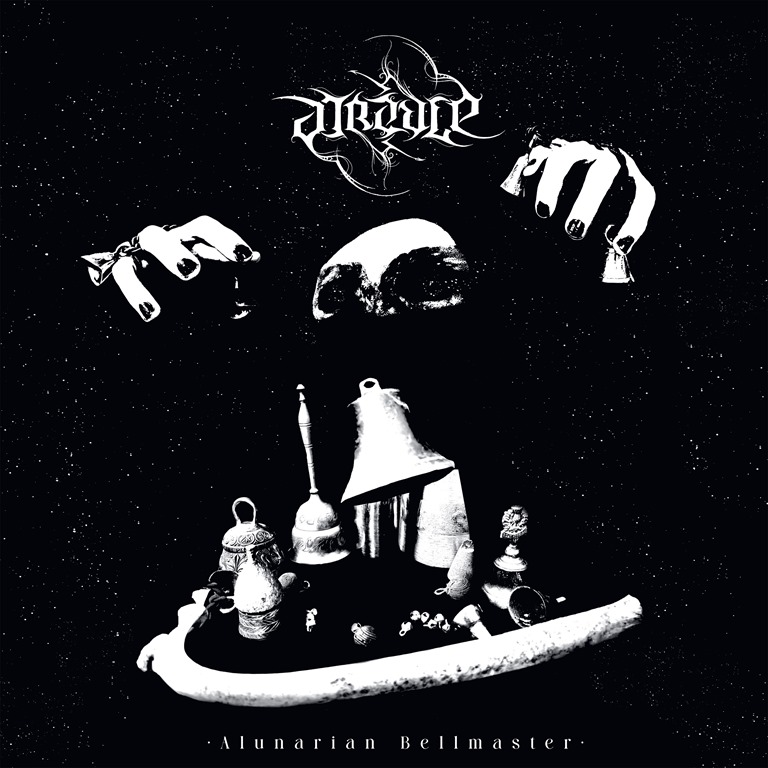
‘For whom the bells toll in the Citadel Alunar shall encounter the Bellmaster!.. The particularly sinister and insidious musical and lyrical universe that Markov "M.S." Soroka is continuously creating with his various projects AUREOLE and TCHORNOBOG as well as ETERNIUM, KRUKH, and DROWN is enriched by a new chapter… The third AUREOLE full-length Alunarian Bellmaster differs stylistically from its direct predecessor Aurora Borealis (2016) in atmosphere and feeling. The album returns to the spirit of the 2014 debut Alunar albeit as a more advanced version with the added experience regarding production techniques and conceptual writing that Soroka has acquired over the years.’
It goes on to explain how ‘Armed with a vicious sound, the album’s lyrical theme is echoed in the sound of 30 bells sampled by Markov and incorporated on Alunarian Bellmaster. The story told on this album is part of the same grimdark fantasy and science fiction based cosmos that AUREOLE and TCHORNOBOG share.’
I don’t know what even half of this means, and I can’t help but be a shade sceptical when bands talk of things like a ‘grimdark fantasy and science fiction based cosmos’. Either we’re plunging into deeply enigmatic territory here, and have perhaps gone beyond a point where lore and mythology and are merely influential elements to become something altogether greater, or we’re in the realms of self-absorbed pretentious guffery. There’s a fine line between high art and theatre, and wank.
In the event, the themes and concepts behind the album are very much that – to the back when it comes to the actual listening experience. The vocals serve as another facet of the overall sound rather than being pitched to the fore, and the titles, too, are sufficiently abstract as to be unobtrusive: that is to say, it’s possible to listen to and appreciate the album without becoming bogged down in any narrative or pseudomythos, while stylistically… well, it soon becomes clear why there’s no attempt to align AUREOLE with any genre. Just as ‘female fronted’ isn’t a genre, neither is ‘experimental’: these are adjectives, and it’s possible to experiment in so many ways within – or without – the confines of any given genre. But experimental, for many, brings with it connotations of happenstance, of the random, the arbitrary, and while the way in which samples and sounds are explored is experimental in nature, to define Alunarian Bellmaster as an experimental work would be to unfairly downplay the detailed, structured nature of the album’s many-layered and multi-faceted compositions.
‘Alunarian Ghosts of Bellmaster’ grows and swells organically from the drones of low ambience searing post-rock, only with ghostly There are echoes of guttural vocals reverberating in the eternal darkness. There are also echoes of Gregorian chants, and guttural mutterings, amplified and reverberated to a colossal scale, which very swiftly swells to become something truly immense. This in itself is a difficult thing to process, even in isolation. In context – an ever-evolving one, where the sounds and textures shift imperceptibly – we find ourselves adrift and in motion through an expanding alternative universe.
The thirty sampled bells are multiplied – and multiple, and multiplied again – to create the immense sound of ‘10000 Bells Resonate Cosmos Untold’, a title which sounds like a phrase from a William Burroughs cut-up. Muttered voices, uttering in an unknown language, flit in and out of earshot. ‘Arrival of the Deathless Interlopers’ is a bold, surging piece of grand proportions and high drama, which isn’t only spectacularly cinematic, but a sweeping piece of neoclassical music which evokes the same stirring of the senses as Mars from Holst’s Planets Suite. If there is a sense of narrative flow between the pieces, then ‘Orbiting Among Alunarian Ruins’ tells us that not everyone here is deathless, as purgatorial howls and screams swirl in a pitch void, from which emerges a big post-metal riff with an atmosphere reminiscent of Field of the Nephilim at their most doomily bombastic. At nearly ten minutes long, it is epic in every sense, while ‘Alunarian Surrender’, another ten-minute monster soundtracks doom and destruction in slow motion against a backdrop of contemplative strong sounds before everything is obliterated by thunderous percussion and slowly the tide turns to another soaring expanse of post-rock with the darkest, most sinister undercurrents. ‘UGC 2885’ is a last piece truly worthy of the word ‘finale’, almost fourteen minutes of dark ambience, through which a piano echoes into nothingness, through the sound of matter slowly collapsing in on itself.
AA
 Aural Aggravation