Posts Tagged ‘textures’

Cruel Nature Records – 28th November 2025

Christopher Nosnibor

November always feels like plunging into an abyss. It’s the month when , after the clocks change on the last weekend of October, the darkness encroaches at an exponential pace, while, simultaneously, the weather deteriorates and temperatures suddenly drop. I struggle with November, and I’m by no means alone in this – but the darkness and muffling cold brings with it a blanket of isolation, too.

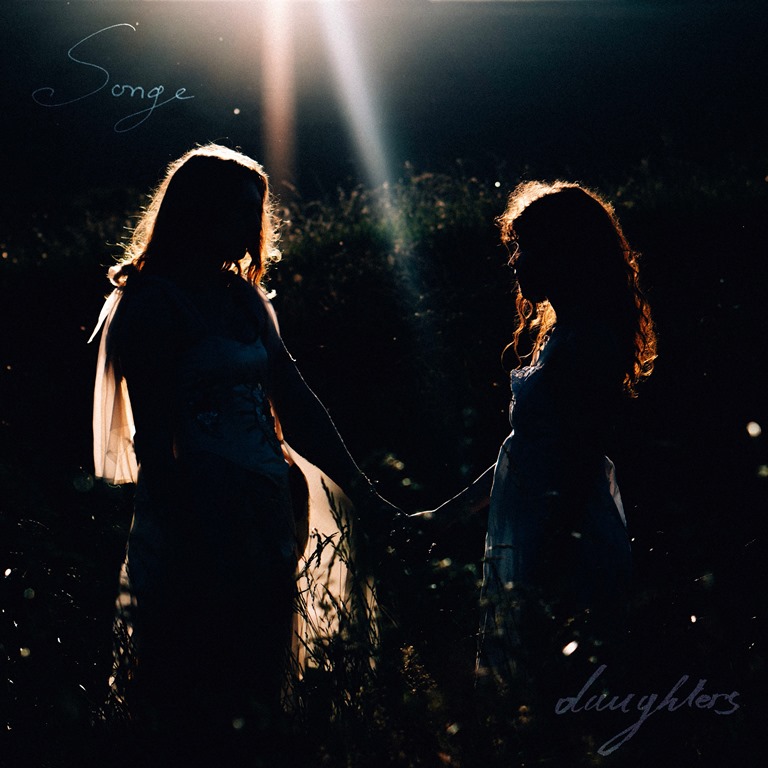
Listening to the debut album proper by Songe in this context makes for a heavy experience. And it’s the context that counts here, because in reality, Daughters is largely calm and spacious rather than dark and oppressive.

The Anglo-French duo consisting of Gaëlle Croguennec and Phoebe Bentham formed in 2023 ‘upon stumbling on a lonely church piano’, and, we learn that ‘Songe explores what it means to live in a postmodern world that feels rooted in destruction’.

This resonates. Right now, it feels as if the world is on a collision course. The so-called ‘great pause’ of the pandemic seems more, in hindsight, as if it was a time during which tensions built and nations pent up rage ready to unleash the moment the opportunity arose. Some of this a matter of perception and distortion, but the bare fact is that the last COVID restrictions were lifted here in the UK on 21 February 2022, and Russia invaded Ukraine three days later. The pandemic, for many, felt apocalyptic. It wasn’t simply the deaths, the fear, but the impact of the restrictions, which didn’t suddenly dissipate the moment those restrictions lifted. The end of restrictions felt like a deep-sea diver coming up for air, the aftereffects akin to the case of the bends. While we were recovering our breath and dealing with the cramps, Russia invaded Ukraine, and from thereon in it’s felt like an endless succession of disasters, storms, and then – then – the annihilation of Gaza.

Musically, Daughters – on which the duo deliver a set of ‘vibrant and experimental soundscapes using a variety of e-pianos, pedals and theremin, pairing a traditional playing style with bit-crushed granular delays to create a soaring top line met with ethereal vocals’ – is by no means dark, bleak, or depressing. In fact, quite the opposite is true. It’s a delightful set of compositions.

But sometimes, the more graceful, delicate, uplifting the music, the harder it hits. And on Daughters, Songe reach some dark and hard-to-reach places. From the most innocuous beginnings, the epic, nine-minute ‘Warmer, Hotter’ swells to a surge of discordant churn beneath soaring, ethereal vocals. The piano-led ‘Ashes’ borders on neoclassical in its delivery, and is rich in brooding atmosphere. ‘Heol’ begins with distorted, discordant harmonics, with frequencies which torment the inner ear. Gradually, through a foment of frothing frequences and fizzing tones, bubbling undercurrents rise. Haunting vocals rise through the mist, the haze, the dense and indefinable drift. It’s ethereal, spiritual, bewildering in terms of meaning.

Waves crash and splash before soft, rippling piano takes the lead on penultimate track, ‘Eveil’. It’s graceful, majestic, emotive – but not in a way which directly or obviously speaks of the album’s subject or context. The vocals are magnificent, but the words impenetrable. It works because of this, rather than in spite of it. It’s slow, subtle, powerful.

It’s not until the final composition, ‘Wraith’, that we feel the emotive power of a droning organ, paired with saddest of strings, that we really feel the depth and emotion al resonance of Daughters. As it fades in a brief reverberation, I find myself feeling sad. No, not sad: bereft. This is an album that takes time to take effect, to soak in. It deserves time to reflect.that time.

AA

AA

cover

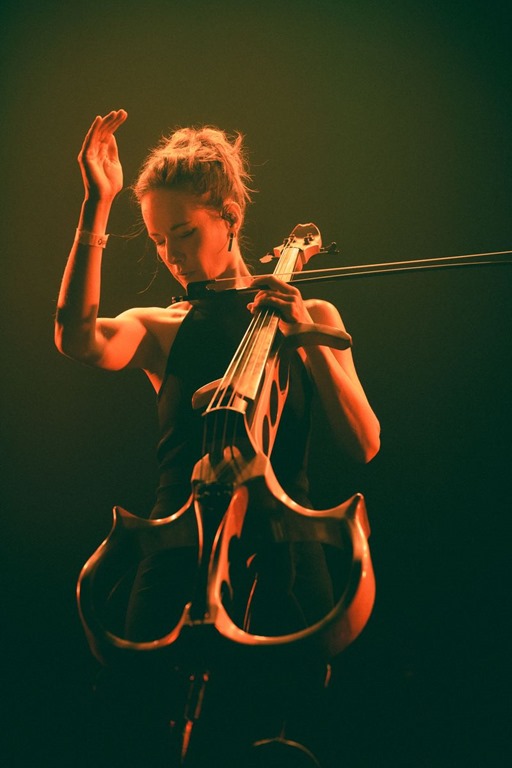
Following recent tours with Wardruna and God is an Astronaut, composer and sound designer Jo Quail is set to release her 7th album Notan on 12th September.

Notan is the seventh album from composer and sound designer Jo Quail—a work of striking contrast and graceful power. Drawing its name from the Japanese concept that explores the interplay of light and dark, the album unfolds as a deeply personal journey through polarity: presence and absence, softness and intensity, expansion and return.

What began in June 2023 as a series of raw, looped improvisations evolved into something far larger: a symphonic tapestry titled Ianus, now destined for recording with full orchestra in late 2025. But Notan is not that orchestral vision—it is the source from which it sprang, and the space to which it returns.

In these solo iterations, the music breathes with both intimacy and grandeur—cello, electric cello, and piano intertwine in richly layered textures. The sounds Jo creates on both acoustic and electric cello range from the traditional to the highly sculpted; all sound design and modelling is her own, forming the distinctive sonic identity that makes her music instantly recognisable. Each track is a live take, with every looped section performed in full, capturing the immediacy of live performance while allowing for a more considered control of sound—one that honours the context of making a record.

Across its arc, Notan evokes archetypal energies. ‘Butterfly Dance’ embodies matriarchal authority—stately and untouchable in its raw grace. First single, ‘Rex’, by contrast, traces Jo’s own evolution. First appearing on her 2010 debut as a tentative, fragile offering, the piece was left untouched for years. Reawakened during the solitude of lockdown, it transformed—emerging here as something altogether more commanding: majestic, grounded, and complete. Jo comments,

The first single from Notan is Rex, some of you who’ve been with me since the early days might remember it first appearing back in 2010. It’s a piece I’ve returned to in live performance, and over time it’s evolved and reshaped itself. This version is something quite different: a reimagining that feels both familiar and entirely new. I’m really proud to be releasing it now — and yes, it’s over 9 minutes long (a bold choice for a single, I know!).

AA

AA

Jo Quail is also set to tour the UK in September to support the release:

12/09 – Manchester – Deaf Institute

13/09 – Newcastle – Cluny 2

14/09 – Glasgow Core Fest

15/09 – Edinburgh – Voodoo Rooms

16/09 – Nottingham – Bodega

17/09 – Bristol – Jam Jar

18/09 – Leicester – The Big Difference

19/09 – Southampton – Joiners

20/09 – London – Omera

AA

toVUUoGA

Photo: Jiawei Zhang

Kranky – 5 April 2024

Christopher Nosnibor

Stars of the Lid are one of those acts who seem to have spent a – now lengthy – career on the fringe, an ultimate cult act who’ve built a substantial following without ever being well-known. Here in the UK, at least, they’re strictly a 6 Music act. With Brian McBride’s passing last year, their future remains unclear, but in the meantime, Adam Wiltzie, who had already been active for some time as a solo artist, offers up a new set of drifting, dreamy, discombobulating amorphous ambient works in the form of Eleven Fugues for Sodium Pentothal.

Sodium Pentothal is (to quote, unfortunately, Wikipedia), ‘an ultra-short-acting barbiturate and has been used commonly in the induction phase of general anesthesia’ and is also perhaps better known as a ‘truth serum’.

We recently aired the opening track, ‘Buried At Westwood Memorial Park, In An Unmarked Grave, To The Left Of Walter Matthau’ here at Aural Aggravation, and it’s inevitably tempting to infer connotations from this title in context of events – something the album’s title wouldn’t seem to necessarily counter. But Eleven Fugues for Sodium Pentothal seems to be preoccupied with memory and place in a broader sense.

We’re infirmed that the album ‘took shape following a move north from Brussels into the Flemish countryside, although it was initially inspired by a recurring dream wherein “if someone listened to the music I created, then they would die.” The album uniquely evokes and evades the allure of oblivion, keening between beauty and ruin, forever unresolved.”

Dreams have a way of staying with you, and of twisting your psyche in some unsettling way, the more vivid ones lingering and replaying for hours, even days on end, the vaguer ones leaving you feeling somehow disjointed and in a slip from being in step with the world, partially detached, partially disconnected, as if looking at your own life through a window. Recurring dreams can prove particularly unsettling, and have a way of encroaching on your waking hours, assuming a reality of sorts.

The track titles, in the main, tell us very little, presenting mere abstractions, although one suspect they carry significantly greater weight of meaning for the composer. Bereavement and loss has a way of bringing layers of meaning to the slightest things, often unsuspectingly – a sight, a sound, something not even remotely directly related, has the capacity to trigger a memory, which in turn has the capacity to elicit an emotion or some not-quite-definable internal response. It’s often fleeting, or otherwise vague and indefinable, something impalpable and beyond reach, leaving a certain pang of bereftness – in much the same way as if waking from a dream.

Eleven Fugues for Sodium Pentothal is not a dark or heavy album, but one which is dense in its atmosphere and carries a certain air of melancholic reflection in its drifting waves. This melancholy may well be as much a reflection of the way places – even unfamiliar locations – have the capacity to stir memories but indirect association – again, a sound, a smell, a certain shade of lighting, the angle of a tree, a riverbank – prods a deep corner of the memory most unexpectedly, causing memories we didn’t even know we had, or still had, to trickle forth, vaguely, out of focus, out of context, and sometimes you wonder if is really is a memory or a fragment of a dream.

There are some deep, rich, grainy textures to be found here, and ‘(Don’t Go Back To) Boogerville’ brings some dark, heavy strings and sonorous scrapes to close the album – which, incidentally, contains only nine tracks. Loop’s Robert Hampson was an inspired choice for the album’s mixing, bringing the layers of organic-sounding drones to the fore.

Returning to the press notes, ‘Wiltzie cites the barbiturate of the title as both muse and sacred escape: “When you are sitting face forward on the daily emotional meat grinder of life, I always wished I could have some, so I could just fall asleep automatically and the feeling would not be there anymore.”’ With Eleven Fugues for Sodium Pentothal, he has created that perfect escape. This is an album that lends itself well to listening – or half-listening – by candlelight with a slow-sipping drink, and to simply drift and nod to.

AA

547558

Mille Plateaux – 1st December 2023

Christopher Nosnibor

It’s always exciting to hear what electronic experimentalism Neuro… No Neuro have cooked up, and Positive* is the second album this year, following on from the collection of glitchy snippets which comprised Compartments back in January. Just as Compartments was a very different project from its predecessor, Faces & Fragments, so Positive* explores very different territory from the ‘Kawaii-Glitch’ of Compartments.

As the accompanying notes explain, ‘Positive* by Neuro… No Neuro is based upon thin slices of memory, and the disintegration of their existence. The day-to-day, with its ‘ups and downs’, all while operating/existing above and to the right of the body. When the day ends, and the separated is reunited; how does one collect what is no longer there? …Separating consciousness from the corporeal… Memory and thought are being swept out to sea in granules that are imperceptible to those around you. Short term is riddled with inconsistencies…Say “so long” to the granules.’

It’s all about focus, and the focus of Positive* is very different from any previous projects. And when it comes to projects like this, details are important. In context, it’s ok to focus on those details, and to do so isn’t obsessive or excessively picky, but to engage with a creative work on the basis of its design, its intent. I preface my assessment this way because the first thing I’m drawn to, before hearing a single note, is the asterisk in the title. Such a mark denotes a footnote, an aside, a necessary commentary on the subject.

But there is not one appended to the accompanying notes. What can it mean? Is this an accidental omission? It seems unlikely, and as such, one can only conclude that it’s for the reader to decipher the nature of the discourse. In my own experience of academic writing, it’s often the case that the real commentary and the grain of the research lies in the notes, and so it is the case here.

‘This Time for Sure’ brings some stuttering ambient drum ‘n’ bass which arrives in a drift of Japanese-inspired scales, bit there are some subtle details and textures to be found low down in the mix. It certainly sets the tone for this comparatively delicate collection of pieces, most of which are fairly fleeting, sitting around the two-and-a-half-minute mark on average.

Each of the titles pins a positive slant on neutral or even potentially negative scenarios – ‘Even I can See this Now’, ‘When You Actually Want to Wake Up’, ‘Drier days Ahead’ – all feel like phrases uttered the kind of pep talks you might give yourself in times of struggle. C’mon, you can do this! Sometimes, try as you might, it still feels empty and futile, and as oft as you repeat it, you struggle to believe it.

‘When You Actually Want to Wake Up’ perhaps represents this struggle most keenly, a loping glitch like the back and forth internal monologue you struggle to overcome: yes… no… yes… no… just get up… but…’

‘Of Course You Know it All’ has an implied snarky, snideness to its title, but it’s still positive, right? Its glitchy, picky, chiming mellowness float beneath some pinging arcs, while the sweeping ambience of ‘Almost Through’ arrives with a sense of sagging fatigue, the kind of positivity many feel in the last half hour of the working week – fagged out and clinging to that point of release.

The world is dark and life is a grind, and it’s often difficult to see the light, the positive aspects among it all – and they are few and far between. Platitudes like ‘at least I have a job’ or ‘at least I have my health’ don’t really carry much conviction. Sure, there’s always someone worse off, but it’s hardly saying much. It’s ok to be negative, to be discontent.

And perhaps it’s here we finally come to understand and appreciate the asterisk. Positive* is, overall, melodic, and feels quite uplifting, being gentle, the urgent beats tempered by ambience and melodicism. It’s actually – dare I say it – quite nice. But finding those uptempo, upbeat aspects, maintaining balance, is hard as you juggle and struggle to keep things together, a day at a time. And perhaps this is how we can best appreciate Positive*. Just as memory drifts and floats, so does our capacity to continue onwards and to stay afloat. All you can do is hang in there.

AA

a3005718583_10

gk rec.

Christopher Nosnibor

This makes for quite a refreshing change: it feels like about two-thirds of my reviews in recent months have been marked by a compulsion to comment on artists going into creative overdrive during lockdown and whacking out releases of new material because they’re not currently touring or working their day-jobs. But for Lithuanian electronic experimentalist Gintas Kraptavičius, it’s business as usual, with a steady flow of output over recent years, and with Amnesia being his second release of 2020.

One of the things I personally admire about Gintas as an artist is how broadly he explores the field of electronic music, with works ranging from minimal ambience to deep dives into microtonal territory, and a whole lot in between. Amnesia conforms to no genre or form, and instead spreads its myriad suggestions from across a host of conceptual spaces to create something wonderfully vague, and also vaguely wonderful.

The release comes with no information whatsoever about its concept or purpose or recording, beyond the fact that it uses drum samples by Travis D. Johnson. Those samples aren’t neatly assembled to form looped rhythm tracks and solid structural foundations for a work with an overt linear trajectory or other sense of solid form.

Amnesia contains a single track which spans a massive forty-four minutes, and begins with crackling, interweaving synths waves which crackle and fizz with distortion, while thumping clatters that sound more like shuffling, clumping footfalls than drums crash sporadically and arrhythmically.

There are some crescendos or swirling noise and shrill, trilling feedback notes that whistle and screech over churning blasts of bilious noise, violent sonic storms. There are segments of laser bleeps and skittering short, sharp toppy notes fire into a swirling morass of mid-range extranea.

A delicate piano tinkles in a nuclear storm and a stammering clanking rattles and clangs behind and alongside. This is a dominant feature of Amnesia: there is always a background and a foreground and a significant degree of contrast between the two, which is both textural and tonal. Harsh top and midrange are laced against softer, more gloopy lower spectrum sounds.

Time slips, drips, dribbles and cascades through a shifting sonic multiverse that’s often uncomfortable, at times undemanding, as the track transitions between ambience and abrasion, and towards the end it takes a turn towards synapse-collapsing early 80s power electronics.

What do you do with this? Where do you take it? What is it all about? There is no clear message, no distinct or decisive form, resulting in a longform composition that meanders and swerves in all directions but ultimately leads nowhere and articulates little – and that’s more than ok: Amnesia is not about sequence and making a bar, but about capturing a sense of vagueness and a certain lack of purpose, of point, and it does so magnificently.

AA

a2114610098_10