Posts Tagged ‘split LP’

Tartarus Records/Sweatlung – 29th August 2025

Christopher Nosnibor

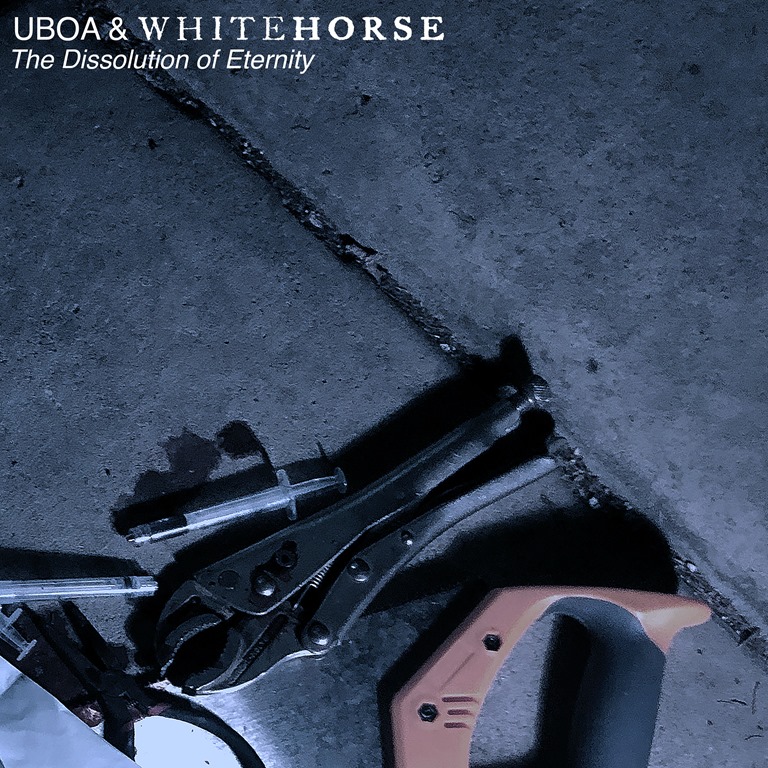
My appreciation of the split release is well documented among these virtual pages, and this colossus of a monstrous beast is exemplary of the perfect balance of the contrasting and the complimentary. It’s quite the face-off, pitched as a head-on crash where ‘Australia’s heaviest force of nature Whitehorse teams up with sonic chaos conjurer UBOA for a split album that crushes, scorches, and transcends. The Dissolution of Eternity is not just an album, it’s a seismic rupture’. Yes. ‘A seismic rupture’. It’s a bold statement, bit one that’s hard to argue with, and the fact that this is getting a proper physical release on vinyl, cassette, and CD is something to get hyped about, especially the vinyl and cassette. The contrasts make the act of getting up and flipping the object an integral part of the experience, like an interval between acts at the theatre, or… well, really, like turning over a record. There’s no substitute for it when it comes to the elements of engagement with a physical release.

There must be something about bands with ‘horse’; in their name that plugs into a direct line to the world of heavy. Horsebastard, and the late, great Palehorse are just two example of UK bands who hit heavy, hard. And as for Whitehorse – not to be confused with Whitehouse, purveyors of extreme electronic noise – they are indeed as heavy as fuck. I’ll take their ‘heaviest band in Australia’ claim on face value, on the basis that ‘Wringing Life’ is almost seventeen minutes of grating, crawling, growling riff assault. It’s a heavy, harrowing, low-BPM sludge trudge, with the most choked, rasping vocals, buried low in the mix, sucking the oxygen from the air in dying gasps. The drum solo in the middle is punishing – sparse, slow, the cathedral-like reverb enough to make your head swim – and then the guitar and bass return lower and slower than ever. It’s bowel-trembling, rectum-quivering stuff, the sound of a slow, zombified clawing out of the cold damp sods: it’s the darkest, doomiest sludge imaginable. By comparison, ‘The Wait’, a mere seven and a half minutes in duration is a pop song. But it’s another crawler, its dingy riff mess strewn with feedback. This shit is so heavy it weighs down on your shoulders, your back, your lungs, just sitting in a chair listening to it.

File together Godflesh and early Swans and Oil Seed Rape and Sunn O))) and your halfway to the sternum-crushing weight of this.

Uboa’s noise brings a different kind of weight, and it’s compressed into shorter songs. When I say compressed, ‘Petplay Polycule Open Fire’ is a mere minute and forty-nine seconds of brutal, raging, clanging fury. It’s tempestuous, savage, demonic, a ravaging, brutal assault, and it bleeds into the gut-gouging morass of plunging, churning, amorphous noise that is ‘Wasted Potential’. Holy hell, is this dark and harrowing. You feel your innards slowly slump under its weight.

The theatrical piano of ‘Deamwalker, Fuck I Miss You’ certainly provides contrast, bit in terms of form and mood, and there’s a gloomy sadness which hangs over it before the darkening shadows gather at pace over the gloomy, semi-ambient ‘Pareidolia Shadow’, which reaches a sustained tempestuous crescendo that marries industrial with dark ambient and post-metal. The last track, ‘The Apocalypse of True Love’ is nothing short of a monster: clocking it at over nine minutes, it begins gentle, expanding synth ripples and surges, providing an atmospheric swell of sound, and you find yourself swimming, drifting on currents and tides… and then it expands in every direction, a surging blast of ambience ad noise and culminating in the most immense sustained crescendo… The final minutes are a slow, sloping comedown from the most all-encompassing blast that hits hard.

This release is quite something. It’s certainly loud. And it’s harsh, brutal, and unforgiving too. In short, everything we like – so this comes recommended.

AA
404158

4 Way Split, with its ‘does what it says on the tin’ title is the third release from Stoke-on-Trent label & promotion service Anti-Mind, and brings together Worm Hero, Sevenyearwaitinglist, GENDERISTHEBASTARD and Omnibadger.

Stoke-on-Trent may seem an unlikely location for an merging scene of all things noisy and gnarly, spanning grindcore and proto-industrial experimentalism, but you often find that with places a way off the beaten track, scenes evolve and thrive independently of national trends. 4 Way Split is a solid document showcasing the strange and heavy noise now coming from Stoke.

To accompany the release, they’ve unveiled a video of Worm Hero’s furious metal noise, which you can watch here:

The 29-track album will be available on CD and digital formats on the 5th of April from here:

a3093017813_10

Christopher Nosnibor

Digital release date: 18th December 2020

Physical release date: March 2021

Released as part of a series of collaborative releases between INA GRM and Editions MEGO, this is something of an unusual package, in that it’s presented as a split LP, but is also sort of two separate LPs. – digitally, they’re being released separately, but the vinyl version is split. Given the length of each contribution – in the 20-25-minute zone that neatly corresponds with one side of a 33rpm vinyl album – it makes sense, and certainly more sense than splitting a continuous piece in two over a 45rpm 12”, or the economics of a pair of one-sided albums.

Hecker – Florian, not Tim – contributes a work of ‘computer-generated sound with resynthesized situated texture recordings’. It’s a rumbling tempest of a composition, the crashing of digital waves against a hard shore of tightly-packed circuitry that rolls and thuds. A sonar pulse is rent by tinnitus-inducing drill-like whirr, and over the course of its twenty-five-minute exploration of toes and textures, Statistique Synthétique becomes quite a challenge – one that you may find yourself drifting from and struggling to maintain focus on at times, while at other wishing you could zone out a bit more instead of having an incessant buzzing and crackling piercing your brain.

I often find that with experimental instrumental works that do place such a strong emphasis on texture and that whole ‘cerebral sonic experience’ for want of a better phrase, that my mind does tend to drift while listening. It’s a challenge as a reviewer to critique something that’s so intentionally removed from the domain of overt musicality, or using a combination of music and words (or even not) to express or article something. Because precisely how does one engage with it – or, to consider another perspective, how is one supposed to engage with it? What does the artist want to convey to the audience, what kind of dialogue are they striving to create? Works like this certainly aren’t preoccupied with emotional responses or striking that kind of resonance that’s so integral to music with even the most vaguely ‘popular’ leaning. It’s not a matter of technical competence, at least in the sense of musicianship: there’s no breathtaking virtuosity on display in the world of electronics – and when I say ‘electronics’, I mean laptop and circuitry, not electropop or whatever. And so this is almost purely cerebral, and I’m forced to reflect on the way certain sounds, pitches, frequencies, and textures make me feel, what they do to me – how much treble and fizz makes me tense, how much s just quite exciting. Here, Hecker pushes all the buttons, literally and metaphorically, and I find myself twisting and turning in varying degrees of discomfort.

The objective, apparently, is to stove got ‘a properly hallucinatory state, that is to say to a meeting point where the object and perception dissolve into each other, in a sort of transcendental field.’ I might not quite be reaching that peak, but it certainly has some kind of effect.

Okkyung Lee gives us howls and yowls and overloading circuitry that bleeps and barrels, and of the two pieces, it’s the sharper, and more abrasive, and is also perhaps less nuanced. That’s no criticism: there’s a dense roar that tears from the speakers and there’s a tangible sense of volume. Everything creaks and groans and stammers, as if the equipment is about to buckle and blow under the weight of so much noise all at once.

This fits in context: Teum is intended as ‘a truly telluric moment’, the expression of ‘where tectonic movements and shear stresses become music’. ‘If the earthquakes were, as we thought in the 18th century, due to underground thunderstorms,’ observe the liner notes, ‘there is no doubt that this piece of music, both celestial and continental, could have been their audible manifestation’.

And there is no question that this is a musical work with a strong sense of physicality. The sound veritably heaves and shudders, a gut-lurching low-end heft you feel as much as you hear.

There’s a lot going on here, and there are – so it seems – some wild brass explosions rioting in the distance at some point amidst the churning sprawl. Again, this isn’t about emotional resonance, but how it touches and effects the listener on other levels.

These two works are distinct and different, both sonically and intent and purpose – and consequently, their effects are different too. But equally, the difference can be attributed to the different forms, and textures, with Hecker’s composition being sharper, more abrasive and, I suppose, more overtly ‘computerised’ than the denser, earthier piece by Lee. But for this, the contrasts are complimentary, and the two sit side by side and back to back nicely, and make for a perfectly-pitched double dose of discomfort.

AA

a3134891178_10

ChristopherNosnibor

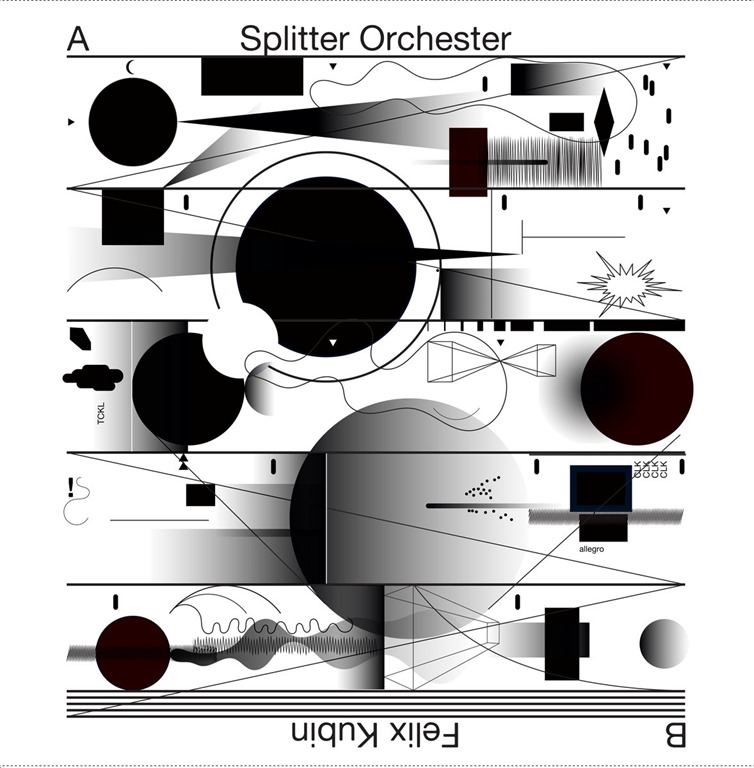
The split album seems to be in vogue again, and it’s a format which perhaps offers more scope for artists who don’t trade in punchy little tunes than the split single or EP. Shine on you Crazy Diagram may only contain four tracks and have a running time of just over thirty minutes, but it allows both contributing acts to showcase the range of their sound by presenting expanded, developed musical works.

The two tracks by Splitter Orchestra explore and examine weird digital percussion: the ever-shifting pitch creates the illusion of ever-shifting tempo (or does it? Perhaps the tempo does shift albeit subtly) beneath whistling contrails of feedback. They sputter and scrape and drone and hum. ‘Diagram 1’, at under four and a half minutes, is but a prelude to its counterpart, ‘Diagram 2’ which hums and wheezes for almost eleven minutes. There are rhythms in the mix, but they’re pinned back in the mix and bounce around against a shimmering backdrop of feedback and extraneous noise.

Kubin’s compositions are altogether less overtly structured, or at least rhythmic, as swampy swashes and thumps rumble and eddy before – from seemingly out of nowhere – faceripping blasts of distortion roar and blast. ‘Lückenschere’ is constructed around a clattering, shifting rhythm.

‘Lichtsplitter’ clatters and moans and hums and drones for an eternity, before stepping up about ten gars. By the end, one has a fair idea of what it just be like to stand within two feet of a Boeing 474 taking off.

This is, without doubt, one of those releases which lends itself perfectly to vinyl: it is, after all, an album of two halves. They compliment and contrast, and showcase two quite different sides of the experimental digital coin.

There’s a digital bonus track from the Splitter Orchester. ‘Diagram 3’ is a ten-minute extravaganza of thick, impenetrable hums and drones. It might not exactly change the complexion of the release, but it does unquestionably fill out and round off the intangible, non-physical format nicely.

Splitter Orchestra   Felix Kubin

Front & Follow – F&F044 – 8th July 2016

Christopher Nosnibor

With this release, Front & Follow inaugurate a new series of split cassette and download releases. The premise is that the artists are given a side apiece, and while the idea is that they’re encouraged to collaborate, it’s essentially down to the acts involved. This first ‘Blow’ release features a total of nineteen tracks, with ten from Hoofus, seven from IX Tab and a brace of joint efforts.

The ten Hoofus track are first, and if the titles, in their evocations of ancient lore, mysticism and history, seem at odds with the bubbling synth cycles which form their fabric, then it’s a reflection of the infinite contradictions which define Hoofus’ enigmatic sound. Shimmering, throbbing and needling, the scratchy, fuzzy tones cover the full sonic spectrum in infinite, iridescent hues. Occasionally sliding into unusual time signatures and oddly dissonant passages – the wonky keys of ‘Twentythree Seven’ shouldn’t work, but instead it’s rather magical – their ten tracks are beautifully weird, and weirdly beautiful. The notes roll and bend, wobble and warp, layering up to form a rich latticework. The effect is to create music that transcends music, enveloping the listener in a thick, pulsating aural blanket. It’s an immersive, multisensory experience, akin to how I would imagine simultaneously being under water and watching the Arora Borealis.

IX Tab’s eight tracks are quite different in tone: more overtly electronic, bleeping, swooshing and rippling notes scurry across one another in vintage sci-fi style. The dizzyingly hectic compositions are contrasted by sedate ambient segments. Samples – snippets of dialogue and lopped phrases – feature heavily, and there’s an overtly experimental air to the tracks. Trilling pipes and rattling chimes flit alongside woozy, opiate drones and church song. The nine-minute ‘The Herepath Comes Away’ is a magnificently expansive, atmospheric work, and something of a standout as it leads the listener on a curious journey of the mind.

The two collaborative tracks, credited to Hoofus & IX Tab, work precisely because they sound like a hybrid of the two acts. ‘The Ministry of Ontological Insecurity’ features sampled voices repeating the statement ‘I don’t believe in me’ (occasionally interspersed with variants ‘I don’t believe in you / him/ her / them’) over a drifting dark ambient backdrop fractured with incidental sonic incursions. ‘The Ploughs & Machines’, which closes the album also incorporates samples and woozy electro oddness with shifting time signatures to mesmerising and disorienting effect.

Individually and collectively, Hoofus and IX Tab have conjured an album that reaches for the outer limits and transports the listener to them and then beyond.


Hoofus   IX Tab