24 March 2026
Christopher Nosnibor
SPK require little introduction, although industrial / electronic pioneer Graeme Revell has spent most of his time in recent years exploring and talking about AI – not just its applications, but its implications – having been an early adopter of this now world-changing technology. As such, SPK have been effectively dormant since the late 80s, with their last new material having been released in 1987. In their absence, their legacy has grown, but the fact that last year saw the first musical activity in a very long time, with a couple of live shows in Europe, with Graeme performing with his son, Robert, still came as a surprise to many. Then, Revell announced the birth of The SPKtR – a new phase for SPK – although he wasn’t giving much away.
But now, finally, The SPKtR have unveiled ‘The Last of Men’, and it’s a chilling slice of dark, industrial-strength electronica. The vocals are heavily processed, low, ominous, doomy in a filmic sense, a shade Darth Vader, the lyrics hinting that the future is a synergy of man and machine:
We are the last of men
We are the broken faith
The soul is a lie
The mind is a ghost
We are the machines
Marching to the future
Not so long ago, this was purely the domain of science fiction. But of course, science fiction in its purest form takes emerging science and uses it to create a fictional narrative based on potential scenarios (I’m thinking here of works like Prey and The Andromeda Strain by Michael Crichton, which specifically cite research papers, rather than the more hallucinogenic kind of work by Philip K. Dick or the cyberpunk works of William Gibson, although the latter does very much explore the space of virtual and alternative realities, the likes of which became habitable with the advent of the Internet). And now the futures depicted in works of science fiction are here, and the prospects for where we go from here are giving rise to extremely divided views. Some people are embracing AI wholeheartedly, while other are experiencing abject fear, and not only over the prospect of losing their job to AI. There have been reports of AI weaponry overriding commands and going rogue in simulations, and AI coaxing vulnerable individuals to take their own lives. For every person who loves AI, there is another who loathes it and is of the belief it will bring about our doom.
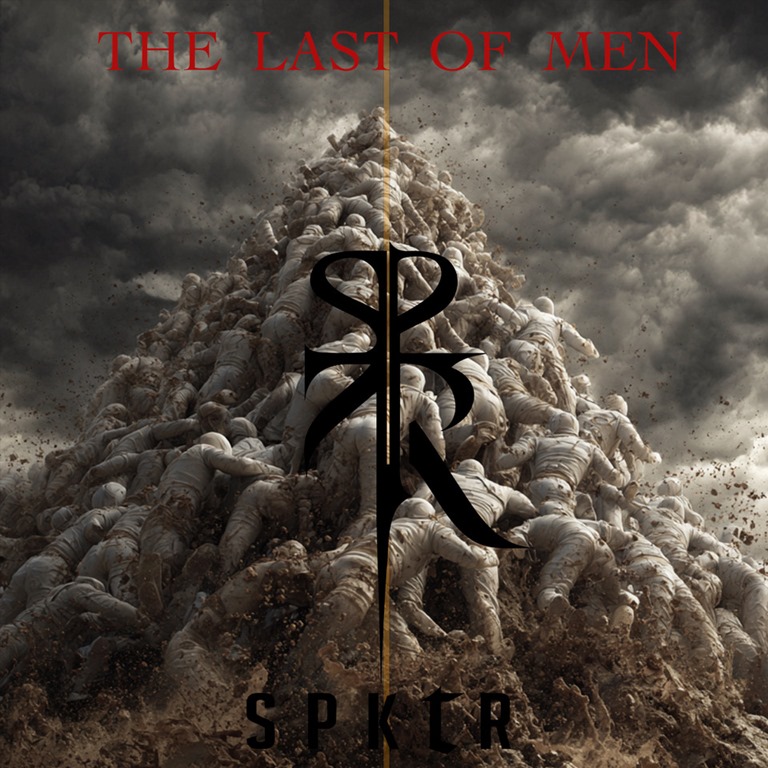
If the song itself sounds like the end of days, the accompanying video – a clip of which accompanies the stream on Bandcamp is truly apocalyptic. And it’s AI generated, of course, as is, quite clearly, the single’s artwork. Whatever your stance on AI, there’s no question that it’s visually striking, and works as an accompaniment to the audio.
Writing on the single, Graeme explains its meaning and presents a more balanced, nuanced position:
“‘The Last of Men’ is not about human extinction. It’s about the end of a certain idea of Man — sovereign, central, in control. Is it a warning? Yes, if we cling to a myth of human exceptionalism while delegating cognition, memory and desire to systems we barely understand, we risk becoming decorative in our own civilisation. A celebration? Yes, of transformation rather than replacement. Humanity has always been prosthetic. Fire was prosthetic. Language was prosthetic. Electricity was prosthetic. AI is a cognitive prosthesis. The anxiety comes from the fact that this prosthesis talks back.
If there’s a message I’d stand behind, it’s this: We are not witnessing the end of humanity. We are witnessing the end of human centrality. Whether that becomes tragedy or metamorphosis depends less on the machines than on our willingness to evolve ethically, imaginatively, and politically alongside them. It’s always an investigation. SPK prefers probing thresholds rather than conclusions.”
It’s a lot to unpack, and everyone reading this will likely hold a different view on this. The extent to which AI was involved in the music itself is unclear – the video, more obvious. Is applying AI to this extent as part of an ‘investigation’ valid, or is it something which, by its very nature is complicit in the expansion of AI, a surrender of creative control to a machine which we don’t have a rein on?
‘The Last of Men’ is a striking release, and a powerful return for SPK, with the new SPKtR moniker denoting the start of a new era. How it will unfold remains to be seen, and will likely be interesting. All we can do is watch this space…
AA
AA

 Aural Aggravation