It’s all been happening in the Eville camp since the release of their second single, ‘Messy’, back in June – and now they’ve been gathering advance airplay in spades for the follow-up, ‘Leech’. Again, produced by Jamie Sellers (best known for his work with the likes of Ed
Sheeran and Elton John), this offering sees them really step things up a few notches.
Whereas ‘Messy’ was grungy and melodic, ‘Leech’ is all fiery fury: the rapidfire clattering drumming and roaring guitars – and vocal howl – which kickstarts the song harks back to the point around the turn of the millennium, when Pitchshifter joined forces with Prodigy live guitarist Jim Davies to create a dance/industrial metal fusion and saw them find favour with the nu-metal crowd – and although their preferred reference points are more in the vein of Slipknot, for all the emotional rawness of the lyrics, there’s still a strong melodic edge to the vocals.
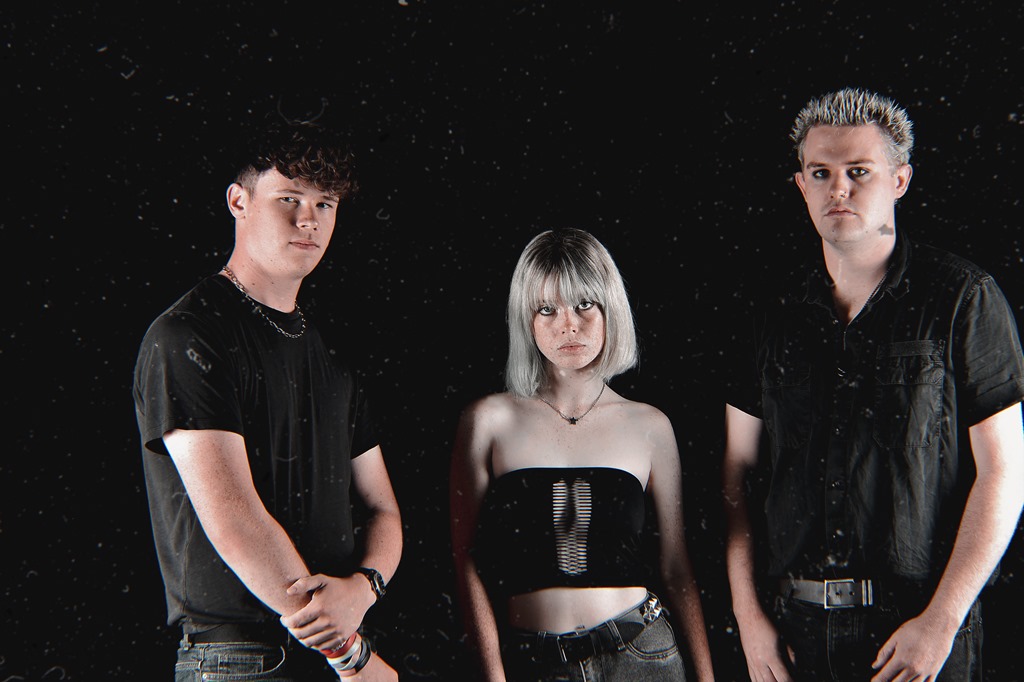
Eva Sheldrake has range, and a knack for delivering a hook, not to mention a monster riff, and in the company of Milo Hemsley (drums) and Billy Finneran (bass), the Brighton ‘brat-metal’ trio are a powerful unit. And as much as I’ve been digging the vogue for duos lately – a setup often born as much out of necessity as choice – and hearing how far it’s possible to push the most minimal format it’s possible to have and still be a band – there is something so classic about a trio. It’s because while maintaining all of the component parts, there has to be absolute focus, there’s no room for a weak element like an iffy rhythm guitarist, and no-one has anywhere to hide, but everyone has to deliver optimally. And when they do, the sum is greater than the parts.
“I hope listeners take as much from it as I did by relating through experience with inner
conflict and toxic situations that are hard to escape,” says Eva.
She certainly channels it, and hard, here. Eville are clearly no suckers, and ‘Leech’ is a killer tune that says this is a band with much promise.
Have I lost the plot covering such commercial stuff as this? No, not at all, and besides, plot is overrated, and this is an interesting one. Having built up something of a following since emerging a few years ago, Luna Aura’s latest EP release coincides with her touring as support for Slipknot Frontman Corey Taylor on his solo tour. If on the face of it, it seems like a surprising choice for such a pop-orientated act to bag such a slot, however big on guitars they are, Corey’s ubiquitous media of late in promotion of his second solo album has seen him really pushing to emphasise the fact that he’s a multi-faceted, genre-fluid songwriter.
I think I’ve been growing a newfound respect for him for this: he genuinely seems more about making the music that he enjoys than about being remotely cool, which is a far cry from the enigmatic masked presentation of Slipknot, where no-one ever knew who any of the members were for a long time. I always thought Slipknot were shit on every level, and I’d always suspected they were middle-aged record company execs donning boiler suits for some postmodern nu-metal equivalent of The KLF, only more calculatingly exploitative. I was wrong, but not completely off track. But it turns out Taylor’s had some high-profile feuds with the kind if people who warrant feuding with, although I digress. The promo rounds for CMF2 have been interesting, in that they show Taylor, aged 49, facing up to the fact that he’s staring directly at a point in life where his physical capacity is waning and frankly, he’s reached a point in his life where he doesn’t care about cool and just wants to do his thing. At 48, I find this far more relatable than an artist trying to remain relevant and be the voice of ‘youth’, like so many acts who emerged around the turn of the millennium, not least of all so many punk-pop acts who are old enough to be grandparents to their target audience. But also, credit due for giving a young, up-and-coming female artist the exposure instead of some predictable all-male band.
Perhaps unsurprisingly, half of Luna’s EP has already been unveiled as video singles, because that’s how it works now, but regardless, hearing all five songs in sequence is what this is about, and over the course of five songs, we get a sense of Luna’s range and what she’s about.
It’s hard to evaluate new music from new artists that resembles the new music by new artists that was emerging when I was at the same point in my own life. As a teen in the 90s, it didn’t only feel like the most exciting time in music ever, but it felt like our generation had something of its own and something that spoke both to and for us. This was our punk, our new wave, our new romantic. I may have been aware of and listening to new romantic and electropop as it emerged, but at the age of maybe eight or nine, I can’t claim it was for ‘me’. Grunge and the alternative music of 92-94… that was different. On the one hand it seems unusual that a generation behind should revisit and reclaim it. But after a wilderness spell of shit mass-produced r‘n’b and a truly dismal decade socially politically, and all the rest, it makes sense that this should once again reflect the zeitgeist.
But something has changed. There has been a shift. Not only has life in general got shitter, but technology and social media have changed everything. Attention spans have shrunk, and that’s a fact. When it comes to music, you’re got maybe ten, fifteen seconds to make an impression (although an article published earlier this year suggested it was as little as five seconds – but interestingly, the study showed listeners tended to like a song more if they listened to the whole thing first, rather than just being exposed to just a clip).
In this context, it’s obvious why ‘Money Bag’ is the first track and why it was the first single: it’s uptempo, guitar-driven and punky and blasts in, all fuzzy guitar, and arrives at the hook in under a minute. It’s a promising start. Savvy songwriting for attention-deprived times. The guitar is up-front, overdriven, gutsy. But the chorus goes for the bubblegum vacuous style, with an airy ‘woo-hoo’ at the fore. It’s popular right now, and it’s a winning formula, but it just gets on my tits because it feels like a lazy stab at a radio-friendly hit without actually writing a lyric. And it often seems to work. Well, for some people: not for me, really.
But after this obvious start that’s probably only weak in my view, the majority of the rest of the EP is pretty solid. ‘Lost in the Fiction’ is smoother but no less guitar-based, and with an overtly digital feel, it slots in comfortably alongside Garbage sonically and stylistically.
Blind? Bland would perhaps describe this derivative turn-of-the-millennium alt-rock bounce-along that’s Avril Lavigne and Natalie Imbruglia and Alanis Morrisette all rolled into one, which isn’t the worst thing, and it’s neatly crafted, but you can’t accuse Luna Aura of being predictable or one-trick. ‘Candy Coloured Daydream’ is an explosion, with a monster hook and killer chorus, and ‘Cut and Run’ closes in kick-ass style, with an opening riff that’s pure Nirvana before adding a 90s shuffling drum groove and more driving guitar. The Fiction EP is grunge for the 21st century – it’s perhaps more melodic, but it’s got attitude and you can mosh to it. And that’s more than reason enough to say yeah.
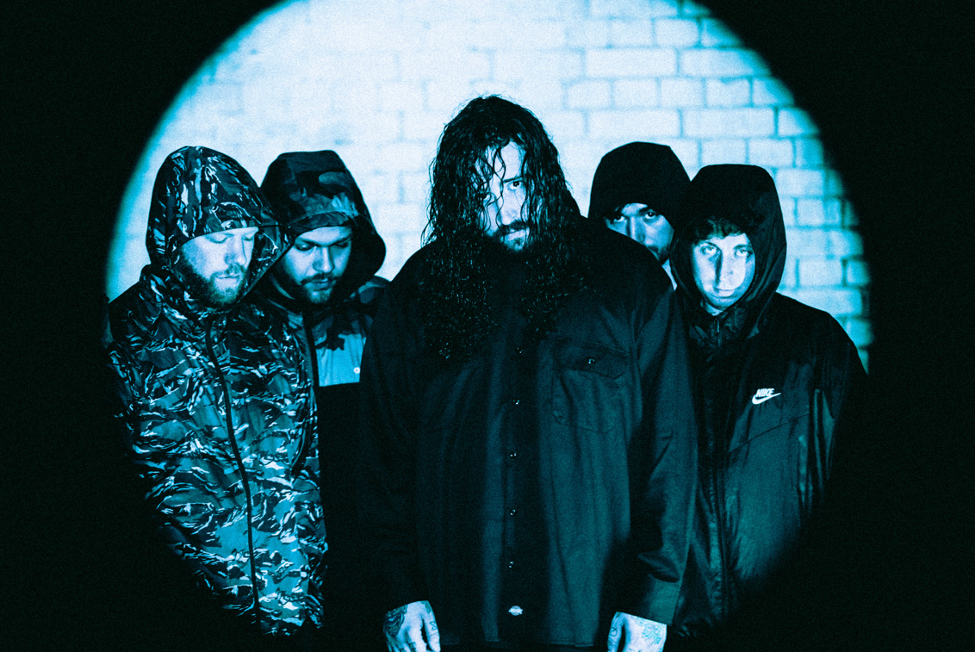
"White Noise is about sensory overload and the overwhelming feeling of claustrophobia that neurodivergent humans experience on a near daily basis,” explains lead vocalist Harvey Freeman. “It’s a horrible feeling of helplessness and anxiety that nothing can really help other than a quiet space and something to take your mind off of the situation.
We wanted to create something visually that could portray how that experience feels. The room used with the exposed hole in the wall was the perfect fit paired with the mirrors in particular scenes. We wanted it to almost look like you were inside the mind of someone going through that feeling."
Mixing moments of snarling nu-metal aggro and the scalding fury of Slipknot’s debut album with instrumental passages that at times recall the genius of Nine Inch Nails’ Trent Reznor, is where they have nailed the Graphic Nature sound.
 Aural Aggravation