Posts Tagged ‘Remastered’

17th December 2024

Christopher Nosnibor

It’s inevitable that with the sheer volume of music in existence, there will be a fair bit which bypasses even the keenest enthusiast of the obscure. Trek and Quintronic is a pairing I feel I really ought to be familiar with. Emerging in 1980 Paul Wilcox (Trek) and David Kane (Quintronic) recorded two albums, noted for pioneering ‘electronic rock’, with Landing in from 1980, and the self-titled follow-up Trek w/ Quintronic LP the following year, created using an array of synths, plus pedals and six- and twelve-string electric guitars. There was a reissue, entitled Landing Plus, released in Europe in 2012 and the US a couple of years later, which featured the entirety of Trek w/ Quintronic and a couple of additional cuts by way of the ‘plus’, but twelve years on, it’s not exactly easy to come by, and this new release offers something quite different, featuring as it does ‘9 of the original Tw/Q tracks plus 11 new, never released songs written by Paul Wilcox, spanning a period of 40 plus years, all remixed and remastered.’

This means that some of the material was recorded after their second album, without seeing the light of day, while some of the contemporaneous recordings have been flaking away on old tapes since 1980 or thereabouts, and their restoration and repair has been quite an undertaking, achieved quite remarkably by David Lawrie of The Royal Ritual. The aim, as they state on the website, was to ‘present the definitive collection of the best of Trek with Quintronic’, and containing some twenty tracks, this is a wide-ranging, and in-depth summary of their work – and it’s often the case that musical careers consist of considerably more than the material that was released at the time, for whatever reasons.

That ‘You Might be Lonely’ and ‘As We Sing’ first appeared on Landing makes this a truly career-spanning document, which showcases the full span of their musical vision and innovation. It’s often easy to forget just how new to the market (affordable) synths were at this point in time. The advent of 80s synthpop and industrial music came about as a result of the emerging technology, which also, notably, included drum machines. It was a revolution.

There’s a gothic, church organ feel to the introduction, and its grandeur also makes a nod to the prog past of the pair, but it’s listening to ‘You Might be Lonely’ that the span of their influences coupled with the use of the kit at their disposal becomes apparent: it’s like Hawkwind but with synths, both rumbling and swirling and with additional laser blasts and primitive drum machine knocking out a metronomic rhythm, all coalescing to provide a backdrop to a vocal delivery that’s an overt Bowie rip.

The Bowie influence looms equally large on the glammy ‘All the Rave’, only here with the addition of sweeping string sounds. It sounds remarkably fresh, as well as prefacing – by a long way – the trend for orchestral flourishes which would be a big thing in the late 90s with, and winding up with a big, flashy guitar solo. It’s visionary stuff, and the execution is remarkably sophisticated, particularly for the time.

Some of the songs sound more of the era: ‘Zolian Space’ lands somewhere in the region of OMD and Ure-era Ultravox, but it’s a nifty enough pop song. There are a fair few of those on offer here, not least of all the bouncy Suicide-meets-Bowie ‘White Hoods’, and the hyperactive twitch of ‘Twin Forces’.

The guitars are to the fore on the previously unreleased ‘Built to Average’, hinting perhaps at one of the many directions they could have veered. It’s a solid tune, but coming on like a collision between Bauhaus and Mr Mister, it’s dated more than some of the other material, whereas, in contrast, the spiky ‘Wally And The Rich Kid’ is pure vintage yet still more impactful in its stark, dramatic stylings.

Some of – what at least I assume to be – the later material stands out because it sounds different: ‘Religion’ is slicker, the drum machine in particular more ‘real’ sounding, and in a way it tells a story of technological advancement and its effect on music-making. Objectively, it sounds better, in terms of clarity, fidelity, separation, but for everything that’s been gained, something has been lost, and it’s something that using emulators or even vintage gear can never fully recapture. There was an unmistakeable zeitgeist about the ‘79-’82 spell, which was unique, and Trek with Quintronic were right there and probably didn’t even realise at the time. No-one did, really.

Hindsight really is everything. Stranger Than Today is an outstanding compilation which goes beyond in providing a hitherto unseen insight into the context of their groundbreaking second album and beyond.

AA

a3920472662_10

Metropolis Records – 23rd August 2024

Christopher Nosnibor

Even at their commercial peak, PIG releases weren’t all that easy to come by, at least here in the UK, despite some of them being on big labels with big distribution. PIG – the project of London-born Raymond Watts – is an act which can legitimately claim to be big in Japan while largely unknown at home.

My own first encounter was seeing them support Nine Inch Nails on The Downward Spiral Tour in Wolverhampton in 1994. I was in the middle of my A-level exams, but no way was I going to miss NIN. I didn’t even know who the support were, but witnessing the heavy grind of PIG, with pigs’ heads on poles at the sides of the stage, as their lanky singer writhed his way through a gritty set was an absolute revelation. The set’s opening song stuck with me, but it was some years before I would actually source a copy of Red Raw and Sore, on this new site called eBay. The debut album, A Poke in the Eye…. With a Sharp Stick and the ‘Sick City’ 12” were fairly easy to find at record fairs around 1994, as Wax Trax! vinyl was available in abundance, and often cheaply, too, but anything else? Pretty much impossible to find. And so it was that PIG felt like a near-mythical act, and despite having played these big shows with NIN, still no-one was really aware of them.

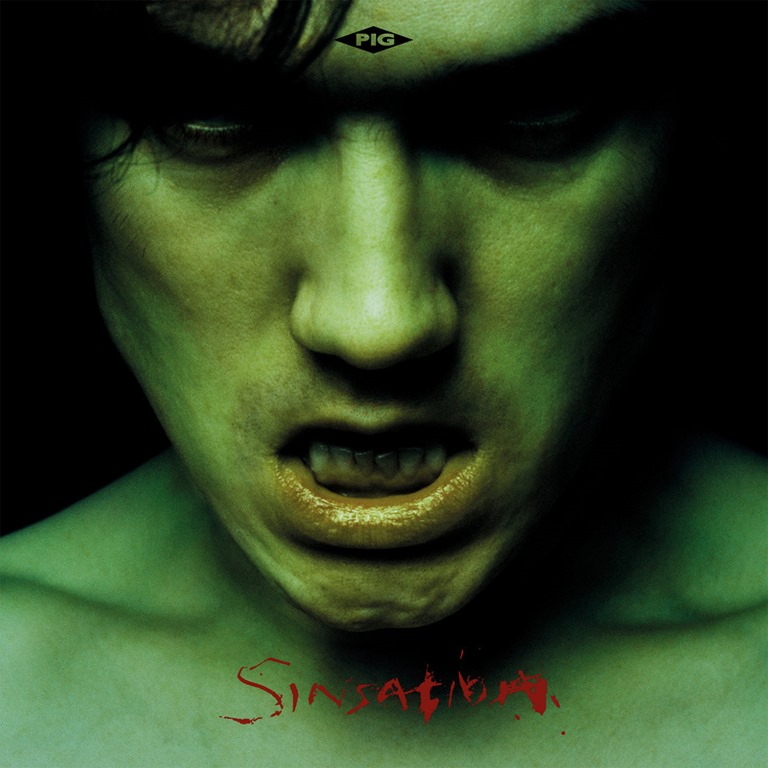
Sinsation was released first in Japan in 1995, and a year later in the US, and on learning of its existence, I got my local record shop to order it in, but had to wait literally months for it to arrive on import. Oh, but it was worth the wait. It delivered all of the theatrical pomp that defined A Stroll in the Pork, but cranked up the dirty industrial guitars and found Raymond Watts in top form with his extravagant wordplay. In short, it reset the bar, not just for PIG, but for what ‘industrial’ music could be. This wasn’t just hard and heavy, but also playful, witty, intelligent, and still dark, seething.

The cover alone is striking. Watts’ image is a standard feature on all PIG releases, but whereas more often than not he is depicted looking buff or brooding, the sickly green hue is unsettling – and slamming in with a series of orchestral strikes and a low, grumbling bass before hitting full-on industrial anthem mode on the first track, the six-minute ‘Serial Killer Thriller’ (the chorus of which provides the album’s title), it’s immediately apparent that Sinsation is something special (and not something sad…).

Admittedly, despite this being an album I’ve played to death over the last thirty years, apart from a few tracks being a few seconds different in their duration, I can’t discern any huge differences between this remastered version and the original: there are, perhaps, more details revealed in the mix, but then, the production on the original was impressive, and again, I’ll come back to that word, ‘detail’. There’s a lot happening; samples, snippets of bits and bobs, strings, multi-layered vocals… A touring member of Foetus early in his career, with JG Thirlwell involved in the early singles and debut album, Watts clearly learned much from Thirlwell, as well as his early involvement with KMFDM. Sinsation felt like the point at which he brought these two aspects together in perfect balance while simultaneously realising his own unique sonic vision. The result was a set of hefty, driving songs, exploding with ideas and noise, and so many layers, so much going off all over the place. It was bold, audacious, and while it’s easy enough to say that it’s a bit Foetus, a bit KMFDM, it goers so far beyond these points that comparisons are a diminishment of Watt’s achievements here.

Sinsation is certainly the first PIG album to showcase the full range of styles and compositional aspects Watts has in his locker, and as such, represents something of a creative peak.

While nominal single ‘Painiac’ (an early version of which was the lead track on a Japanese-only EP, and a video for which got a few spins on MTV on the album’s release) is a throbbing industrial beast of a tune, ‘Golgotha’ is a dark, semi-ambient interlude which sits between the driving snarl of ‘Hamstring on the Highway’ and the swaggering industrial-strength glam-tinged gospel-infused dark pop of ‘The Sick’, which would provide the blueprint for the PIG renaissance which started with The Gospel in 2016. ‘Analgesia’ is a magnificently atmospheric piano-led instrumental which incorporates elements of ambient and electronica and extraneous noise ‘Volcano’ is serpentine and sleazy, with some audacious orchestral work in the mid-section which take the bombast of Foetus’ Nail to another level, while ‘Hot Hole’ drives hard and heavy with pulsating electronics colliding with hefty chugging guitars and ferocious beats.

For the many who likely missed this the first time, this re-release provides the opportunity to make acquaintance with one of the definitive PIG albums, and for those already familiar, it’s a timely reminder of the incredible journey that has been PIG’s career to date, while offering the first chance to get it on vinyl. Almost thirty years on from its first release, Sinsation still sounds phenomenal – insanely ambitious, utterly deranged, and in a league of its own, quite unlike anything else before or since, even within the PIG catalogue.

AA

a2059987689_10

Keplar Keplar – 3rd March 2023

Christopher Nosnibor

However much you think you know about music, there is always more to learn. And so it transpired that Holo was first released in 1998 and is ‘one of those rare records that managed to carve out a niche of its own while also building bridges to variety of genres like Chicago-style post-rock, the ambient mysticism of projects like Rapoon or the music made at the intersection of shoegaze, and electronic music in the late 1990s.’

Where have I been? Living in a cultural vacuum? Hardly. And yet this is my first encounter with KILN. And I’ve not heard of Rapoon and have no knowledge of Chicago-style post-rock either. Chicago house, I’m aware of, but… well, I daresay I’m not alone, and so this reissue off Holo may well prove to provide an introduction, and an entry point to the trio’s supposedly niche-carving brand of ambience.

It’s an album that’s rich in detail and texture, from clanking, clattering tin can percussion and big sweeps of amorphous sonic clouds that wash and crash in waves.

It’s hard to decipher precisely what’s what – is that a didgeridoo or just a digital drone? It’s impossible to unravel the layers and determine the individual sources as glugs and gurgles slide in between soft dulcimer-like notes and easy beats that bubble between all kinds of textures and tones which drift and slide and groan and drone in and out of the ever-shifting fabric of this fascinating album. Guitars and extraneous sounds flit and flicker in and out while instant drums nag and boom. At times it’s new age, at times it’s more tribal, and Holo pushes ambience in numerous directions.

There are segments – interludes, breaks, fragments – where this is a catalogue of challenging source materials melted together. At others, it’s altogether less challenging and simply washes of you in a soft breeze.

For an album that’s so chilled, there is much happening on Holo¸ and as much as it is an album to chill to, first and foremost it’s an album to explore.

AA

KeplarRev13LP_front

24 April 2021

Christopher Nosnibor

The title is pretty much a summary of this release: a collection – or compilation – of works by dark ambient act In The Absence Of Words. It’s the first of two volumes, and draws on their seventeen previous releases (discounting the 2020 ‘reworked’ version of III (originally 2017).

There are a lot of numerals to assimilate here – which is a point of interest given that the man behind In The Absence Of Words is a copywriter by day, a person who spends the majority of their time immersed in the formation of words in order to convey specific information. The craving for some time away from words is one I can personally relate to, and is one of the reasons for my pursuit of a musical project centred around noise and abstraction. We all need a break from the dayjob, and for a writer, that headspace comes not from time out of the office in the gym, but from something not only devoid of words, but which blanks out words completely, and covers over the internal monologue and that inner voice, whatever it’s saying, to wash away and cleanse the mind of words, if only for a short while.

A Collection I may assemble six compositions from a vast and swiftly-built catalogue, but it’s explicitly not a ‘best of’ intended to shift units of back-catalogue: instead, it’s a carefully-curated project where the pieces have been, as the liner notes explain, ‘carefully selected to complement each other and to create a single immersive listening experience. Each track was originally released individually on Bandcamp between 2017 and 2019 and each has been remastered and assembled specifically for this compilation.

As such, it’s less about singling out individual pieces and immersing oneself in the holistic experience, allowing oneself to simply take the journey and observe the landscape, absorbing the sights, sounds, and scents. That said, there are clear distinctions between the tracks, and these very much signpost the route from beginning to end.

As such, some notes on the passage seem appropriate, in the same way one may jot down observations from any other journey, and ‘The Meeting Point’ undulates slowly, and I’m reminded of the tranquil ripples of Prurient when they’re not devastating the ambience with a blitzkrieg of white noise and distorted vocals.

The seventeen-and-a-half minute ‘Suspension of Belief’, originally featured on debut I back in 2017 isn’t discernibly different, but swells and groans out a textural rinse that rumbles and rolls on and on, its churning grind becoming quite uncomfortable over time.

Much of the album is soft, cloud-like, with sonorous, billowing drones changing shape and form often but subtly over time, and while the second half of the album feels less varied in terms of both texture and tone, the way the individual pieces melt into one another to create a extended sonic space in which it’s possible to relax and empty your mind is credit to the artist for his selection and sequencing of the material to render such an experience.

AA

A Collection I

Neurot Recordings – 2nd August 2019

Christopher Nosnibor

The best collaborations are greater than the sum of the parts, and transcend 2 + 2 = 4 equations of artists playing to type while rubbing up against one another in a predictable fashion. We often hope for more, but artists seldom really deliver.

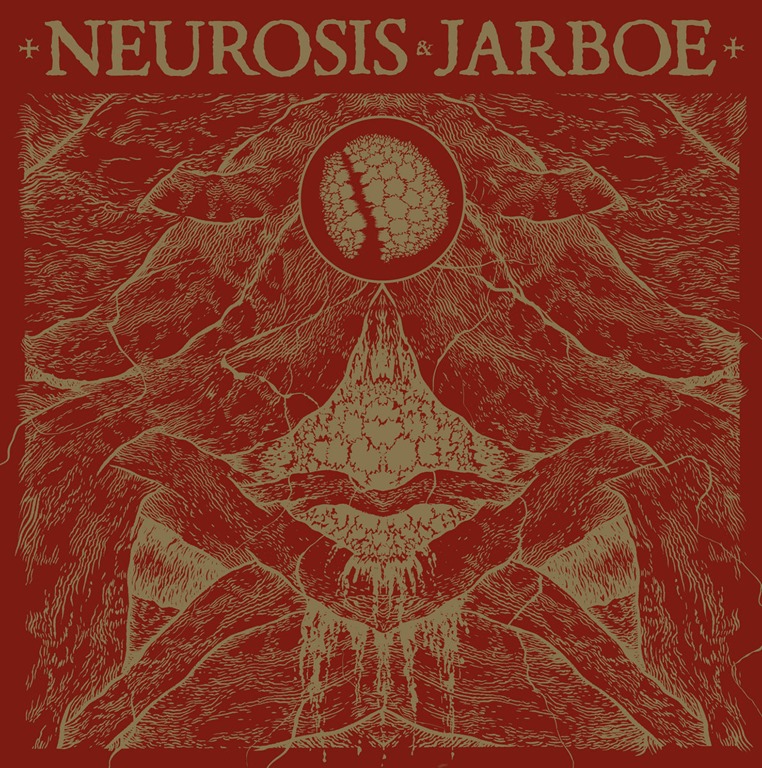
The self-explanatory Neurosis & Jarboe, originally released in 2003, now fully remastered and with entirely new artwork from Aaron Turner, and available on vinyl for the first time sounds neither like Neurosis nor Jarboe, nor 50/50 Neurosis and Jarboe, but something that draws on the best elements of both to forge something very, very different.

The lugubrious slow grind of Neurosis is present in the low bass churn and the more ethereal elements of Jarboe’s vocals, which have brought grace to Swans since 1986 and her own solo work over a good two decades now. Both artists’ work has a certain timelessness about it.

In context, this is both noteworthy and, if not exactly ironic, a point of cognitive dissonance. In my head, 2003 is recent and this reissue is shockingly close to the original release. But this is the point at which the passage of time and its acceleration comes screaming in my face to remind me that 2003 was sixteen years ago. There are kids who’ve been born and are now of a legal age to raise families and to vote since the album was first released, and yet Swans calling it a day the first time around in ‘96 with Soundtracks for the Blind still feels quite recent. How is this album sixteen years old? Nostalgia isn’t what it used to be, and Neurosis & Jarboe has very much stood the test of time, largely because it doesn’t sound quite like anything else.

‘His Last Words’ is perhaps the most overtly ‘modern’ cut on offer, and after a slow guitar grind, hits a groove that straddles dance and psychedelia. But there’s a deep, dark atmosphere that creeps over this and the album as a whole, with the majority of the tracks stretching out beyond seven minutes and pushing repetitive motives which worm their way under the skin and penetrate the skull by means of sonic bludgeoning.

The nine-minute ‘Erase’ brings some heavy, emotion-wrought doom-country with a distortion-tinged vocal that alludes to a dirgy Come, with Jarboe sounding more like Thalia Zedek in the song’s early minutes before the anguished howl emerges, culminating in a throat-tearing, raw-spewing roar by its uncomfortable climax.

Then, ‘In Harm’s Way’ recreates the woozy two-chord grating attack of early Swans when they were at their most gut-churningly jarring and abrasive, and it hits hard.

So why remaster, and why now? What does it add? According to Steve Von Till, ‘We recorded this ourselves with consumer level Pro Tools back then, in order to be able to experiment at home in getting different sounds and writing spontaneously. The technology has come a long way since then and we thought we could run it through better digital to analog conversion… This new mastered version is a bit more open, with a better stereo image, and better final eq treatment’.

And because they got Bob Weston of Shellac, and engineer at Electrical Audio to work on it, it does sound bloody great and lands with maximum impact. And the new artwork’s rather nice, too.

AA

Neurosis and Jarboe

Young God Records

It’s perhaps too much to convey the experience of hearing Soundtracks for the Blind for the first time on its release in 1996. Admittedly, hearing any Swans release for the first time was memorable – I was introduced in the late 80s via Children of God, which, aged 17, was unlike anything I had heard before. It was what one might call a pivotal moment. I was compelled to explore their back-catalogue, which yielded a succession of further pivotal moments, not east of all on the discovery of Cop.

For all its length, The Great Annihilator was pretty straightforward, and represented a continuation of the White Light / Love of Life albums. Just a year later, Soundtracks for the Blind was altogether different, and represented a new expansion on all levels. It was about three hours long, for a start. The third song was over a quarter of an hour long, and there were extensive instrumental passages that bordered on ambient. Elsewhere, reworkings of older songs, bent almost beyond recognition (‘YRP’ and ‘YRP 2’ emerging from ‘Your Property’ from 1984’s Cop), surfaced amidst the churning soundscapes drawn from the contents of the library of tape loops and found sounds gathered by Michael Gita over the band’s whole career. It felt like the culmination of a lifetime’s work. It felt fitting it should be Swans’ final studio album, and it seems appropriate that its remastered reissue should arrive when Gira has again called time on the band. Its arrival gives us cause to reflect on the cyclical nature of the band’s career, and the differences and similarities between their first unbroken span and their later incarnation, which closed with another uber epic in the form of The Glowing Man and followed by a live document (as Soundtracks was accompanied by the conclusive Swans are Dead, so The Glowing Man was accompanied by Deliquescence).

This is the first time Soundtracks has been released on vinyl, and naturally, its formatting and packaging is something else: as the press release and Young God website detail, ‘the vinyl package will consist of four LPs in jackets enclosed in a box with a poster, insert and download card. The box set will be a limited edition of 4,000 copies worldwide and once sold out will be followed later in 2018 by a gatefold LP version. The album will also be reissued on CD featuring a repackage of the original digipak for the 1996 Atavistic release plus a bonus disc of the contemporaneous Die Tür Ist Zu EP (a German language version of some of the material from Soundtracks that also includes unique material) recently released for the first time on vinyl in the USA for Record Store Day 2018. Outside of the USA, Die Tür Ist Zu EP will be released as a limited edition companion piece double vinyl set, also on 20th July’. Yes, as with the previous reissues, they’ve gone all put to render a truly definitive edition.

Listening to Soundtracks now, it seems that Gira, having declared the band spent in 1997, spent a long time cogitating over the directions and possibilities that this album presented, and took them as the starting point for the post-millennial iteration: it certainly shares more with this period than its predecessors, with exceptions like ‘The Yum Yab Killers’ which delivers the same kind of punch as ‘Mother/Father’ on The Great Annihilator (and recoded live, with somewhat muffled sound, it still seems a shade incongruous in its inclusion here, although Jarboe sounds so fucking fierce I’d not want to make to big a deal of it). We’re reminded, too, that Soundtracks emerged during a fairly prolific spell for Gira, and it’s perhaps inevitable that elements of other projects – namely the solo album Drainland and The Body Lovers / The Body Haters. ‘All Lined Up’ is a different version of ‘I See Them All Lined Up’ which featured on Drainland. It’s simultaneously more distorted and weirded-out, and more explosive, more driving, more… Swans.

Some of the rambling monologues are quite disturbing (with recordings of Gira’s father talking about his life and excerpts from FBI tapes, amongst other things), but then so is the musical accompaniment that provides the backdrop: ‘I Was a Prisoner Inside Your Skull’ and ‘How they Suffer’ make for uncomfortable listening.

There are some incredibly tender, raw, emotive moments: Gira’s voice, cracked and plaintive on ‘Animus’, as woodwind bursts around him from a hovering hush, is one of Swans’ most affecting moments. For a band whose back catalogue contains some of the most intense sonic brutality ever committed to tape, it’s quite a contrast, and perhaps all the more moving in context.

It’s a sprawling expanse of sound, and it isn’t entirely cohesive. Gira’s conception of sound as something malleable and his approach to dynamics would evolve immensely in the time away from Swans, and as such, Soundtracks is as much a signpost toward the next phase as a bookend to the one it belongs. At the time, it was almost too much to digest. On revisiting, the same holds true. The density of both sound and ideas, the sheer scale of the album, the fact that it condenses fifteen years into two and a half hours… of course it’s too much to bear. This was always the way with Swans: even their gentler albums are delivered with an intensity that transcends words. And this, of course, is the ultimate objective of music – to touch body and mind in ways that are beyond any form of articulation. Soundtracks for the Blind doesn’t simply touch those parts, but poke, prod, squeeze and stab at them.

AA

soundtracks_grande