Posts Tagged ‘Not Applicable’

Not Applicable – 23rd May 2025

Christopher Nosnibor

For about five minutes, AI looked like it may provide some entertaining diversions in terms of creative potentials. It wasn’t so long ago that it produced glitchy, idiosyncratic writing and wild art that was so wrong it was hilarious, and lame synth-loop electronic music which had neither style nor substance. It didn’t look like the threat to humanity that dystopian sci-fi novels had portrayed.

But then more information began to emerge about how AI was ‘learning’ by essentially stealing from all available sources. AI is the worst plagiarist imaginable, and nothing is safe or sacred. Then there came the reports of the vast amounts of energy, and water, required to power it, and it started to look like AI will doom the planet by sapping its resources instead of going rogue and obliterating humanity. But then…AI evolved, and fast. In no time at all, people stopped having additional limbs and appendages, the writing transitioned beyond repetitious babble, and people have begun to use to AI chat as a substitute for expensive therapy, despite reports of rogue AI advocating suicide… and as its usage accelerates and it morphs into the nightmare of sci-fi dystopia we’d dismissed just a few months ago, so the use of energy and water increases exponentially. One way or another, it does now look very much like AI will finish us.

And so there’s a certain discomfort in approaching Put Emojis On My Grave by the spectacularly-monikered Ancient Psychic Triple Hyper Octopus, an album which is sold on the way it ‘boldly explores AI and improvisation on an album of freely improvised, experimental electroacoustic music’.

It features, as the press notes put it, ‘a new lineup of celebrated, British musicians’ (Alex Bonney (trumpet, bass recorder, Strohviol), Will Glaser (drums and percussion) and Isambard Khroustaliov, aka Sam Britton (electronics), and ‘ claims to forges ‘a new musical language’, with an album ‘which eschews traditional musical composition, seeks instead to “adopting the language of AI’s deep learning failures and glitches”, attempts to imagine how AI could make a positive contribution to the creative process’.

It’s hard to know how to really assimilate this. The six compositions which make up Put Emojis On My Grave are fine examples of exploratory jazz, with wandering trumpet tooting in meandering lines across clanking, clattering abstract percussion which sounds like cutlery and wind-chimes being knocked about while bleeps and bubbles interject seemingly at random. It has that avant-jazz, experimental, iprov feel which is in some ways quite familiar in its own strange way. That is to say, while it’s niche, the sonic experience is very much representative of a certain field. A field filled with jackrabbits, apparently.

‘Goats on Helium’ is bubbly, bibbly, scratchy, scrapy, wheezy, groany, a splatter and clatter of sounds piled up and colliding all over, and it gets pretty messy over its six and a half minutes. Warping drones and scratching, gargling abstract drones twist around deranged brass tootlings and crashing cymbals on ‘The Adiabatic Flux Differentials of the Id’, and I would challenge anyone to find a title that’s posier, more wankily intellectual than that this year. And while it’s a bit jazz-jizz in places, it’s certainly better than the title suggests.

This is, in my opinion, a fair summary of the album, a work which is concerned with space and time – not outer space, but inner space, the space which our minds explore in reflection like the clatter of 1,000,000 bongos, the space – or distance – between concept and execution, and virtual space, those our other selves occupy, both in the moment and, subsequently, leaving echoes and traces in infinite corners of the virtual world. It’s impossible to discern where the musicianship cedes to AI intervention here, which is certainly in its favour – and if Put Emojis On My Grave is used to train generative AI, then it could confuse it for a while, making for some interesting results. And Put Emojis On My Grave is certainly interesting.

AA
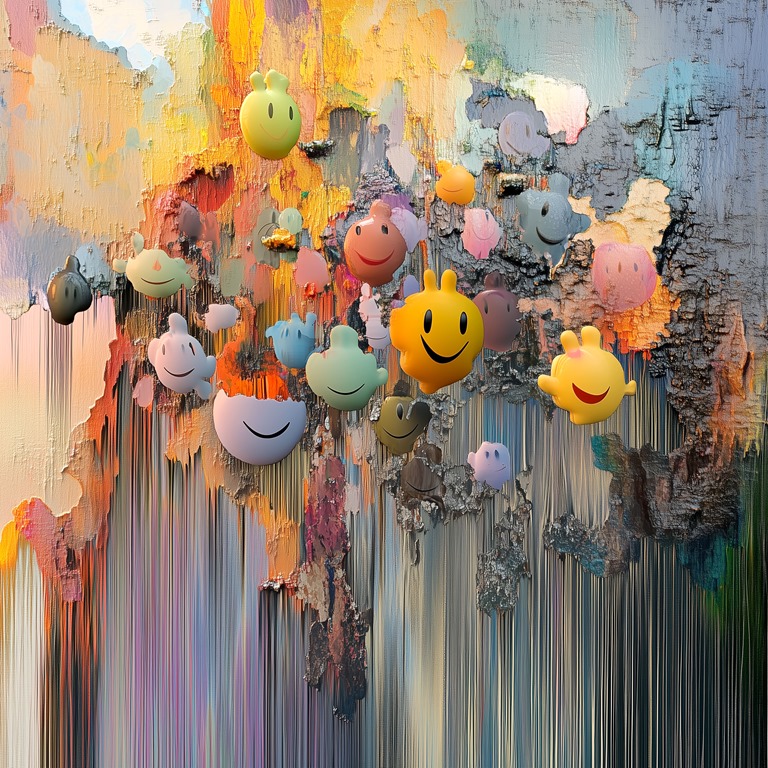
Ancient Psychic Triple Hyper Octopus – Put Emojis On My Grave cover 4000px

Not Applicable – 16th February 2024

Christopher Nosnibor

What we’re given to expect from this three-way collaboration is ‘an album of explorative, freely improvised electroacoustic music by an acclaimed trio of acclaimed genre-defying musicians’. I can’t help but blame the music press – as was, rather than the broken skeleton of what remains of the music press – and streaming algorithms for the obsession with genre. One could probably take it as far back as to the 50s when the press was all over this shocking ‘Beatnik’ counterculture, but to consider more relevant and recent history, ever since the ‘goth’ tag was applied to a fairly disparate selection of post-punk bands – and their fans – categorisation has been the method by which to both shortcut detailed analysis and to market acts. The groupings rarely make sense, or at least never did to me. For example, I loved Nirvana, but had absolutely no interest in, say, Soundgarden or Pearl Jam, who lacked ant of the elements I loved about Nirvana, and to my ear weren’t especially grungy. Bauhaus and the Sisters of Mercy have nothing in common beyond there being an arch, art aspect to their work, and the idea that both Throbbing Gristle and Ministry are ‘Industrial’ is absurd (and while I get that ‘industrial metal’ may be the distinction when considering Ministry, Pitch Shifter, etc,. it’s never rendered any more clear than when the term ‘hardcore’ is used. Many acts claim to be ‘genre defying’, but so few are. That said, the very function of the avant-garde is to defy genre, to smash preconceptions, to push boundaries, to do something different. In the Gloaming, remarkably, is something very different, and is truly ‘genre defying’.

It’s often intriguing to see just what players of such an unusual selection of instruments will produce when they come together and set out with the primary purpose of seeing what happens. Lothar Ohlmeier’s bass clarinet, Isambard Khroustaliov’s electronics, and Rudi Fischerlehner’s drums make for an interesting lineup, and sometimes, even the most experienced musicians will come together and create sound, but it doesn’t really gel. This is most certainly not one of those instances.

The album contains six pieces, and they each explore subtly different musical terrain, seemingly with all participants working on the understanding that less is more. There is a lot of space in which they all breathe and step back from soundmaking to allow the atmosphere to evolve. While the bass clarinet clearly has jazz connotations, this isn’t an overtly jazz album in any sense.

‘Leaf Silhouettes’ is a celebration of discord and dissonance, as clattering drum rattle like bin lids blown down an alleyway in a gale, the squelching electronic sounds conjuring an eeriness amidst seemingly random toots, while ‘Out to Dry’ has an almost sixties sci-fi feel, with hints of the BBC Radiophonic Workshop about the alien ambience, where the electronics take the lead, but remain restrained, with the result being sparse and atmospheric.

If any one of the pieces does have a more avant-jazz feel, it’s the nine-minute ‘Violet Weeds’, where the clarinet tootles and hoots every which way, spreading like tendrils over the bibbling synths. The percussion remains noteworthy for its restraint, as it does over the course of the album. And if ‘End Zone’ employs the same elements, the mood is quite different by virtue of the difference in balance of its instruments. It is, in the main, a subdued, understated piece, but whistles of feedback and extraneous bleeps bringing extra dimensions..

The final piece, ‘Pixel Head’ is a ten-minute monster of a composition, and one which, while spacious, brings so many different ideas and segments that it really does bend the brain.

From the beginning In the Gloaming is a work of intuition, and the interplay between the three musicians is something special.

AA

a1898630103_10

Not Applicable – 25th June 2021

Christopher Nosnibor

Chris Sharkey’s first album released under his own name is what I suppose one might call an ‘environmental’ album. Not an album about the environment in the broader sense, or the ecological sense, but in the sense of having been inspired by the artist’s surroundings, and the music herein is a direct response to that in many ways. While so many releases from the last year have been environmental in the context of creative responses to lockdown and a shrunken vista consisting of four walls and the view from the window, paired with a pervading anxiety on account of the 24/7 news media and social media doomscrolling, Presets comes from a very different perspective. First and foremost, its inspiration is travel.

“I had been touring and travelling a lot. Lots of long car journeys, the M1, driving between shows in Europe. Long waits in airports. The occasional long-haul flight to play farther field. Throughout this period my relationship to music changed. I found that listening to songs or short pieces would leave me agitated and frustrated. I’d been listening a lot to Actress, particularly ‘Ghettoville’ and ‘Hazyville’ which really worked for me on the road. I wanted a music that develops slowly over time, drawing you in, making you forget about the clock. Music that has so much grain and texture that you could almost pick it up and turn it around in your hands, examining from all sides. Like a physical object. Music that resembles something you might see out of the window of a plane, high above the clouds, a meteorological event or a storm on distant mountains from the back seat of a car.”

I can certainly relate to the agitational effects of listening to certain musical forms while in transit: I always had to stop music and be on full sensory alert on arriving at a train station and walking through an unfamiliar city, for example, and since lockdown, I’ve not been able to listen to my MP3 player at all while walking around anywhere.

The physical setup for the album’s production was minimal, and Presets is the product of two months’ intensive recording, producing hours of material. But this was only the start of a protracted second stage, which Sharkey details as follows: “As the process continued, I would select my favourite parts and create playlists just for myself. By the end I had over 4 hours of music that lived on my phone and whenever I would travel, I’d listen. Over the course of the next 5 years: touring, travelling, listening, I slowly whittled it down to what you hear on Presets.”

In short, Presets is the product of many years’ work – not just the five years in post-recording evolution, but the years of experience and observation that preceded its creation also. It was, unquestionably, time well spent: while many of the individual segments are quite short – mere fragments – the album as a whole sees them sequenced and segued so as to feel like one continuous piece that gradually transitions between tones and shades. It’s also an immense work, clocking in around the eighty-five minute mark. It’s very much a good thing that it’s intended as a background work, because it’s practically impossible to sustain focus for that kind of time. But Presets is about not focusing, about disruptions and interruptions, about life.

It begins with quavering, key-ranging notes that do, at least vaguely, sound like guitar, before layers of processing build, before the source instrument becomes lost, evolving to conjure organ -like drones and entirely abstract washes. Before long, particularly over the course of the eighteen-minute second track, ‘the sharecropper’s daughter’, you find yourself not so much listening as floating along with the sounds as they slowly creep and shift.

The titles are sparsely descriptive and evocative at the same time: from ‘blue cloud, red fog’, to ‘scorpion bowl’ via ‘detained at the border’, there are hints of mini-narratives attached to each piece, and the sense of travel and movement does come across through the difficult drones and scrapes of feedback that build and buzz through the foggy murk.

It’s an epic work, and a major achievement.

Chris Sharkey Presets cover 3000px