Peaceville – 1st November 2024
Christopher Nosnibor
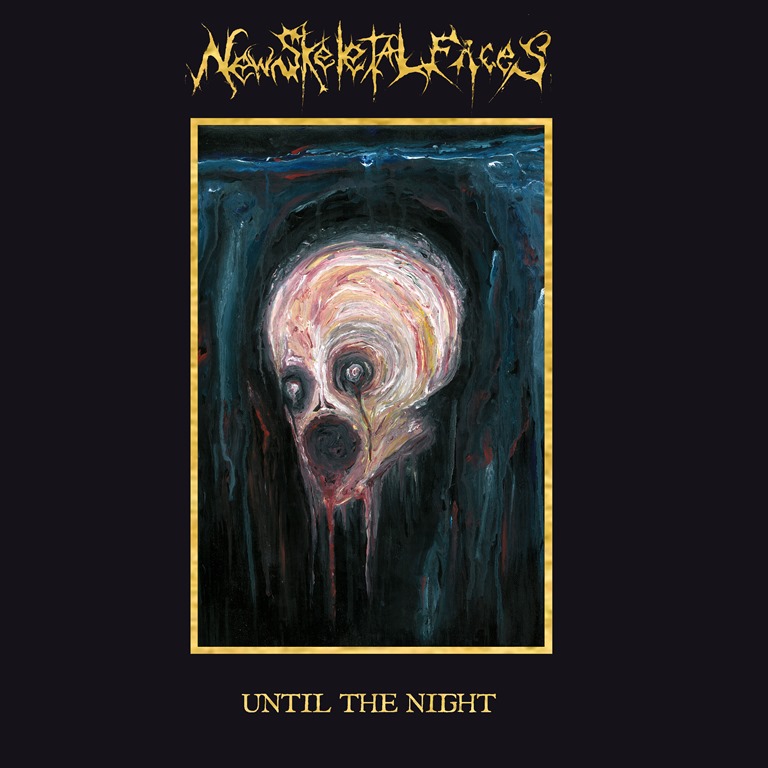
The claim that ‘New Skeletal Faces cast their own black light onto the long dormant corpse of Death Rock, shattering the mirror of modern Heavy Metal into fragments that reflect back a fresh new take on this form of music with an energised & outlandish conviction’ is a bold one. Ominous, menacing, perhaps, or deluded and deranged?
California may be known for its sun and sand, but it has a long history or dark currents which run contra to its popular image, perhaps most notably Charles Manson’s Family being based in The Golden State – which in turn drew Trent Reznor for the recording of The Downward Spiral. In between, Christian Death spawned the proto-goth / nascent death rock sound which, while evolving in parallel to the scene in the north of England, was unique and distinct, and the early eighties saw California home to a thriving hardcore punk scene. I suppose that wherever there is affluence and clean-cut TV slickness, there is bound to be rebellion, a counterculture which stands at odds with it all. No doubt some of these factors drew New Skeletal Faces to California for the recording of Until The Night, the follow-up to 2019’s Celestial Disease.
They proffer an ‘effortless blending of the spirits of old; with the seductive & spellbinding gothic prowess of bands such as Christian Death fused with the raw unbridled energy of early Swedish black metal legend, Bathory to create a bold new statement of intent, in stark contrast to the often overly-refined polish of contemporary metal. Until the Night is, as a result, something more akin to listening to the 1980’s Sunset Strip in an alternate universe from hell.’ For good measure, and to really clarify their position, there’s a cover of Bathory’s ‘Raise The Dead’.
In all, it’s apparent this is destined to be dark from the outset. Across the album’s eight tracks, they paint everything darker shades of black with densely-woven layers of sound. The guitars, while overdriven, are reverby, and quite smooth, and while the riffs take their cues from black metal, there are some overtly gothy licks, and the atmosphere is very much reminiscent of Only Theatre of Pain but with the dial cranked a few notches further over into the ‘metal’ domain for the most part. Then again, the title track, with its thunderous tribal percussion, spindly guitar laced with flange and chorus, and thumping bassline, encapsulates the sound of goth circa 1985, only with shouty vocals which belong more to the hardcore sound of the same time.
Titles such as ‘Ossuary Lust’, ‘Wombs’, and ‘Pagan War’ are fully invested in the trappings of gnarly metal and its themes, but ‘Zeitgeist Suicide’ reflects a self-awareness which may not be immediately obvious.
As I touched on in my recent review of Vessel’s cover of ‘Body and Soul’ by The Sisters of Mercy, while there is a clear interface between goth and metal – even if it does tend to be primarily a one-way street, which finds metal fans embracing goth bands, in particular The Sisters of Mercy and Fields of the Nephilim – its rare to encounter a particularly successful merging of the genres. In the main, goth-metal is cliché and cack. Despite appearances, Until The Night is neither, and is perhaps the most potently-realised stylistic synergy since The End of Mirrors by Alaric in 2016.
AA
Chiming guitars swirl around relentless, barrelling beats on ‘Wombs’, before ‘Zeitgeist Suicide’ leads with a weaving bassline and some fizzy, treble-dominated guitar, and they go at it hard and fast. ‘Enchantment of my Inner Coldness’ brings together vintage goth with a vocal performance that evokes the spirit of Public Image Limited, and in doing so, succeeds in sounding – and feeling – both expansive and claustrophobic at the same time.
Until The Night scratches and drives its way – all the way – to the Bathory cover which drawn the curtain down on this dark, fiery, and furious album. It may well alienate goths, metalheads, and post-punk fans alike, but it feels very much like their loss, being an album strong on songs and confident in its own identity in the way it positions itself uniquely across the genres.
AA
 Aural Aggravation