Posts Tagged ‘Midira Records’

Midira Records – 5th May 2023

Christopher Nosnibor

Aidan Baker is one of those artists whose output is almost impossible to keep pace with – but the more remarkable thing is that for all of this hyperproductivity, the standard of work is of an unstinting quality. Recorded between 2020 and 2022, Engenderine – a double CD – lands almost simultaneously with Trio Not Trio, the first in a series of five albums on Gizeh Records, and just as Baker is gearing up for a tour with Nadja, the ‘ambient doom / dreamsludge, / metalgaze’ duo he is one half of.

To pause for breath for a moment, it’s worth stepping back and running through the context of this, which is worth quoting:

‘The neologism ‘engenderine’ comes from Lydia Yuknavitch’s The Book of Joan, a futuristic/dystopian/cli-fi retelling of the Joan of Arc story, and describes beings partially composed of pure energy capable of manipulating matter who, amongst a largely devolved human population, might be considered post-gender and a new evolutionary step.

‘Other song titles come from phrases and images from Tricia Sullivan’s duology Double Vision and Sound Mind, surrealistic fantasies about the nature of reality and perception and, like The Book of Joan, the possibilities of manipulating those.

‘Musically, the songs on Engenderine began as a series of slowly evolving ambient guitar loops – a bed layer of reality, so to speak – over which were layered bass, drums, and organ parts. These instrumental additions – the trappings of perception, signifiers, metaphorically speaking, our attempts to codify perception – incorporate traditional rock structures and progressions but are stripped down to a sort of somnambulant minimalism that might encourage introspection, a meditative background, uneasy listening, as much as they demand attention.’

It really is extremely uneasy listening. It’s perhaps as well it is, for the larger part, ‘background’, because the two CDs, while only containing eight tracks in all, span almost ninety minutes. We’re not quite in Sunn O))) or latter-day Swans territory, but still…

The first track, ‘Baby Dragon Slaughter’ pitches a long, unchanging organ drone note against a growling doom guitar and stop-start percussion which crashes hard. It’s hypnotic, paralysing, and I can imagine some might toss in a Doors comparison, but that’s only on account of the organ and the slightly trippy vibe, because it’s not only nothing like The Doors, but infinitely better.

If you want comparisons – because pretty much everyone seems to work on the premise that everything sounds like something else and recommendations – mostly algorithmic and based on purchases or streams, depending on the platform, Engenderine sits in the low, slow, doom-drone bracket of Sunn O))) and Earth 2. And this is indeed some ultra-low frequency shit. The first track on Disc 2, ‘Resurrection of the Child Army’ features some melodic, trilling pipe sounds around seven minutes into its nine-and-three-quarter-minutes gloomy, thick humming drone, is something you feel as much as you hear, and it resonates through the intestines and vibrates eternally.

The bass on ‘Calabi Yau Manifestations’ is pure dub, floor-shakingly dense, dark, minimal but quiveringly heavy, and it dominates the erratic drum clatters and rumbling roar of a drone that sounds like a jet engine warming up several miles away. Having experienced jet engines nearby, trust me., this is a good thing, but the rumble is unsettling. And then there’s ‘Dorvay’, which seems to take its cues from The Cure circa Pornography, with its hefty percussion dominating the sound.

Engenderine isn’t an album for a track-by-track, blow-by-blow critique: the tracks melt into one another and it’s an album that needs to be experienced as an album – and in context, that’s a continuous droning hum of murky noise without any clear sense of shape or form.

The second disc feels lower, slower, darker and more difficult: the erratic jazz drum-work on ‘Fear Sculptures’ is difficult to digest and assimilate – but then again, so is Engenderine as a whole. It’s just so much dark and difficult droning to chew on that it leaves you feeling low on energy, sapped, physically and mentally. But this isn’t about entertainment, and artistically, Engenderine is an outstanding exploratory / concept work.

AA
MD136_front

Midira Records – 25th November 2022

Christopher Nosnibor

This album is, as the title suggests, a soundtrack work. Although released under the moniker Houses of Worship, it’s essentially the second album by Thisquietarmy x Hellenica.

The summer of 2020 saw Eric Quach (thisquietarmy) and Jim Demos (Hellenica) come together to record a collaborative album, which emerged as Houses of Worship, described as ‘an epic work of experimental industrial ambient, is an ode to dying buildings and the unwelcome gentrification of neighborhoods’.

This, the follow-up, came about after they ‘played their first concerts in the streets of Montreal from inside of a cube truck. These performances were filmed and recorded to produce "TQAXHLNKA: MIGRATION,” a twenty-two-minute experimental art documentary and an accompanying soundtrack. The film simulated the cautionary tale of what the Montreal arts and music scene could look like in a post-pandemic world. As the title suggests, it reflects the highly concerning exodus of artists constantly being divided and pushed out further from their community.’

At twenty-two minutes in duration, it’s a minute short of the magic spot, but this is a magnificently atmospheric work that goes beyond dark ambience and ventures into the vastly cinematic, space-drifting expansiveness that transports the listener beyond the terrestrial domain.

The album contains more audio than the film’s running time, and drags the listener through a bleak journey which articulates via the medium of sound the themes and scenes which preoccupy the duo, who explain, ‘With the current struggles linked to the pandemic restrictions, we have seen the acceleration of the gentrification process in neighborhoods where the heart of these activities takes place. As a result, a multitude of venues, studios and artistic spaces – places used for exchanging ideas with our peers and building communities meant to inspire and nurture our souls had to shut down.’

The tone is dark, the textures industrial, yet tinged with echo-heavy melancholy, a combination of anger, emptiness, and sadness. The soaring drones inspire a certain elevation, while the gritty grind is the sound of construction, regeneration. Gentrification is the face of capitalism eating itself; having run out of new ideas, it’s simply fallen into a cycle of recreation and rehashing. Upscaling, upwhatevering, it’s all about selling the new version of the same od shit at a higher price to the same saturated market. When will enough ever be enough?

Meanwhile, capitalism follows the former tropes of the avant-garde, destroying to rebuild, and Migration is the soundtrack to that.

There are lots of drones, lots of dolorous tones, lots of scraping, sinewy mid-range and gravel-grabbing, churning lower spectrum sounds, as well a haunting piano and infinite empty space. The titles paint the picture in themselves, and it’s dark, smoggy, sulphurous. ‘Total Waste Management’; ‘Polytethylene Terephthalate’; ‘Oil Terminal Tank Farm’ are all evocative of stark industrial scenes.

‘Industrial Estate Bird’s-Eye’ is a haunting wail, presumably of a theremin – over a low, throbbing drone that’s reminiscent of Suicide, and elsewhere, the duo conjure thick, billowing clouds of doom that sound like Sunn O))) behind a power station, as dense rumbles ripple forth. The twelve-and-a-half-minute finale, ‘Throbbing Magnetics’ fulfils the promise of its title, a bucking beast of claustrophobic, crushing gloom, and you feel yourself dragged into the sludge of that relentless, interminable cycle of collapse and construct.

It’s an accomplished work, but a depressing one, and listening places to the fore the abject nature of late capitalism, and the fact that any attempt to save the planet is futile in the face of the onslaught of bulldozers. Redevelopment has nothing to do with environment, only profit, and hard as you might rebel, as strongly as you may protest, you’re powerless against the big money. It’s not a conspiracy, it’s the sad truth. Houses of Worship recognise this. They may hope for better, but Migration is not a protest record, but the sound of grim acceptance.

AA

a3486628679_10

Midira Records – MD080 – 13th December 2019

Christopher Nosnibor

It’s new year’s day, 2020. Like many, I’ve spent the last few weeks reflecting on the passing year: I usually do around this time, remembering where I was a year ago, two, three, five, ten years previous. Wondering precisely what I’ve got to show for it. that slow, sad, weight of nostalgia as the images captured in memories fade and curl around at the corners. Wondering: was I actually happier then, less prone to panic, or is this simply rose-tinting, psychological refuge in the comfort of the known, the life lived, rather than the fearful prospect of the unknown future? Such conflict, such dichotomy and dilemma.

And so, another year is indeed over, and here we are, staring into the void. Teetering on the brink of the abyss of a new decade in a post-fact, post-truth world where the capitalist world teeters on the brink of self-induced collapse and global climate catastrophe. And there is no success like failure.

We’ve failed as individuals, and as a species. The year is over… so what is there in prospect?

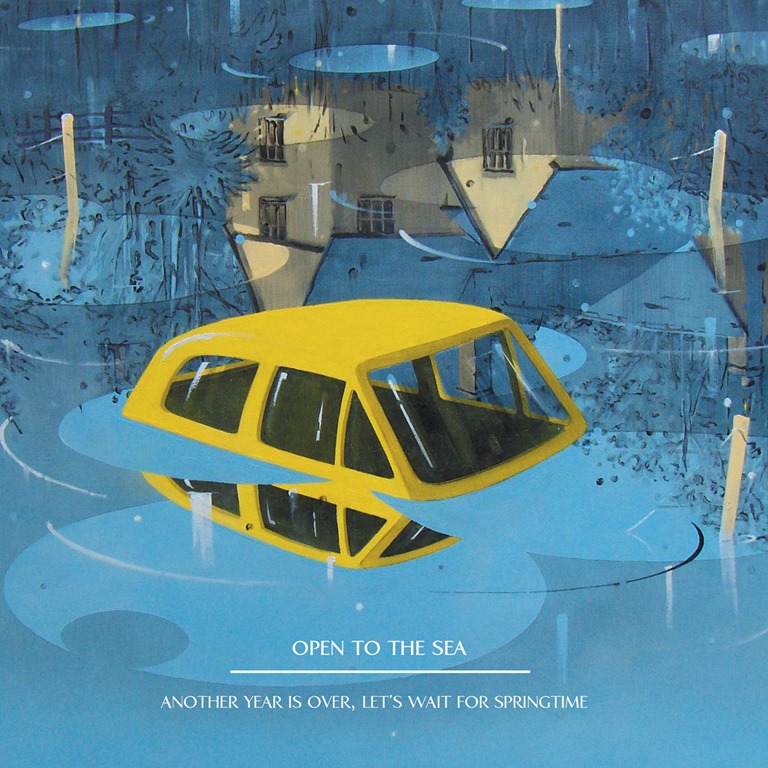
Open to the Sea’s new album, released late December provides the soothing backdrop to my existential strife, and it’s barely there for the most part. And yet, it’s there just enough: understated, yet still clearly stated.

The press release provides some useful insight into the album’s origins and its creators: ‘Open To The Sea is the collaboration project of Matteo Uggeri and Enrico Coniglio and Another Year Is Over is their second album. While Coniglio focusses on guitar, synths and other instruments, Uggeri adds samples and field recordings to create a soundcosmos full of tiny melodies and themes with appereance by some guest musicians on drums, trumpet and cello. That would make a perfect experimental ambient album with jazzy moments, but Uggeri & Coniglio push this release further by adding some vocals to most of the tracks by inviting guest singers like Dominic Appleton (This Mortal Coil) or Lau Nau from Finland.’

Minimal post-rock forged from sparse piano notes which drift into a rarefied air, spun with subtle, near-subliminal swirls of ambience, and stammering, glitching beats that hammer like a palpating heartbeat rattling in a tense ribcage, and picked guitar notes waft into the ether.

With different vocalists contributing to the various tracks, the tone and feel changes: ‘Heavy Like a Falling Leaf’ is soft, airy, yet poised, while ‘Uninvited Ghost’ and ‘Crystal Dog Barks’ feature a spoken word lyrical delivery, which in some respects changes both the dynamic and balance, and the function of the musical accompaniment, rendering the piece less a song and more of a narrative with instrumental backing.

‘Duduk Confession’ is hushed, brooding, with haunting strings and ominous hums lingering in the shadows, and on ‘Tapes and Cows Pt 1’, lonely brass wails softly over low notes to produce the most forlorn jazz imaginable. Scraping strings and frosty synth flickers accompany the deepest woe, which gradually evolves into warped space-age electro that melts into some warbling jazz trumpet.

The penultimate composition, ‘facing the waves’ is by far the most conventionally ‘songy’ of the ten, with a straight-ahead drum rhythm and solid piano providing the primary instrumentation on a whispy indie/shoegaze work. The fading refrain of ‘time now to start again’ is sung by a layered-up vocal set and, unexpectedly, Interpol come to mind.

The final song, ‘Another Year is Over, Let’s wait for Springtime’, with its whispering dialogue and soft dulcimer shimmers and soft, snowy strings that glide smoothly into the darkest corners, reminds me of my urge to hibernate, but also the fact that everything passes in time and everything is cyclical. Yesterday, today, tomorrow – they’re all points on a circle, and as linear as life lived is, as sure as birth and death, one year will follow the last, and so it will go on, whether we’re here or not.

AA

MD080_front

Midira Records

Christopher Nosnibor

The press release informs us that Four Movements Of A Shade is the second solo album by Sarram, and that it ‘features four haunting tracks, that move through different genres like doom, drone, ambient and somehow minimal post-rock, played with just a guitar and some synths. The idea behind that album was to go to the studio without having tracks, just an idea and the mood he had in mind to play an improvisational session. The result was recorded in one day and turned out as a very dark and intense soundjourney. You can feel the temper of the recording session by listening to that record. Sarram recommends very loud volume.’

I can’t recall an album that mentions volume which actually recommends playing at a reduced level, although increased volume can definitely increase or even optimise the level of impact and appreciation, depending on context. Music played and recorded at high volume is definitely best heard at the volume intended: there’s a distinct relationship between volume and frequency, and certain frequencies and notational interplays only occur with the amps up. Many of the bands which stand out as purveyors of dangerous decibels – MBV, Sunn O))), Swans, A Place to Bury Strangers – simply wouldn’t work quiet: and I say that as having witnessed Swans’ show at Leeds Cockpit (no longer in existence) a few years ago. At regular gig volume, they sounded like a band rather than a transcendental sonic force capable of shattering atoms.

Listening to Four Movements of a Shade, the benefits of increased amplification soon becomes clear. It’s got some heft, and while these are countered by extended quieter passages which are often delicate and nuanced, and chime along nicely at ordinary levels, it’s when the crescendos climax that Sarram’s music really needs to be felt vibrationally as well as sonically.

The first movement begins quietly, rising to a bowel-trembling wall of low and mid-range dark ambient droning sonic cloud. Big, barbed, sonorous swells of sound scrape sharp edges, while other aspects of the resonant whirling blackness cast sinister shadows, long and deep: hints of the billowing drone of Sunn O))) build into tempestuous thunder and rumbling, grating storms that cast unsettling atmospherics into the psyche and resonate around the gut, but this is very much a composition of ebb and flow. Nevertheless, while the underlying menace remains undiminished, around the mid-point the darkness yields to dappled sunlight and soft strings, hinting and optimism and freedom. For a fleeting moment, one actually feels somehow lighter, despite the inescapable sense that it’s only the calm before the next storm – an instinctive drag that proves – of course – to be correct. It’s always a matter of when, rather than if….

The album’s second half – comprising the megalithic, fifteen-minute third movement and the final, eight-minute forth – focus on the atmospheric layers and the drifting clouds of drone on drone, occasionally straying into expansive post-rock territory.

If it feels like the grip of darkness is being released, the dying minutes swirl into a deep, dark vortex that leave the listener drained, shattered.

The success – and ultimate power – of Four Movements lies in Sarram’s attention to detail and the compositional awareness: it’s not just the way the crushing weight contrasts with the graceful levity, but the timing of the transitions. Everything is exquisitely poised and placed to yield the greatest effect – cerebral, emotional, physical – and that effect is most moving.

AA

Sarram – Four Movements of a Shade