Posts Tagged ‘Metal Machine Music’

Portraits – 27th June 2025

Christopher Nosnibor

Stephen O’Maley will be forever synonymous with Sunn O))). However fervently fans revere Khanate, whatever the reputation of Burning Witch or KTL, however many solo albums he releases, and regardless of the outstanding work Ideologic Organ presets to the world, none of it will ever come close to the success of Sunn O))), which will eclipse anything and everything else he is involved ion for all eternity. It’s not difficult to grasp the reasons for this. It likely quite frustrating, but that band have elevated a niche not-really-a-genre to stratospheric levels, and have achieved more with a single, sustained chord than most could ever dream of.

When I saw him perform solo some years ago, he appeared quite comfortable with this, playing – just off stage – through a backline that was so immense it wouldn’t quite fit onto the stage of the 450-capacity Brudenell in Leeds. Better to have a reputation to play up to than not, and since bowel-churning guitar drone played at eardrum-shredding volume is what people want, delivering it seems like a fair trade.

The blurb for his latest solo release suggests, however, something a shift, but by no means a departure, writing that ‘With But remember what you have had, Stephen O’Malley continues and expands his musical approach by transposing it to multiphonic electroacoustic writing and acousmatic listening. Drawing not only on his extensive experience as a composer and live instrumentalist, but also on the countless studio production and mixing sessions he has taken part in the course of his many projects (in solo, with SUNN O))) or KTL, to name but a few), Stephen O’Malley’s work on this new piece is ambitious, engaging in an inspired research that delves into the deep intricacies between polyphony, intonation and timbrality, enhanced by melodic motifs. To do this, O’Malley summons up his own very personal sound universe, constellated with amplified textures, instrumental sustained tones and raw energy, in order to diffract them into wavefronts, waves and blows that weave a complex, rich and fascinating matter. But remember what you have had stands out as an important work in Stephen O’Malley’s repertoire: it brings together the multiplicity of his musical approach in an exemplary way, while laying the foundations and promises for the future of an already extraordinary journey.’

But remember what you have had is a single, continuous piece, just over thirty minutes in duration. It begins with a parping drone that sounds somewhat like a didgeridoo. It lingers, resurging, cyclical hums and layers of sound and texture build atop of one another… and then what the fuck’s this? Bagpipes? It sounds like bagpipes. But then, it also sounds like guitar feedback and a single chord being struck and resonating for an eternity. And then another chord crashes like a giant Wave breaking over rocks at high tide with a stormy wind behind it.

Whereas the overall pitch and tone of the Sunn O))) sound is low and growling, But remember what you have had altogether more keenly favours the mid and upper ranges, and howls of feedback while whining engines fill the air as it heats up. There’s more discord as the sounds bounce off one another. It’s an exploration of the interaction between notes and frequencies, conducted in a way which can only happen at volume,

By the midpoint, the feedbacks are interweaving in such a way to form a huge reverberating howling drone, which in some respects shares common ground with Metal Machine Music, and it would be difficult – and inappropriate – to completely sidestep Earth 2 here, too. By twenty-minutes, O’Malley conjures an immense collision of sound, jousting and jostling amidst a sonic tempest, before gradually diminishing to a point of tranquillity which is more reminiscent of a string quartet than experimental wave of noise. It makes for an unexpectedly soothing finish, but once again shows the range of O’Malley’s musicianship, as well the breadth of his sonic interests, which extend far beyond all-out weight and sheer volume.

AA

AA

a3988746175_10

2nd September 2022

Christopher Nosnibor

UK duo Thraa consists of Sally Mason and Andi Jackson, whose bio states that ‘Working without the constrictions of a traditionally structured song, this duo improvise around meditative drones, combining Sunn 0))) influenced guitars with soaring vocals. Making single take recordings, they capture an organic sense of sound that has cavernous textures with minimalism at heart.’

In some respects, this debut EP brings us full-circle in terms of drone evolution, and it’s fitting in the most appropriate, and planetary sense. The most successful and celebrated purveyors of drone, Sunn O))) famously took their moniker as a reference to drone/ doom progenitors Earth, who will, in certain circles, be forever remembered for the tectonic grind of their epic second album, Earth 2, from 1993, which contains just three tracks spanning some seventy-three minutes, with nothing but guitar and bass feedback stretching out, crunching along at a glacial pace and carrying the weight of entire continents. It’s hard to believe that this release will ever be surpassed for all that it is, with two of the three tracks stretching out around the half-hour mark with no shape or form, only an endless, grating, grumbling grind. Into Earth connotes a return to base material, a slow collapse, even a decay into compost form, but also hints at a sonic slide toward this territory carved out by the original and definitive drone act some twenty-nine years ago.

Thraa intimidated at the shape of things to come in June with the release of ‘Move Among Them’, which is the first of the EP’s four tracks. It’s swampy, sparse, beginning with an awkward, gurgling, wheezing, a kind of tentative snuffling grunt in the bass region before soaring, sculpted feedback howls and churns metallic—tinged clouds of scraping ambience. It probably sounds like a contradiction on paper, but hear me out: the screeding layers blur into a whirl without definition and tumble into a vortex of abstraction, and in doing so, create the sound closest to that early Earth whorling wall I’ve heard from any other band.

The title track lacks even more overt form, spurs of guitar feedback screeching as it breaks loose from the dense, rippling wall of undifferentiated noise. There are strong elements of Metal Machine Music here, but it’s around the midpoint that a slow, rhythmic piano emerges, along with a haunting understated vocal from Sally that’s half-buried beneath the noise of explosions and / or tidal waves. It’s both dolorous and ethereal, and BIG | BRAVE comparisons aren’t out of place here, either.

Everything coalesces after the subdued scrape and low-end rumblings of ‘Elgon’ on the seventeen-minute finale ‘Over Warm Stones’. Nothing different happens as such: there is only more, in terms of duration, and in terms of atmosphere. The snaking, rattling notes that swell and shimmer provide a sparse, textured backdrop to a quivering, evocative vocal performance.

Into Earth may not offer anything new, per se, but does provide a strong contribution to the canon of emotive, evocative ambient drone / doom which features vocal, which in this instance are essential to the experience, and it’s an experience which is compelling, immersive, heavy as hell and at the same time heavenly, before it collapses into a landslide of feedback that stretches out to the horizon.

aa

a3764076389_10

Clang Records – Clang 042 – June 10th 2016

Christopher Nosnibor

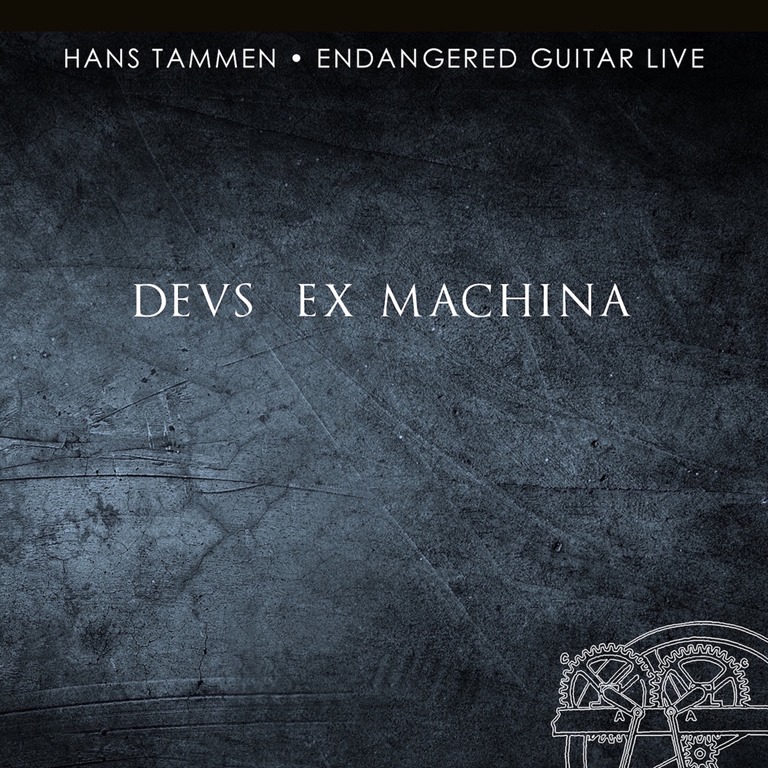
Hans Tammen’s Music for Choking Disklavier was one of the first albums to be reviewed here on Aural Aggravation, back in December last year. Deus Ex Machina finds Tammen continue to explore the possibilities of instruments when played in a fashion they were not designed to be played. Since 2000, Tammen has been working with the ‘Endangered Guitar’, and tirelessly developing its functionalities.

Tammen’s website summarises this ‘Guitar-Controlled Live Sound Processing’ in a fshion that’s more intriguing than explicitly instructive: ‘The Endangered Guitar is a journey through the land of unending sonic operations, an interactive hybrid between a guitar and a computer. The software “listens” to the playing, to then determine the parameters of the live sound processing. The guitar is the sound source, but the same sound is also used to control the software. Sounds of the guitar are processed in realtime, pitch and various other parameters of the actual playing serve as control source of the processing. Currently, additional control sources are provided by a Leap Motion Controller.’ Technical yet simultaneously vague, what it boils down to is that Tammen has devised a guitar / computer hybrid, and in 2004 her introduced a random element to the software.

Tammen’s collaboration with Lars Graugaard under the Infernal Machines moniker, which came out earlier this year, was more about utilising the Endangered Guitar in a tempered, moderated and counterbalanced way. In contrast, this live recording, the title of which references the theatrical practice of lowering a ‘god’ character on stage using a cable device in order to resolve a troublesome situation in the plot of a play, and in which Tammen casts himself the role of the actor, lowered to the stage to daringly intervene, is built on improvisation and a wide-ranging exploration of the hybrid instrument’s capabilities.

Tammen writes of the computer crashing while performing, and of how wildly unpredictable the whole setup is, and this very much translates into the audio captured on the album.

Scratched overdriven chords and discords splinter and snarl. Massive, distorted, overloading sludged-up Sunn O)))-like drones rumble on… and on… walls of sound collapse in on themselves. Pickups cut in and out intermittently, feed back and crackle. Occasionally, recognisable notes – albeit notes that sounds like a version of Metal Machine Music are distinctly audible. There are no tunes to be found here, and often, it doesn’t even sound like a guitar. On ‘Transaxle’, the guitar effects the sound of violin strings being scraped, against a droning, wheezing sound like a deflating bellows, while on ‘Interlude at Rake’, it conjures a techno sound, replicating synth stabs and booming bass beats. Rapid, looping modulations, bleeps and squiggles replicate the effect of analogue synths, with sounds which would be at home on a track by Factory Floor or Whitehouse, and elsewhere, dark ambient passages hum, rumble, grind and billow and grating industrial barrages relentlessly assault the senses. At times, it hurts. But it’s also entertaining and often enjoyable: Deus Ex Machina is sonically challenging and one can’t help but contemplate just how the sounds of a guitar can be mutated in real-time to create the diverse and sometimes utterly insane sounds captured here. It’s by no means a novelty album, either: the concept of the Endangered Guitar may sound like something of a gimmick, but Tammen demonstrates that his leading preoccupation is with innovation for the purpose of creating new sound, and more importantly, creating something with those sounds.


Hans Tammens - Deus Ex Machina