Anyone who has been paying attention will know that the human race is in a perilous position. We inhabit a planet that is overheating and being drained of the resources needed to sustain a healthy balance for the life which exists upon it, while our politicians indulge in pointless regional wars, or blinkered domestic bickering; anything to avoid having to make the unpopular decisions which may help mitigate the effects of humanity’s selfish excesses. We can’t last forever, so what happens after we’re gone?
Williams’ new single is a journey (literally, in the case of its dazzling video) – hard, hyperactive synthetics melt into Duane Eddy guitar licks, before the choirs and orchestras (several of each) join the stampede to a coruscating climax.
The earth will heal just fine without us. That’s what will happen after we’re gone.
Dallas Kent might sound like a fictional cowboy, or possibly a made-up American town in a made-up state, but it’s actually the name bestowed upon the collaboration between London-based composer/producer Ian Williams (originally from Canterbury, Kent) and singer Crystal Brown (from Dallas, Texas). In that context, the moniker makes sense, of course.
As their bio explains, ‘It started in the late 2010s when Williams was looking for a singer to work with on some of his dark electronic pop songs, with Brown happening to live one street away from his studio in Hackney, East London… They swiftly recorded a considerable amount of material, but had to shelve the project when Brown relocated to the USA. The duo continued to discuss their options until finally, with Crystal settled in San Francisco and the pandemic giving everyone time to pause their normal lives, they decided to complete what they had begun so many years before.’
There’s no question that the pandemic changed a lot, if not, in some ways, everything. While many suffered with extreme alienation and the traumas of isolation and separation, it also forced a realisation of what was achievable, creatively, despite separation, and proved that the idea that ‘distance is no object’, which had long been embedded within the channels opened by The Internet was not merely a concept, but something which was more than simply a conceptual matter.
I suppose I realised this around the turn of the millennium, when I experienced something akin to a lockdown situation of sorts, albeit for very different reasons. I had relocated to Glasgow around Easter 2000 under difficult personal circumstances. I didn’t really know anyone. I was yet to make friends in my new job there. And I was so fucking broke I could barely afford to eat – a situation not particularly conducive to socialising and building new friendships. A friend I had known in York, who had subsequently moved to Sheffield, introduced me to Hole’s chatroom, and, stuck at home and unable to sleep, I found myself spending my nights online chatting to people from around the world at all hours, at least until, with dial-up Internet costing a penning a minute, I racked up a phone bill I couldn’t pay, and had my phone cut off. Then along came MySpace, and again, the possibilities for communication and collaboration across continents were immediately apparent. People who missed the age of the chatroom and MySpace were perhaps less predisposed to these potentialities, and consequently, the pandemic lockdowns hit them harder: they had to learn these things anew.
Anyway. This single entitled ‘Ghost Highway’, which, their bio tells us, ‘is redolent of Massive Attack and Ennio Morricone’ is the first fruits of their collaboration, ahead of ‘a full album that promises to be a mash-up of cinematic downtempo sounds, Americana, French disco and anything else they can throw into the mix.’
‘Ghost Higheway’ is very much a spacious trip-hop-influenced piece, with haunting vocals and a thick, dubby bass rolling low under a slow, deliberate, nod-along beat. Its magnificence lies in its sparse simplicity, and the fact it’s over almost as soon as it begins, and you find yourself yearning to delve deeper, to keep moving into this atmospheric world they’re presenting… it’s like the opening pages of mysterious, mystical novel, drawing you in and then…
The accompanying video is similarly compelling but without resolution: they describe it as ‘David Lynch-ian’ and explain how it was ‘filmed by Brown on her phone before being edited as psychedelically as possible by Williams.’
That they’ve kept this all in -house and simple and delivered something so compelling, so strong, is testament to their imagination and capacity for innovation, proving just how much can be achieved with minimal tech and over distance, given the drive and determination.
AA
DALLAS KENT | Crystal Brown (photo by Ian Williams) & Ian Williams (photo by Damien de Blinkk)
The art world is not so much a desert as a breakers’ yard, stacked to the sky with abandoned and aborted projects, works which were commissioned and shelved or otherwise dropped, canned, kicked into touch. The endless hours spent on projects which have never seen the light of day hardly bear thinking about. A career in the arts is likely to be one dominated by failure over success, even for a successful creator. But what is success? Artistic success and commercial success exist in different spheres, and while the world at large seems to judge more or less anything by the measures of the latter, one should ask why this us. Units shifted, radio plays, streams on Spotify, these are the metrics of success, based on the monetisation of art. Something is simply not right.
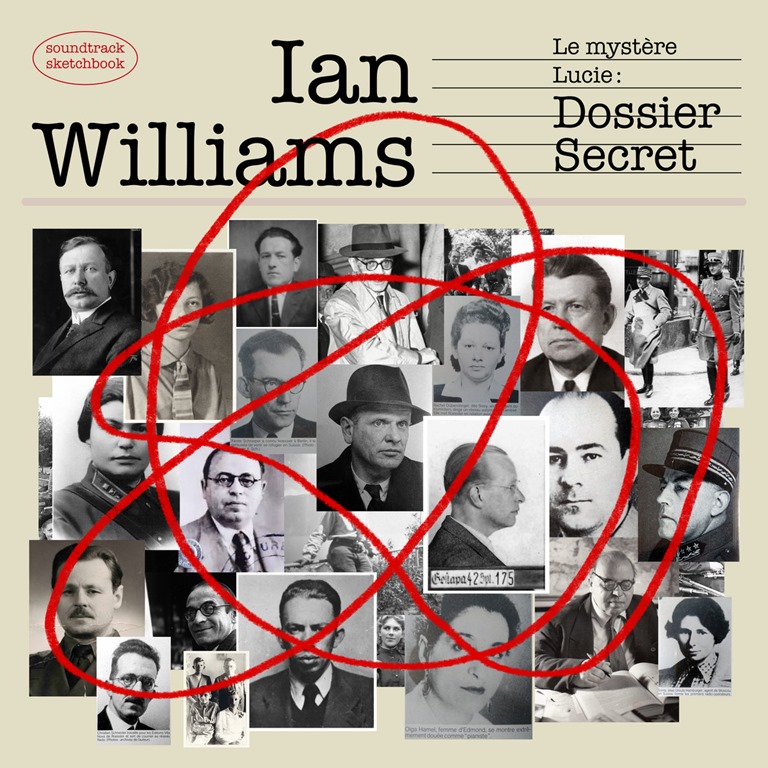
Ian Williams’ latest release is a product of failure. Le Mystère Lucie (Dossier Secret) (that’s Codename Lucy (Spies Against Nazism)’, a companion piece to the recently-released Le Mystère Lucie (Des Espions Contre Le Nazisme), his recent soundtrack album of music for the 2023 French documentary Le Mystère Lucie (Des Espions Contre Le Nazisme) / Codename Lucy (Spies Against Nazism).
As the accompanying blurb expounds, ‘it features music composed for but ultimately not used in the documentary, which was originally conceived as a 75 minute film but eventually released as a 52 minute TV broadcast. It seemed a pity not to make these additional themes and sketches available, so here they are, another collection of World War II spy music – melodic, electronic, orchestral, tuneful, abrasive, with both releases showcasing Williams’ knack of fusing big tunes with occasional blasts of industrial noise.’
Grand, bold, epic, expansive… these adjectives give a hint of the cinematic compositions n offer here. Being designed as a soundtrack, the album’s seventeen compositions are brief – largely under three minutes – and gentle, employing smooth synth bass and conjuring an atmosphere which is accessible to the ear. The tracks blur into one another with great rapidity, as one would expect for a soundtrack, where the segments flow with the scenes.
Le Mystère Lucie (Dossier Secret) is rich in mood and atmosphere, as befits its subject. There’s not much industrial noise present here but string-soaked cinematic sweep abound. Le Mystère Lucie (Dossier Secret) feels filmic, it builds drama and layers of simmering tension, as well as lakes of brooding darkness and ripples of uneasiness. It’s an accomplished score, and one which most certainly was too good to go to waste.
London-based musician/composer Ian Williams has released a new single entitled ‘Chronopolis’ today. Taking its title from a J.G. Ballard short story, it is an edited version of a track from his current album, Slow-Motion Apocalypse.
An accompanying video was shot in Canary Wharf in London. It highlights the clock-watching and surveillance of the workforce (facial recognition, keystroke logging and anything else they can think of) that makes the vast multinational corporations located in this financial heart of the beast untaxed billions, leaving crumbs that the average worker is supposed to feel grateful for.
The epic soundtrack to this scenario perfectly encapsulates the colossal architecture and human hive of activity, with hyperactive sequencer lines agitating under soaring lead synths as towering piano chords and immense drumbeats propel the whole machine along.
Ian Williams began his music career in Edinburgh in the mid 1980s as a founder of Beautiful Pea Green Boat, whose ethereal, atmospheric sound pre-dated the vogue for dream pop by at least twenty years. Several collaborations with Lebanese choreographer Joumana Mourad and her contemporary dance company Ijad saw him fuse Arabic/classical/techno/ambient styles, following which he changed tack to work with singer Claudia Barton as Gamine, releasing two albums of dark, piano-led torch songs and lullabies.
Williams’ own releases include THE DREAM EXTORTIONISTS (2019), a debut solo album of dark piano and electronics; LES BLESSURES INVISIBLES (2019), an eclectic electronic soundtrack to a documentary film by French director Eric Michel, and ALL BECOMES DESERT (2021), an album of minimalist ambiences and warm analogue soundscapes.
Williams has also composed the soundtrack to Michel’s new WW2 spy documentary, LE MYSTÈRE LUCIE (Code Name Lucy), which will be released in July. Further details will follow in due course.
‘Kalahari’ is the opening track on All Becomes Desert, an album of improvised analogue soundscapes by London based musician and composer Ian Williams that evokes the hostile beauty of the most spectacularly empty places on earth. The velvety warm, undulating tones of his Roland Juno 106 provide a perfect setting for the meditative sonic backdrop of the piece.
In regard to its video, Williams explains that “it was originally planned to be shot with a nine strong crew during a two week safari to the hostile climes of the actual Kalahari desert, honest, but due to circumstances beyond our control – scuppered by the pandemic, would you believe it – we had to improvise a Plan B, sticking a sand art picture in front of an iPad, which, we’re pretty sure, will be convincing to the vast majority of viewers. And it still looks really cool, so who’s complaining?”





 Aural Aggravation