Posts Tagged ‘History of Guns’

British electronic artist Max Rael presents ‘Pressing Against The Glass’, a danceable elegy for the unbelonging. Capturing the deep-seated ache of being on the outside, this is a soundtrack for those who feel eternally separated from the warmth and safety they can only observe.

Based in Hertfordshire, Max Rael is a key creative force in the UK underground through 1990s-2000s electro-goth trailblazers History Of Guns, frontrunners of the Wasp Factory / FuturePunk scene, and Decommissioned Forests. Here, he showcases his singular talents on this record, featuring unique twists on sound design and his acclaimed outsider lyrical perspectives. Musician, writer, actor, engineer and producer, Max Rael has collaborated with Fish (Marillion), Last July, Kommand + Kontrol, Freudstein and Bienheldenschafgegenstand.

“I’ve always been taken by the image of someone being outside alone in the cold looking in through a window to warmth, comfort and safety that’s not for them. I was thinking of Heathcliff looking through the windows of Thrushcross Grange in Wuthering Heights or Frank Abagnale Jr in the film "Catch Me If You Can", outside in the snow at Christmas, unseen looking in through the window at his mother with her new family, happy and warm indoors and realising there is nowhere he belongs, and no one he belongs to,”  says Max Rael.

This is the latest audio-visual offering from his debut solo album The Enemy Is Us, released via London imprint Liquid Len Media. Offering up a dark bouquet of minimalist synth, darkwave and spoken-word electronic pop, this album introduces Rael’s compelling ‘futuretroist’ sound: an alternative sonic universe built on a unique sound design that feels at once familiar and alien.

AA

AA

Rael’s powerful and thought-provoking spoken-word lyrics confronts a world in freefall—its corruption, alienation, and misery. The result seemingly effortlessly conflates a painfully personal portrait of an interior world, with an achingly universal depiction of society and the world outside. He still unearths a resilient core of hope and gallows humour that burns brightly through the darkness, offering a complex and compelling take on the human condition.

Earlier, Max Rael released the poignant shadow-streaked ‘Slightly Less Than Human’, a nervy electronic track with a great hooky synth melody and spoken word vocals. Partly inspired by Japanese author Osamu Dazai. Lyrically, Max Rael relays his feeling of being somehow different from the rest of the human race, while the non-album B-side ‘When the Only Winning Move Is Not to Play’ relates to the 1983 film War Games and the book The Games People Play by Eric Berne.

In April, Max Rael shared his spoken-word electronic pop song ‘Brighter Future’, where he questions avoidant strategies of coping with life in a seemingly increasingly chaotic and unsafe world and queries how can we reverse course from an anticipated dystopian future. The B-side ‘The People We Love Have Won (Persistence Is All)’ is a darker beast, named after Coil’s 2000 London performance at The Royal Festival Hall, which also happens to be tattooed on the inside of Rael’s left wrist.

Spoken word, electronic music and loud drums feature strongly on the 12-track album, produced and mixed by Max Rael with additional mixing by Caden Clarkson and mastered by Pete Maher (U2, Nick Cave, Depeche Mode, Pixies. Nine Inch Nails). Fusing a range of electronic music styles with other genres, Max Rael is a master journeyman of existential exploration into humanity, self, society, reality, psychology, philosophy and the future.

Max R

Liquid Len Recording Company – 28th January 2025

Christopher Nosnibor

I suppose I lost track of ‘new goth’ bands at the end of the 90s, and am still a way behind even now I’m a bit more back on it, and so History Of Guns, described by Mick Mercer – the authority on all things goth, who’s Gothic Rock Black Book was a bible for be when I was 13 and discovering the scene, as “By far, the most inventive UK band to have got their hands caught in the Industrial threshing machine” – bypassed me.

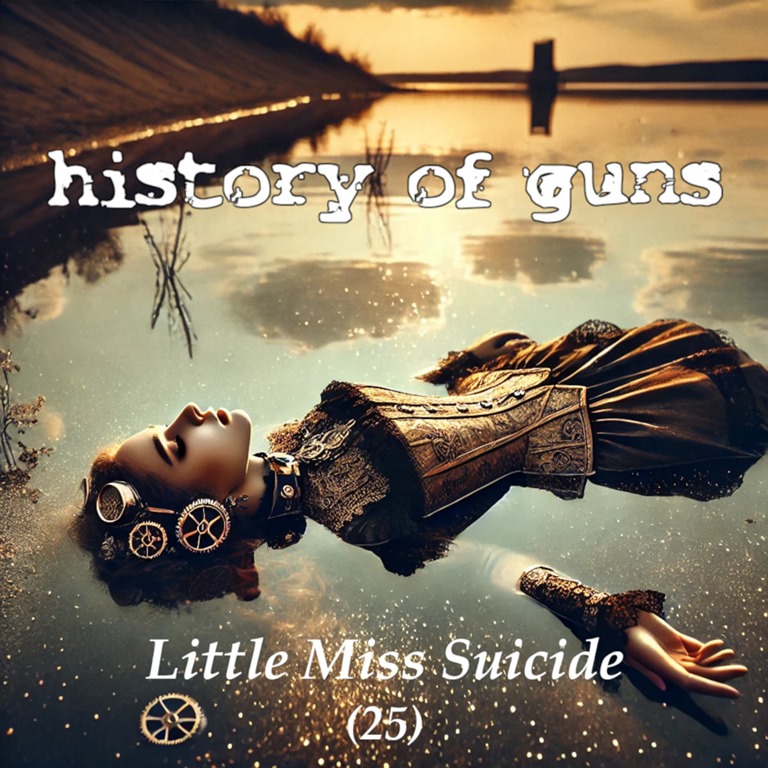
As the parenthetical numerals in the title suggests, this is a remixed version of their debut single, released twenty-five years ago, and it’s accompanied by a brace of new songs by way of B-sides, in the way things used to be done back then, when you had 12” and CD singles – and while I don’t get nostalgic for much, there was something special about these formats. Then there’s the fact a 12” single used to cost about £3.50 and a CD single a couple of quid – which probably sounds as incredible as a £1 pint or 3p tin of beans (Kwik-Save, No-Frills, c1995) to anyone under 35 – meant they were affordable, accessible.

But while we’re talking nostalgia and the passage of time, the accompanying video uses footage, originally filmed by Danni Cutmore on a VHS camera, of the band writing and performing the song at Earthworks studio in Barnet in 1998. It’s grainy, fuzzy, saturated, and looks like it could just have easily have bene shot in 1988, or even 1978. On the one hand, digital technology means the quality of video footage, even when shot on a cheapy mobile phone, is usually crisper, and isn’t prone to deterioration – but on the other, it’s so commonplace, it has less currency and less buzz about it, somehow.

The music itself… yes, it’s got that vintage post-punk feel to it, spun with an industrial edge, and pitching the band alongside Alien Sex Fiend, Cabaret Voltaire, Nitzer Ebb, Coil, Nine Inch Nails, Deathboy, The Prodigy, and LCD Soundsystem is all quite fair enough.

The classic spindly goth guitar sound spins spidery webs across a thumping drum machine, and there’s that quintessential low-slung bass groove… not to mention Del Gilbert’s theatrical baritone which looms powerfully over all of it. But then there are shuddering laser synth blasts which bubble up from nowhere, fizzes and whizzing and bleeps create the sensation of listening to two songs at the same time. Perversely, it somehow works, not least of all because there are strong hooks and the beat hits just right.

First B-side, ‘i am defective’ shows how they’ve evolved: it’s a dubby instrumental which leans far more into the electronic territory which only coloured their debut single. It’s also harder-edged and more overtly industrial, too, not just with the electronics, but the crunching, serrated guitars which cut in and threaten speaker damage. ‘LMS (Deep Mix)’ – a radical reworking of ‘Little Miss Suicide’ is in the vein of Rosetta Stone circa The Tyranny of Inaction – at least to begin with, but then swerves hard into the kind of electronica that qualified as technogoth or even cybergoth and reminding me why I drifted from the goth scene at the time. Now, I’m a bit more open to these things, and as an example of hard-edged industrial goth, it’s solid.

This release presents a neat straddling of the band’s formative years and their current sound: a clear win for fans, and a neat introduction for the unfamiliar.

AA

AA

a1503917006_10

Christopher Nosnibor

It was in my early teens that I discovered goth, and Mick Mercer’s Gothic Rock Black Book was something of an early bible for me. Mercer has built a career on being a huge authority on the genre, and things in the post-punk sphere. So the fact that the latest release from History of Guns – a ‘maverick’ industrial act from Hertfordshire leads with a quote from Mercer, describing them as “by far, the most inventive UK band to have got their hands caught in the Industrial threshing machine,” is quite a strong sell. The strongest sell, of course, are the wares themselves, and highlighting just how unfettered by convention History of Guns are is the fact that Drug Castle isn’t just another video single, another lyric video, another ‘vizualizer’ (thank fuck). No, this is, they explain, ‘a short film for one of the more experimental parts of their latest album, Half Light, in which they take their instruments to the beach, and experiment with different audio and emotional frequencies, in an effort to contact beings from another world.’

If this sounds utterly deranged, the context counts for a lot, and to provide this, I shall quote at length:

‘Drug Castle was the nickname given to a facility in England where they used to conduct experimental, often unethical psychological procedures during the 60s and 70s. No one’s quite sure of its exact location, other than it was near the sea, and some of the sessions happened out on the beach. Different psychologists and psychiatrists could effectively book it out, and then take patients or unwitting volunteers down there for however long, and do whatever they liked. There are stories from people who received really helpful, life-changing treatment there, but it’s probably more famous for the awful horror stories and reports of extreme abuse and deaths. Apparently, there was very liberal use of experimental drugs and techniques, hence the nickname. One of the experimental treatments was called Frequency Therapy which involved using sonic frequencies to match or harmonise with emotional frequencies, which would cause a third frequency to be created which caused some quite profound healing and bizarre experiences. One survivor of a group of a group reported making contact with alien creatures.’

Sourcing information about ‘Drug Castle’ is virtually impossible, but then, that’s hardly surprising given the nature of the operation. We know that the CIA’s operation MK Ultra ran from 1953 well into the 1970s – but there’s also a lot we don’t know. This is how conspiracy theories are born – though the known existence of government conspiracies. While most of the documents relating to MK Ultra were destroyed, those which survived and were declassified, despite heavy redactions, contained staggering and truly terrifying revelations.

‘Staggering and truly terrifying’ happen to be fitting descriptors for this dark, challenging audiovisual excursion. Scaping, droning, groaning, tectonic-plate-shifting heavy industrial churns and grinding metallic noise and dissonance provide the sonic backdrop to a menacing spoken-word piece. The vocals layer upon on another and the experience grows increasingly uncomfortable. Strings swirl and build, but what may, done differently, be a soothing experience, creates nothing but tension.

The guys looks like they’re participating on some ritual as they sit, cross-legged, on a beach. That beach becomes the location of a washed-up emptiness further on, and then transition to acoustic-led neofolk-tinged darkness in the later parts of thee tune a dramatically alters the trajectory of this work. The pleasantry of the surroundings transition to unsettling territory.

It’s quite apparent that History of Guns have gone way, way deep into their excavations in shaping dark domains of Drug Castle. Dark and uncomfortable, this is remarkable art.

You can see it all here:

AA

AA

0036723499_10