Posts Tagged ‘Heaven’

15th January 2023

Christopher Nosnibor

As Joni Mitchell sang on ‘Big Yellow Taxi’ ‘Don’t it always seem to go / That you don’t know what you’ve got till it’s gone?’ This will surely prove to be a true summary of the music press, which has been utterly decimated since the turn of the millennium, and seems to be vanishing at a rate faster than the Amazon in the last few years. Suddenly, there is outcry and all kinds of furore following the announcement that Pitchfork will be absorbed into GQ by magazine monoliths Condé Naste – or Condé Nasty, if you will – as publishing becomes ever more focused on profits and the bottom line. John Doran has today published an essay in The Guardian. It’s good, but it’s perhaps too little, too late. I don’t recall the same level of discontent over the demise of Sounds, or Melody Maker, or NME, but perhaps this is the straw whereby people finally realise that, after decades of slating music critics as pond life and scum for unfavourable reviews and scabbing free CDs and guest list, the music press is actually a vital wing of journalism. The prose may not always be Shakespeare or even Hemingway, but the press exists to raise awareness and engage in dialogue around acts people may not have heard of, or otherwise only encounter via the hype. And the press is also low-cost advertising. It costs a hell of a lot less to bung a CD in the post (if only that was still a regular thing) or grant entry to a live show than the expense of pissing away hods on sponsored links on social media.

Algorithms are no substitute for ears and the critical faculties of a functional brain, and ultimately do nothing but narrow the path of engagement. I know, I know, many people over thirty-five bemoan there having been no decent new music since they were twenty, but that’s simply not true, and what happens when people reach a certain age and disengage from the world. Some simply can’t be saved. But it’s wrong to deprive those who can from the whole world of exciting new music that’s out there, and there is absolutely stellar new stuff emerging every single day.

And because I’m still here, and because this site operates completely independently, on a zero-budget basis, and it’s just something I do by compulsion and on top of the dayjob which pays the bills, I can bring you this belter double A-side release by The Silent Era. ‘Heven/Hell’ is sharp, sassy, a beefy blast of post-punk energy propelled by loping drums and driving guitars and it lands between Evanescence and All About Eve, a collision of goth and melodic metal with blistering results. Is it epic? Yes, yes it is. It’s hard, it’s heavy, but it’s also tuneful.

The same is true of virtual flipside ‘Scorpio’. Recorded live at the BBC, the sound quality is as good as a studio recording, and it captures the band bringing low-slugging riffy weight atop some deft bass fretwork and a powerful vocal delivery.

This is exciting and exhilarating stuff, but you’re unlikely to find coverage of The Silent Era in the page of GQ. And that’s probably for the best, but… they deserve it. But since it won’t happen, you can thank me later.

AA
a4210393821_10

The French darkwave group Divine Shade, has just unveiled their brand new single, ‘Heaven’.

The last single, ‘Oublier’ featured Steve Fox-Harris (guitarist for Gary Numan). These songs will be part of an album, Fragments Vol.1 available in April, 2024.

The album’s theme focuses on the concept of resilience and the inner capacity to fight against self-defense mechanisms and identification with nature. darkness through rebuilding self-esteem and love.

Check ‘Heaven’ here:

AA

7469e874-8a0a-d165-13cd-cb667dadfdb9

Christopher Nosnibor

Heaven may not be a venue one would immediately associate with heavy, heavy noise, but tonight it’s packed with a broad demographic that only a show as genre-smashing as the line-up would be likely to draw.

Bong are only just setting up their kit five minutes before they’re due on stage, but despite the absence of a proper soundcheck, they sound every bit as mighty as they ought. The Newcastle trio take their time, grinding out power chords with endless sustain without mercy during a half-hour set that contains just a single track. Epic is indeed the word. For all the leaning toward the doomy, droney low end, the guitar packs a crackling treble hit, which balances the sound against the shuddering, throbbing bass and the megalithic drumming, each thunderous beat registering individually on the Richter scale, crashing heavy through the 20bpm dirge with stutters and pauses to maximise the impact of each stroke. Their thirty-minute set consists of just one song. And this is precisely the way it should be: the band use the allotted time to fully demonstrate the expansive nature of their sound and compositions. This is heavy, grinding two-chord dredging pushed to the max and is designed to simultaneously batter and hypnotise the audience, and they deliver it beautifully.

Bong

Bong

If the reality of the studio realisation of Concrete Desert, the collaborative project which saw The Bug’s dubby dancehall stylings drawn out into infinite regressions of reverb as they collided with the dark drone of Earth’s earlier works felt somewhat restrained, and at times bordered on the ambient, in a live setting, the dynamics prove to be altogether different. Perhaps The Bug’s input felt somewhat muted on the release, as Carson’s murky, chiming ambient drones dominated he sound. Sure, the stealthy, bulbous bass and clacking beats, paired with quavering guitar notes which occupy the album’s grooves are atmospheric, but it often feels somewhat cautious, even subdued. Live, however, it’s an entirely different proposition and it feels far more like an equal partnership.

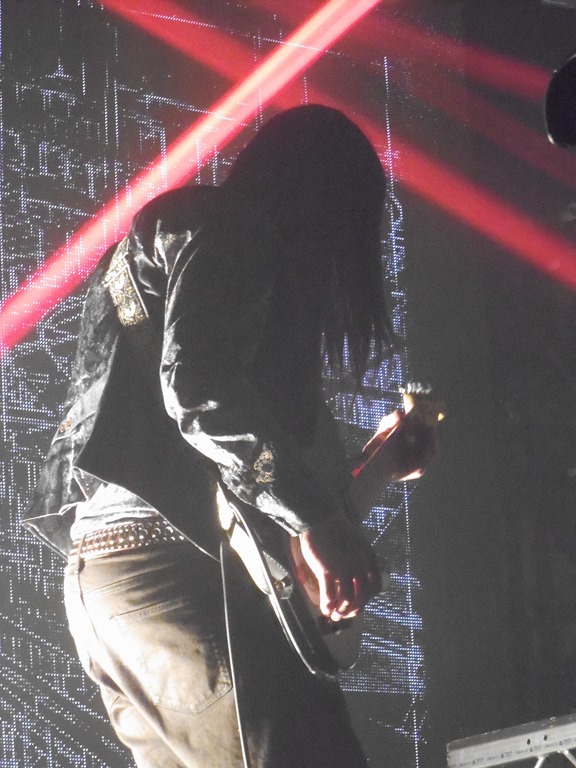
On the surface, the pair exist – and perform – in entirely separate, personal spaces, despite sharing a stage. The Bug – aka Kevin Martin – and Dylan Carlson, representing Earth, stand apart, separated by a wall of equipment: Martin is surrounded by banks of electronic gadgetry and stands focused on his Apple laptop for the majority of the set, while Carlson stands, side-on to the audience, one eye on Martin as he cranks out deep, seething drones and sculpted feedback squalls of noise.

DSCF8335

The Bug vs Dylan Carlson

Volume matters, and can so often prove to be integral to the live music experience: and this is loud. Proper, seriously, loud. Martin begins by sending bibbling waves of electronica out in juxtaposition to Carlson’s screeds of guitar: before long, it’s a veritable sonic tsunami as thunderous bass and violent blasts of percussion crash against a wall of relentlessly dense multitonal noise bleeding in every direction from Carlson’s fretboard. The bass frequencies – and gut-churning volume – are something else. Confetti glued by static electricity or other means to the venue’s high ceiling after being blasted out during the venue’s famous club nights shower down on band and audience alike as the thunderous vibrations rattle every molecule of the building’s interior fabric as well as my nostrils, my trousers and every inch of my flesh.

Many of the compositions are unrecognisable in relation to their studio counterparts, so radically reworked and so much more up front are the dynamics. This is no stealthy, sedate recreation of the album but something way more attacking and pure in its physicality. This is one of those sets which builds in intensity – and seemingly in volume – as it progresses, and toward the end, the pair drop a colossal slow-burner with slow, deliberate drops of bowel-shuddering bass frequencies: a single note resonates through the floor and the solar plexus for what feels like minutes, and the effect is utterly immersive and all-encompassing. The security guy in front of me, blocking the stairs (Heaven has a very strange arrangement of stairs up to the stag and only limited security at front of house, which is welcome), is clutching his ears despite waring plugs, and while it’s an uplifting euphoric experience which plasters a huge grin on my on face, it’s not hard to fathom why this much bass, and this much guitar, at this kind of volume, would cause discomfort. Because actually, it hurts. And that’s the best thing about it, because this is how it’s meant to be.