Industrial metal pioneers Godflesh will release their new album Post Selfon November 17th via Justin K. Broadrick’s Avalanche Recordings on CD, digital and LP formats, with a cassette version incoming on Hospital Productions. Over two years in the making, Post Self explores a different side of Godflesh, taking in their formative influences to conjure something informed by late 70’s/early 80’s post-punk and industrial music. The album deals with themes of anxiety, depression, fear, mortality, and paternal/maternal relationships.
Bleak Recordings/Division Records – 22nd September 2017
Christopher Nosnibor
Black Earth is pitched as and expansion on their previous releases, and as ‘a sonic mammoth that pushes their music even further into new dimensions of heaviness, harshness and despair.’ We also learn that ‘the lyrical themes are directly related to the presence and function of men in the planet and, particularly man himself.’ Given that man has pretty much singlehandedly fucked up the planet – creating the ‘black earth’ of the title, it’s small wonder that this is a work of seething fury edged with self-loathing and guilt.
‘(No) Shelter’ hammers out an industrial metal trudge reminiscent of Godflesh and perhaps even hints at early Pitchshifter, the mechanised drum explosions slicing through a wall of low-end grind that’s countered by tripwire guitars with some attacking treble. From the relentless, rhythm-driven maelstrom, vocals howl pure blackened nihilism. It’s a punishing eight and a half minutes and a brutal way to open an album.
‘Feral Ground’ plunges deeper into doomy drone in the opening bars before a pulsating throb of battering ram percussion and churning guitars and bass blended into a thick wall of sonic clay. It’s all about the chunky chop ‘n’ thud, stuttering, stop/start riffs, the trudging grind. One can trace a lineage of brutally nihilistic music which achieves absolute catharsis by simply bludgeoning the listener with brute force, and which possesses a tangible physicality from Swans’ initial phase, through Godflesh and Pitchshifter via Earth to Sunn O))). It’s within this context that Process Of Guilt introduce elements of Neurosis’ gnarly organic enormity to the slow pounding fury of their precursors.
On ‘Servant’, the guitars shriek in tortured anguish, the notes bent out of shape into howls of feedback while the rhythm section pounds on, hard. The twelve-minute title track is a relentless succession of sledgehammer blows, tearing guitar chords and straining feedback, and provides the album with a towering centrepiece.
The fifth and final track, ‘Hoax’ is a trudging dirge of a tune, nihilistic fury distilled and dragged to around 60BPM.
Black Earth is bleak, and it’s heavy, and it feels like the end of days.
They don’t make 12” EPs like they used to. While I was never big on the idea of packing a piece of wax out with remixes or an extended mix alongside the single version on a throwaway B-side, at its best, the format offered the punter an additional track over a 7” and larger artwork. But they haven’t really made records like that since the mid 90s or thereabouts.
Uniform’s Ghosthouse is a 12” in the style of the 12” EPs of old. And it’s a fucking belter, if you like dark, pulsating, intense noise. Early Godflesh make a reasonable comparison when it comes to this NYC duo’s uncompromising guitar and drum-machine assault, but the dingy punk din of Head of David and 90s noisemakers Headcleaner are also fair reference points.
The intense throb of the title track calls to mind Suicide with its primitive metronomic thudding beat and grating bass loop, but with a screaming lo-fi metal edge. Shards of feedback pierce the murk.
‘Waiting Period’ sounds like it’s coming from a long way away. Not so much lo-fi as no-fi, the production is more concerned with actually getting the track down on tape than making it pretty. the sound levels waver all over and the drums bounce around in a riot of reverb, while the guitars buzz in bursts of treble and the gnarled vocals… well, it’s anyone’s guess really, but the end result is something that sounds like a hardcore Dr Mix and the Remix – messy, but in a good way.
The final track, ‘Symptom of the Universe’ stamps the Unifrm sound on the Sabbath track, and amalgamates the grinding industrial metal fury of Ministry with the freneticism of Dead Kennedys – which, put another way, means it sounds a fair bit like Lard. With hollered vocals reverberating over a descending minor chord sequence and a guitar sound that’s pure overload, it hits optimal chuggage instantly. It’s crisp, sharp-edged and dangerous, and culminates in a full-on sonic supernova of mangled noise.
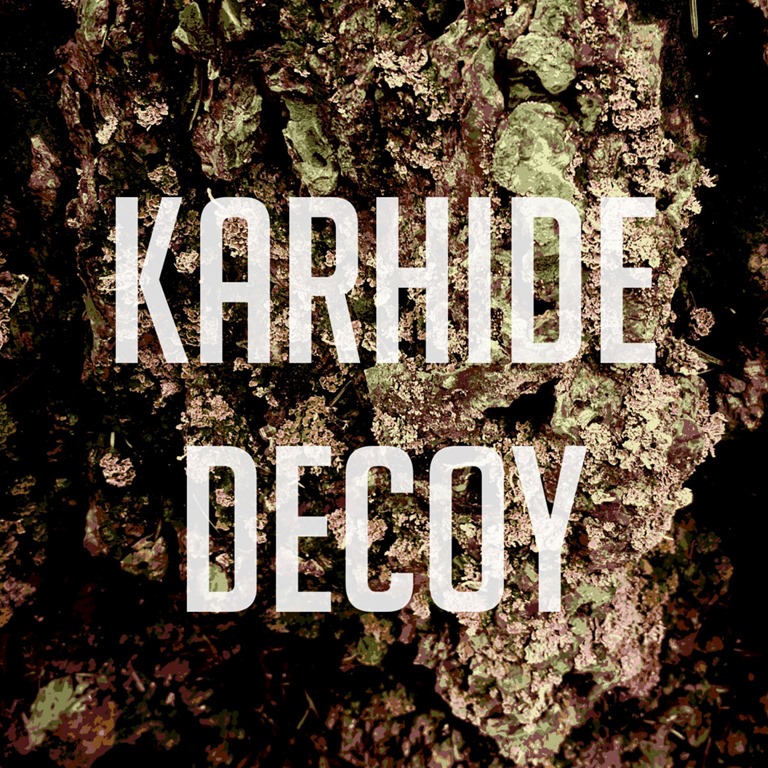
Karhide is Tim Waterfield, whose biography notes that he’s been programming beats for as long as DJ Shadow, but where Josh Davis came from a background of hip hop culture and breakbeats, Tim’s electronic upbringing in the East Midlands was through the industrial-strength beats of Godflesh and Frontline Assembly.
Formerly of ‘Big Black-but-one-louder’ Nottingham duo Ann Arbor, he throws all his past experience onto a choppy, grindy, angular racket on this two-track single release.
It’s a squalling treble-orientated racket with infinite twists and turns, a gnarly hybrid of Shellac and Truman’s Water and Jacob’s Mouse and Oils Seed |Rate and Arsenal, driven by the piston-pumping relentless thump of drum machine rhythms in the vein of Big Black. It’s abrasive, harsh and sinewy. And yes, it’s awesome.

 Aural Aggravation