Posts Tagged ‘found sounds’

Mortality Tables – 25th October 2024

Christopher Nosnibor

Some time in the last decade or so, genre distinctions simply exploded to the point of obsolescence. People – many people, and I won’t deny that I’m not immune or above doing so – will spend endless hours quibbling over categories. Is it post-punk or goth? It is doom or stoner doom? Country, or Western? Or both? It does seem that the ever-fragmenting microgenre, once the domain of dance, with its infinite focus on detail, has more recently become a battleground within metal – but then, a friend recently described an act as being ‘Jungle adjacent’ and I felt my brain begin to swim. What I suppose I’m driving at is that artists themselves are breaking out of genre confines and the place we find ourselves now is a point at which anything goes. But listeners – not to mention labels and journalists – or perhaps especially labels and journalists – find themselves clawing desperately to define whatever it is. There have to be benchmarks, touchstones, comparisons. We’re simply not attenuated to music which doesn’t conform to some parameters or others. This is one of a number of reasons that I tend to try to focus my attention on what a work does, what it actually sounds like, the sensations and emotions it elicits and other more tangential provocations – because the way we respond to music tends to be personal, and instinctive, intuitive. One may react immediately, and enthusiastically to a punch in the guts from an overdriven guitar, or may instead feel a greater emotional stirring from something soft and delicate, be it an acoustic guitar, a harp, or a flute. In summation, one’s first instinct is not to assess whether or not those opening bars belong to a specific microgenre, at least when it comes to a ‘blind listening’ experience.

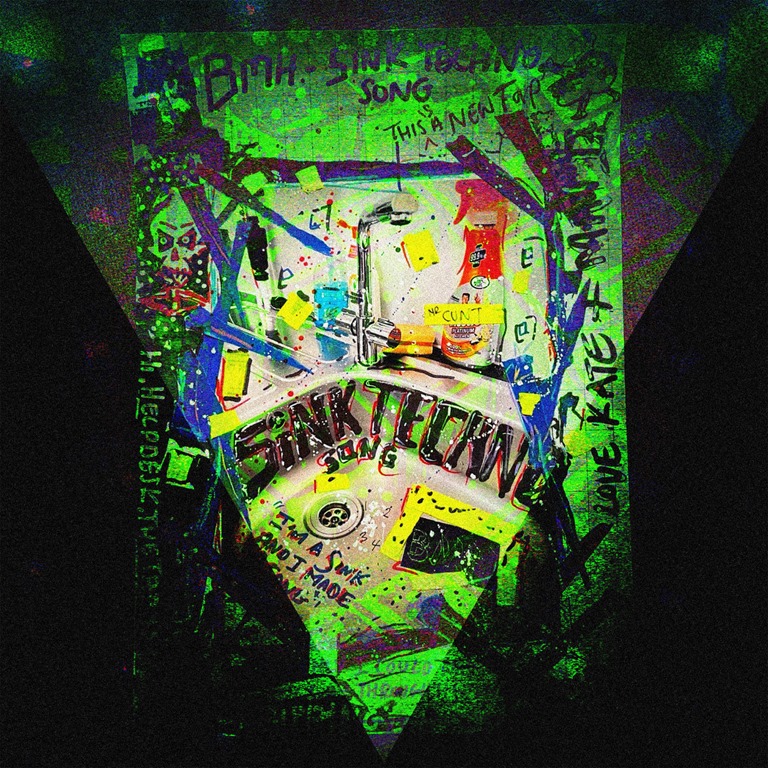
But then there’s always a spoiler, and here I find myself facing a ‘spontaneously-created acoustic punk techno EP made with a dripping tap’. What the hell do you do with that? How do you prepare for listening to something so far beyond the outer limits? Personally, I start by pouring a large vodka, and putting the light off.

The EP features four tracks; two versions of the title track, plus two versions of the longer ‘Water Sink Song’. The former centres around a relentless thudding beat, clearly derived from a dripping tap, with swishing, swashing, gurgling watery noises and other scraping and thumping and crashing incidentals. There’s nothing quite like taking the sounds from one’s surroundings and manipulating them in order to forge new sounds, and new sonic experiences. It’s life, but not was we know it. Or, perhaps it’s too close to life as we know it.

“Matt Jetten and I made the track in the sink at work,” says BMH’s Kate Bosworth. “The tap was leaking and we managed to get to it minutes before the engineer did. The original is in mono, but our mate Stuart Chapman (Terminal Optimism) suggested we ‘do a Beatles’ on it and bring it into stereo by duping and layering and adding effects etc. All in all, the process was very quick.”

‘Water Sink Song (End Dark Train 21st October 2024)’ features a haunting vocal which drifts mistily over a swampy swell and a thick wash of static, as well as more watery sounds, like heavy rain and swashing, glooping, the disconcerting sounds of ingress in a storm. The shuddering electronic rhythms call to mind Suicide, but with an esoteric folk twist; one can almost picture the performance of a pagan ritual at a stone circle in a torrential storm – but then stammering vocals cut through in a rising tide of mains hum and buzzing electricals. Synths buzz and crackle at the fade. The ‘Original’ version (17th October 2024) is more heavy rainfall and water running from a roofs onto gutters – or the sound of a number of men urinating hard onto a corrugated shed roof. Thuds, clatters, clanks, trickles and sprays, a bottle or jar filling at pace; the incidental sounds, the additional layers, are wet and uncomfortable.

It may be that my response is as much coloured – a hazy amber – by my recent experiences of a trip to Castlerigg stone circle in a saturating downpour, and a train journey whereby the train was rammed solid with rowdy football fans, who, unable to make their way to the broken toilets, resorted to urinating in water bottles and Costa coffee cups, which they left on luggage racks and on tables, while cheered on by mates passing more cans of cheap shit lager and a bottle of lager along the carriage.

Jetten’s vocals are breathy, semi-spoken, and there’s a sense that they’ve been recorded quietly in the bedroom of a flat or terrace, trying not to disturb the neighbours. There’s an element of triumph in the tone as Jetten announces the title, as if he’s utterly pumped by the experience – or something seedier.

As an experimental work that encapsulates the DIY ethos, this is a quality example of the kind of weirdness that can only happen independently. It’s perverse, and imaginative, and it’s different. Oh, and all proceeds go to Kidney Cancer UK.

AA
a4195200752_10

Preston Capes – PCT001 – 1st July 2022

Christopher Nosnibor

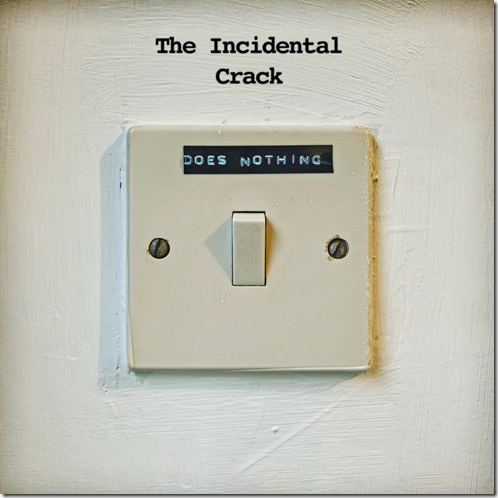
The Front & Follow label may have reverted to mothballed status (at least for the time being), but that doesn’t mean that Justin Watson is doing nothing these days, despite the title of the latest release from three-way collective The Incidental Crack, who we’ve been following – and covering – for some time here at Aural Aggravation. For this outing, they’ve found a new home on newly-established cassette label – and these seem to be springing up all over now – Preston Capes (and I’m guessing no relation to Geoff).

As the notes explain, ‘The Incidental Crack began with Rob [Spencer] recording himself wandering around in the woods and finding a ‘cave’ – Justin put some weird noises to it, and then Simon joined in. The rest is history. The Incidental Crack are joined again by Dolly Dolly / David Yates on this album.’ Indeed, however much The Incidental Crack may evolve, they remain fundamentally unchanged, their albums assemblages of random field recordings and strangeness melted and melded into awkwardly-shaped sonic sculptures that unsettle the mind and by turns ease and tense the body.

The Incidental Crack Does Nothing follows the two albums they released in 2021, the second of which, Detail, was a challenging and expansive work, and this very much continues in the same vein.

With The Incidental Crack, it very much feels as if anything goes, and reflecting on the name of the collective, this seems entirely appropriate. What their works represent is a crack, a fissure, in time, in continuity. Their methodology may not be specifically influenced by William Burroughs and Brion Gysin’s cut-ups, but are, very much, open to, of not specifically channelling and incorporating, the assimilation of random elements, and have a collage aspect to their construction.

‘Shitload of Rocks’ is comparatively airy, and serves as a brief introductory passage before the dank, gloomy ambience of ‘The Worst Party’. It’s a dark, ominous piece that hovers and hums, echoes, clanks, and rumbles on for a quarter of an hour; it’s cold, clammy, and unsettling. But is it the worst party ever? While it does sound like hiding in a cave while an armed search party charged with the task of your erasure stomp around in adjacent tunnels off in the distance, I don’t actually hear any people, laughing drunkenly or loving the sound of their own voices while holding court with tedious anecdotes, so I don’t think so.

‘Hair falling from our bodies clogs up the sewers,’ we learn as a clattering beat clacks in and rattles away on the industrial chop-up churn of ‘Hair’, featuring Dolly Dolly, who’s clearly no sheep. It’s the album’s most percussive cut, the monotone spoken-word narrative somewhat surreal, and looping eighties synths bubble in around the midpoint, although it’s probably too weird for the Stranger Things retro adopters.

‘Couch Advantage’ is the album’s second longer piece, a sinuous, clattering workout almost nine minutes in duration. It’s minimal, yet somehow, there’s enough stuff going on as to render it all a blur: is that jazz drumming, a groove of sorts off in the distance? Or is it simply some clattering chaos, the sound of bacon sizzling? What is going on? And following the brief interlude that is ‘Belting’, the final piece, the ten-minute ‘Photography’ with more lyrical abstraction from Dolly Dolly depicting random fragmentary images against a backdrop of clicking sparks and evolving, supple sweeps of drifting clouds of sound. It’s all incidental, every second of it: fleeting, ephemeral – and in the cracks, is where it happens. As they open wider, you peer in, and observe. There is movement. There is life. Because life is what happens between the events, among the random incidents and accidents.

The Incidental Crack Does Nothing may be confusing, bewildering, difficult to grasp – but it is, without doubt, a slice of life. You can do with that what you will.

AA

cover

Fabrique Records – 29th April 2022

Christopher Nosnibor

On her latest project, Jana Irmert shrinks the focus of her thoughts and her music on the microcosmic – although that certainly doesn’t extend to the microtonal. What Happens At Night is an intensely-focused work that places the lens onto textures and tones, and an examination of the relationship between the physical and the cerebral. You may call it a celebration of overthinking, but ‘philosophical’ feels a more appropriate term for her musical meditation on life and death – specifically death and beyond, the part of the life journey no-one has ever reported on and will, one assumes, be forever unknown and unknowable.

The liner notes set out the granular nature of the album’s composition: ‘Like layers of sediment, sounds are being pushed up from underneath, floating away or sinking back to the bottom. At the core of the album lies a question: What will be left of us? While Earth melts, we go on. But eventually, there will be a point in the future where all that will be left of humanity is a thin layer of rock. While this may seem like a deeply gloomy prospect, it also carries a great deal of comfort: the reminder that we are only a small particle in a vast system so big that we can never fully grasp’.

This is the limitation we all live with: the inability to comprehend life without us, what it would be like to not exist. Much of it’s ego, but perhaps it’s also a preprogramed limitation. Everything is dust, and once we pass, ashes to ashes, dust to dust, we become desert, and nothing changes: the world goes on… and on. And that’s a disheartening prospect; for the majority, our legacy won’t extend beyond our lifetimes, and the world at large is unaware of our existence while we’re here, let alone likely to experience any ripples in our wake. But even the world will be finite, ultimately. It will be swallowed by the sun in supernova. But none of us will be here to report on it by then.

What Happens At Night is dark and stark, and with just four tracks and a running time of less than half an hour, it’s perhaps technically only an EP, but feels like an album in every respect.

There’s a dolorous chime of a bell and a shrieking anguish of tortured spirits trailing like comets fading through the sky at the start of the album’s first piece, ‘Particles’, and everything simply floats and drifts. It’s ambient in the conventional sense: it’s background, you don’t really pay close attention while it’s playing, but it does subtly slant the mood.

‘Ashes’ is but a drifting fragment between the megalithic pieces on either side: it’s barely three minutes in duration. If ‘Dust is the Rust of Time’ is sparse it’s also dense, and a sedated heartbeat pulses uncomfortably throughout, amidst shuddering, gasping breaths of panic. You feel the anxiety at the passing of time; what have you achieved, and what will be your legacy? How will you be remembered in a world without you? It’s a tense, dense, gloomy sound, and you come to realise you are nothing, you’re simply here to go, and one day you will be but dust. Deal with it. And yet… It’s not a question of there being something more beyond, as such. And yet… ‘Stratum’ closes, and it’s the splash of waves and the quiet roar of a buffeting wind and the slow sound of the dust settling as incrementally, life returns to earth in slow, sedimentary layers, and each layer fossilises a period in time for all eternity. You may be dust, you may be forgotten, but in some form, are eternal in the earth.

Irmert articulates nothing specifically or directly here, but instead, What Happens At Night provides a sonic backdrop which invites contemplation.

AA

FAB097_front

15th March 2021

Christopher Nosnibor

It’s been a full decade since I first encountered the surreal & fantastical world of Sone Institute, the vehicle for electronic artist Roman Bezdyk, and I’ve followed his work up to 2018’s Where Moth and Rust Consume, which was championed by 6Music’s Gideon Coe.

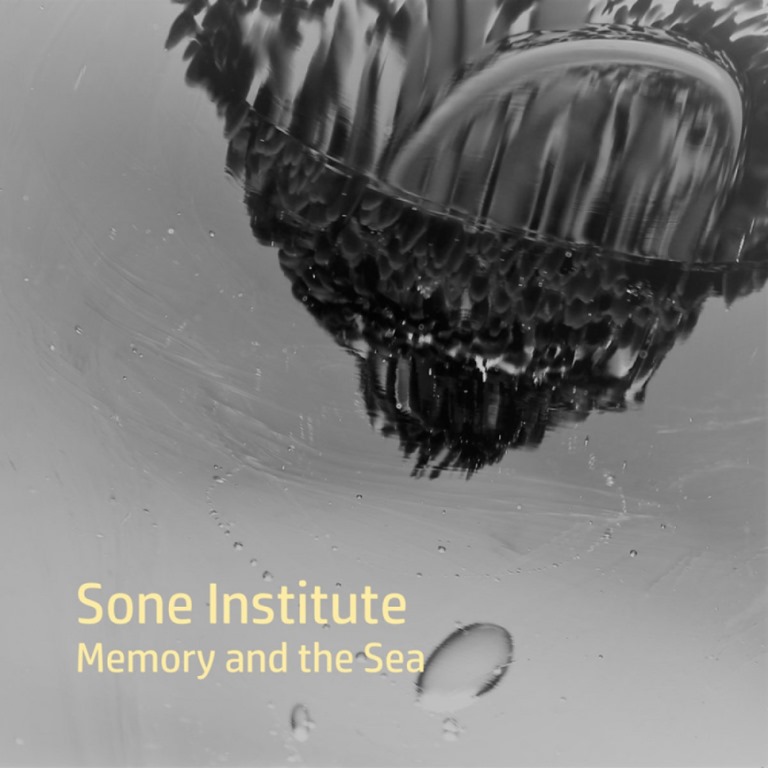
Bezdyk’s output has always been interesting, and always evolving, and this standalone single release, which spans a full ten minutes, is an evocative work which draws together, as the title suggests, the sea and the echoes of memory.

There is something unique about the sea and its pull, and I suspect many of us have some memory connected to the sea, be it a family holiday or a journey by boat or ferry. And because the sea is capable of such very different states or moods, from the tranquil lapping of a low ebb to the raging torment of a storm or even a tsunami, so our relationships with the sea are likely to be wide and varied, and a love of the ocean must necessarily be tempered by a certain caution.

Chiming bells ring out against a sloughing wash of waves on a beach, and ‘Memory and the Sea’ brings the more tranquil aspect of the tides to the fore instead of elevating the tempests that can destroy lives and landscapes, through a combination of field recordings and abstract wavering drones. Amidst woozy, warping electronic tones the listener is pulled back to some kind of reimagining of the sea in some almost generic form: every moment spent either building sandcastles or otherwise simple staring out across the rolling waves merge together to forge a new consciousness which may or may not be real. The colour fades and takes on a Polaroid filter, or the soft hue of a dream. Wish you were here?

AA

a4243834059_10