Posts Tagged ‘Fibonacci Drone Organ’

Dret Skivor – 4th April 2025

Christopher Nosnibor

This latest release on Swedish microlabel devoted to the most underground of underground music, Dret Skivor, may be form an act we’ve not heard of before, but something about it has all the hallmarks of the eternally prolific Dave Procter all over it. The man behind Legion of Swine (noisy) and Fibonacci Drone Organ (droney) and myriad other projects and collaborations – some occasional, some one-off – has a distinctive North of England drollness and a penchant for pissing about making noise of all shades, after all.

Released on CD in a hand-painted edition of just two, the notes on the Bandcamp page for the release are typically minimal: ‘Is it dungeon synth? Is it just spooky music? Is there torture afoot?’ I would say I will be the judge of that, but dungeon synth is a genre I’m yet to fully get to grips with, although it does for all the world seem as if it’s a genre distinction that’s come to be applied to spooky music, and seems to have grown in both popularity and usage comparatively recently, despite its roots going back rather further.

The cover art doesn’t give much – anything away, and in fact, I might have hoped for something more… graphic. But perhaps less is more here. However, the titles of the two tracks –‘the shithouses’ shithouse’ and ‘the festering flesh of the neoliberal’ are classic Procter and could as easily be titles for poems by Dale Prudent, another of his alter-egos.

The first begins with a swelling thrum of what sounds like a chorus of voices, possibly some monastic indentation, layered and looped and multitracked to create a torturous cacophony. For the first twenty, thirty, forty seconds, you wait for a change to come, for something to happen. After a minute that expectation is diminishing, and by the three-minute mark it’s impossible to be certain if there really are keyboard stabs swirling in the mix in the midst of it all, or if your ears and mind are deceiving you and you’re losing the plot. For some reason, I’m reminded of the Paris catacombs – not because it’s actually creepy, but because, just as seeing rows and rows of bones stacked up for quite literally miles becomes both overwhelming and desensitising after a time, so hearing the same sound bubbling away for ten minutes is pretty much guaranteed to fuck with your head. Near the eight-minute mark, there are most definitely additional layers of buzzing drone and there are some tonal slips and slows, like listening to a tape that’s become stretched or is slipping on its spool, but by this time your brain’s already half-melted, and I find myself contemplating the fact that while visiting the catacombs on a sixth-form art trip, one of my fellow students accepted the challenge to lick a skull for eight Francs – which was about a quid at the time. I was less appalled by the fact it was a human skull than the fact the bones looked dusty and mossy, and had probably been touched by even more unwashed hands than the handle of the gents lavs at a busy gig venue.

And so we arrive at the twenty-two-minute ‘the festering flesh of the neoliberal’. It begins with a distant clattering percussion – like someone bashing a car bonnet with a broken fence post heard from a quarter of a mile away, but with a gauze of reverb, as if echoing from the other side of a valley – or, put another way, like listening to early Test Dept through your neighbour’s wall – while a pulsing, pulsating electronic beat, like a palpating heartbeat, thuds erratically beneath it. And that’s pretty much it. But there are leaps and lurches in volume, and the cumulative effect of this monotonous loop is brain-bending. There are gradual shifts, and seemingly from nowhere rises a will of croaks and groans which grow in intensity, and it may well be an auditory confusion, but regardless, the experience is unsettling. Twenty-two minutes is a long time to listen to a continuous rumbling babble that sounds like droning ululations and a barrage of didgeridoos all sustaining a note, simultaneously, for all time.

Is it dungeon synth? Probably not. Is it spooky? Not really. It is torturous? Without doubt. This is a tough listen, with dark babbling repetitions rendered more challenging by the cruelly long track durations. The torture afoot is right here.

AA

a2009823040_10

Dret Skivor – 1st November 2024

Christopher Nosnibor

Procter’s been at it again. The only artist I know who can go on tour and play under different guides doing different music – or ‘music’ – depending on the booking. Not that anything he does is commercial or has any kind of mass appeal: it comes down the question of if you’re on the market for harsh noise or something a bit gentler. And how he’s back from one of his excursions, here we have new studio work, which clearly didn’t make the merch table – released in a limited physical edition of just three hand-painted CDs.

One might wonder just how far it might be possible to push the concept of Fibonacci Drone Organ, but since the mathematical Fibonacci sequence is endless, so it would seem are the limits of this project. This particular outing, with a title inspired by Ken Loach, does mark something of a departure for FDO, being less droney and more barrelling bassy murky noise. It’s also more overtly political – nothing new for Dave Procter, but usually something reserved for his other projects.

‘Disenchanted with the state of the fucking world? You’re not alone’ he writes. ‘This is a synthesised reflection of the current state of my brain. I hope it brings you some peace.’

How much peace one can expect from longform tracks entitled ‘war war death death’ and ‘american client state’ it’s hard to really know, but I for one can relate to Proctor finding solace in the cathartic release of creating dense noise. Because there comes a point where words are not enough: indeed, there are no words. In fact, I derive some comfort – small as it is – from this release. It does indicate that the state of Dave’s brain isn’t the best, but with the US election looming and the very real possibility that Trump could become president again, I can’t help but feel a combination of gloom and outright terror. In recent months, as the war in Ukraine has rumbled on, and the hell on earth in Gaza has escalated, and escalated, and escalated, and Israel’s nauseating genocidal mission continues to be funded by the West, it’s felt like a growing weight in the atmosphere. I’ve found myself tense and on edge. Everything is wrong. ‘I find no peace,’ as Thomas Wyatt wrote.

It feels as if the world was waiting for the pandemic to pass, and as if during the successive lockdowns, world leaders were simmering, festering, building their fury to unleash the moment restrictions were listed. Recent years have been painful, and as Procter’s brief notes indicate, there are many of us who are struggling, powerless, as our governments continue to push the line of Israel’s ‘right to defend itself’. No-one would deny that right, but no rational person would agree that a death toll of almost 44,000 – with many tens of thousands of women and children, not to mention other civilians in that figure – is proportional, or merely self-defence. While news outlets do report these figures – which are, it has to be said – beyond nauseating – there is no compassion in the reporting. Deaths are but numbers, the words ‘humanitarian crisis’ but words. The images of smoke and dust and devastation are horrifying, but to actually be in the midst of it, with no safe places to go, as schools and hospitals are targeted, is beyond imagination.

It’s in this context that Procter has created two grey, grating, heaving and ugly tracks, one fifteen minutes in duration, the other over twenty-three.

‘war war death death’ is bleak, and dense. There’s the heavy whip of helicopter blades at the hesitant start of the track, which gradually emerges as a long, wheezing, churning drone, resembling the rumble at the low end of the mechanical grind of the first Suicide album. And this is pretty much all there is. And from this minimal piece emerges a sense of desolation, particularly as the end, which concludes with just rumbling static – and nothing. Devastation. Dust. Annihilation.

‘american client state’ is again, heavy a serrated edged, humming drone that hovers, panning and circulating like a malevolent drone. It’s pitched in the range that really gets under your skin and penetrates the skull, not in an exhilarating way, but instead slowly wears down the spirit, dissolving any sense of motivation. The monotone hum seems to somehow articulate, in ways that words cannot, the sense of powerless I personally feel, and suspect others do, too. There’s something empty in the monotony, not to mention a squirming discomfiture. What can we do?

All digital sales money from this release will go to the Palestinian Medical Relief Society, and while it may be a drop in the ocean, and while what needs to happen is for aid to actually be allowed to be delivered – something which will require an intervention which is long overdue – something, anything, is better than nothing.

Often, there’s a droll humour to Dave Procter’s work, but apart from the title, the higher the monkey climbs, the more you see of his arse is a bleak work, and a depressingly droney as it gets. But it provides an outlet, an expression through which to focus that release, and reminds us that we must hope against hope for better ahead.

AA

a1192190513_10

Ojud Records – 1st January 2021

Christopher Nosnibor

It may only be January 1st, but 2021 already feels very much – as expected – like a continuation of 2020. As a friend pointed out to me only this morning, in summarising the fact that the pandemic position remained unchanged and now we had the added shit bonus of having fully left the EU, ‘shit never sleeps’. Seeing so many post on social media about being glad to see the back of 2020 was somewhat depressing: I get the sentiment, and very much am on board with the significance and psychology of book-ending a period of time with the striking of midnight marking the start of a new calendar, but really, what changes? This year or ever?

One positive of this continuity is that Dave Procter is kicking off the new year where he left off the old one, namely by making and releasing more noise, and its timing is noteworthy, as a common theme within Procter’s work is some form of commemoration or ritual, with events like midsummer drone walks

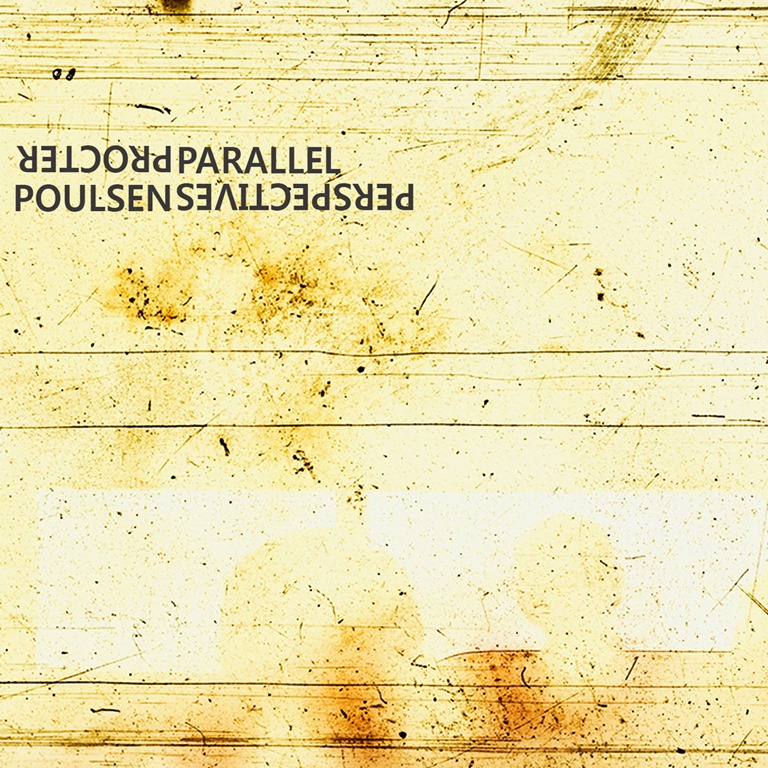
This time, it’s with an alliteratively-titled work with occasional collaborator Claus Poulsen, with whom he plays one concert and makes one release every year. Parallel Perspectives is very much from the dronier end of his working spectrum, and follows Solaris (2019) and Minimum / Maximum (2018) in a continuum stretching back to 2015 and the release of his first work with Poulsen, PP. The release of Parallel Perspectives being a day late for 2020, despite having been recorded almost a year ago on 20th January 2020 also seems somehow, if accidentally appropriate, and something that won’t be lost on the artists, not least of all with Procter having relocated to Sweden ahead of the finalisation of Brexit. And works like Parallel Perspectives illustrate why: when creativity is so reliant on collaboration, free movement is essential, and this is a perfect advertisement for everything the un-UK has just thrown away in the name of ‘sovereignty’.

Not that there is anything remotely political about the album itself: this is purely a coming together of musical minds, and a celebration of their commonalities and differences – and it’s that mutual understanding, paired with an awareness of the power of contrast that make this.

As the liner notes detail, Parallel Perspectives was recorded in Copenhagen. The single track on the album is an extension of Procter’s Fibonacci Drone Organ minimalistic project, but with Poulsen adding overdubs. With his different perspective, he quickly forgets the minimalistic nature of the piece and details it with waves of half speed vinyl and samples.

An elongated organ drone hums, hovering and wavering gently in semi-stasis. Ruptures and incidentals abound, from seemingly random discordant cascades of sound and piano interjections to slow-whispering thermal winds and desolately chill nuclear gusts, and I’s remarkable just how much those details prove to dramatically colour the mood. Perhaps it’s the – for a better term – blankness of the flat organ drone that is as much key here, in that as of and in itself, it has no particular ‘mood’; it’s a neutral sound, imbued with precisely nothing. It’s only when rubbing against or along with another sound that it slides upwards or downwards, into light or darkness. There is no shortage of either over the course of the album’s fifty-three minutes, but there are many protracted passages which explore the realms of the ominous and eerie, the uncomfortable and the suspenseful, as fear chords creep like drifting mist in a dark city alley.

At times, it chimes, and at others, it grates. Sometimes it rings, and at others it drifts. At times, it swells, at others it tapers to nearly nothing. Its pace is barely perceptible, a continuously creeping shift, not so much a slow-burn as a smoulder of smoke tricking from a peat burner, and the layers added by Poulson only serve to protract the transitions, grinding a slow-motion audio that has a cognitive effect as you feel yourself slowing in line with its interminable aural crawl. And for all the moments that sounds like there is a heavy craft looming on the horizon, for all the protracted ponderous spells, there are moments that sound very like the soundtrack to breaking dawn, the soundtrack to redemption on the horizon.

Parallel Perspectives is subtle, but the devil is very much in the detail here.

AA

a1597962294_10

Christopher Nosnibor

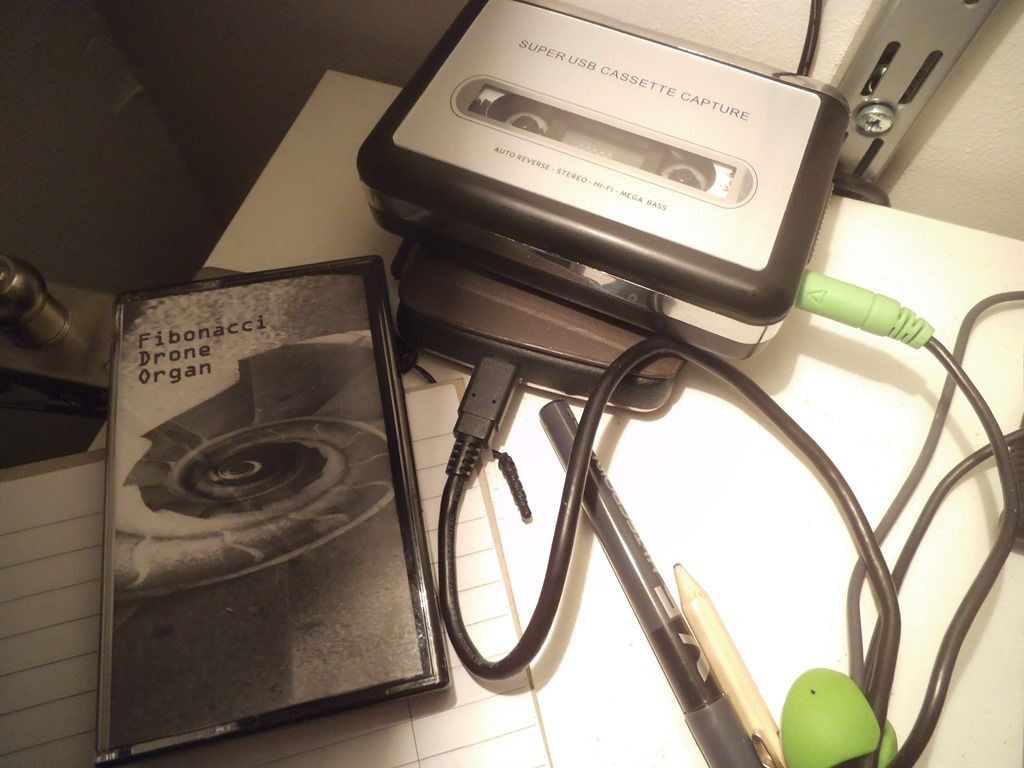
Fibonacci Drone Organ: three random words spliced together, unshackled from the constraints of context to allow free association to determine interpretation? Or a descriptive indication of what Dave Procter’s second- or t(h)ird-latest (this month saw the debut of HUNDBAJS, which is Swedish for dogshit, the absolute latest) of his myriad projects which include the Wharf Street Galaxy Band and Legion of Swine? The cassette release contains precisely no information whatsoever, even down to a track listing, but a spot of digging reveals that it’s the latter – which should come as no surprise, given that the man behind FDO curated a ‘10 Hours of Drone’ event a while back. The album contains two pieces, each occupying a side of the tape, and they’re formed around droning organ notes. Long, long droning organ notes.

And my (rather limited but suitably fruitful) research uncovered that FDO ‘uses the Fibonacci Series as part of the compositional process,’ that ‘the notes are chosen via dice rolls and coin tosses,’ and that ‘the durations of the notes are chosen by the Fibonacci Series. Notes are added at the appropriate time.’

From this, I infer that in technical / theoretical terms, FDO compositions emerge from an intersection of John Cage-inspired randomness and the mathematical precision of Fibonacci. What this actually means, ‘m not entirely sure, and thankfully, the technical aspects don’t impinge too heavily on the output from a listening perspective. Ultimately, it’s all drones. And on this outing the ‘appropriate’ time for adding noes is seemingly after an eternity.

This means that across the tape’s duration, not a lot happens. Notes may be added, but at such distance that the layers build so gradually that the pieces are over before much depth, resonance or layering has occurred. This is all testament to Procter’s unswervingly uncompromising approach to music-making, and encapsulates the reasons I personally hold him in such high regard (and it’s fair to say that if there’s one person I’ve worked with who’s intuitively understood my vision for creating spoken word with the most hellishly mangled noise, it’s Dave who’s been behind the majority of my best and most exhilarating collaborative live work). With more projects, pseudonyms and releases to his credit than seems humanly possible, he’s practically a one-man underground scene in his own right. Look up ‘northern avant-garde’, and you’ll likely find a picture of Dave Procter – or a bloke in a lab coat sporting a pig’s head or something.

Procter gets art, and is an artist, but doesn’t espouse the pretentious trappings of being an ‘artist’ (or, worse still, an ‘artiste’). Which means he can not only get away with releasing a tape containing 40 minutes of theory-backed drone without appearing a tit, but delivers some of the most brilliantly self-aware electronic drone you’re likely to find.

Side two (not that the sides are marked) brings a quavering decay to the elongated drones – which hover toward the higher frequencies – by way of contrast to the strong, stable drones of side one. The effect is cumulative and ultimately soporific, and it’s definitely the music and not the beer as I listen to the spindles rotate on my tape deck and the notes drift from the speakers. Sometimes, there’s no shame in sleep.

DSCF6863

AA