Everest Records – 14th January 2021
Christopher Nosnibor
Language is fluid, it evolves. Sometimes I appreciate that, and like the fact. Other times, this is something which can be intensely frustrating, and it seems the meaning of hypernormal has evolved – seems to have been reconfigured, rechannelled – with remarkable rapidity. Initially, it was something of a colloquialism, an on-trend sassy term to describe something that was so normal it was beyond bland.
The connotations of the scarily mundane, the individual who was so lacking individuality that they made clones appear unique, which emerged late in the first decade of the new millennium remained largely stable until Adam Curtis delivered his seismic three-hour documentary in 2016, which espoused the theory that HyperNormalisation is a process whereby a mundane, readily-digested version of life and society has been superimposed over the complex world by those in power. And so according to this, we now live in a ‘fake’ world. And this concept of a constructed reality overlaying the true reality seems unsettlingly feasible. What, and who can you trust or believe? Trust no-one; believe nothing.
Perhaps because I think too much and don’t sleep enough, I’ve wondered ever since I was a child if the world we live in is real, or if we’re all figments of our own imagination, and if reality is a construct. Yes, I experienced existentialism combined with some kind of take on The Matrix at the age of five. But I digress, and there is a point to all of this, and that is that nothing is fixed, nothing is certain. We know so little, we don’t even know ourselves.
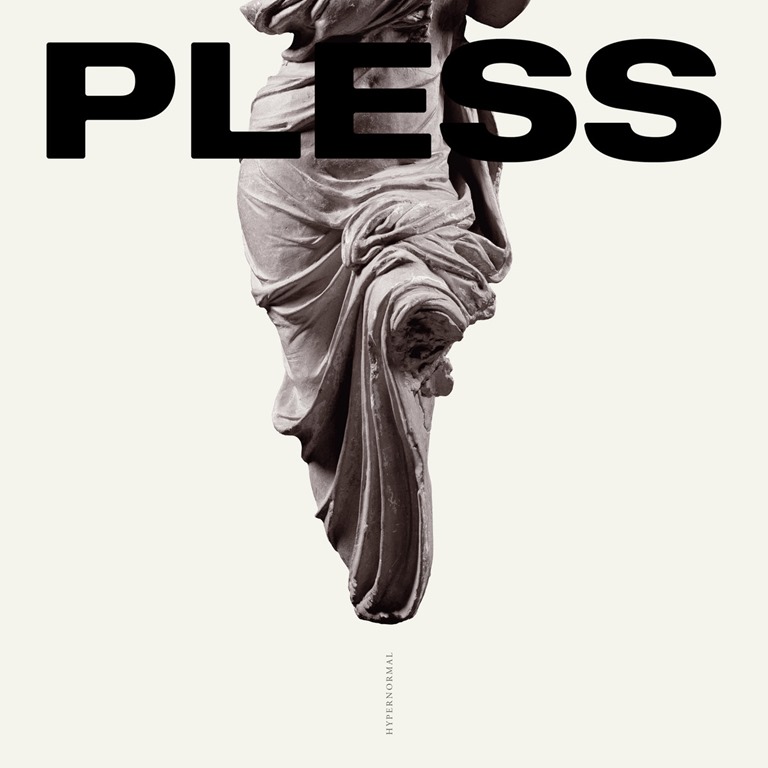
Pless’ hybrid sound is absolutely not normal, and it’s certainly not normal beyond normal so as to be the next level of mundane; but nor does it feel entirely like a carefully-constructed fiction which bears the ultimate lie. That said, there is a certain element of deception here: the façade of simplicity, of minimal, semi-ambient electronica belies the detail and complexity of these layered compositions, and as such, it’s something not normal, disguised as something that resembles normal, or at least familiar. Ultimately, it’s something else entirely; something mellow, something layered, something dark and something light. All of this filters into cognisance in the first piece, the slow-paced, semi-abstract ‘Azure’, whereby spectral synths drift around a metronomic drum and ever-moving bass tones.
The drum sound is noteworthy: it’s somehow immediate, up-front, and dry, as well as reverby, landing between Joy Division and Duran Duran.
The synths of ‘La Cienaga’ lean towards A Flock of Seagulls, but the stuttering drums and stammering incidentals contribute to transporting this track to another place entirely, one filled with dark shadows cast by brooding electropop and darkwave. Meanwhile, the six-minute ‘La Grenouille Volante’ has a bass that thrums like an engine throbbing at the dark heart of its soft ambient washes and distant drums. Around two-thirds in, it unexpectedly revs up a gear, and while the same, the additional volume translates to additional intensity, too.
The haunting, spectral organ drone of ‘Ante finem’ is blasted through with hefty tribal percussion, gradually shifting to a slow, deliberate bass-driven trudge, while ‘Fog City’ is every bit as murky and disorientating as you would likely imagine, with vocal samples and reverberated snare cracks echoing through stark synth stabs, and ‘Hot God’ comes on like a collision between Kraftwerk and DAF with a dash of early New Order, mining a deep seam of late 70s/early 80s electronica. The final track, the ten-minute ‘Reodorant’ is a dark-ambient epic in every sense, deep, moody, a little unnerving.
Each of the pieces shifts as it progresses, and evolves over the course of its duration, often subtly, twisting through expansive soundscapes front one plateau to another. Under the cloak of minimalism is shrouded considerable detail, and a quite remarkable focus on texture and movement. Even in the most stagnant of moments, there isn’t an element of stillness here. It may be cold, it may be distanced, but it’s also quite its own work. Normal? What even is that anyway? Stark, sparse, yet so, so rich, with Hypernormal, it becomes clear that Pless is more.
AA


 Aural Aggravation