Posts Tagged ‘Eric Quach’

18th April 2025

Christopher Nosnibor

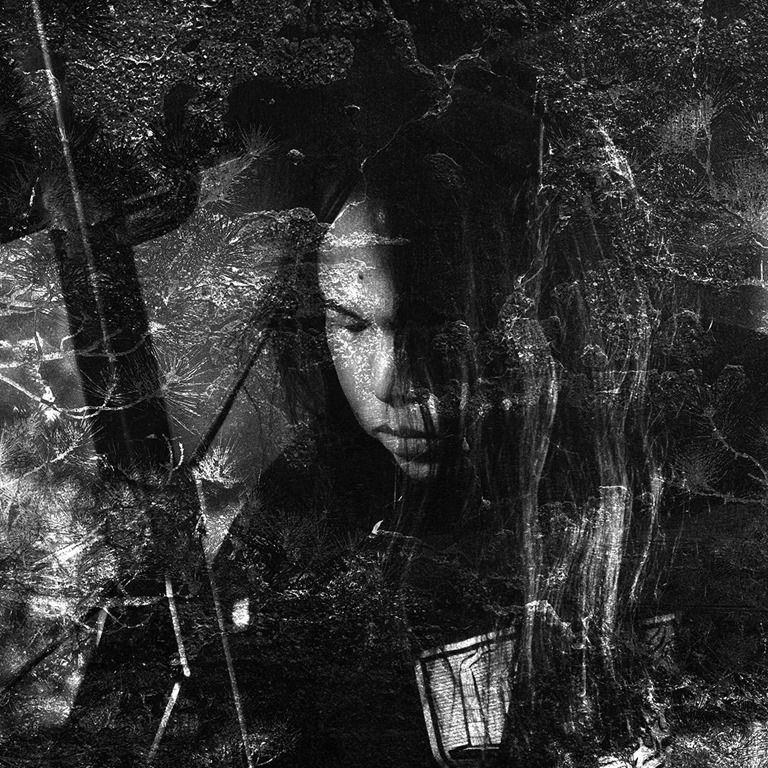
Eric Quach has been making music – or perhaps more accurately sculpting sound on the fringes of music – as thisquietarmy for over twenty years, amassing a substantial body of work as a solo artist, with an expanded band lineup, and with various collaborations, the most recent being Cîme, his second with Tom Malmendier

We learn that Langue Hybride was written and arranged in less than 4 weeks during thisquietarmy’s music residency at Centre d’Expérimentation Musical (CEM) in the region of Saguenay—Lac-St-Jean, Québec.

The album consists of five longform tracks, which range from seven and a half to sixteen minutes in duration. It’s the shortest work, ‘Les Rayons Cosmiques’ which lifts the curtain the album, with droning, dolorous strings and distant, delicate percussion conjuring evocative atmospherics, coloured with both a simmering tension and an underlying sense of sadness, which, while hard to define, is palpable. Around the midpoint, that distant percussion builds to stand front and centre and a groove emergers, suddenly and unexpectedly, and the whole feel changes towards something that’s a cinematic hybrid of folk and space rock.

‘Respirer l’instabilité’ crashes into altogether darker territory, a gloomy, doomy trudge of slow, deliberate drumming and a low, grinding bass, over which discordant sonic mayhem plays out. After a lull of calm around the mid-point, a pulsating rhythm merges, and things evolve into a strolling wig-out with some strong jazz-funk leanings and already, a pattern is beginning to emerge in terms of compositional structure, in that around halfway, the trajectory shifts, and the piece ends in a completely different place from the one in which it started.

This is confirmed by the pivot which takes place around five minutes into the third track. Reminiscent of latter-day Swans, ‘Les radicaux libres’ is woozy and weird, expansive and haunting, and begins to pick up pace and volume six minutes in, building to a bursting sustained crescendo that’s both hypnotic and tense, and if ‘Organismes en aérobiose’ starts out soothing, the sound of dappled sun through leaves on a summer’s day, it transitions to a fist-waving stomper and concludes as a skyward-facing surge of sonic exultation, via the detour of a post-rock tidal wave, while fifteen-minute closer ‘Solastalgie impalpable’ rides a wave of thick riffage and strings reminiscent of the long play-out on ‘Layla’ – only this is arguably more successful, as it always felt like an epic and overlong anti-climax in the wake of that guitar-line. True to form, ‘Solastalgie impalpable’ does make a shift, tapering into some elongated swirling drones which reverberate and rattle the ribs and taunt the senses, before suddenly bursting into life with a driving rock riff by way of a climactic finale.

Langue Hybride is a wild ride, and while claims for acts producing ‘genre-defying’ works are not just tedious and predictable but usually completely spurious, there’s no neat way of categorising this schizophrenic hybrid, where each track is a work of two halves, presenting almost oppositional styles and characteristics .But this stylistic polarity makes for exciting – if challenging – listening: given that the only thing that’s predictable is that each piece will fly in a different direction at some point, there’s no way one could call this album predictable. The vision – and its execution – are superb, and with Langue Hybride, thisquietarmy offer something which is quite different, and rather special.

AA
a1481414249_10

Midira Records – 25th November 2022

Christopher Nosnibor

This album is, as the title suggests, a soundtrack work. Although released under the moniker Houses of Worship, it’s essentially the second album by Thisquietarmy x Hellenica.

The summer of 2020 saw Eric Quach (thisquietarmy) and Jim Demos (Hellenica) come together to record a collaborative album, which emerged as Houses of Worship, described as ‘an epic work of experimental industrial ambient, is an ode to dying buildings and the unwelcome gentrification of neighborhoods’.

This, the follow-up, came about after they ‘played their first concerts in the streets of Montreal from inside of a cube truck. These performances were filmed and recorded to produce "TQAXHLNKA: MIGRATION,” a twenty-two-minute experimental art documentary and an accompanying soundtrack. The film simulated the cautionary tale of what the Montreal arts and music scene could look like in a post-pandemic world. As the title suggests, it reflects the highly concerning exodus of artists constantly being divided and pushed out further from their community.’

At twenty-two minutes in duration, it’s a minute short of the magic spot, but this is a magnificently atmospheric work that goes beyond dark ambience and ventures into the vastly cinematic, space-drifting expansiveness that transports the listener beyond the terrestrial domain.

The album contains more audio than the film’s running time, and drags the listener through a bleak journey which articulates via the medium of sound the themes and scenes which preoccupy the duo, who explain, ‘With the current struggles linked to the pandemic restrictions, we have seen the acceleration of the gentrification process in neighborhoods where the heart of these activities takes place. As a result, a multitude of venues, studios and artistic spaces – places used for exchanging ideas with our peers and building communities meant to inspire and nurture our souls had to shut down.’

The tone is dark, the textures industrial, yet tinged with echo-heavy melancholy, a combination of anger, emptiness, and sadness. The soaring drones inspire a certain elevation, while the gritty grind is the sound of construction, regeneration. Gentrification is the face of capitalism eating itself; having run out of new ideas, it’s simply fallen into a cycle of recreation and rehashing. Upscaling, upwhatevering, it’s all about selling the new version of the same od shit at a higher price to the same saturated market. When will enough ever be enough?

Meanwhile, capitalism follows the former tropes of the avant-garde, destroying to rebuild, and Migration is the soundtrack to that.

There are lots of drones, lots of dolorous tones, lots of scraping, sinewy mid-range and gravel-grabbing, churning lower spectrum sounds, as well a haunting piano and infinite empty space. The titles paint the picture in themselves, and it’s dark, smoggy, sulphurous. ‘Total Waste Management’; ‘Polytethylene Terephthalate’; ‘Oil Terminal Tank Farm’ are all evocative of stark industrial scenes.

‘Industrial Estate Bird’s-Eye’ is a haunting wail, presumably of a theremin – over a low, throbbing drone that’s reminiscent of Suicide, and elsewhere, the duo conjure thick, billowing clouds of doom that sound like Sunn O))) behind a power station, as dense rumbles ripple forth. The twelve-and-a-half-minute finale, ‘Throbbing Magnetics’ fulfils the promise of its title, a bucking beast of claustrophobic, crushing gloom, and you feel yourself dragged into the sludge of that relentless, interminable cycle of collapse and construct.

It’s an accomplished work, but a depressing one, and listening places to the fore the abject nature of late capitalism, and the fact that any attempt to save the planet is futile in the face of the onslaught of bulldozers. Redevelopment has nothing to do with environment, only profit, and hard as you might rebel, as strongly as you may protest, you’re powerless against the big money. It’s not a conspiracy, it’s the sad truth. Houses of Worship recognise this. They may hope for better, but Migration is not a protest record, but the sound of grim acceptance.

AA

a3486628679_10