Posts Tagged ‘Difficult’

The Helen Scarsdale Agency – 8th August 2025

Christopher Nosnibor

When the accompanying notes and press release which replicates them describes a release as ‘dire’, you know you’re in for an uncomfortable ride. In the world of noise, such a choice of adjective doesn’t carry quite the same negative connotations as is the majority of musical spheres. When it comes to noise, and certain strains of metal, the objective is to make it as unpleasant as possible. It will alienate most people, and that’s precisely the objective: those who can withstand the torture are the right people.

And so it is that Mutual Consuming is described as ‘a dire piece of isolationist thrum, spectral caterwaul, and heavy gloom through an oblique and abstracted coupling of electronics, noise, and ominous field recordings.’

To quote further from the accompanying notes, Roxann and Rachal Spikula, the twins who make up Relay for Death’, offered the consideration that “Mutual Consuming comes from a concept in the philosophies that underpin traditional Chinese medicine theory, where the two opposing states (yin and yang) are 2 states on a continuum and their interactions produce an infinite possible number of states of aggregation. Within this interplay, there is a dynamic balance that is maintained by a constant adjustment of their relative levels. So an excess of yin consumes yang and vice versa.” We asked if this has anything to do with the concept of the Ouroboros, to which they responded, “We hadn’t thought about Ouroboros, but the eternal cycle of things makes sense too. The gorge fest of existence.” Does this relate to previous works? The twins concisely respond to that question in a rare interview in Untitled, “No.”

The album features but two pieces, each clocking in around the seventeen minute mark. An awkward length, but plenty of time to make for an uncomfortable, unsettling, and even torturous experience. And it is.

‘intone the morph orb’ is a darkly unsettling expanse of dark ambient, the sounds of thunder and cavernous growls from the pits of hell are collaged with scrawling metallic drones. Distant detonations reverberate, like volcanic eruptions beyond the horizon, as wispy ominousness lingers in the air. Very little tangible takes place, but the tension grows. There is a dark thriller / horror aspect to this: the hairs on the back of your neck prickle and you fear whatever may lie around the corner. The second half of the track is less precipitous, given to a protracted mid-to-high-end drones that swirls and eddies, cut through with occasional whistles of feedback.

There’s something vaguely Ballardian about the title ‘terminal ice wind’, and it is, indeed, a cold atmosphere which runs forth from the speakers, churning an ever denser sonic murk as the first few minute pass. It’s a seeping morass of dark discordance which takes cues from Throbbing Gristle. Three minutes in, thunderous explosions register, and all is noise, albeit for a brief time. In time, dissonant drones, thrumming reverberations and low rumbles emerge and come to dominate the mix in what is an ever-shifting soundscape, where light is in limited supply. This is, indeed, dark, and oppressive.

Everything about Mutual Consuming is as it should be. A collage of challenging sound on sound, any underlying concept fades to insignificance as the sounds assail the ears without apology. Mutual Consuming is not harsh, and on the noise spectrum, it’s fairly gentle, but it’s by no means accessible or easy on the ear.

AA

AA

RFD Promo

Petroglyph Music – 25th August 2024

Christopher Nisnibor

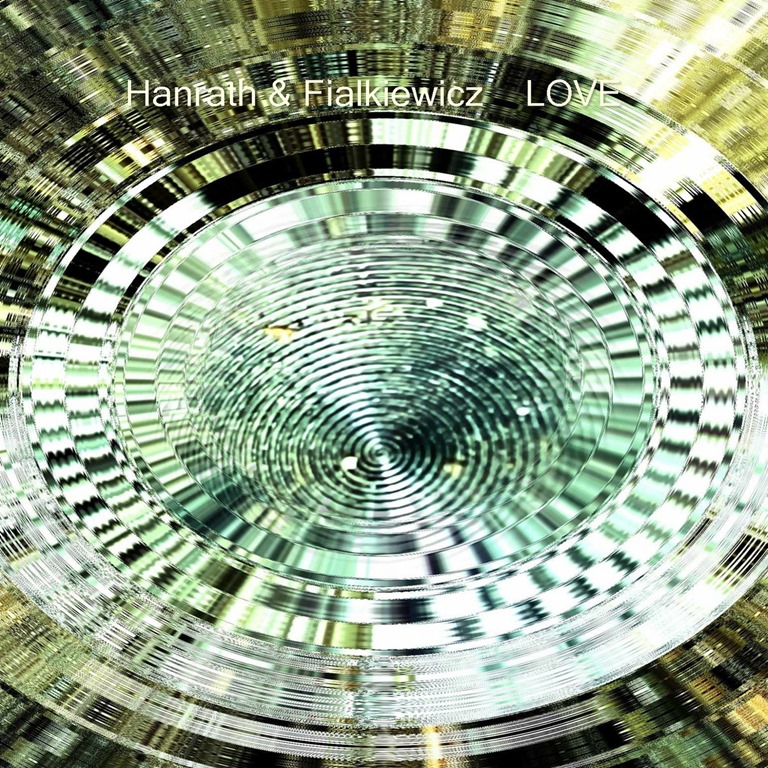
Deborah Fialkiewicz, who I first encountered performing as one half of her noisy dark ambient duo SPORE, is one busy and highly prolific creator, who not only manages to whip musical work spanning contemporary classical to ambience from out of the air at a remarkable pace, but clearly thrives on collaboration. This latest one, with German sound sculptor Wilfried Hanrath, is a further example of the way in which the coming together of artists with slightly different background and musical bents can make for unexpected – and brilliant – results.

As the accompanying notes explain, ‘the album starts with Deborah’s wonderful piece ‘Love’ and ends with Wilfried’s interpretation of it – ‘Love in other words’… The eight tracks in-between are based on noisy, dark ambient drones Deborah provided. Wilfried, inspired by a short trip to the sea, added to these by playing his synthesizer in the beautiful seaside resort. The result is a melange that combines the influences that both bring into this project to something larger than its components.’

Having recently returned from a week by the sea – on the Cornish coast – I can certainly vouch for the replenishing, refreshing, and inspirational qualities of the sea. Living inland and in climes which are perpetually humid and polluted, one immediately notices the difference in air quality when in the presence of a sea breeze.

As collaborations go, this is a particularly interesting one, not only musically as of and in itself, but it’s difficult to separate out what each of the contributors has brought here.

Fialkiewicz’ opening composition is gentle, combining tweaks, tweets, and twitters over the picked strings of a chamber orchestra of sorts, and a billowing wind which fills the background. It’s simultaneously sedate and mournful, and ends feeling unresolved.

Fialkiewicz’ capacity for conjuring dark drones is well-documented, primarily with her work as one half of Spore, but just how much manipulation they’ve been subjected to at the hand of Hanrath – which should really be an album title for a future collaborative / remix work of his – is impossible to determine. This is how collaborations should be, really: the aim should be to achieve a blend, to, and to conjure something which is neither one party nor the other. LOVE fits this criteria: it’s not about who does what, specifically, but the overall listening experience being something different, which is neither one artist or the other, but what they create in combination.

Following ‘Love’, ‘Oneness’ marks a complete shift in every way: it’s a bubbling quickfire electro piece that pretty much brings Kraftwerk together with Gershon Kingsley’s ‘Popcorn’. This numerical sequence of pieces, which runs from ‘Oneness’ to ‘Eigthness’ is an evolutionary, exploratory series, the majority of which are an expansive seven or eight minutes in duration and really mine a deep seam of bubbling, squelchy electronica which becomes increasingly engrossed in the quite granular details of the interplay and interaction between tone and texture, but without venturing fully into the dots-in-front-of-the-eyes details of the truly microtonal.

Slow winds and wide washes define the soundscapes offered here, and I suspect these are the foundations Fialkiewicz provided before Hanrath began to add his spin to them, with stabbing strikes and all kinds of digressions and generally unpredictable incidents which change both the course and the mood of the pieces.

‘Threeness’ is a particularly layered piece, ominous and brooding at first and subsequently, but interrupted by wibbling bleeps, a hint of an R2D2 seeking escape from the haunting confines of the track’s opening. Nothing is quite as it seems, and nothing feels quite right here.

‘Fourness’ is a torturous mess of oscillating drones and groans pitched against a mangled sampled vocal loop, and as one of the album’s darkest and most uncomfortable pieces, it’s very much in the vein of Throbbing Gristle. But suddenly, emerging from the frothing tempest of noise emerges a piano which brings tranquillity to provide balance. And this is where LOVE exceeds. There is a lot going on, and it’s an album which really revels in its contrasts and its manifold depths. This means that overall, and in context, LOVE is a standout work which conforms to no set parameters, doesn’t really sit anywhere, not least of all within the realms of expectation.

AA

a0291842123_10

Hærverk Industrier – 25th August 2023

Christopher Nosnibor

Having a memorable name counts of a lot – as does having one that stands out at the top of Google searches. How many times have you had conversations where one of you has been struggling to think of the name of… that band… that band… You know, the one with… they did an album…. They supported… clicking fingers, scratching heads, gesticulating. Nah. And the acts that are simply untraceable, particularly those with banal single-word monikers. It’s like they didn’t think about the practicalities when picking a name – or they simply have no interest in being found, which is commercial suicide before they’ve even started.

This is not an accusation which can be levelled at this Oslo-based noise rock duo, who follow up their 2012 self-titled 12” EP on Handmade Records and self-released 2017 cassette This Century with their new album An Ki, which is being released by Hærverk Industrier and promises ‘Four tracks of extreme dynamics, density and intensity, resulting in an almost claustrophobic chaos of sheer rock ‘n’ roll ecstasy (sic)’. Burning Motherfuckers is neither forgettable nor hard to find.

The same is true of their music, in terms of its being memorable at lease. An Ki is an album which contains just four tracks, but ‘Lost It’ is a beast which clocks in at ten and a half minutes, and the title track is over twenty minutes long, making this a monster that runs for over forty minutes of feedback-strewn riffery. It’s a noisy mess of a record, and truly glorious in the most cacophonous and challenging way. ‘Difficult’ music, when it’s harsh and loud and discordant, isn’t simply something you can step on from. It’s hard to describe, but it’s disruptive, physically, and mentally. Such turbulence disrupts the mindflow and makes waves around the organs.

‘Eilert’ builds and builds and builds and it takes the very idea of building to a ludicrous level, up, and up, and up… what do you do with this? The form is very much 90s underground alternative, and this manic racket calls to mind the likes of Terminal Cheesecake – but then again, the driving guitars and thrashing drums of ‘Lost It’ are quite reminiscent of That Fucking Tank – arguably one of the greatest noise duos ever, and an act who really pushed the parameters not only of noise rock, but of the two-piece format to the max. And Burning Motherfuckers… woah, do these bastards make a racket. ‘Lost It’ hurts; the tempestuous assault of everything all at once is not comfortable. But it’s more than that: the vocals are deranged, demented, and this is brain-splitting, cracked, something else, an unapologetic mess of noise.

‘Unless It’s Trees’ is a real departure and stands apart from the rest of the album: a soft, almost folky indie piece, it’s largely bass-driven and it’s uncomfortable but gentle at the same time.

And then there’s the title track. Fuck, and fuck, and fuck. It’s a monster in every sense, taking the mutant form of an eternal guitar drone and mangling noise which builds while discordant vocals melt and burn among a riotous racket.

It’s not neat or tidy, it’s not even ordered or organised. But it’s not conventionally noisy or messy: this is something else. It’s a new level of mangled noise and it’s difficult, awkward, It hurts, and it feels like taking a kicking and being hit around the head with a plank. These motherfuckers sure know how to make music with impact.

AA

a1641074360_10

Kohlhaas Records – 22nd April 2022

Christopher Nosnibor

Simon Whetham’s notes which accompany (II)ntolerance – the sequel to his 2017 collection, InTolerance – are informative, albeit perhaps more so when reading between the lines: ‘InTolerance consisted of a selection of combined scenes and activities in various global locations. Through the process of constructing the piece, it became clear that it was as much about my ability and fortune to be able to travel and cross borders with relative ease as it was about the situations I was able to document. (II)nTolerance is a sequel and a response to InTolerance. It is a personal reaction to the global pandemic and its wide-reaching effects through suffering, fear, misinformation as much as confinement and curfews. It is a personal response to the (somewhat incorrectly named) United Kingdom leaving the European Union and all the resulting events that are continually unravelling.’ He continues: ‘Travel has been limited when not impossible. Cultural exchange is only possible through mobile, online, remote communication. Tactile contact is feared. Families and friends have been divided physically, mentally, politically.’

The pandemic but a block on everyone’s lives, but everyone was affected differently, and while I struggle to find sympathy for those bemoaning their inability to take their 204 kids on their half-term skiing holidays and the like, touring artists who depends on mobility for their livelihood, it’s a different matter, especially as that transit and a shifting geography is integral to the creative process. Reading Whetham’s notes, it’s clear that his obstacles have not been purely pandemic-related: The ‘United’ Kingdom has degenerated into a cesspit of division where not only ‘tactile contact’ is feared, but so is anything from ‘outside’. Never has this felt like a smaller, more isolated, island, and not just geographically.

Tolerance is something many of us – mostly those of us who wanted to remain – can now only dream of, as we hide our faces behind our hands as we peep at Twitter and Facebook, where it’s bordering on a virtual civil war.

Whetham describes (II)ntolerance as a personal response to all of this, and ultimately, that’s the only real response any artist can make. The idea that we’re all in the same boat has been proven untrue, for while we all endured the pandemic, everyone experienced it so very differently: home schooling while working from home was, for example, in no way comparable to living alone or in a shared house while on furlough. Similarly, the effect of Brexit for a container driver, versus that of, say, a hedge fund manager is simply not comparable. But this in itself is an issue: increasingly, it seems people have become unable to relate to experiences and situations which differ from their own.

As an artist, of course, one can really only represent oneself, and hope that through the personal there is an element of universal therein, and on this level, (II)ntolerance succeeds, containing as it does fourteen abstract compositions that state nothing explicitly, and yet convey so much implicitly.

There are a number of pieces that form sequences, namely the ‘Angry Earth’ pieces and the three ‘Kinetic Readymade’ pieces, which give the album a sense of cohesion and thematic unity (while making a small nod to avant-garde greats like Marcel Duchamp). And (II)ntolerance is an album of movement, of turbulence: the first piece, ‘Angry Earth Seething 1’ sounds like a harsh deluge of rain, and the lashing precipitation sets the tone for a stormy sonic journey, riven with growls and gulps and crashes of static and ominous drones and clicks and stammers.

(II)ntolerance marks a shift from field recordings and a focus on geography to shift the focus inward in a response to a shrinking environment, and the result is claustrophobic and uncomfortable. ‘Moving Sentry 2 – Angry Earth Seething 3’ is a gurgling mess of abrasion, while ‘Reception – Windpipes’ whips and gurgles in a fog of phase. Oftentimes, such as on ‘Angry Earth Seething 4’, Whetham conjures a dark, gravel-shunting grind of uncomfortable noise, while ‘Kinetic Readymade (Turbine)’ embraces all shades of difficult, dominated by churning, scraping noise – and as a whole, (II)ntolerance is not an ‘easy’ album. It’s noisy, with serrated edges and low-end growlings that unsettle the intestines. A difficult album for difficult times.

A

Simon W

Christopher Nosnibor

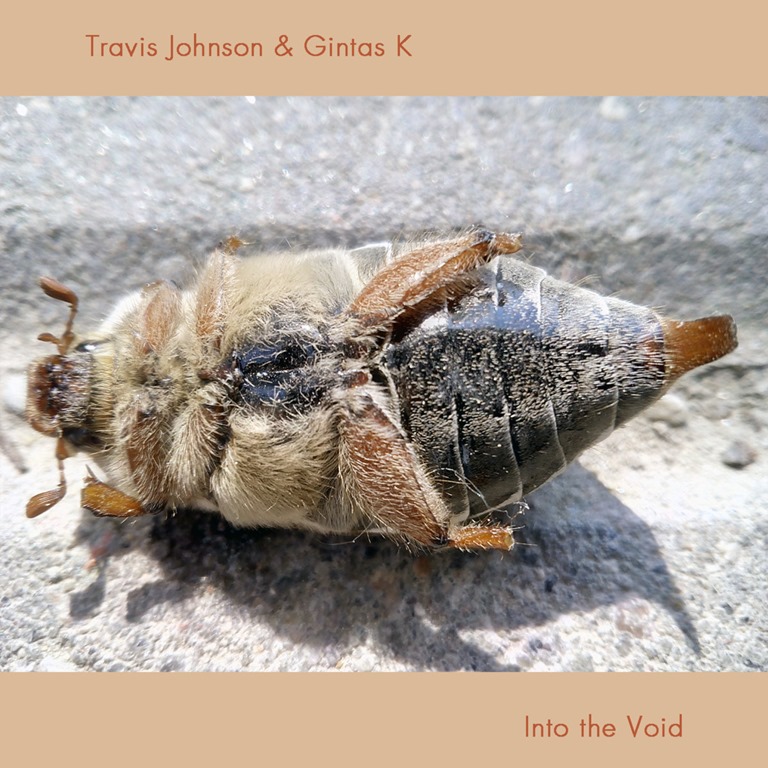
Into the Void is Gintas K’s second album-length release of 2018, and we’re not even quite halfway through. For this outing, the enigmatic granular sonic artist from Lithuania has delivered an array of 14 fragmentary pieces, the majority titled by number, spanning snippets less than a minute in length to quarter-hour brain-sizzlers, with the majority of pieces clocking in around the two-minute mark.

The limited notes accompanying the release state ‘Pieces created by Gintas K using Travis Johnson sound material.- rhythms loops.’ It’s perhaps worth noting that this is Travis Johnson (2) as listed on Discogs – the ‘sound designer, electronic music producer, improviser, and farmer from Suwannee County, Florida, United States’, and not the bassist with metal band In This Moment or either of the other two.

We’re all staring into one void or another, so there’s a degree of universality in the experimental intent of this release.

Those rhythms and loops are warped, splayed, disjointed, whipping backwards and forwards across the heads in a jumble of crazed anagalogia reminiscent in places of some of William Burroughs’ tape experiments from the late 50s and early 60s, when he and Brion Gysin, with the assistance of Iain Sommerville, who was an electronics engineer and programmer.

For the most part, it’s about variation – or not so much – on a theme. Beats stutter and funnel into disarray and fuzzy edges dominate the sounds as those beats crackle and fizz. Most of the loops on here sound sped up and pitch-shifted, gloopy electronica and synthy beats shifted up to resemble clicks and bleeps and scratches of static. Everything crunches and collides at a frenetic pace to create an overwhelming blizzard of sound, a sonic soup that batters rather than massages the senses and the brain. A great many of the rhythms are arrhythmic, or otherwise disturbed or distorted in some way or another. At times akin to a palpating heart, and at others a flutter beneath a screeching squall of static, a fizz of treble and a mess of skittering noise, Into the Void leads the listener into difficult territory, and at times threatens to abandon them in a sandstorm of sound that will leave them completely adrift.

There are some moments of variance: ‘Void4’ is a slow, woozy slice of opiate dub, and ‘Void6’ is largely distorted thumping and rumbling, and ‘Void12’ brings the emptiness of it all into sharp relief, a quavering, oscillating humming drone. It’s minimal, but delivers maximum discomfort.

Personally, I dig it, but as a listening experience, its uncomfortable and far from easy.

AA

Travis Johnson & Gintas K – Into the Void