Magnetic Eye Records – 22nd August 2025
Everything gets an anniversary reissue now, doesn’t it? And however much you love a band or an album, the constant cycle of repackaged reissues with bonus this, that or the other, a new remastering starts to feel like a cynical drain. Not that such exploitation is anything new: the late 80s and early 90s with infinite formats of single releases whereby fans felt compelled to purchase multiple versions to obtain all the tracks and mixes in order to attain a higher chart position – when these things actually counted – were shocking for it. But back then, 7” and cassette singles cost 99p, a CD single wasn’t much more, and a 12” was maybe £3.50. But the point was that you got different stuff on different formats, and being a completist didn’t require a second job. Now, you’re looking at £30 for a splatter vinyl remaster with maybe one bonus track of an album you’ve already got five copies on, but you buy if for that track and for the sake of the collection… and being reminded that an album is now ten, twenty, twenty-five years old is like a body blow as you realise how quickly your life is passing by. On a personal note, I’m feeling this most acutely as I find myself on the cusp of fifty. How the hell have I been here half a century? And this means that anything that happened twenty-five years ago – at the turn of the millennium – was a quarter of a century ago. Remember how the entire civilised world was shitting itself over the so-called ‘Millennium bug’? It felt like the apocalypse was imminent at the time. How, it feels like a picnic.
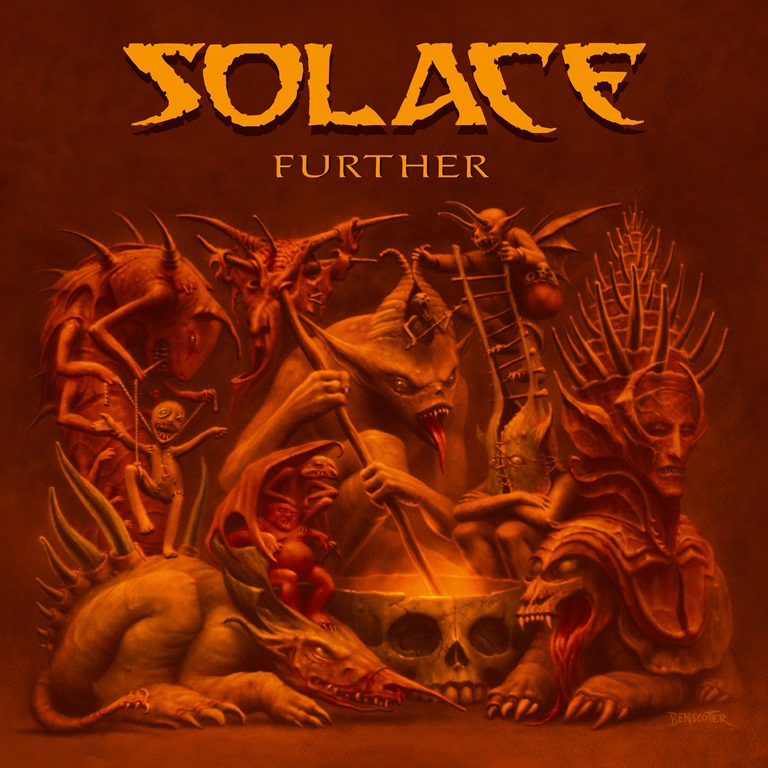
But there are positives. Sometimes, a new edition can bring an album to the attention of a new generation of fans, and / or provide long-term fans with something special which serves to expand on the legacy of the release. This is likely the case with Further, an album which bypassed me, but won New Jersey stoner metal act Solace critical acclaim and fans, and there’s a poignancy about this re-release, too, as founder and vocalist Jason died in January of this year (the reissue was already in the pipeline before his departure), making for a fitting tribute and summation of his and the band’s legacy, remastered and expanded to include three previously unreleased tracks, and the original EP version of ‘Heavy Birth / 2 Fisted’.
Now, as this is my first exposure, if you’re already familiar with the album, this review will likely not be of much use to you: I’m in no position to comment on how the 2025 remaster compares to the original, or how the track sequencing – which follows that of the 2005 reissue, down to the 11-minute cut of ‘Heavy Birth / 2 Fisted’, with the additional material appended to the ten-track version.
For those unfamiliar, this is a solid slab of heavy metal that takes plenty of cues from Black Sabbath, straight from the off with the rifferola of ‘Man Dog’. The lead guitar work is busy, atop riffs which are thick and heavy, while the rhythm section is dense: the drums feel loud despite being fairly low in the mix, giving the impression of extreme volume on the part of the guitars while the bass slides like sludge at the bottom end of the sonic spectrum.
Jason’s vocals tend to manifest as bombastic and Ozzy-like, but there are moments, as on ‘Black Unholy Ground’ where he channels some palpable aggression, just before an epic solo breaks loose. There are no shortage of epic solos to be found here. The slower eight-and-a-half-minute ‘Followed’ exploits the classic quiet / loud dynamic and goes for the atmospheric slow-building intro, but when it gets going, by the mid-point it packs the filthy heft and rage of Fudge Tunnel. It’s a ball-busting blast of anguish which races to a pulverising conclusion with a blown-out cyclical riff. ‘Hungry Mother’ goes mellow – a brief acoustic interlude with some psychedelic hues – before the behemoth that is ‘Angels Dreaming’, a nine-minute monster that is peak stoner metal. Like ‘Followed’, ‘Heavy Birth’ draws as much on 90s underground noise as much as vintage heavy metal, and packs a massive punch.
The musical landscape of recent years is another world from that of 2000, and it’s important to bear this in mind, not because Further has aged badly, but because it sounds so contemporary. While stoner metal wasn’t a completely novel concept at the time of release – Melvins had been doing it since forever already, of course, and Queens of the Stone Age would unleash breakthrough major label debut Rated R in June 2000, it certainly isn’t the sound of the time, when nu-metal was the dominant style the world of guitar music, and after grunge fell to indie, big riffs were largely out in favour of guitars that sounded like slabs of concrete and vocals which switched between rap and emoting.
Further is heavy, gritty, unashamedly drawing on grunge (which with acts like Tad had taken cues from 70s metal in the first place), and hearing it now, it feels like an album that’s more at home in 2025 than it would have been in 2000. But this also demonstrates just how, while fashions come and go, quality music always holds up at any time – and this is quality. The bonus tracks – including the obligatory live cut in the form of ‘Funk #49 (Live in Tokyo ’98)’- are all worthy additions of a standard which is equal to the album itself.
AA
 Aural Aggravation